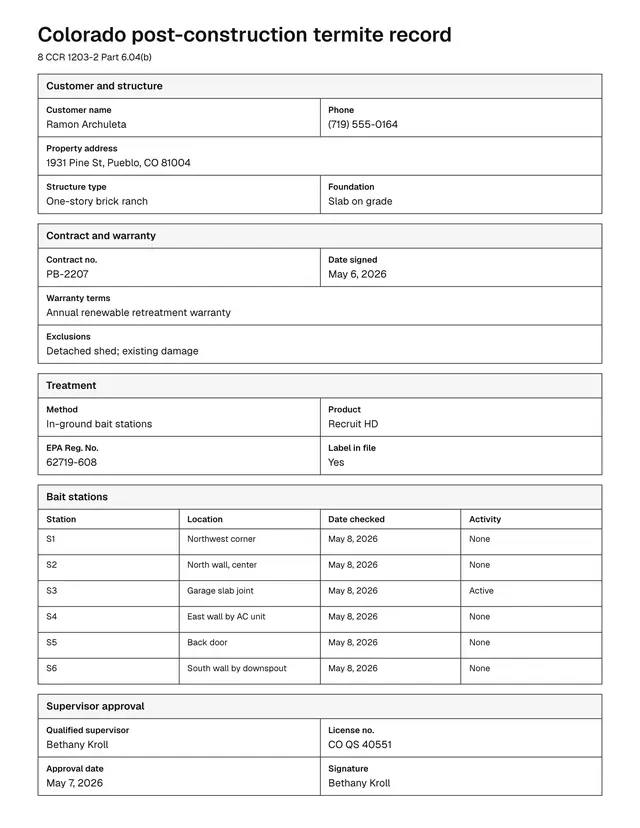
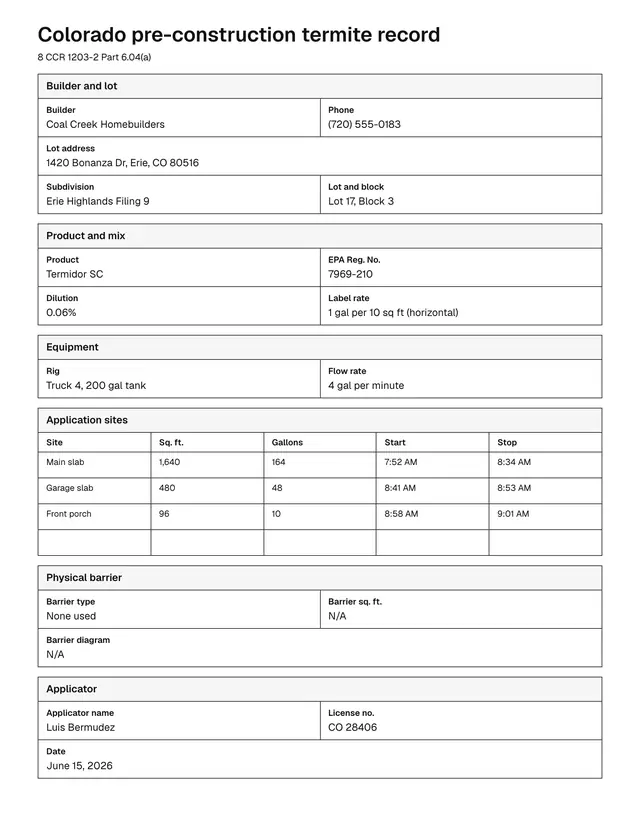
Colorado commercial pesticide application record
Colorado wants a record of every pesticide job you do for hire, with the time written down to the half hour. Here’s what Part 6 of 8 CCR 1203-2 asks for and how long to hold on to it.
At a glance
- Rule
- 8 CCR 1203-2 Part 6.03
- Keep for
- 3 years (C.R.S. 35-10-111)
- Time
- Within a half hour, marked start or stop
- Agency
- Colorado Department of Agriculture
Completed example
Download PDFWhat is this record?
It’s the office log behind every job. Part 6.01 of 8 CCR 1203-2 says commercial applicators must keep “accurate and legible office records of each application of pesticides made for hire.” It isn’t a door hanger and the customer doesn’t sign it. It’s what you hand the Colorado Department of Agriculture if an inspector asks.
Most shops fill it out on a route sheet or in an app at the stop. That’s fine. What matters is that every item in Part 6.03 is there and readable later.
What goes on each line
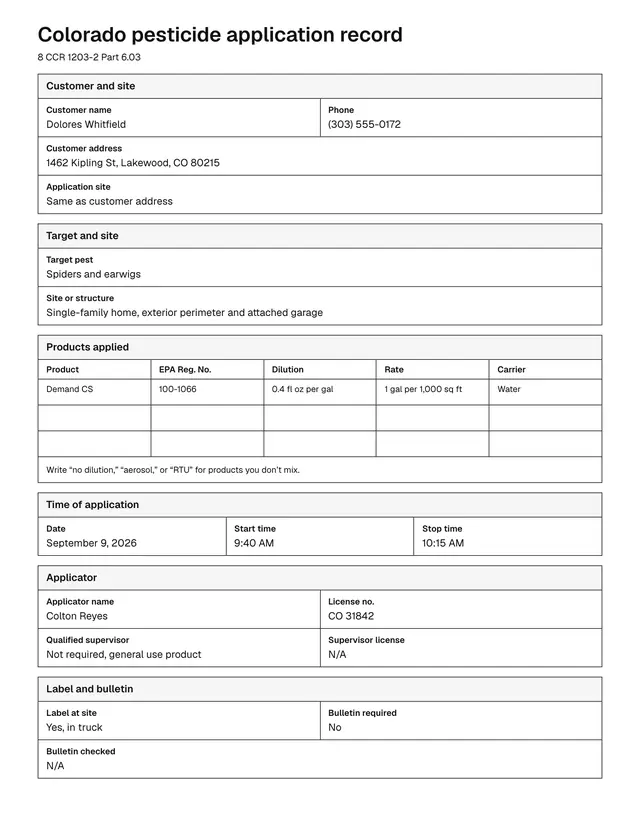
Who and where. Write the name and address of the person you did the work for. If you treated a different spot, like a rental unit or a business location, add that address too.
The pest. Name the target pest. A general term only works if the label uses that same term. The rule’s own example is “broadleaf weeds.” “Bugs” won’t pass.
The site. Write the site, crop, commodity, or structure you treated. “Single-family home, exterior perimeter” is clear. “House” is thin.
The product. The EPA registration number is required. Brand name and maker are optional. For example, Demand CS from Syngenta is EPA Reg. No. 100-1066. You can check any number in the EPA label search.
How much. Record the dilution rate. If you didn’t mix it, write “no dilution,” “aerosol,” or “RTU.” Then the application rate. For crack and crevice work, the rule lets you write “crack and crevice.” If the carrier isn’t water, name it.
Put together, one line for a fall perimeter job in Lakewood might read: Dolores Whitfield, 1462 Kipling St. Spiders and earwigs. Single-family home, exterior perimeter and attached garage. Demand CS, 100-1066, 0.4 fl oz per gallon, 1 gallon per 1,000 square feet, water. 9:40 AM start. Colton Reyes and the license number. That’s every item, and it fits on one row.
The time rule trips people up
Part 6.03 wants the date and time “within at least one-half hour accuracy.” The record must also say if that time is when you started or when you stopped. The rule is blunt: “An entry merely stating ‘A.M.’ or ‘P.M.’ is not sufficient.” So “9:40 start” works. “Morning” doesn’t.
Who did it. Write the name and license number of the person who made or supervised the application. If a technician applied a restricted use product, list the technician and the qualified supervisor who was on site.
Bulletins. Some labels send you to an Endangered Species Protection Bulletin. When the label requires one, note that you checked it.
How long to keep it. C.R.S. 35-10-111 says to keep records for “three years after the date of the pesticide application.” Keep them at the address on your business license. Part 7.05 also wants the label at the site while you work.
Where Colorado records usually come up short
Most gaps aren’t about missing whole records. They’re small holes in records that exist. These are the ones worth checking before an inspector does:
A brand with no number. “Talstar” isn’t enough. The EPA number is the required part, and some brands are sold under more than one number.
A tech with no license number. Every name on the record needs its license number next to it, including the supervisor on a restricted use job.
One time for a long day. A big commercial site that took three hours should show a start and a stop, not just when you pulled in.
A vague site. “Apartment complex” doesn’t say which building or which units. Write what an inspector would need to find the spot.
Writing the same record for the same stops every month?
Recurring accounts are where records go stale. The pest, site, and product barely change, so it’s tempting to copy last month’s line. Don’t copy the time. Each visit needs its own start or stop time and its own applicator name.
One more Colorado detail lives on the bill, not the record. Part 14.01 says every customer invoice must include “Commercial applicators are licensed by the Colorado Department of Agriculture.” in 10 point type or larger. Put it in your invoice footer once and forget it.
Noma specializes in the Colorado commercial pesticide application record (8 CCR 1203-2 Part 6.03). It runs the account around it: online booking, each visit on the schedule, the app on your phone at the stop, and invoices customers can pay online. See how Noma runs pest control routes.
Frequentlyaskedquestions
Send this document in minutes, not an afternoon.
Other states
After-treatment notice templates- Alabama
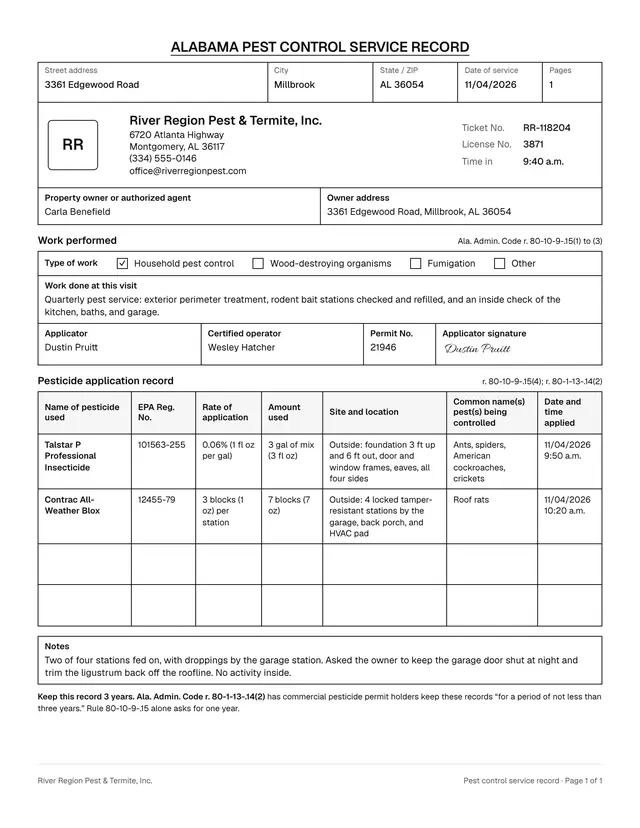
Alabama Pest Control Service Record
Record each pesticide applied at a service visit. - Arizona
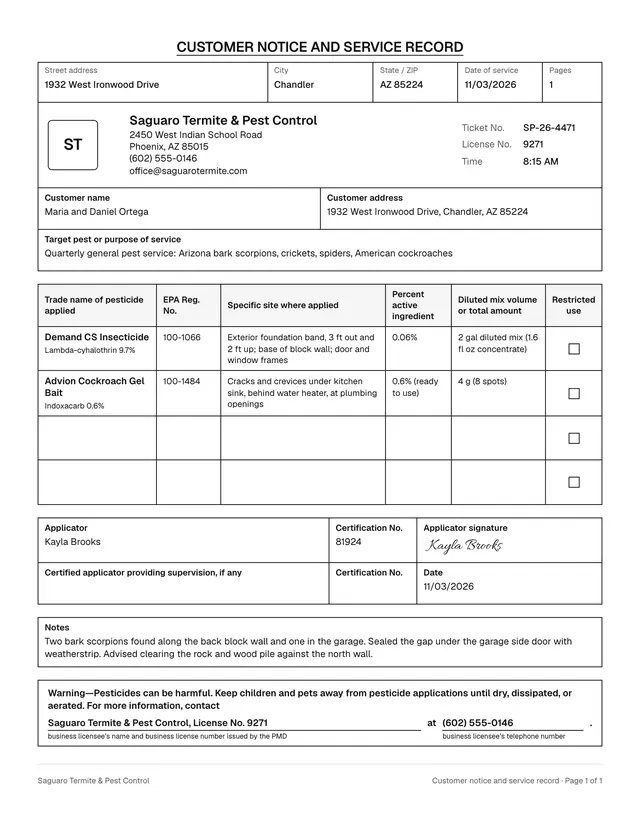
Customer Notice and Service Record
Record each pesticide applied at a service visit. - Arkansas
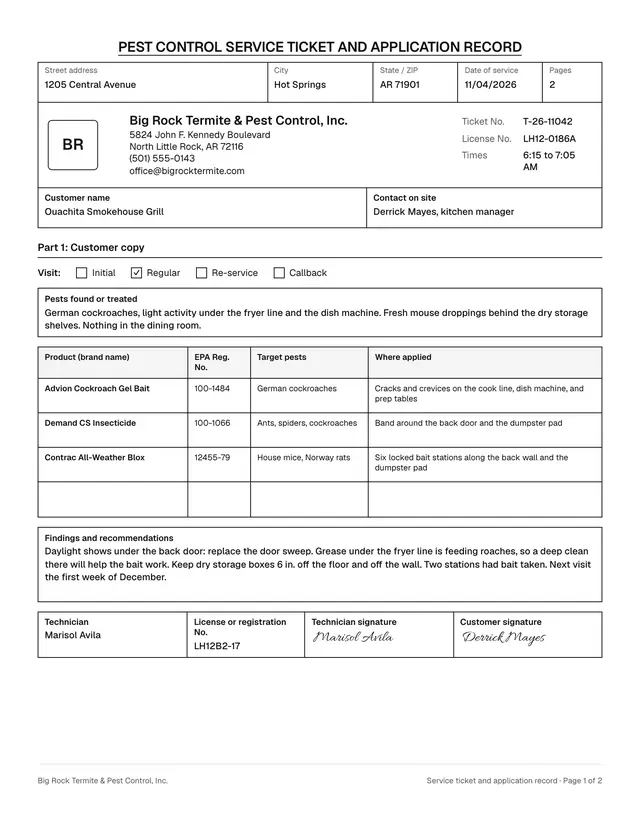
Pest Control Service Ticket and Application Record
Record each pesticide applied at a service visit. - California
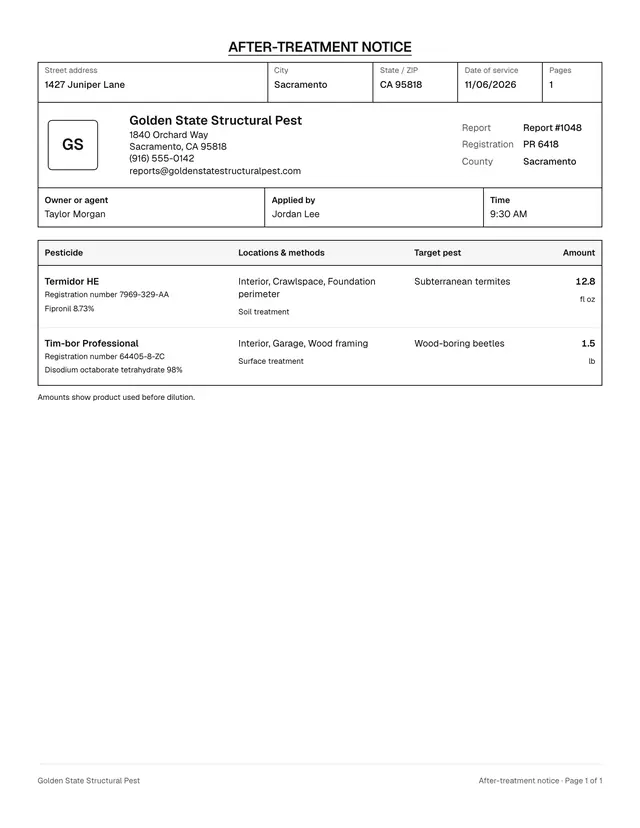
After-Treatment Notice
Record each pesticide applied at a service visit. - Connecticut
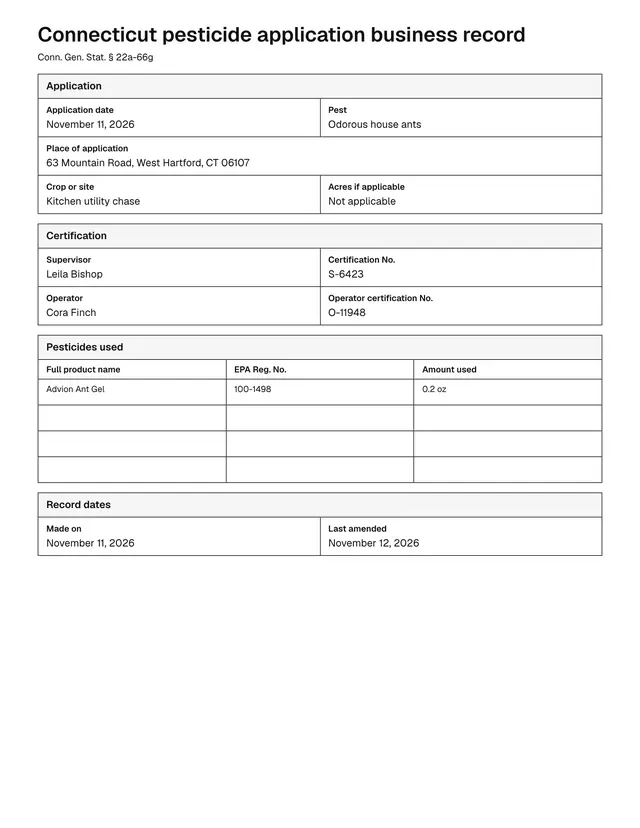
Connecticut pesticide application business record
Record each pesticide applied at a service visit. - Delaware
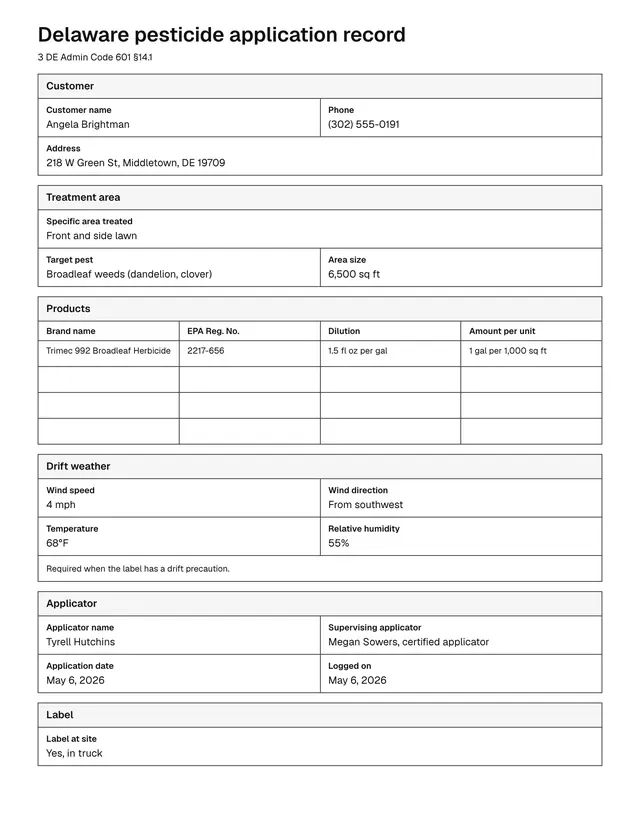
Delaware pesticide application record (3 DE Admin Code 601 §14.1)
Record each pesticide applied at a service visit. - Georgia
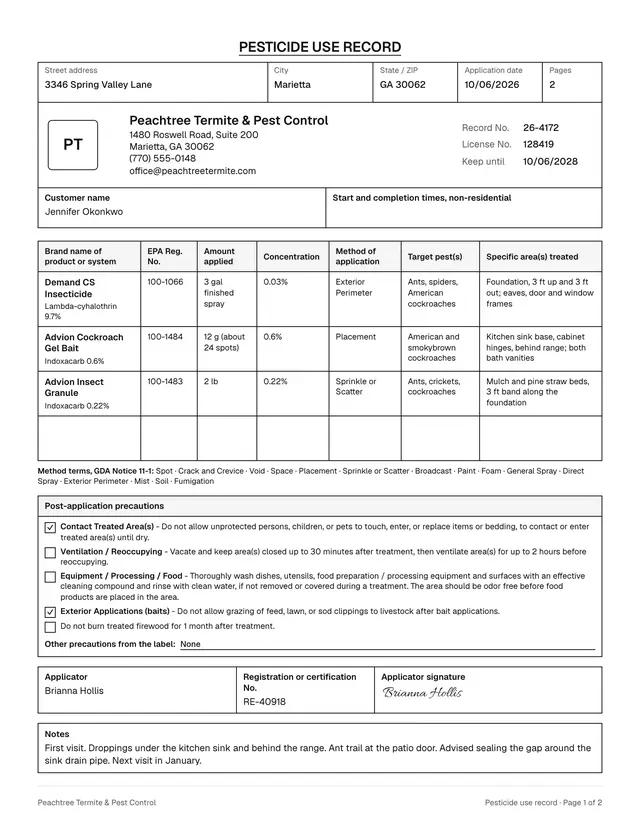
Pesticide Use Record
Record each pesticide applied at a service visit. - Hawaii
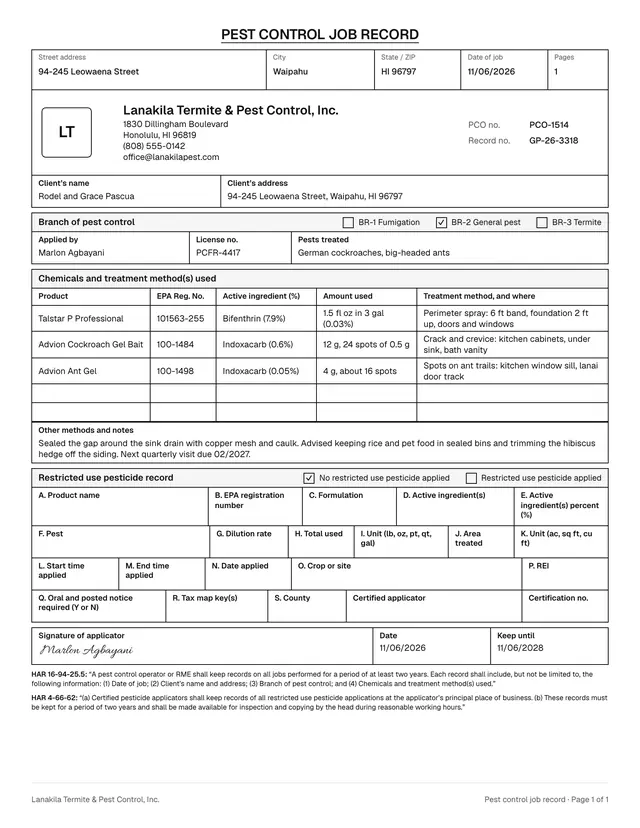
Pest Control Job Record
Record each pesticide applied at a service visit. - Illinois
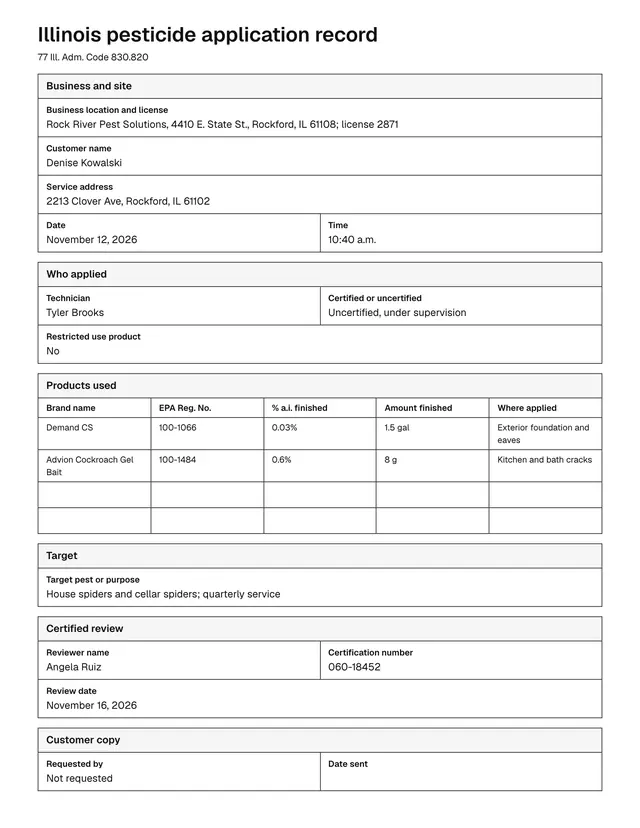
Illinois structural pest control application record
Record each pesticide applied at a service visit. - Indiana
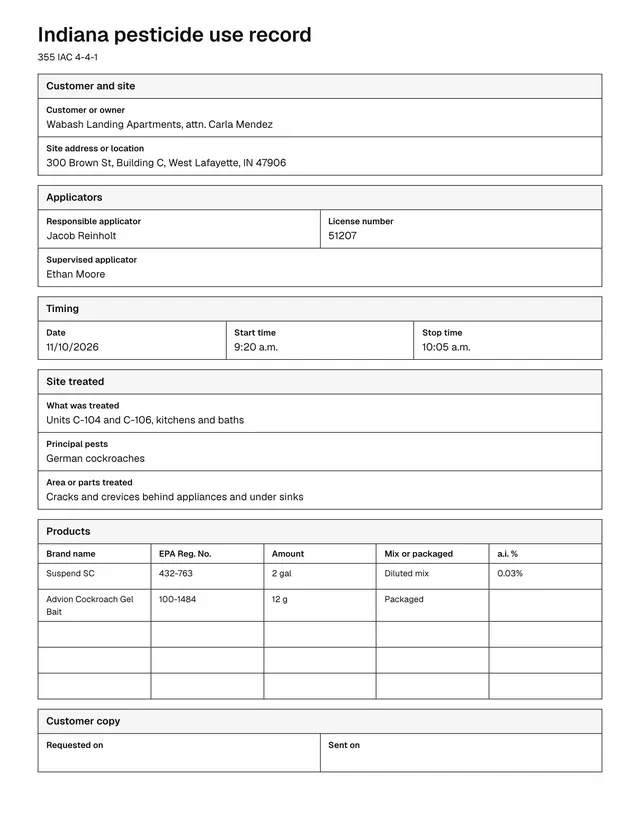
Indiana commercial applicator pesticide use record
Record each pesticide applied at a service visit. - Iowa
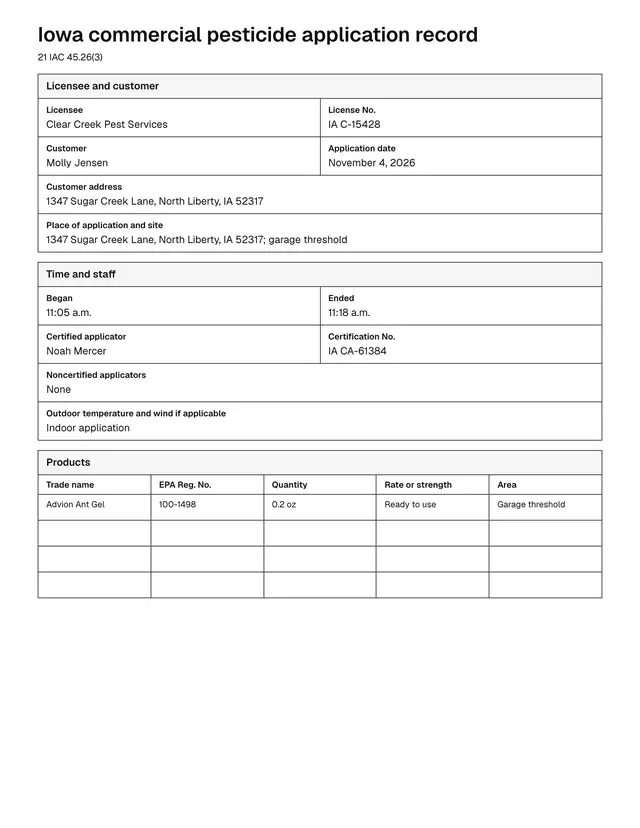
Iowa commercial pesticide application record
Record each pesticide applied at a service visit. - Kansas
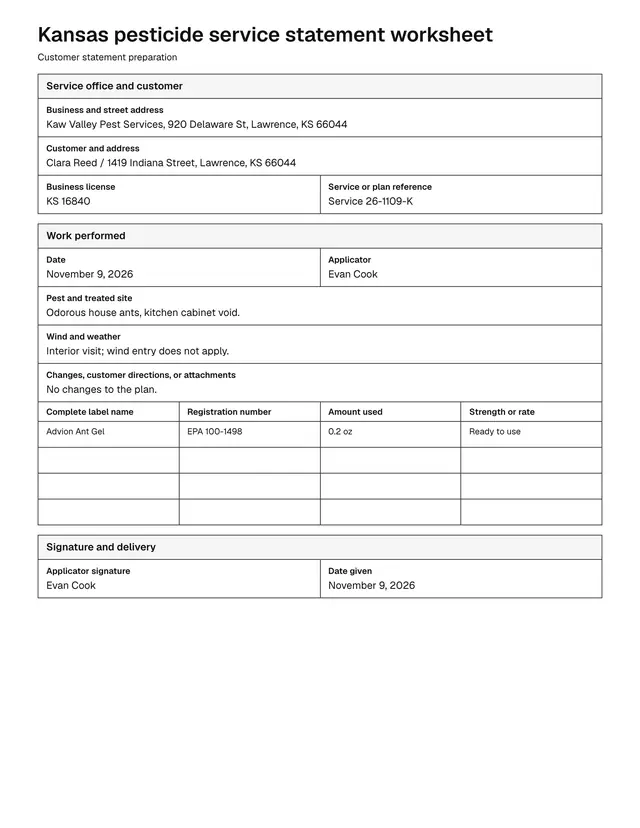
Kansas pesticide service statement worksheet
Record each pesticide applied at a service visit. - Kentucky
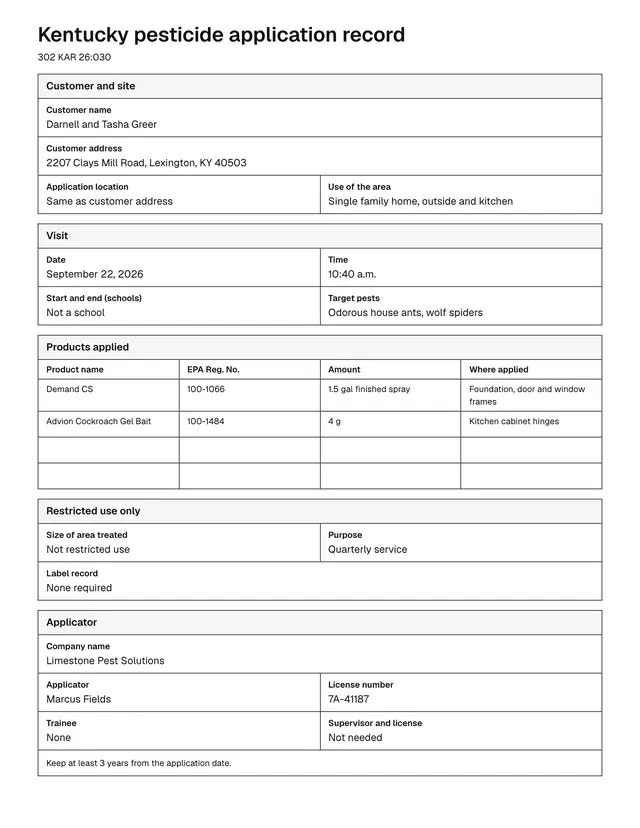
Kentucky pesticide application record (302 KAR 26:030)
Record each pesticide applied at a service visit. - Louisiana
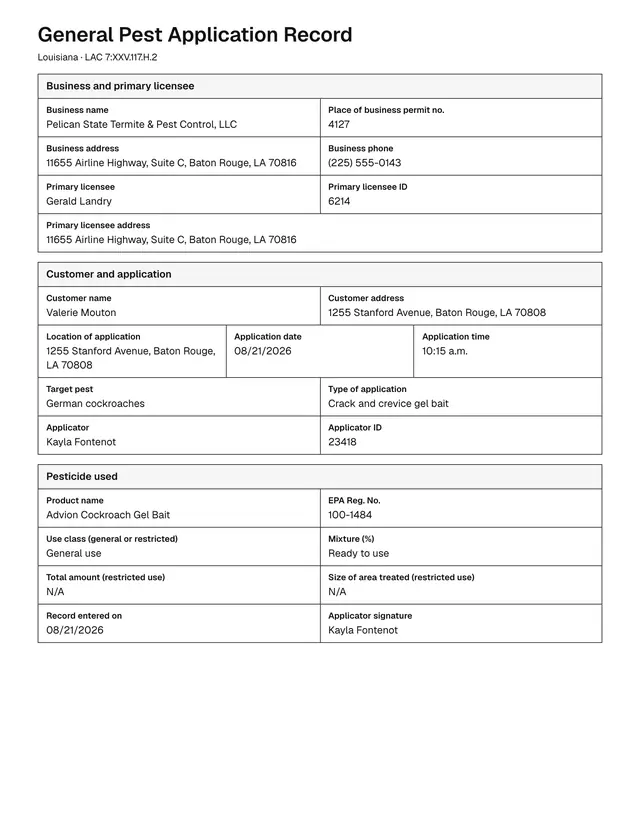
General Pest Application Record
Record each pesticide applied at a service visit. - Maryland
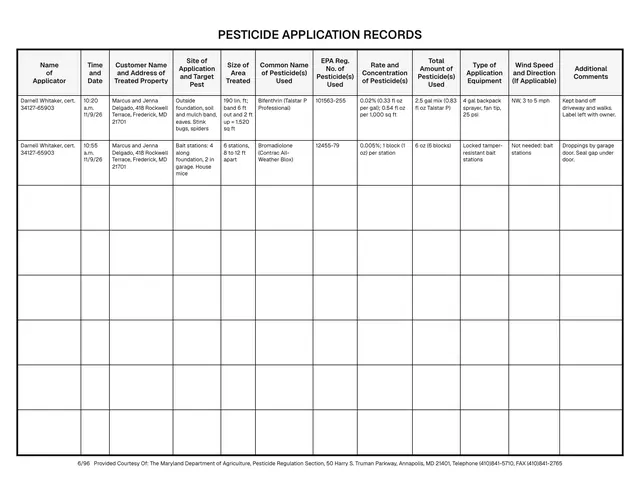
Pesticide Application Record and Customer Pesticide Information
Record each pesticide applied at a service visit. - Massachusetts
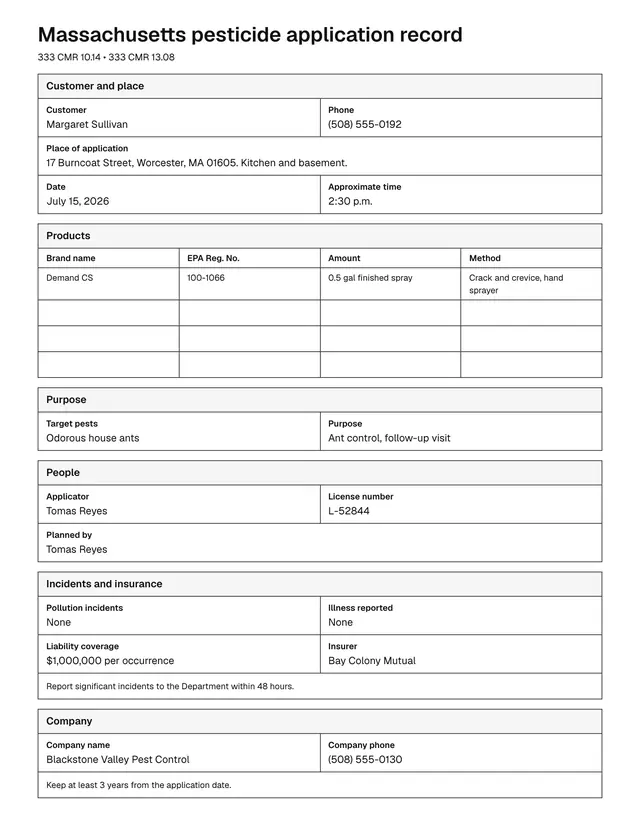
Massachusetts pesticide application record (333 CMR 10.14)
Record each pesticide applied at a service visit. - Michigan
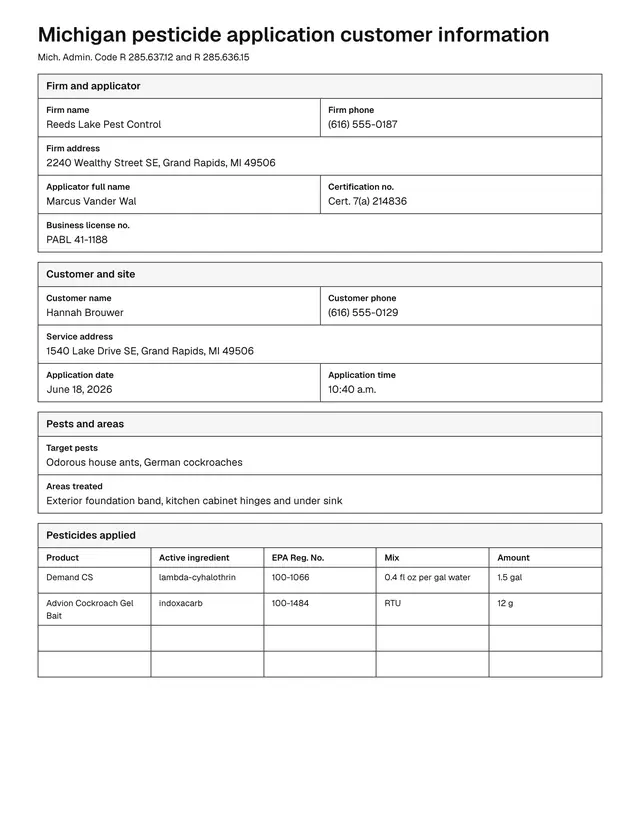
Michigan pesticide customer information receipt
Record each pesticide applied at a service visit. - Mississippi
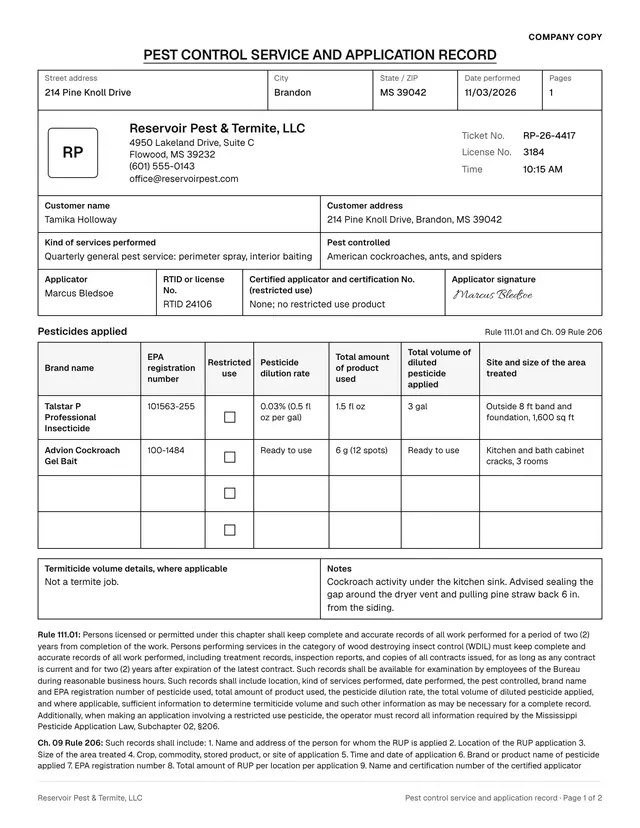
Pest Control Service and Application Record
Record each pesticide applied at a service visit. - Missouri
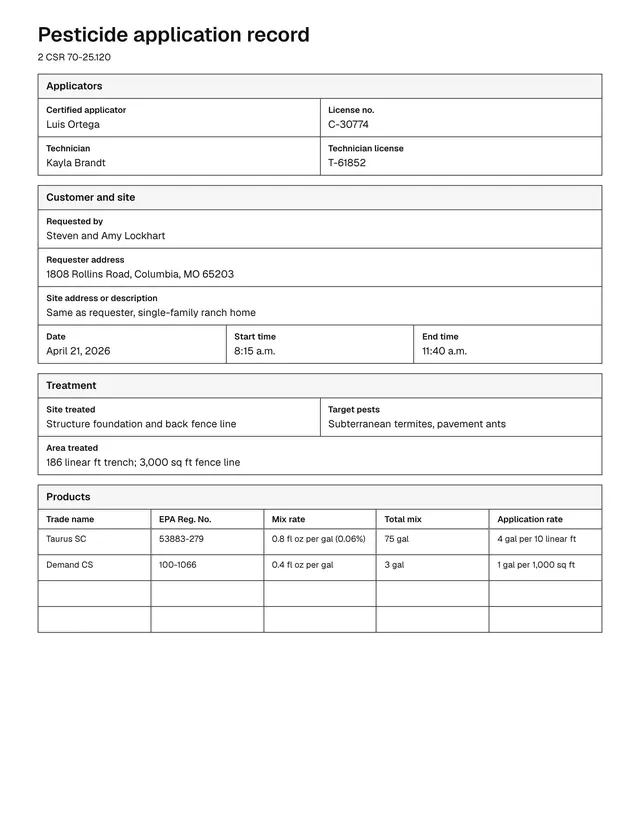
Missouri pesticide application record (2 CSR 70-25.120)
Record each pesticide applied at a service visit. - Nevada
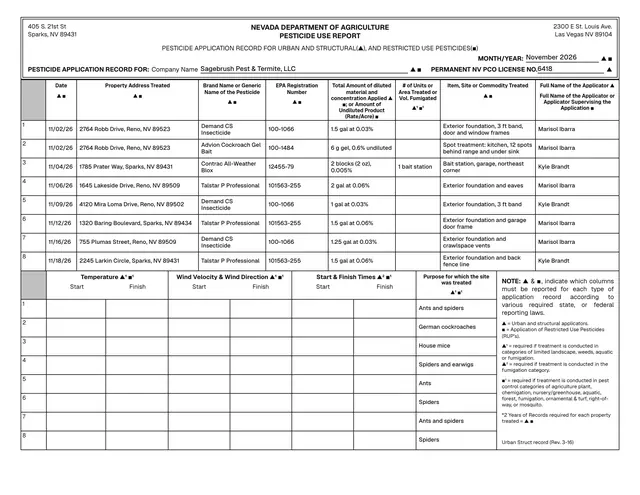
Pesticide Application Record for Urban and Structural and Restricted Use Pesticides
Record each pesticide applied at a service visit. - New Jersey
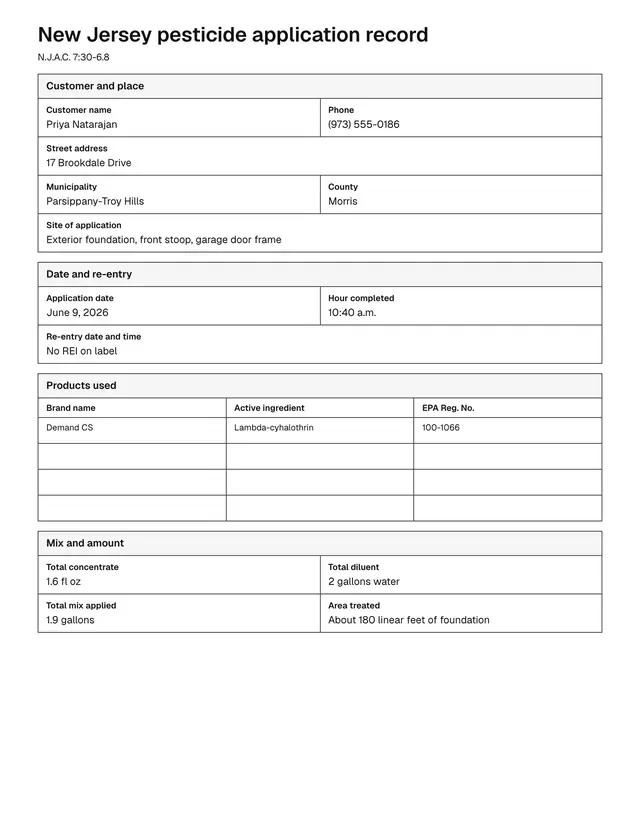
New Jersey pesticide application record (N.J.A.C. 7:30-6.8)
Record each pesticide applied at a service visit. - New Mexico
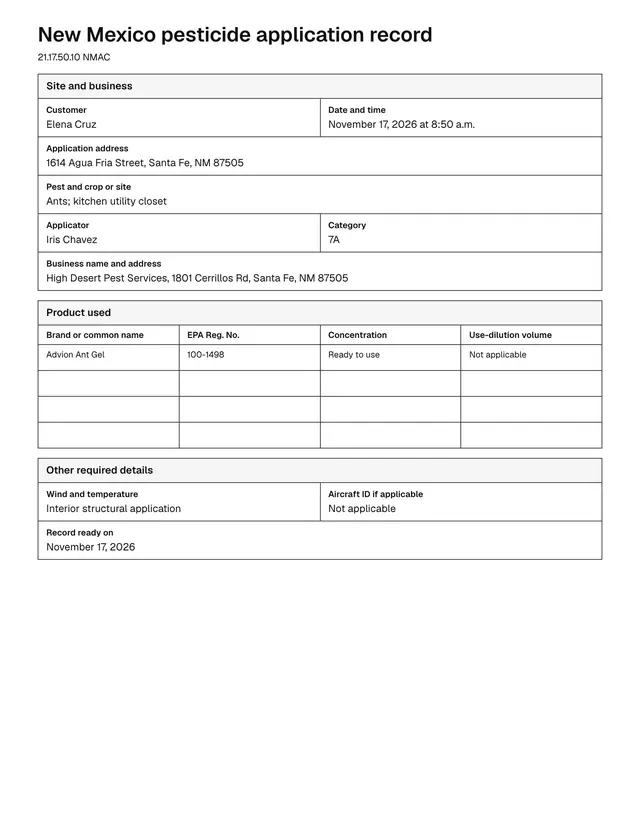
New Mexico pesticide application record
Record each pesticide applied at a service visit. - New York
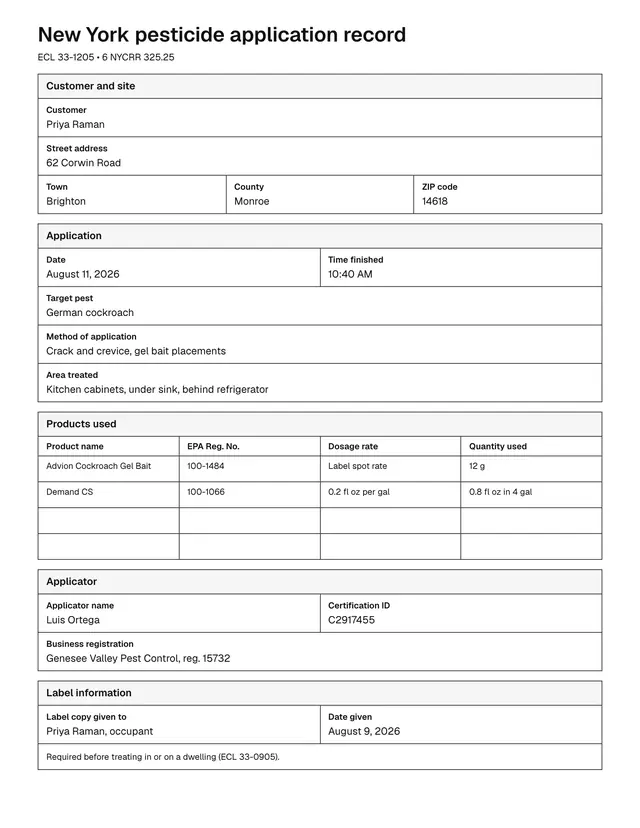
New York pesticide application record (6 NYCRR 325.25)
Record each pesticide applied at a service visit. - North Carolina
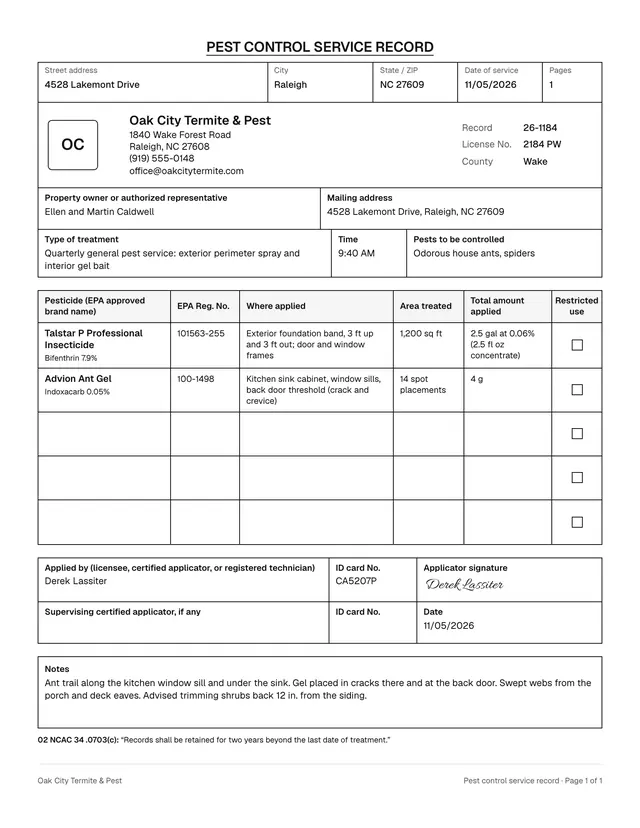
Pest Control Service Record
Record each pesticide applied at a service visit. - Ohio
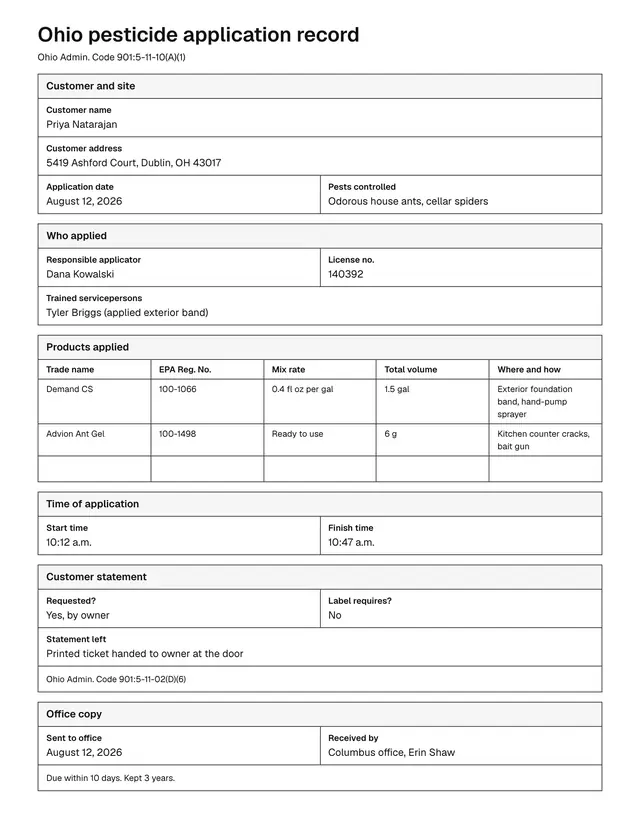
Ohio pesticide application record
Record each pesticide applied at a service visit. - Oklahoma
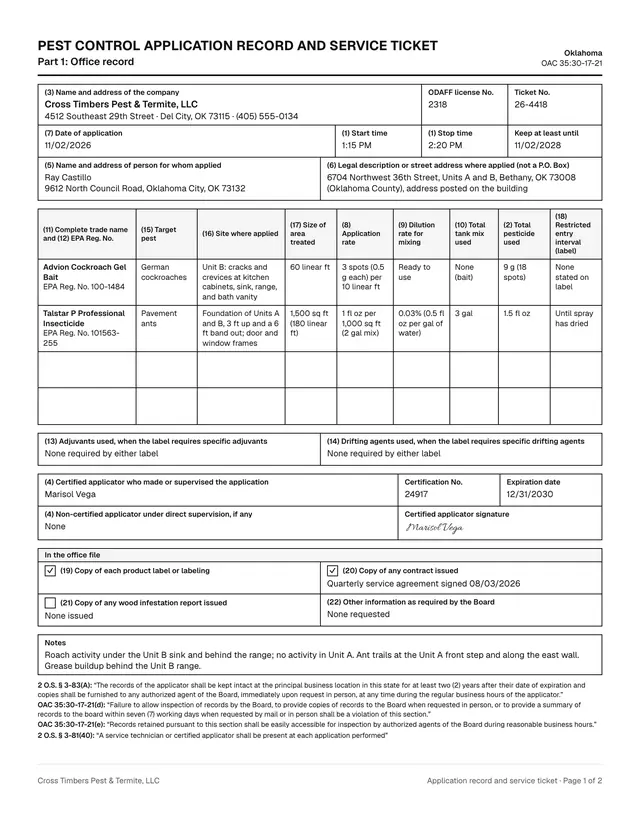
Pest Control Application Record and Service Ticket
Record each pesticide applied at a service visit. - Oregon
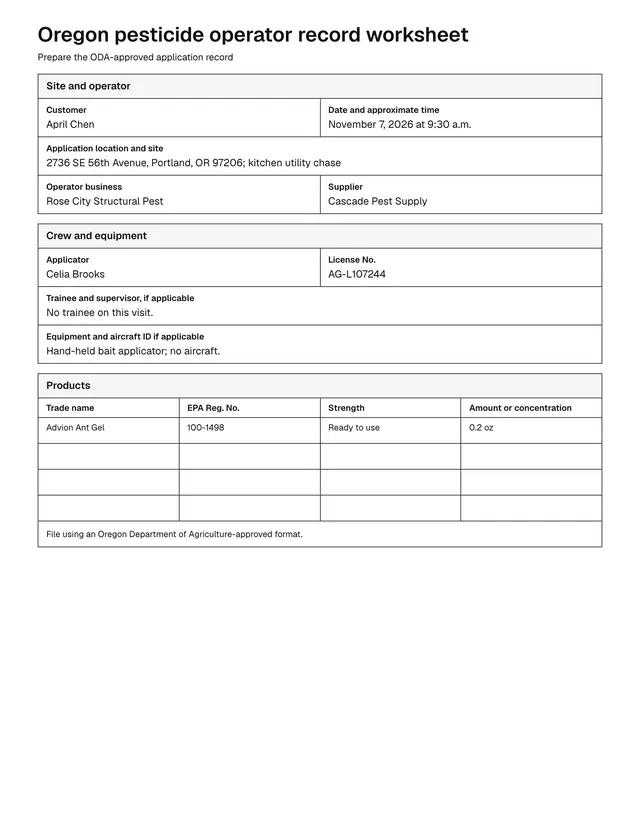
Oregon pesticide operator record worksheet
Record each pesticide applied at a service visit. - Pennsylvania
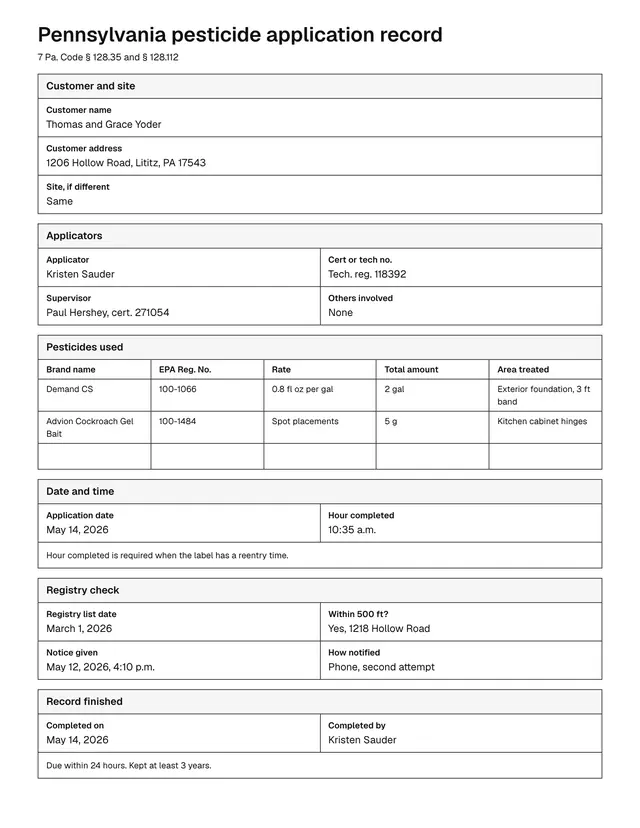
Pennsylvania pesticide application record
Record each pesticide applied at a service visit. - South Carolina
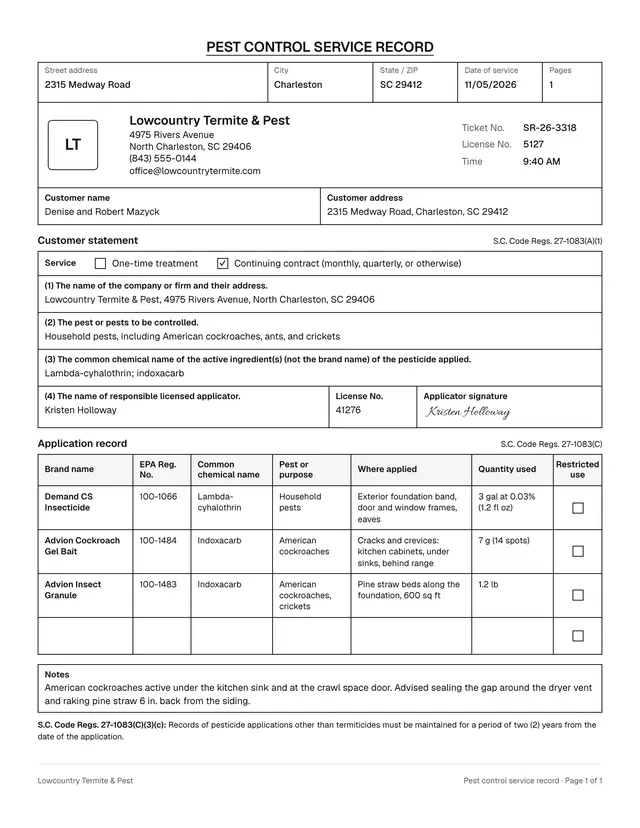
Pest Control Service Record
Record each pesticide applied at a service visit. - Tennessee
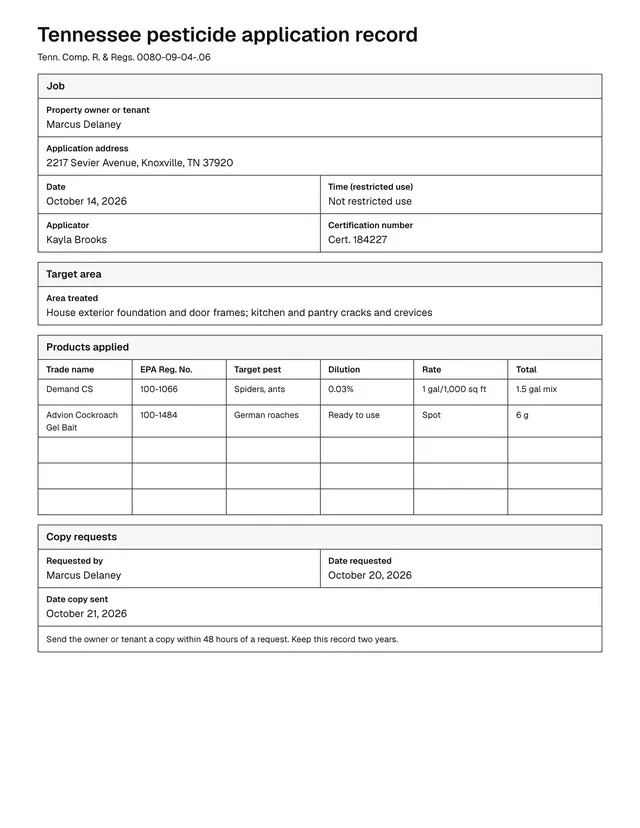
Tennessee pesticide application record
Record each pesticide applied at a service visit. - Texas
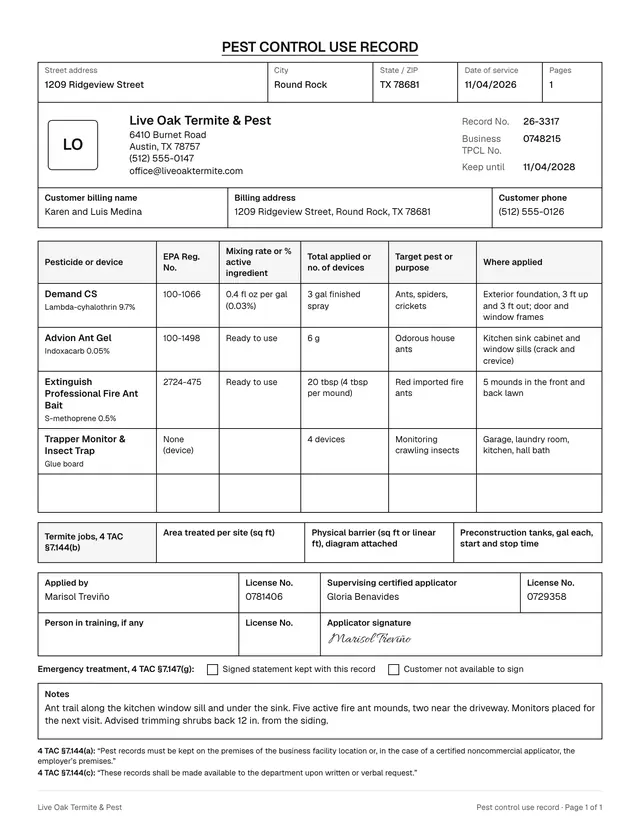
Pest Control Use Record
Record each pesticide applied at a service visit. - Utah
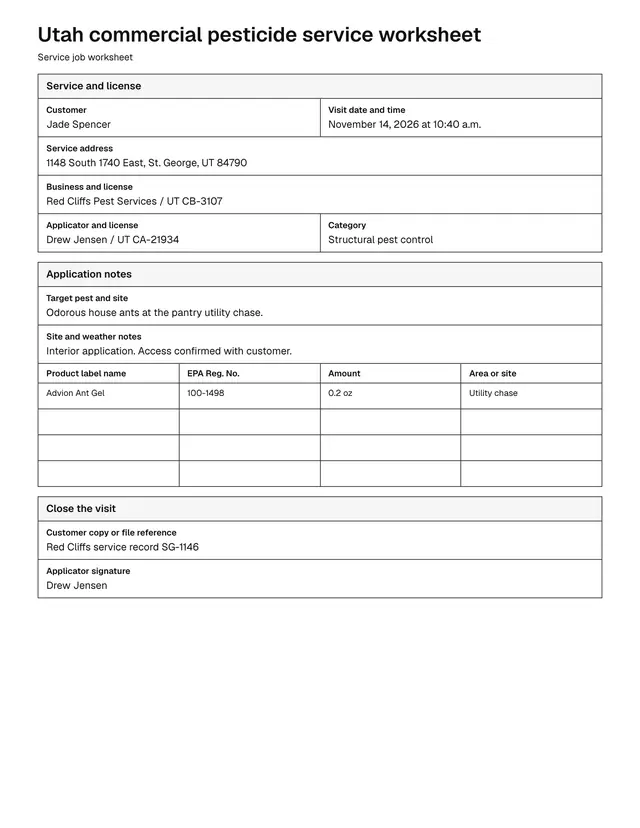
Utah commercial pesticide service worksheet
Record each pesticide applied at a service visit. - Virginia
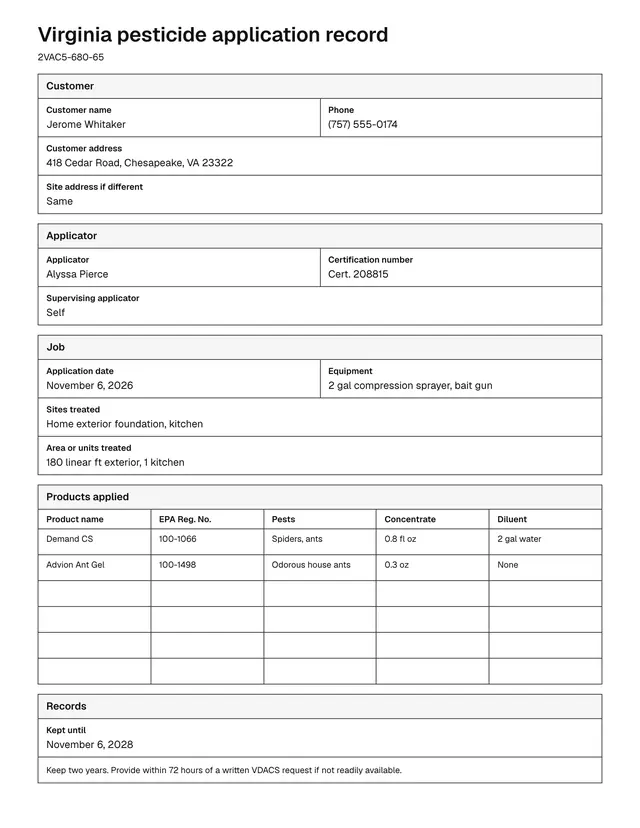
Virginia pesticide application record
Record each pesticide applied at a service visit. - Washington
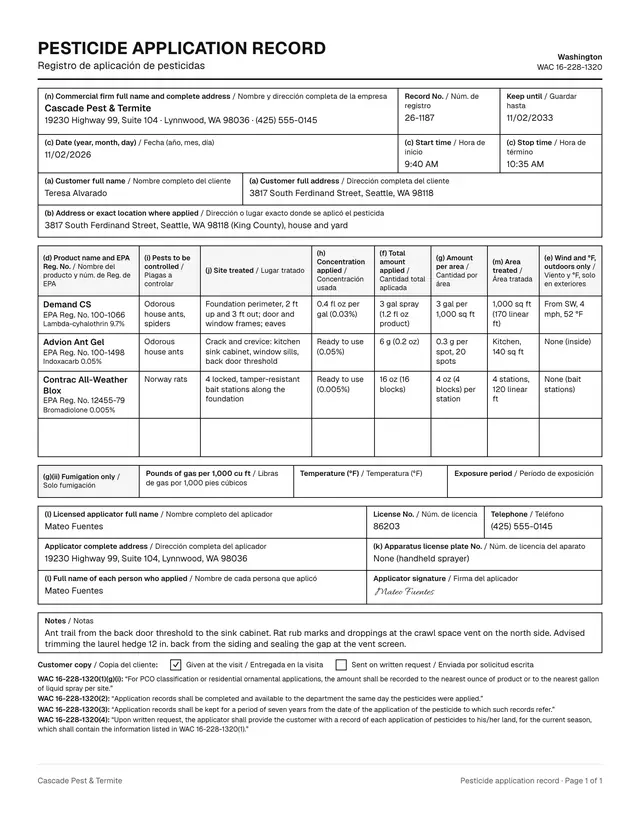
Pesticide Application Record
Record each pesticide applied at a service visit. - Wisconsin
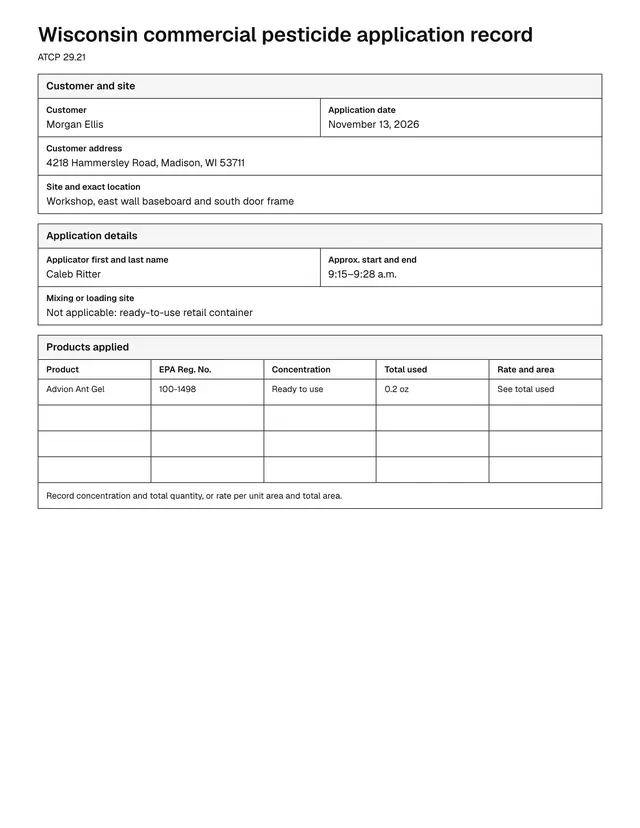
Wisconsin commercial pesticide application record
Record each pesticide applied at a service visit.