Colorado post-construction termite treatment record (Part 6.04(b))
Treating an existing Colorado home for termites takes more than the usual application record. Part 6.04(b) adds a diagram, the signed contract, the label, and a supervisor’s sign-off.
At a glance
- Rule
- 8 CCR 1203-2 Part 6.04(b)
- Sign-off
- WDO qualified supervisor approves the diagram
- Keep for
- 3 years (C.R.S. 35-10-111)
- License category
- 301, Wood Destroying Organism
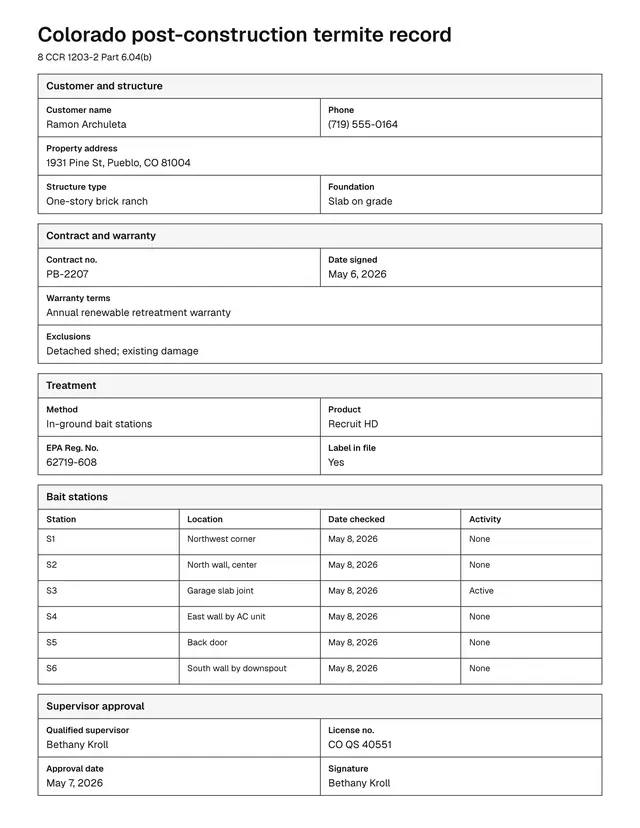
Completed example
Download PDFWhat Part 6.04(b) adds to a normal job
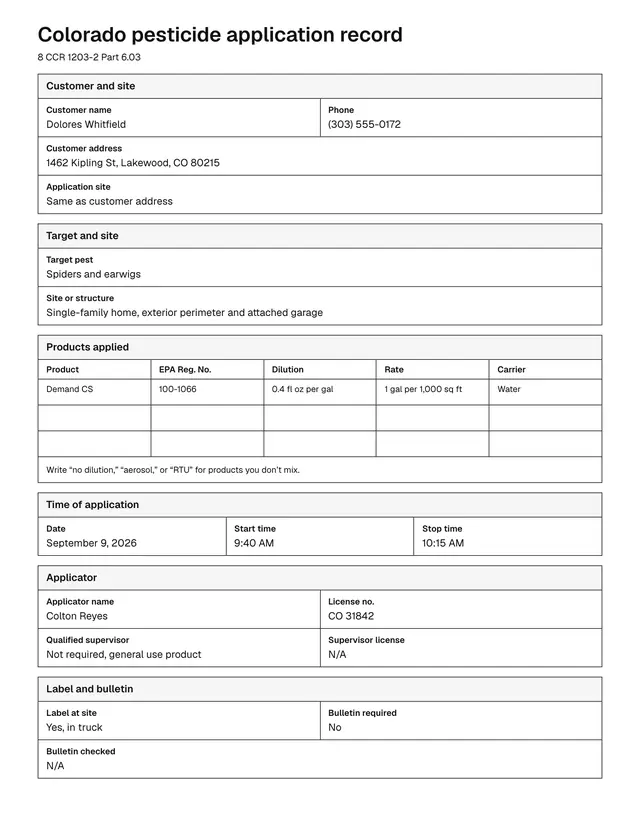
Every pesticide job for hire in Colorado needs the basic record in Part 6.03: customer, pest, site, EPA number, rates, time, and applicator. That’s the application record page.
When you treat termites in a home that’s already built, Part 6.04(b) of 8 CCR 1203-2 stacks five more items on top. It applies to both liquid treatments and baits. Think of it as the customer’s termite file: the diagram, the contract, the label, the supervisor’s approval, and for baits, the station history.
The diagram does most of the work
Part 6.04(b)(1) asks for “a diagram, blueprint, or plat” of the structure. It has to show approximate measurements and these things:
Current activity. Where you see live termites or fresh tubes today.
Past activity. Old tubes, old damage, or spots the owner says were treated before.
Conducive conditions. Wood touching soil, a leaky downspout, firewood stacked on the foundation, a crawl space that stays wet.
What you’ll treat and how. Mark each area and the method, like slab injection or trenching along the foundation.
Draw it before you treat. The rule calls for the supervisor to approve the proposed diagram, so it has to exist before the rig comes off the truck.
The rest of the file
Contract and warranty. Keep the signed contract and the warranty details, including what’s excluded. If the warranty doesn’t cover the detached garage, the file should say so.
The label. Keep a copy of the product label in the customer’s file. If you switch products on a retreat, add the new label too.
Supervisor approval. A qualified supervisor signs to approve the proposed diagram. That supervisor must be licensed in the wood destroying organism category, which is Category 301 in Colorado’s rules.
Bait stations. For a bait job, record how many stations you installed and where each one is. Then keep every station service inspection in the customer’s record, done as often as the label calls for. For example, Recruit HD termite bait from Corteva is EPA Reg. No. 62719-608. Its label sets the service schedule, and your visit log should match it. You can pull any label from the EPA label search.
The statute, C.R.S. 35-10-111, says to keep pesticide records for three years after the application. On a bait account that runs for years, each check starts its own three-year clock.
A worked example from Pueblo
Say a homeowner in Pueblo calls about swarmers in the garage. The house is a 52 by 28 foot brick ranch on a slab. You find live tubes at the garage slab joint and old, dry tubes at the back door. Firewood is stacked against the north wall, and a downspout dumps water at the southeast corner.
The diagram. Draw the outline with the two measurements. Mark an X for live activity at the garage joint and an O for old activity at the back door. Mark the firewood and the downspout as conducive conditions. Then mark six stations around the perimeter, spaced the way the label says, with one right by the active joint.
The approval. Your qualified supervisor reviews the drawing and signs it before install day. If the supervisor wants a station moved, change the drawing first, then sign.
The contract. Write in what the warranty covers and what it leaves out, like the shed in the back yard and any damage that’s already there.
Install day. Fill in the regular Part 6.03 record for the install, and start the station table with each station’s first check. Every visit after that adds a row.
A liquid job follows the same path. The diagram just shows trenching along the foundation and drilling through the slab where it meets the wall, instead of station spots.
How do you keep bait checks from slipping for years?
Baits are a long game. The job isn’t done after install day. Miss a few service visits and the file no longer shows the station checks the label calls for, which is exactly what Part 6.04(b) asks you to keep. The fix is putting every check on the calendar when you sign the contract. If you come back to retreat under the warranty, that visit gets its own Part 6.03 record, and the diagram should be updated to show the new activity.
Noma specializes in the Colorado post-construction termite record (8 CCR 1203-2 Part 6.04(b)). Draw the treatment diagram on the job in the app, then keep each station visit on the schedule with an invoice ready when it’s done. See how Noma handles termite accounts.
Frequentlyaskedquestions
Send this document in minutes, not an afternoon.
Other states
Termite treatment record templates- Arkansas
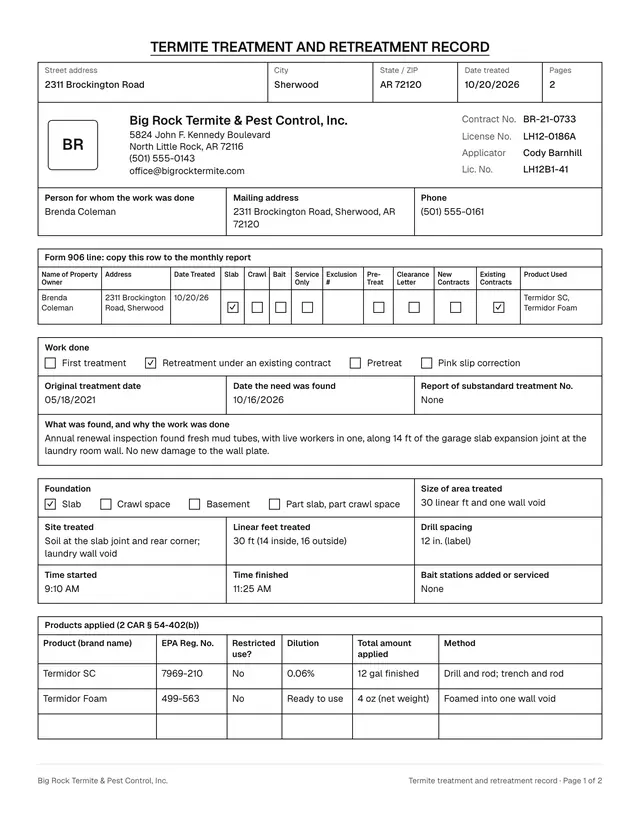
Termite Treatment and Retreatment Record
Record the termiticide, the amount, and the method for each job. - DelawareDocument # 65-01-06/01/09/02
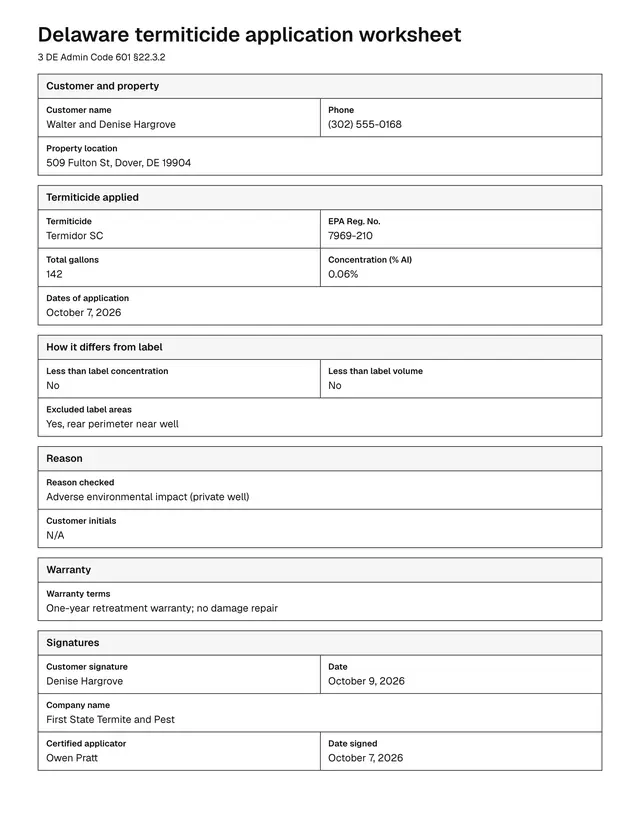
Delaware Notice of Termiticide Application
Record the termiticide, the amount, and the method for each job. - Illinois
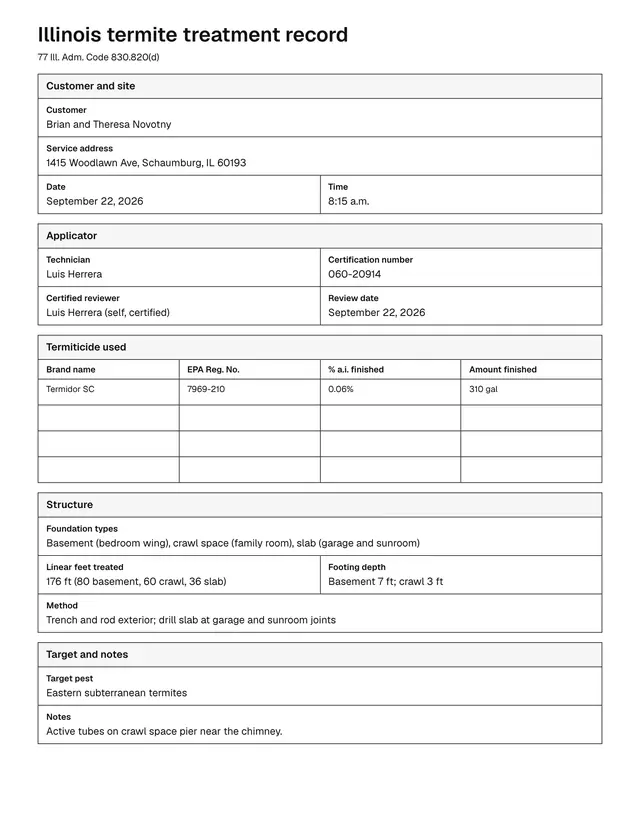
Illinois termite treatment record and diagram
Record the termiticide, the amount, and the method for each job. - Indiana
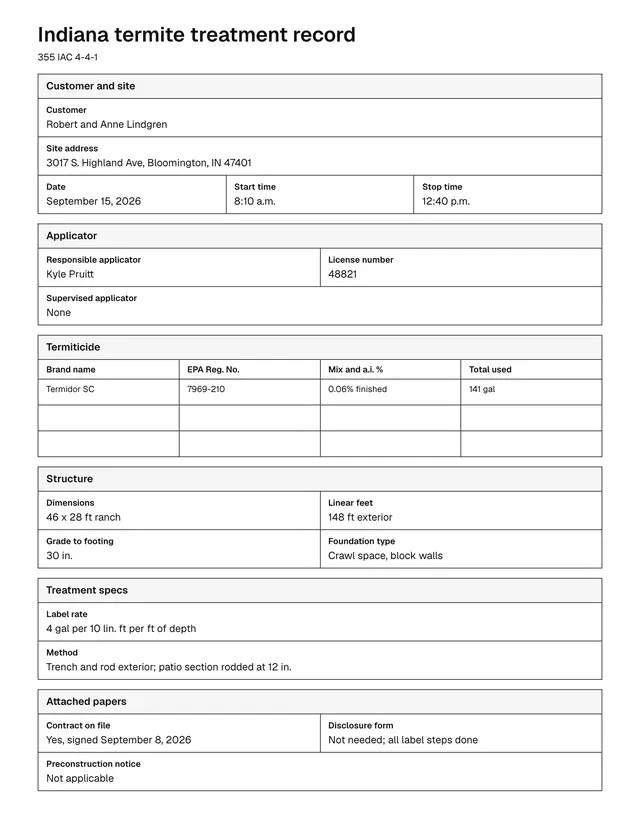
Indiana termite treatment record and graph
Record the termiticide, the amount, and the method for each job. - Kansas
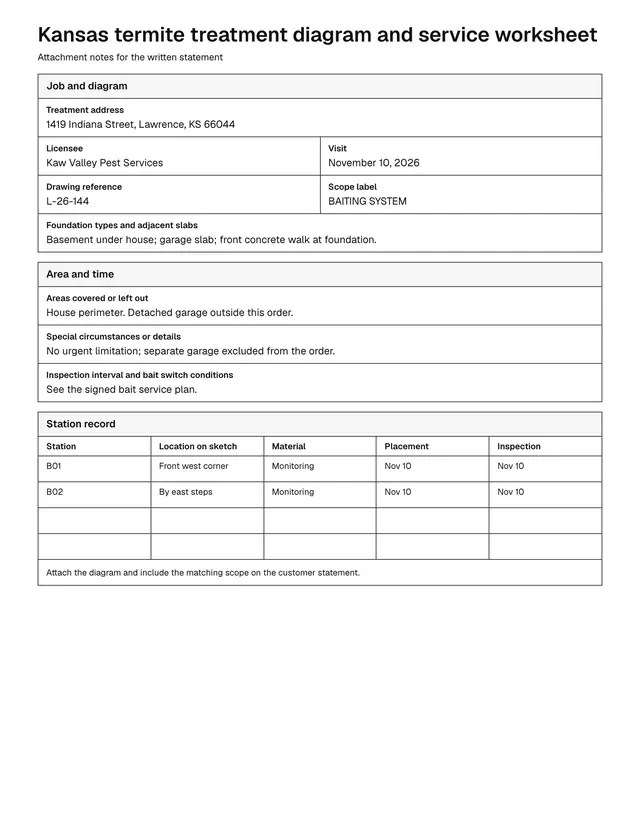
Kansas termite treatment diagram and service worksheet
Record the termiticide, the amount, and the method for each job. - Kentucky
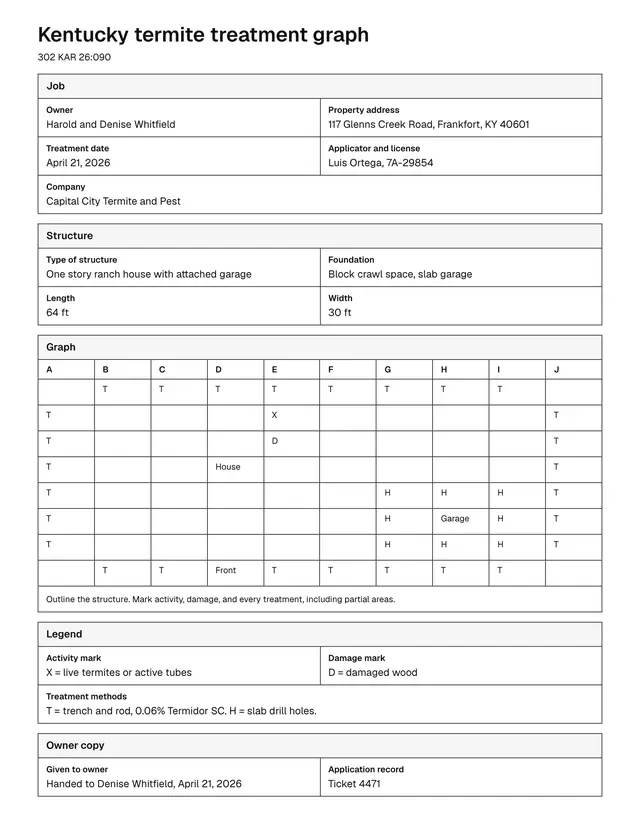
Kentucky termite treatment graph (302 KAR 26:090)
Record the termiticide, the amount, and the method for each job. - Louisiana
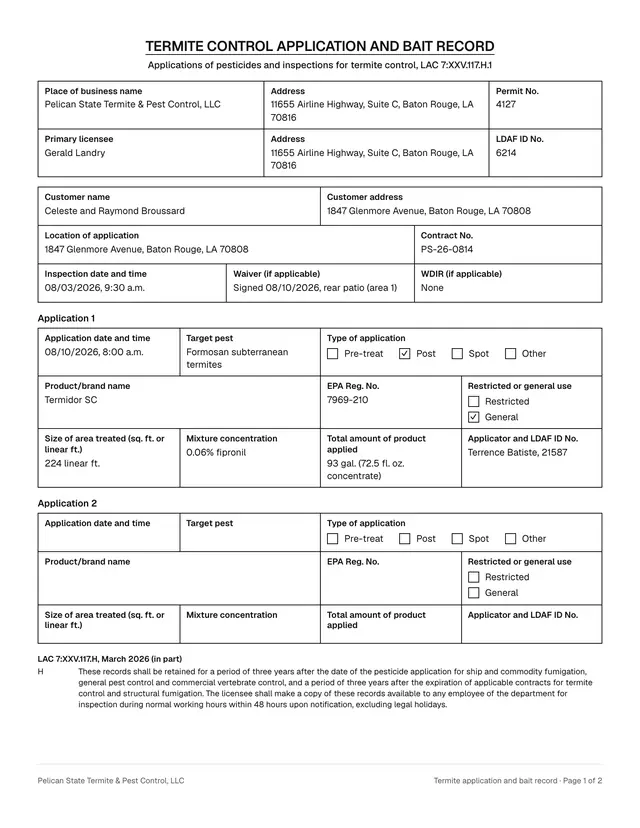
Termite Control Application and Bait Record
Record the termiticide, the amount, and the method for each job. - Maryland
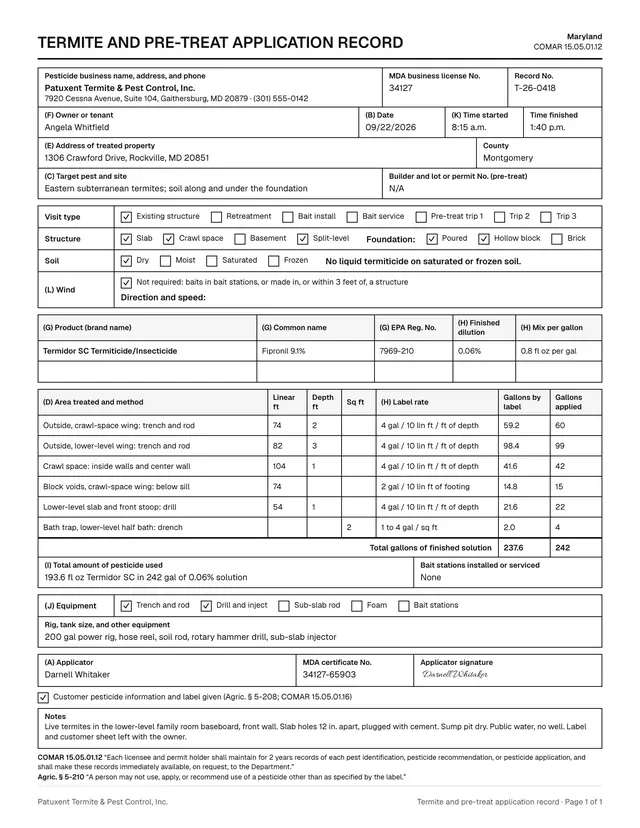
Termite and Pre-Treat Application Record
Record the termiticide, the amount, and the method for each job. - Mississippi
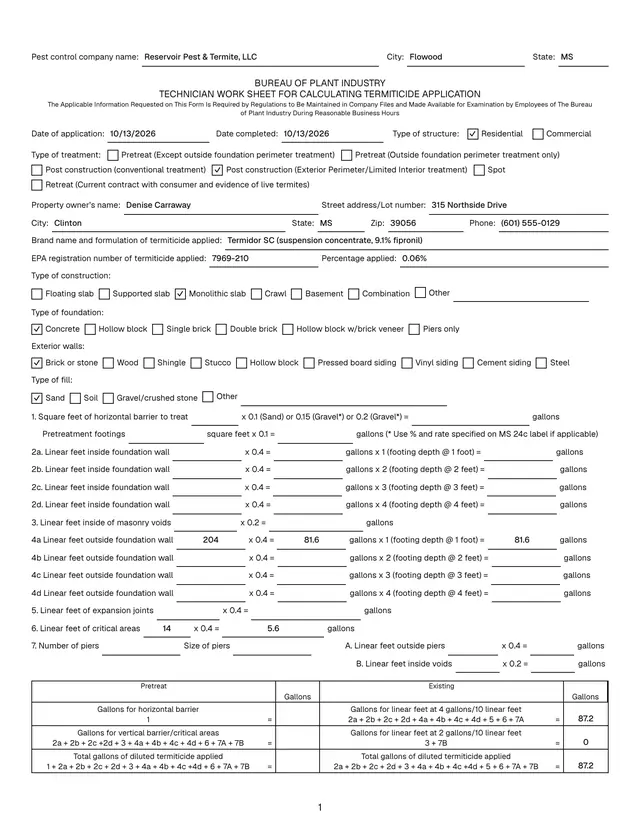
Technician Work Sheet for Calculating Termiticide Application
Record the termiticide, the amount, and the method for each job. - New Jersey
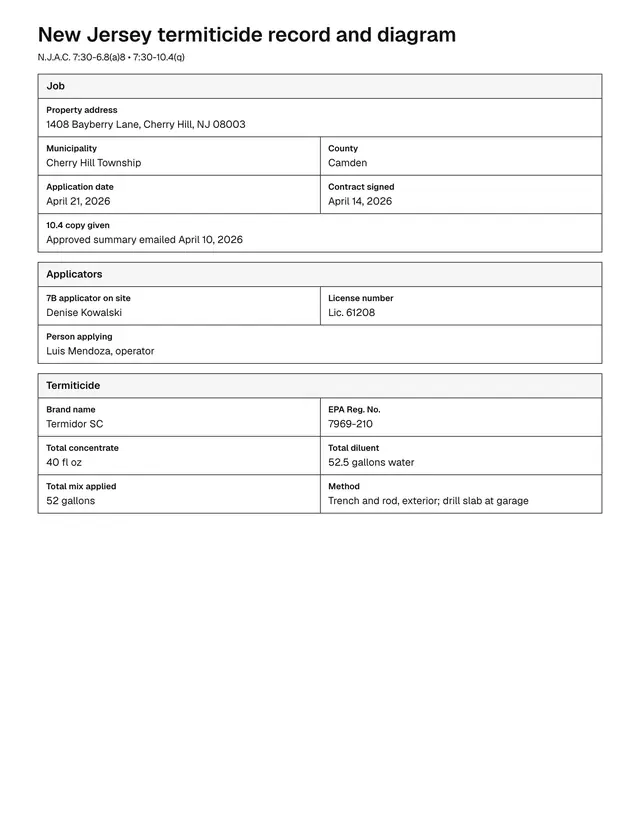
New Jersey termiticide record and diagram (N.J.A.C. 7:30-6.8 and 7:30-10.4)
Record the termiticide, the amount, and the method for each job. - Ohio
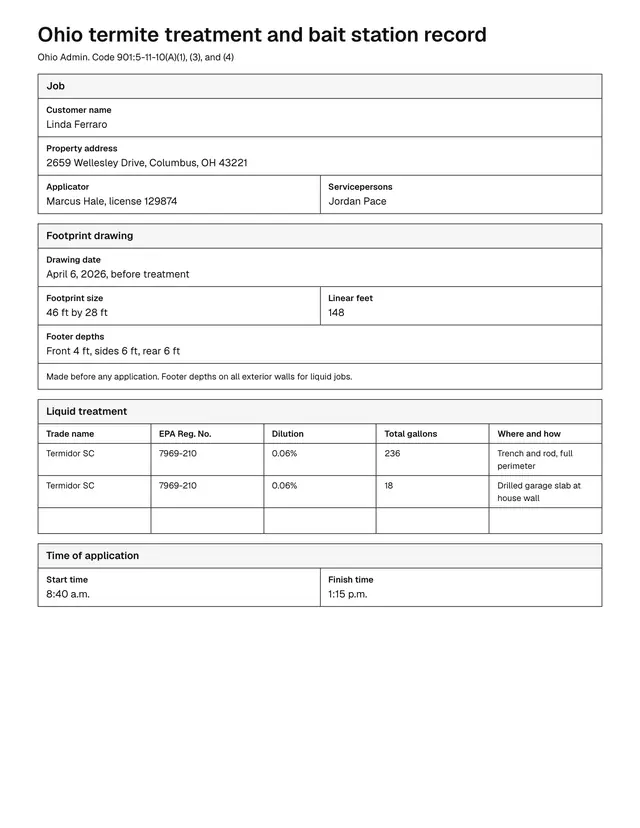
Ohio termite treatment and bait station record
Record the termiticide, the amount, and the method for each job. - Oklahoma
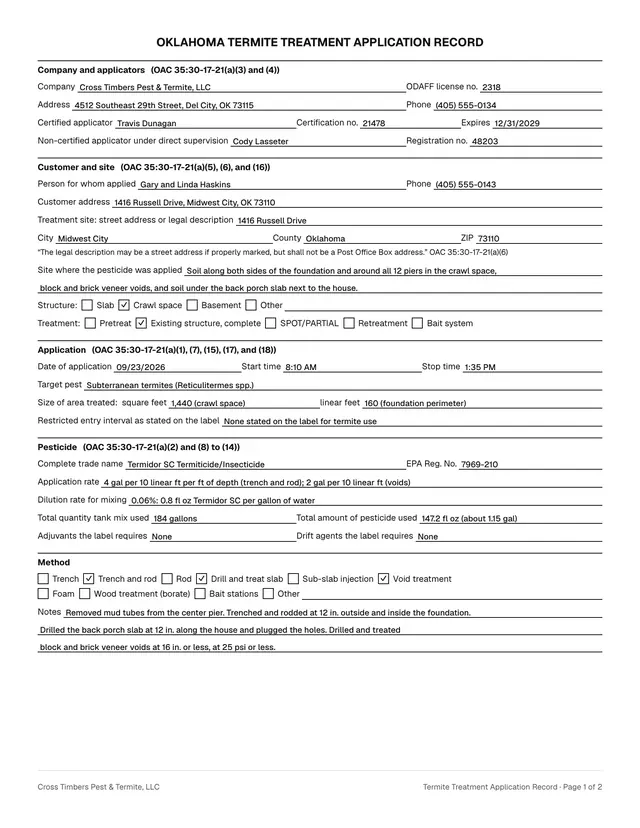
Oklahoma Termite Treatment Application Record
Record the termiticide, the amount, and the method for each job. - South Carolina
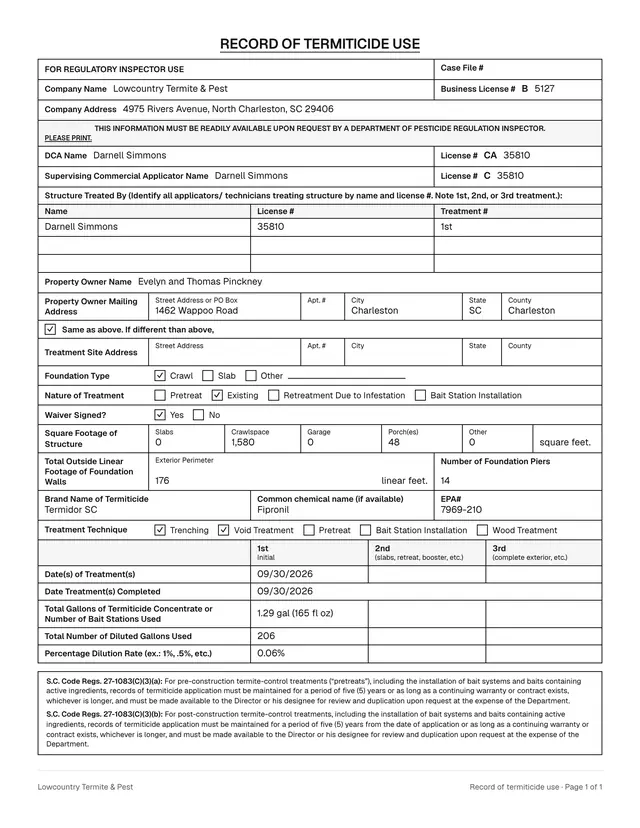
Record of Termiticide Use
Record the termiticide, the amount, and the method for each job.