Colorado pre-construction termite treatment record (Part 6.04(a))
Pre-treating a slab in Colorado means writing down numbers you skip on a normal job: square feet, flow rate, and start and stop times for each part of the pour.
At a glance
- Rule
- 8 CCR 1203-2 Part 6.04(a)
- Extra items
- Square feet, flow rate, start and stop time
- Barrier
- Square feet plus a diagram
- Keep for
- 3 years (C.R.S. 35-10-111)
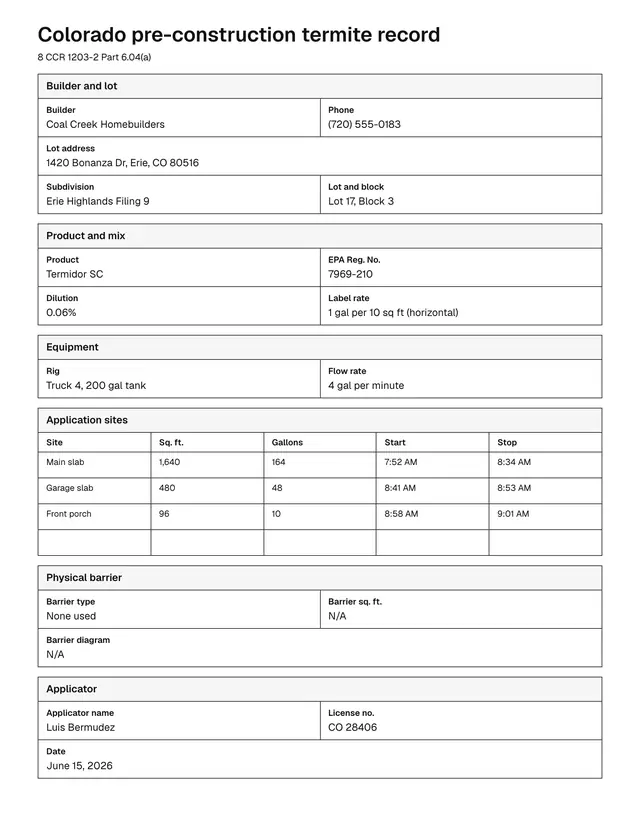
Completed example
Download PDFWhy pretreat records look different
Once the slab is poured, nobody can check your work. The soil under it is gone from view for the life of the house. So Colorado asks for a record that proves the volume went down where it should.
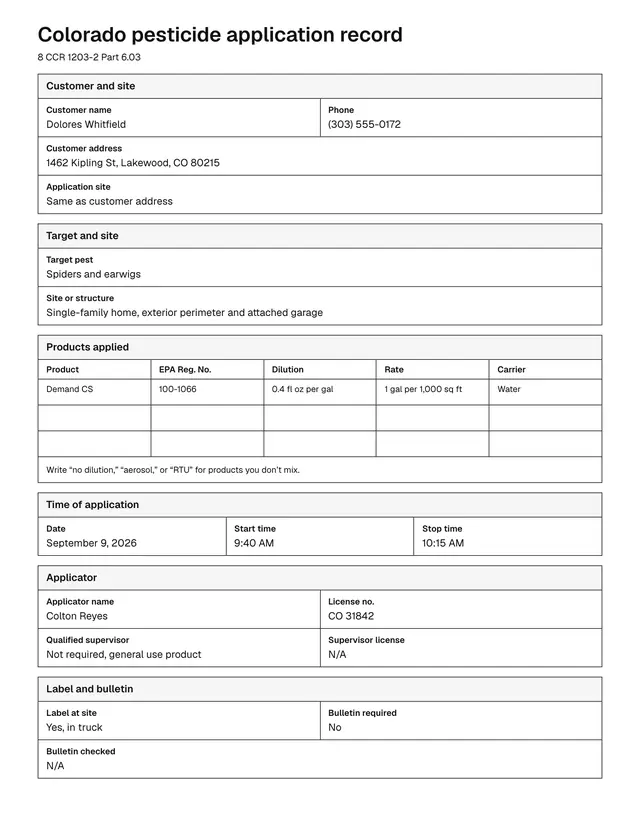
Part 6.04(a) of 8 CCR 1203-2 covers pre-construction termite work. It wants three things the basic record doesn’t: the square feet treated at each application site, the flow rate of your equipment, and the start and stop time. You still need everything in the regular application record too, like the EPA number, dilution, and your license number. The three-year clock in C.R.S. 35-10-111 applies the same way, and the record stays at the address on your business license.
Break the job into sites and check the math
List each site on its own line. The main slab, the garage slab, and the front porch are three sites. Each gets its own square footage and its own start and stop time.
Measure your flow rate. Run the rig into a 5-gallon bucket and time it. If it fills in 75 seconds, you’re at 4 gallons a minute. Write that number down for the day, and redo it if you change tips or pressure.
Let the numbers prove the volume. Say your label calls for 1 gallon per 10 square feet on a horizontal barrier. A 1,640 square foot slab needs 164 gallons. At 4 gallons a minute, that’s about 41 minutes of spraying. If your start and stop times only show 15 minutes, the record says you came up short.
Name the product. For example, Termidor SC from BASF is EPA Reg. No. 7969-210. Write the dilution you mixed, like 0.06%, and pull the label from the EPA label search if you need the rates.
Using a physical barrier?
Some builders go with a physical termite barrier instead of, or along with, a liquid. Part 6.04(a) still applies. Record the square footage of barrier you installed, and provide a diagram showing where it went.
Draw the diagram on site, not from the plans back at the office. Plans change. Plumbing penetrations move. The diagram should match what got covered by concrete.
One lot, start to finish
Here’s how a full record comes together for a single lot in Erie. The builder is Coal Creek Homebuilders, the lot is 1420 Bonanza Drive, and the superintendent texts that forms are set and the pour is tomorrow morning.
Before you spray. Check the label rate for a horizontal barrier and mix Termidor SC to 0.06%. Time the rig into a bucket. Today it’s 4 gallons a minute. Write both down.
Main slab. 1,640 square feet. You start at 7:52 and stop at 8:34, which is 42 minutes, or about 168 gallons at your flow rate. The label needs 164, so the numbers line up.
Garage slab. 480 square feet, 48 gallons, 8:41 to 8:53.
Front porch. 96 square feet, about 10 gallons, 8:58 to 9:01.
Wrap up. Add your name, license number, and the date. No physical barrier was used, so mark that section N/A instead of leaving it blank. A blank box looks like you forgot.
That’s a record an inspector can check with a calculator, and it would still make sense to someone reading it two years from now.
What if the builder pours before you get there?
The hardest part of a pretreat isn’t the spraying. It’s timing. Builders call when the forms are set, and the concrete truck may be booked for the next morning. If you miss that window, there is no slab left to treat.
Ask the superintendent for a pour date when the job is booked, and plan the pretreat for the day before. Get the lot number and subdivision in writing so the record matches the builder’s paperwork. Many builders also want a copy of the record for the buyer’s closing file, so send one with the lot and block on it the same day.
Noma specializes in the Colorado pre-construction termite record (8 CCR 1203-2 Part 6.04(a)). Builders can book online, you set the job on the schedule ahead of the pour, draw the barrier diagram on the job, and send the invoice the same day. See how Noma schedules builder jobs.
Frequentlyaskedquestions
Send this document in minutes, not an afternoon.
Other states
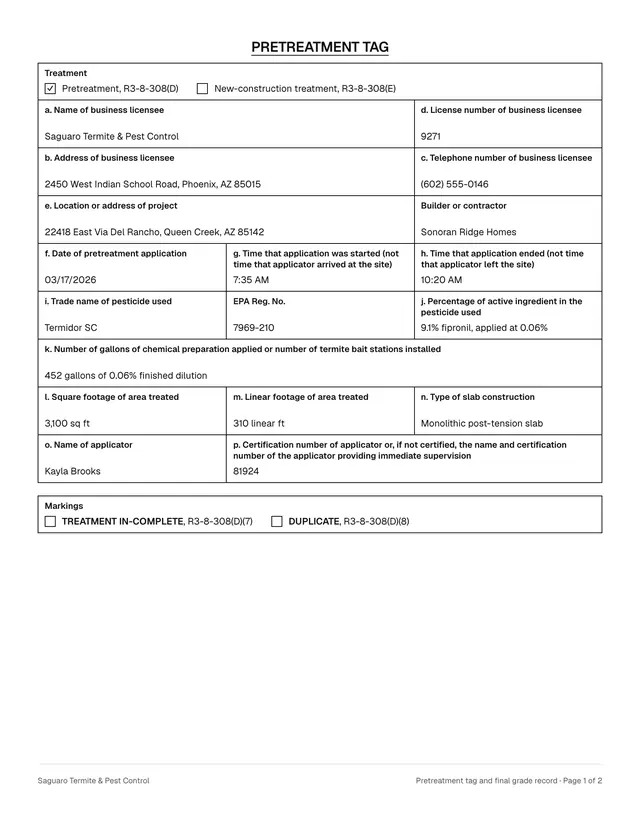
New construction treatment record templates- Arizona
Pretreatment Tag and Final Grade Record
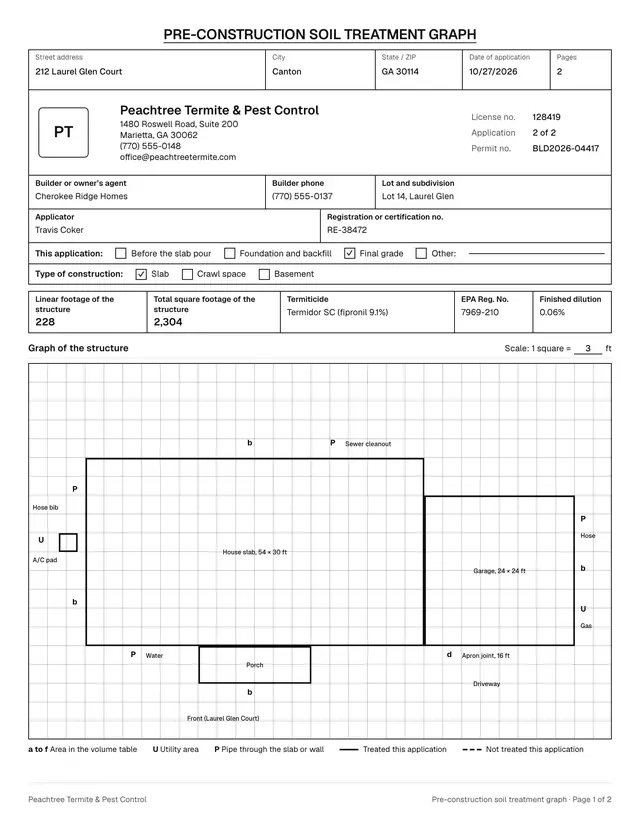
The treatment record for a new home’s termite pretreatment. - Georgia
Pre-Construction Soil Treatment Graph
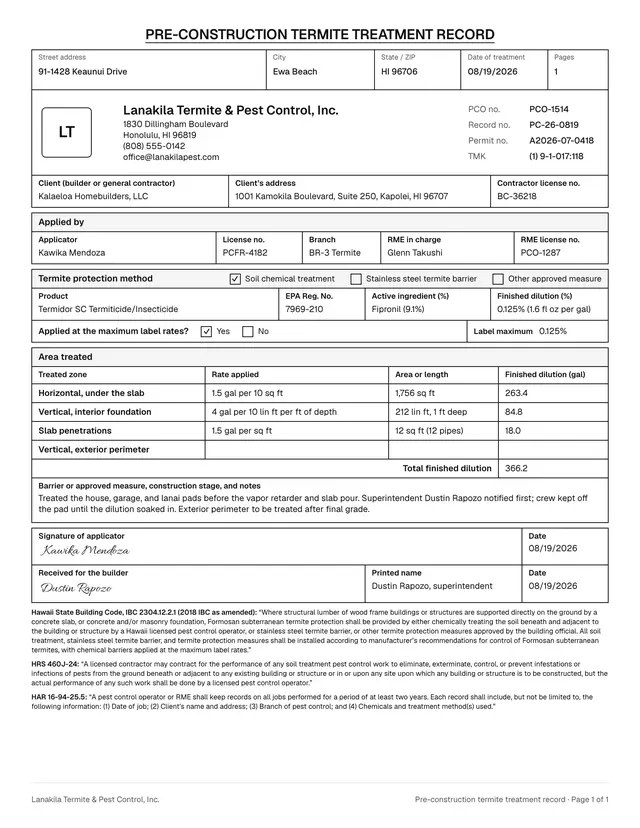
The treatment record for a new home’s termite pretreatment. - Hawaii
Pre-Construction Termite Treatment Record
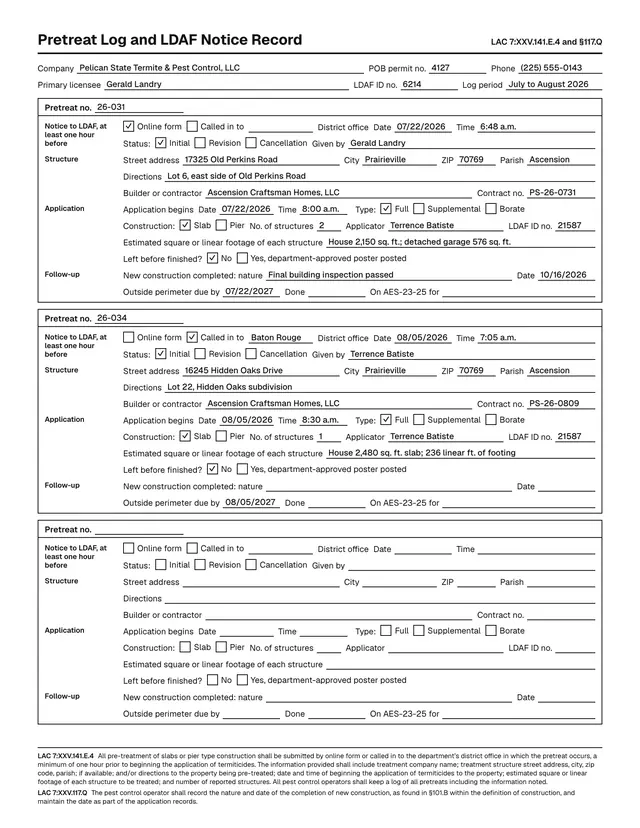
The treatment record for a new home’s termite pretreatment. - Louisiana
Pretreat Log and LDAF Notice Record
The treatment record for a new home’s termite pretreatment. - Mississippi
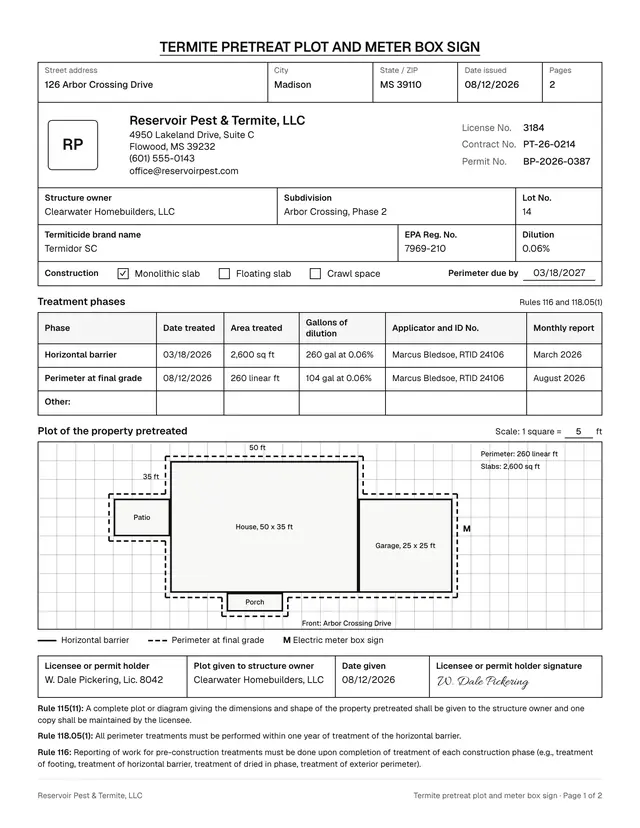
Termite Pretreat Plot and Meter Box Sign
The treatment record for a new home’s termite pretreatment. - Nevada
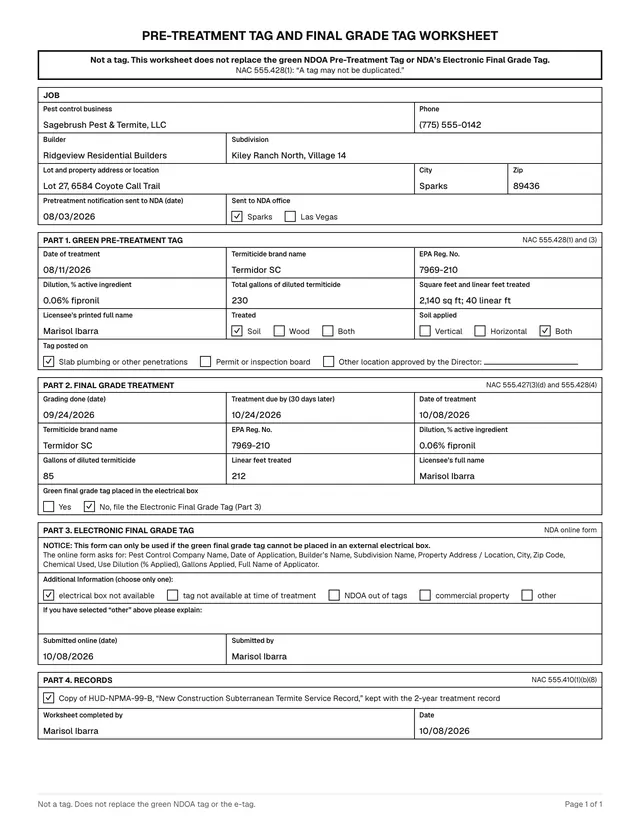
Pre-Treatment Tag and Final Grade Tag Worksheet
The treatment record for a new home’s termite pretreatment. - OklahomaHUD-NPMA-99-B
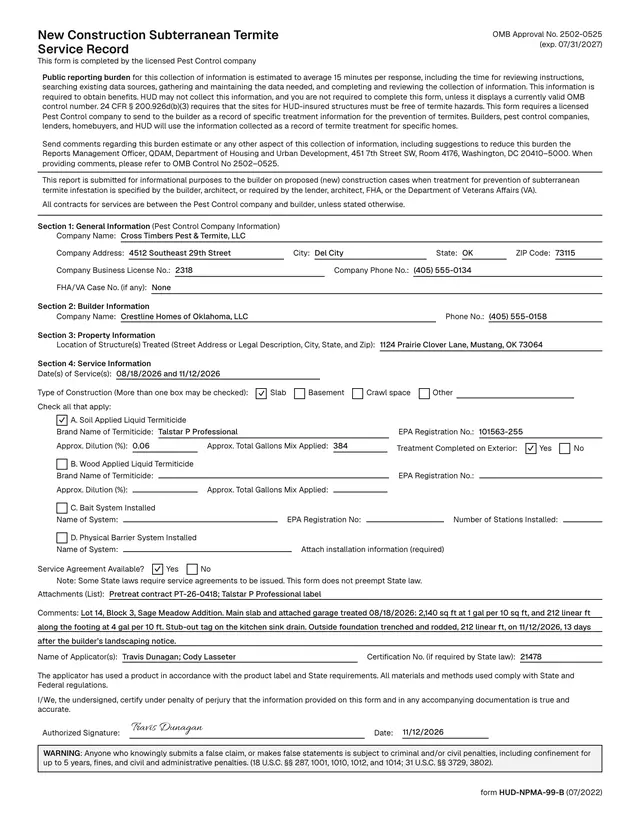
New Construction Subterranean Termite Service Record
The treatment record for a new home’s termite pretreatment. - Tennessee
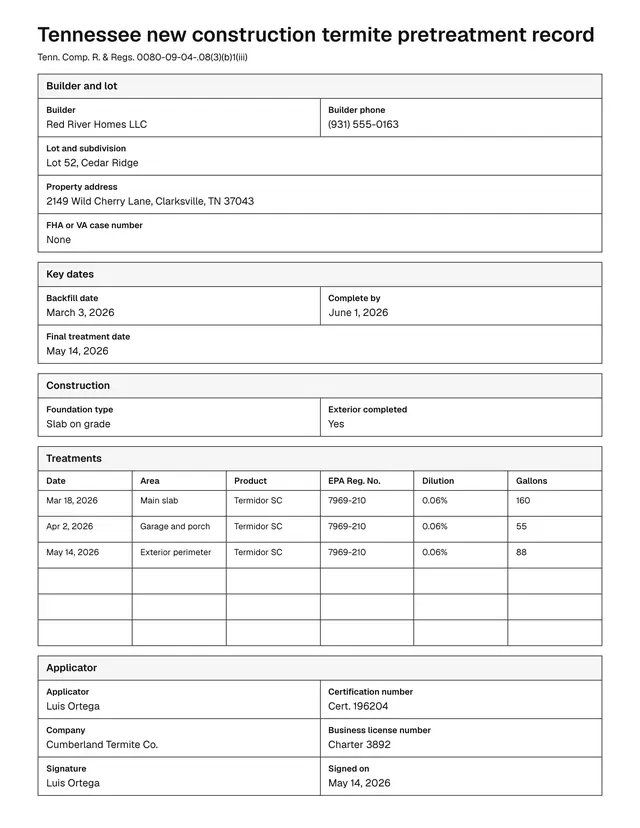
Tennessee new construction termite pretreatment record
The treatment record for a new home’s termite pretreatment. - Virginia
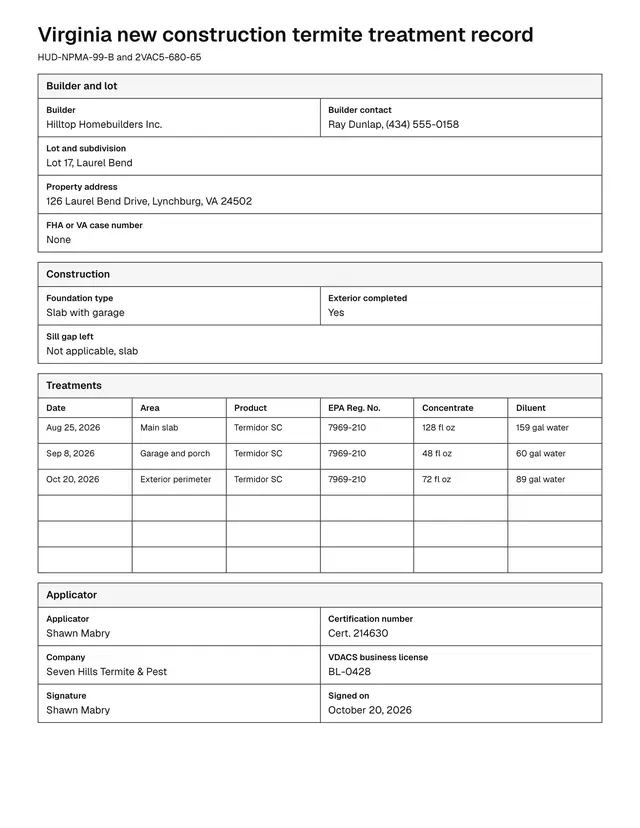
Virginia new construction termite treatment record
The treatment record for a new home’s termite pretreatment.