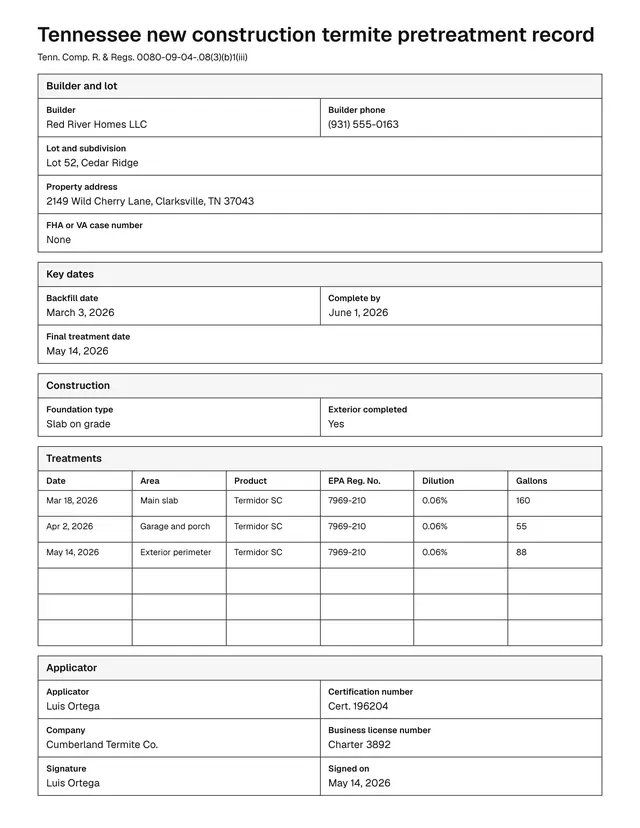
Tennessee new construction termite pretreatment record
Tennessee gives you 90 days after backfill to finish a new construction termite pretreatment, unless the label says otherwise. Most builders also want the HUD-NPMA-99-B when it’s done.
At a glance
- Rule
- 0080-09-04-.08(3)(b)1(iii)
- Deadline
- 90 days after backfill
- Federal form
- HUD-NPMA-99-B
- Goes to
- The builder
Completed example
Download PDFThe 90-day clock starts at backfill
Tennessee has one pretreat deadline, and it’s in rule 0080-09-04-.08(3)(b)1(iii): “Unless contrary to pesticide label directions, pretreatments for new construction shall be completed within 90 days after backfill of the project.”
Count from the day the foundation is backfilled. If a Clarksville crew backfills on March 3, 2026, the pretreatment has to be done by June 1, 2026. Write both dates on the record so the math is on paper.
The label comes first. Some termiticide labels tie the final exterior treatment to grading being finished, so read the label you’re using. If it gives a different window, follow it and note that on the record.
The rule doesn’t say how to prove the backfill date. Ask the builder for it in writing, a text or email is enough, and save it with the job.
Jobs with several buildings can have several backfill dates. Track each building on its own clock.
The two HUD forms builders ask for
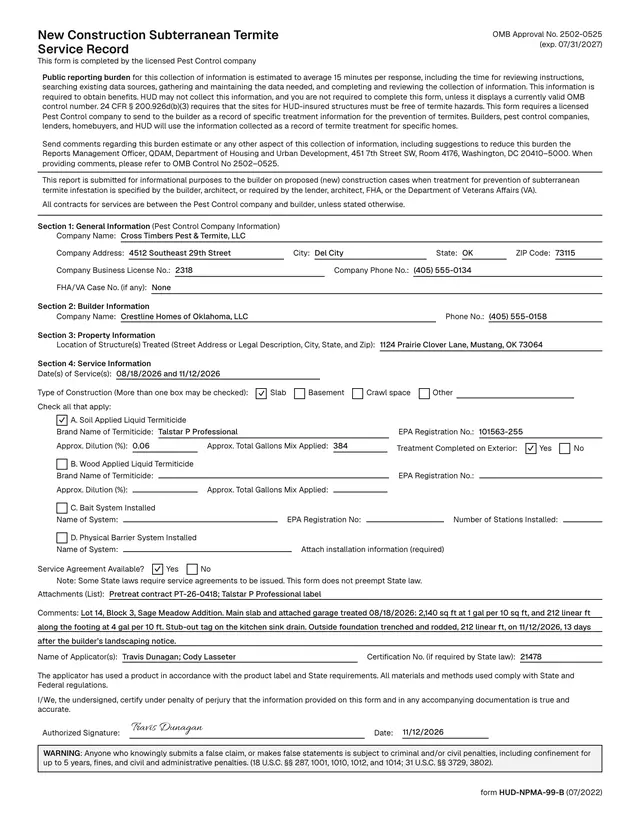
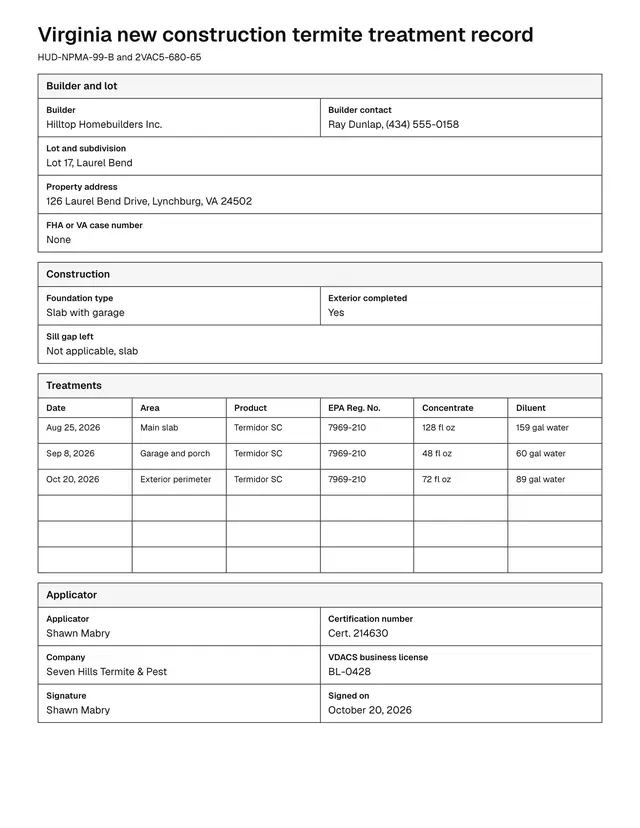
Tennessee doesn’t have its own pretreat certificate. Builders ask for the federal form instead. The HUD-NPMA-99-B is the New Construction Subterranean Termite Service Record. A licensed pest control company fills it out and sends it to the builder.
The 99-B asks for your company name, address, and business license number, the builder, the property, and the FHA or VA case number if there is one. Then it asks for the service details by type. For a soil-applied liquid, that’s the brand, EPA Reg. No., approximate dilution, approximate total gallons, and whether the exterior was finished. There are also lines for wood treatments, bait systems, and physical barriers. The applicator signs it under penalty of perjury.
The builder then completes the HUD-NPMA-99-A, the builder’s guarantee to the buyer. When it applies, the 99-B has to go with the 99-A.
Bait systems and physical barriers have their own parts of the 99-B, so a builder using bait stations instead of a liquid still uses the same form. The form cites HUD’s rule at 24 CFR 200.926d(b)(3) and carries an OMB expiration of July 31, 2027, so print fresh copies from HUD instead of using an old stack.
The buyer sees the builder’s 99-A at closing, with your 99-B attached when it applies. Get the 99-B to the builder before the closing date, not after.
If the buyer has an FHA or VA case number, it belongs on the 99-B. Ask the builder for it at the start instead of chasing it the week of closing.
Keep your own copy of the 99-B with the application records for that lot.
Track each stage, not just the end
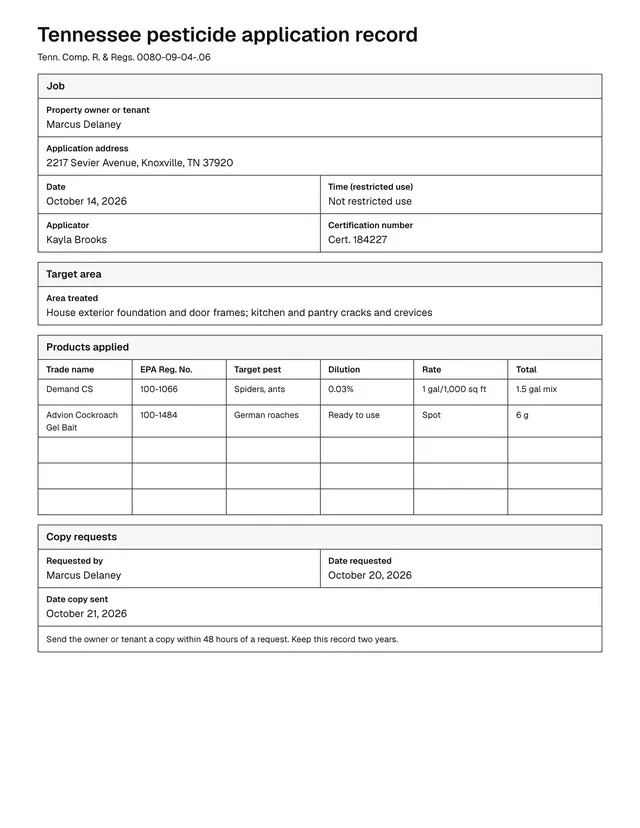
A pretreat often takes more than one trip: the slab, then the porch and garage pours, then the exterior once grading is done. Log each trip as its own pesticide application record. Rule 0080-09-04-.06 treats each one as a custom application, kept for two years.
Measure the mix. Termidor SC (EPA Reg. No. 7969-210) at 0.06 percent is 0.8 fluid ounces per gallon. Tennessee’s 10 percent rule means the finished mix has to land between 0.054 and 0.066 percent.
Record the gallons. The 99-B asks for approximate total gallons, so add up each stage as you go. Guessing at the end is how numbers stop matching.
Mark the exterior honestly. The 99-B asks yes or no on whether the exterior treatment was finished. If grading isn’t done, mark no and come back.
Note the foundation type. The 99-B asks for slab, basement, crawl space, or other. A slab house with a crawl space addition goes on the other line, described in words.
The WDO contract rule in .08(3)(a) applies to any WDO pesticide application, so set up the termite contract with the builder before the first trip.
How do you keep up with a builder’s pour schedule?
Builders call the day before a pour, and a missed slab means drilling later. Tracking backfill dates, return trips, and the final grade across 30 lots in a subdivision is where pretreats go wrong.
Send one invoice per lot when the 99-B goes out, so the builder can match payment to the house.
Noma specializes in the Tennessee New Construction Termite Pretreatment Record (Tenn. Comp. R. & Regs. 0080-09-04-.08(3)(b)1(iii)). Noma schedules each pretreat trip by lot, techs log the work in the mobile app at the site, and you invoice the builder with online payment when the lot is done. See how Noma schedules builder pretreats.
Frequentlyaskedquestions
Send this document in minutes, not an afternoon.
Other states
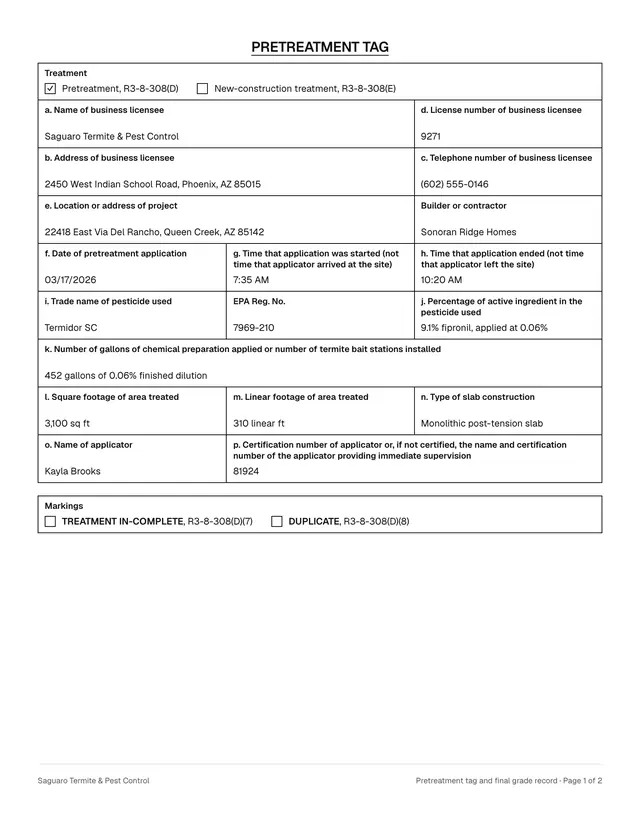
New construction treatment record templates- Arizona
Pretreatment Tag and Final Grade Record
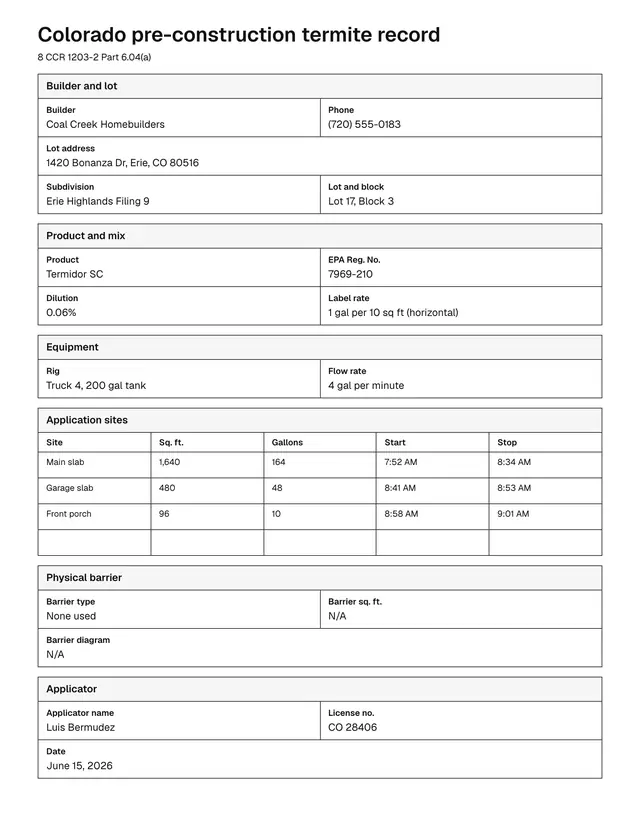
The treatment record for a new home’s termite pretreatment. - Colorado
Colorado pre-construction termite treatment record (Part 6.04(a))
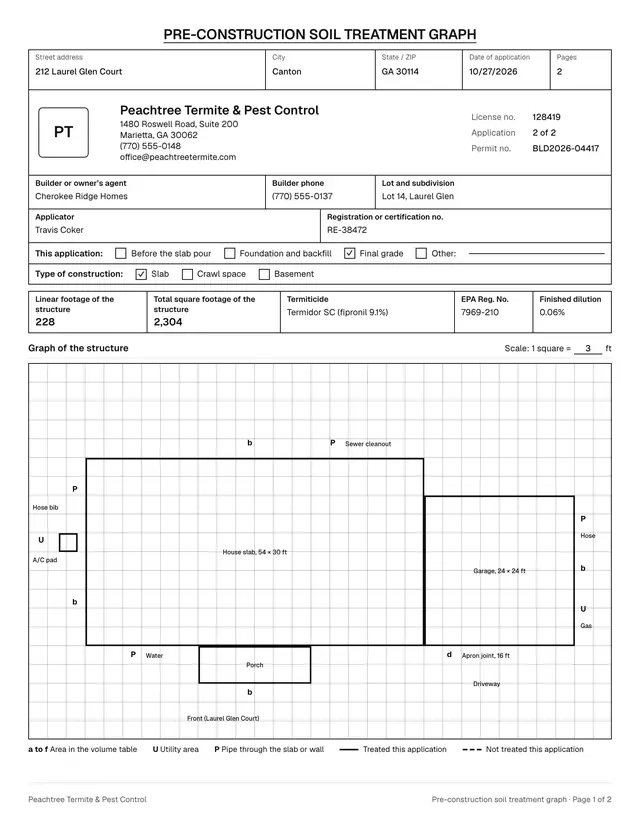
The treatment record for a new home’s termite pretreatment. - Georgia
Pre-Construction Soil Treatment Graph
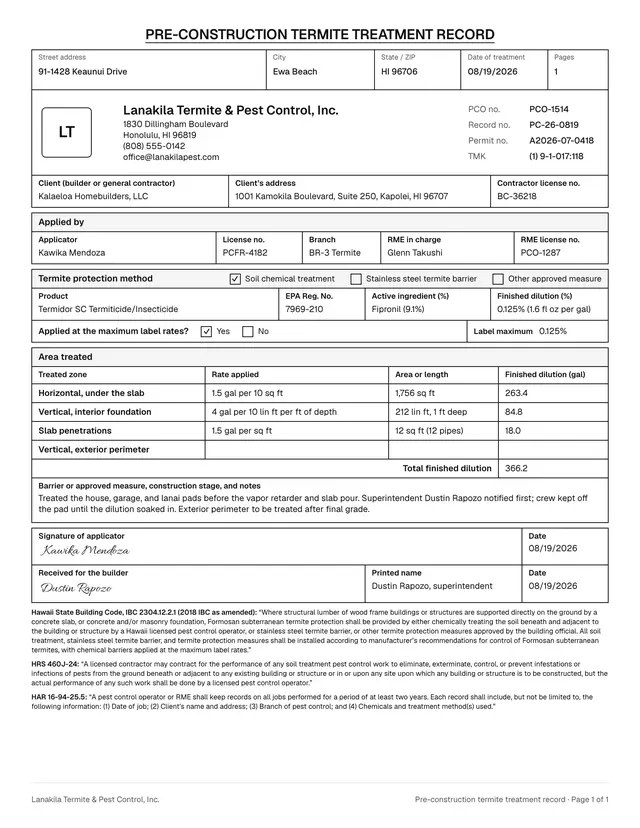
The treatment record for a new home’s termite pretreatment. - Hawaii
Pre-Construction Termite Treatment Record
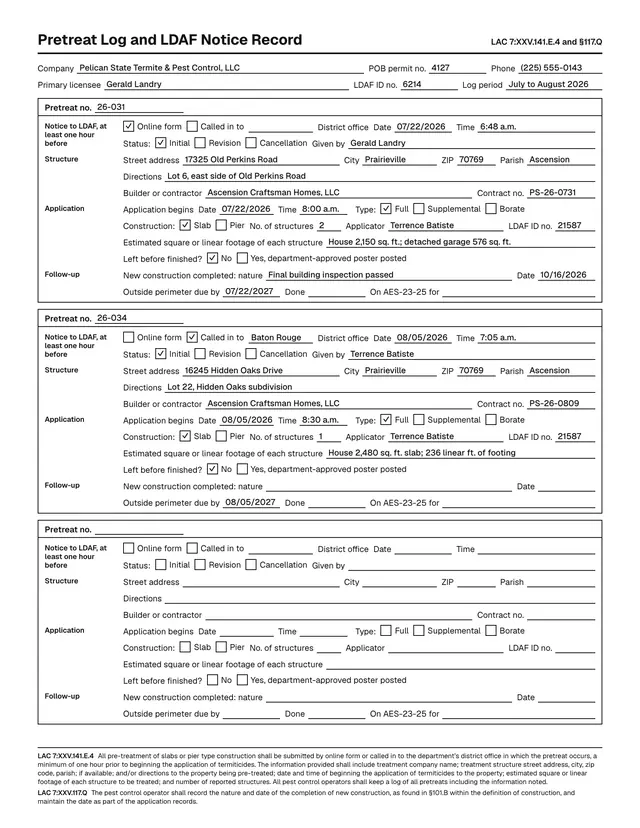
The treatment record for a new home’s termite pretreatment. - Louisiana
Pretreat Log and LDAF Notice Record
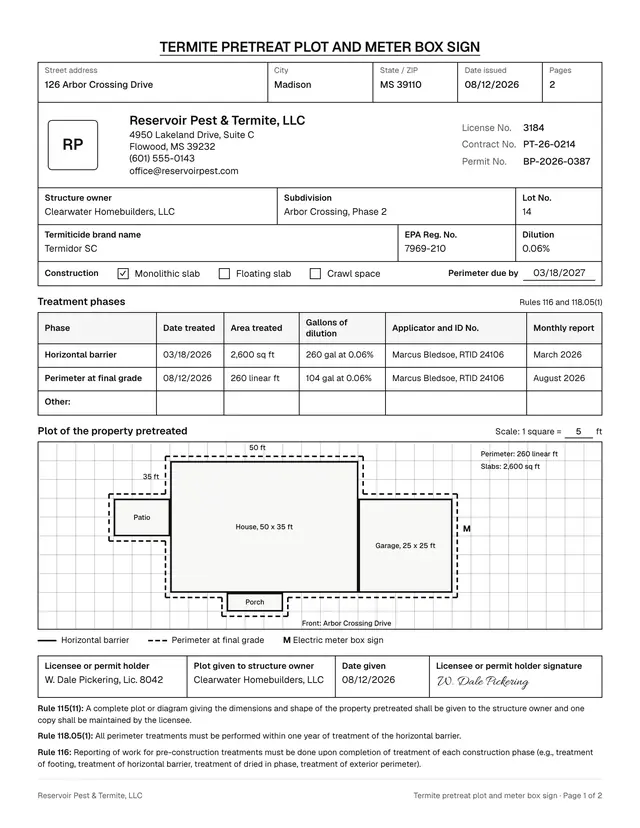
The treatment record for a new home’s termite pretreatment. - Mississippi
Termite Pretreat Plot and Meter Box Sign
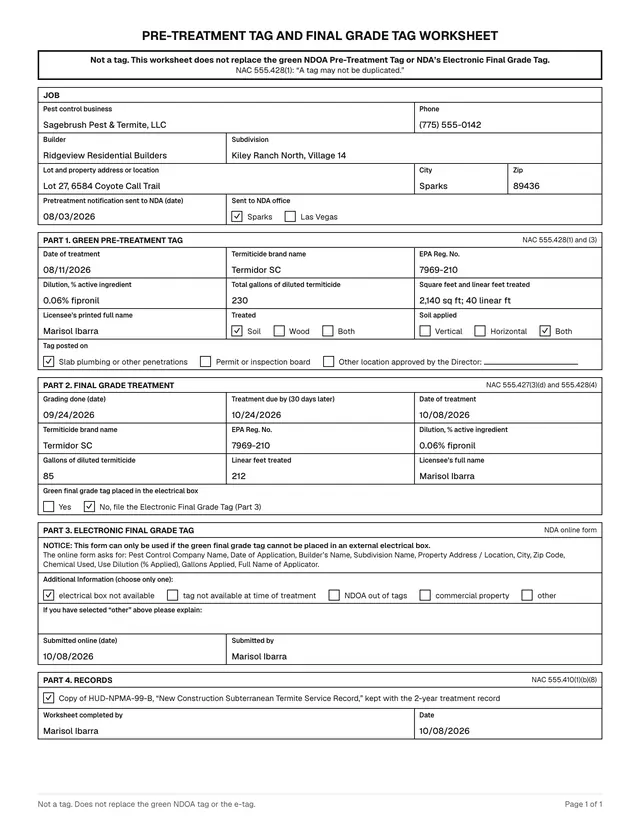
The treatment record for a new home’s termite pretreatment. - Nevada
Pre-Treatment Tag and Final Grade Tag Worksheet
The treatment record for a new home’s termite pretreatment. - OklahomaHUD-NPMA-99-B
New Construction Subterranean Termite Service Record
The treatment record for a new home’s termite pretreatment. - Virginia
Virginia new construction termite treatment record
The treatment record for a new home’s termite pretreatment.