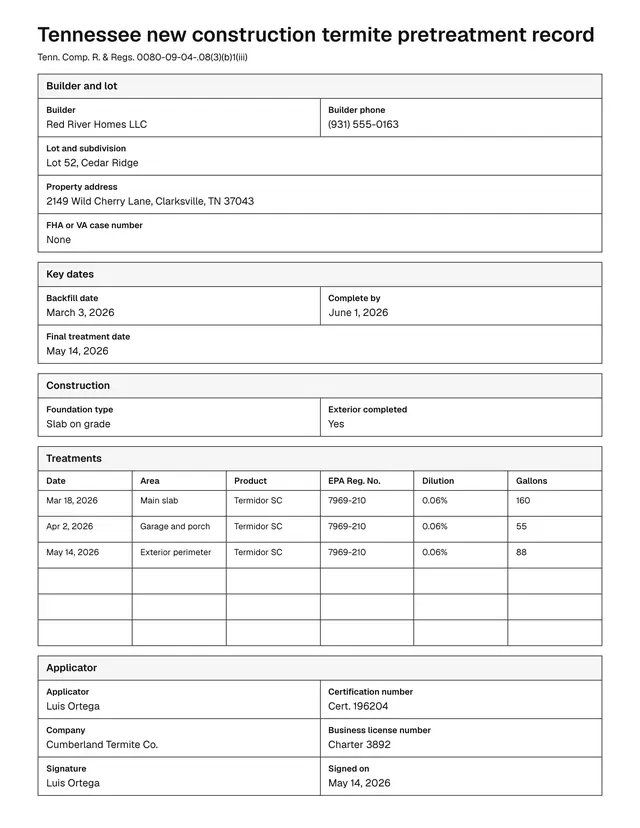
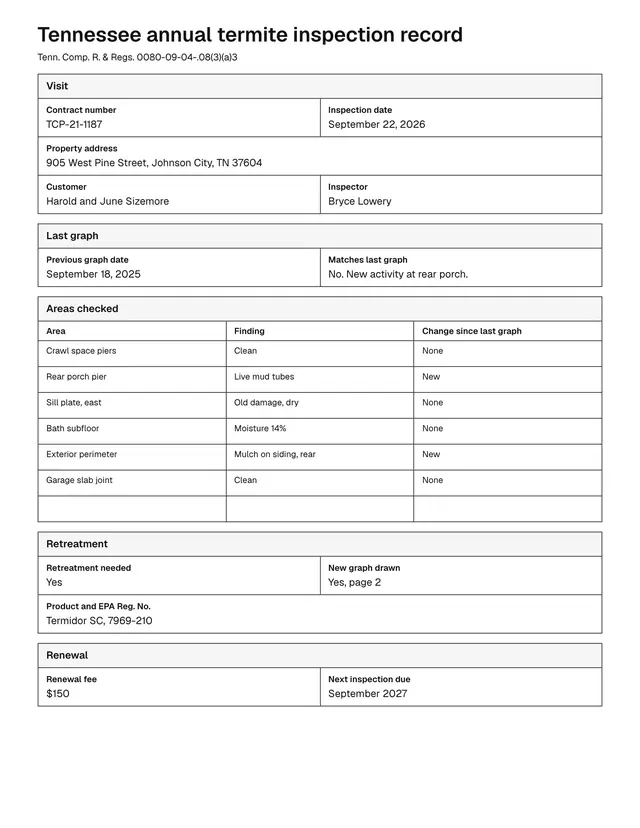
Tennessee annual termite inspection record
Every property under a Tennessee WDO contract gets a yearly inspection. Rule 0080-09-04-.08(3)(a)3 says to log the date, compare against the last graph, and retreat when they don’t match.
At a glance
- Rule
- 0080-09-04-.08(3)(a)3
- How often
- Every year under contract
- Copies
- Within 48 hours of request
- Keep for
- 2 years from inspection
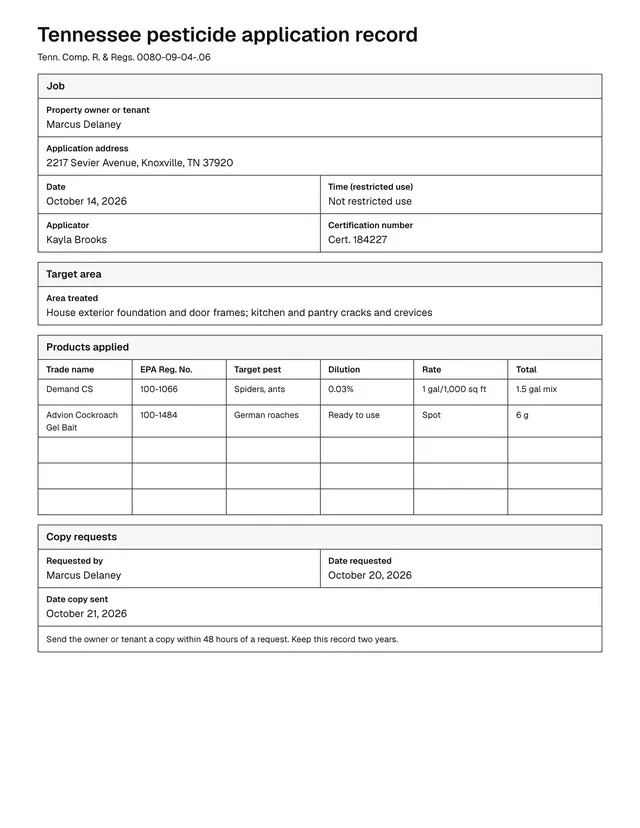
Completed example
Download PDFOne visit a year, written down
A Tennessee termite contract isn’t a one-and-done treatment. Part (3)(a)3 of rule 0080-09-04-.08 says an annual inspection shall be performed on each property under contract, and the date of that inspection must be documented.
Notice what the rule doesn’t say. It doesn’t give a form or a required checklist. It asks for a date, a comparison to the graph, and action when things change. Most companies build a one-page record for that, plus a fresh graph when needed.
For a renewal crew in Johnson City running 15 stops a day, the record is also proof of the visit. If a customer files a complaint about a missed retreatment, the dated sheet is what you show TDA.
The rule says annual, not “on the anniversary.” Picking the same month every year keeps a renewal from drifting past twelve months.
If a customer cancels twice, write down each try with the date. It shows you attempted the yearly visit.
Start with last year’s graph
Bring the last graph to every visit. Walk the same areas, in the same order, and mark each one as unchanged or changed. That’s the heart of the rule.
If you find activity “inconsistent with the previous graph,” the rule says you apply pesticide and create a new graph. New mud tubes on a pier that was clean last year count. So does fresh damage in a room that wasn’t marked.
If nothing changed, write “no change” for each area and keep last year’s graph as the current one. The rule only calls for a new graph when the activity doesn’t match.
That retreatment is a pesticide application like any other. It needs its own entry on the pesticide application record with product, EPA Reg. No., dilution, and amount. Don’t stop at the reinspection sheet.
Photos help. Take one of each area on the old graph so next year’s tech can compare.
Watch for changes to the house too. A new deck, a closed-in porch, or mulch piled against the siding can open a path the first treatment didn’t cover. Note it even when there’s no activity yet.
A walk-through order that works
Outside first. Walk the foundation. Look for mud tubes on block, soil or mulch touching siding, wood touching the ground, and anything new attached to the house, like a deck or fence post.
Then under the house. Piers, sill plates, rim joists, and every spot plumbing comes through the slab or floor. Use a moisture meter on wood that looks dark.
Then inside. Baseboards, door frames, and window sills along outside walls, plus baths and kitchens.
Last, the garage. Slab joints, the bottom of door frames, and anything stored against the walls.
Ask the owner. Have they seen wings near windows or had a leak since last year? A leak under a sink wets the wood, and wet wood draws termites. Eastern subterranean termites usually swarm in spring, so ask about it even on a fall visit.
Copies, complaints, and how long to keep it
The contracting party can ask for copies of annual inspection and treatment records, and the rule gives you 48 hours. Keep them easy to pull up by contract number.
Send the copy as a PDF the same day when you can. Forty-eight hours goes fast over a weekend.
Records and graphs stay on file for two years from each inspection date. Under rule 0080-09-04-.06, any pesticide you apply during the visit has the same two-year clock.
TDA’s consumer tips list failure to retreat as one of the problems the department investigates. A clean yearly record, with a new graph whenever you treated, answers that kind of complaint fast.
How do you keep hundreds of renewals from slipping?
Renewals come due every month, and a missed one means a missed inspection. Most shops miss them because the dates live in a spreadsheet nobody checks.
Send the reminder a few weeks out, book the visit, and collect the fee in one step. A renewal that’s paid but never inspected still misses the rule.
Techs should see last year’s graph and notes on their phone before they knock.
Noma specializes in the Tennessee Annual Termite Inspection Record (Tenn. Comp. R. & Regs. 0080-09-04-.08(3)(a)3). Noma schedules yearly reinspections, sends the renewal invoice with online payment, and lets techs draw the new graph on their phone at the house. See how Noma schedules termite renewals.
Frequentlyaskedquestions
Send this document in minutes, not an afternoon.
Other states
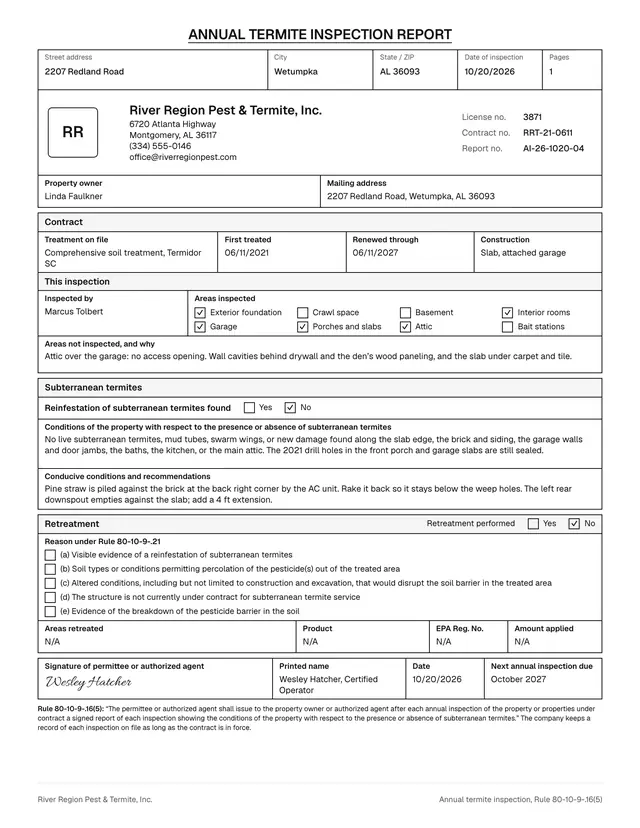
Reinspection report templates- Alabama
Annual Termite Inspection Report
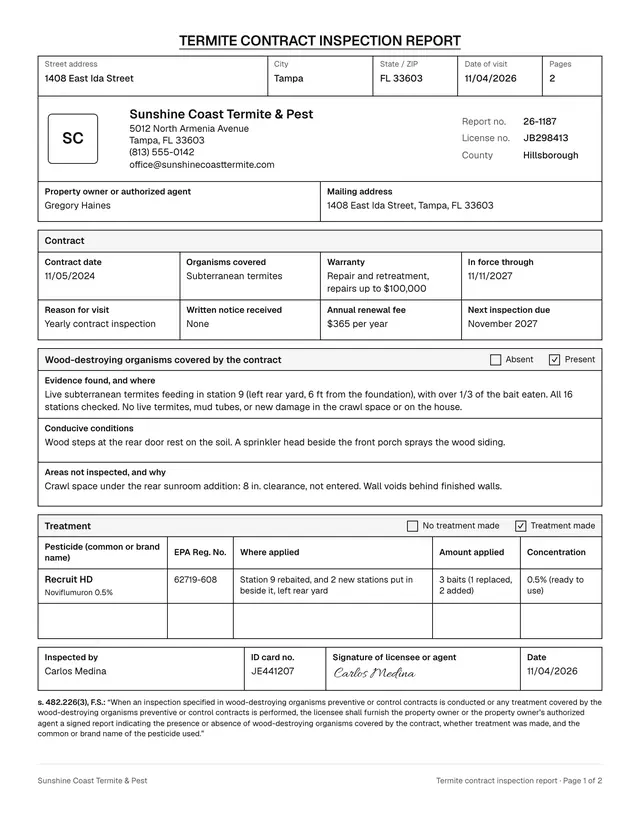
Record each warranty visit and any retreatment. - Florida
Termite Contract Inspection Report
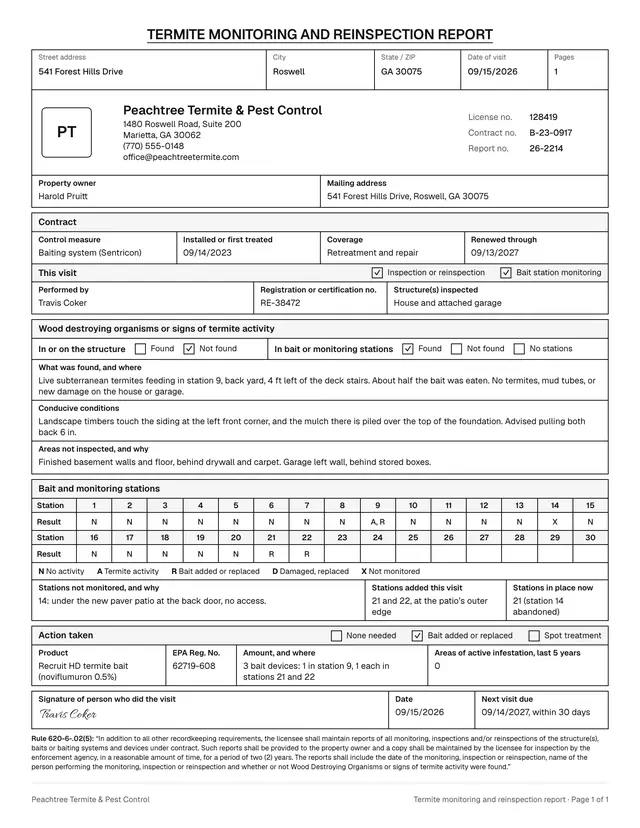
Record each warranty visit and any retreatment. - Georgia
Termite Monitoring and Reinspection Report
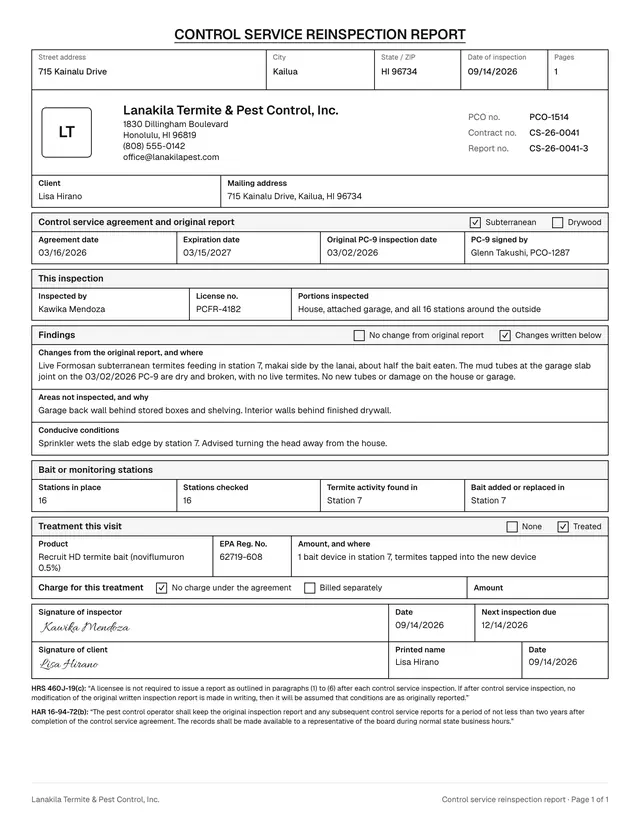
Record each warranty visit and any retreatment. - Hawaii
Control Service Reinspection Report
Record each warranty visit and any retreatment. - Maryland
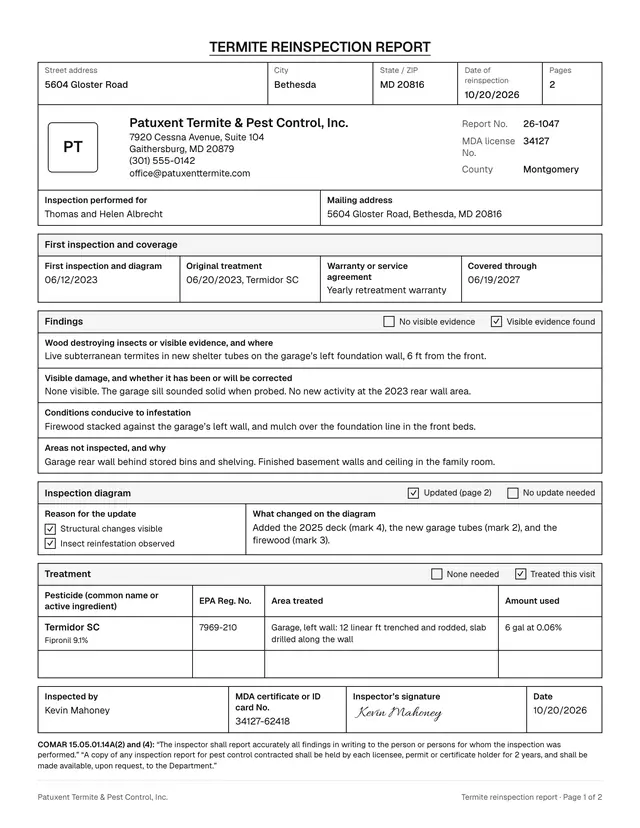
Termite Reinspection Report
Record each warranty visit and any retreatment. - Mississippi
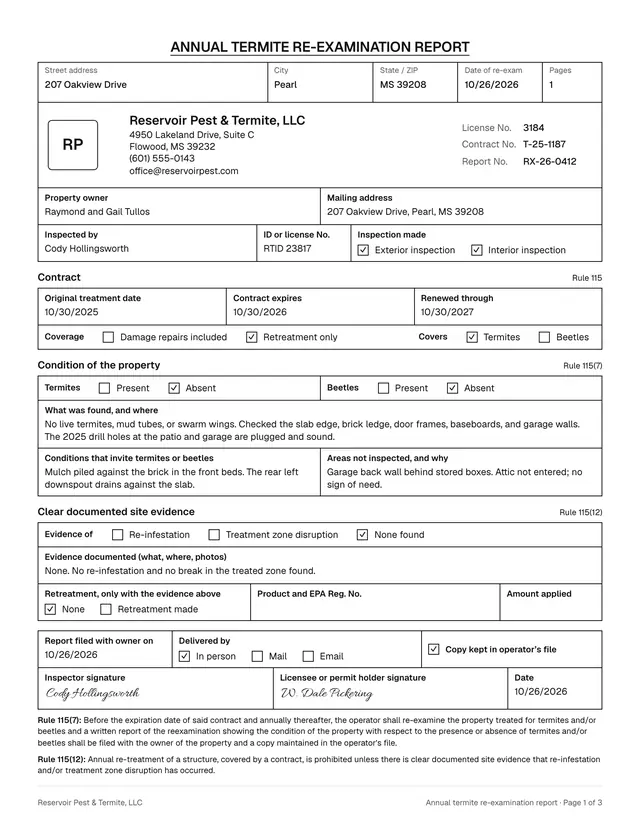
Annual Termite Re-examination Report
Record each warranty visit and any retreatment. - North Carolina
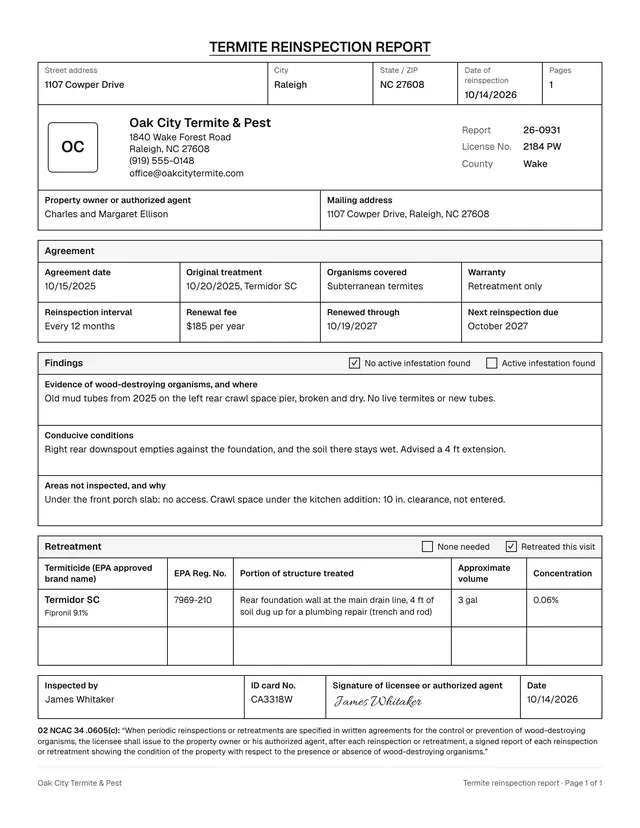
Termite Reinspection Report
Record each warranty visit and any retreatment.