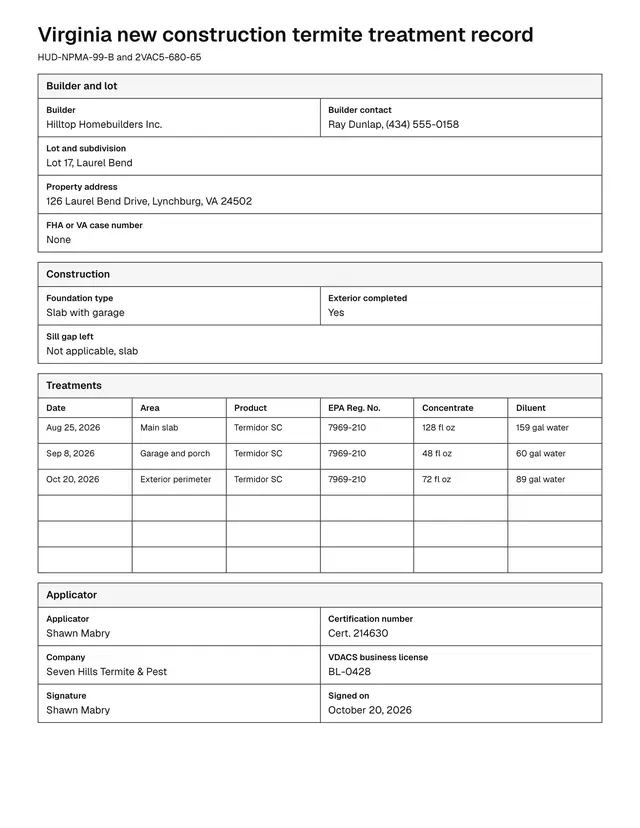
Virginia new construction termite treatment record
Virginia’s pesticide rules don’t set a pretreat deadline. Builders lean on the HUD-NPMA-99-B, and each trip still needs a 2VAC5-680-65 record.
At a glance
- State deadline
- None found
- Federal form
- HUD-NPMA-99-B
- Each trip
- 2VAC5-680-65 record
- Applicator
- Category 7b
Completed example
Download PDFWhat Virginia does and doesn’t set
Virginia’s pesticide rules don’t give you a deadline for a pretreat. We read the VDACS business and certification rules and didn’t find one. Timing comes from the termiticide label and the pour schedule.
Read the label for when each part goes down, like before the vapor barrier or after final grade, and log each one that way. If the builder pushes you to skip a trip, the 99-B’s yes or no on the exterior is where that shows.
Write down the backfill and pour dates anyway. If a buyer or lender asks later when the treatment happened, the record should answer without a call to the builder. And keep the company’s VDACS business license current, since it expires March 31 each year.
What Virginia does set is who and how. The person applying termiticide works under category 7b, wood-destroying pest control. And every product you put down is a pesticide application under 2VAC5-680-65, so each trip gets its own record, the same as a route stop.
That record wants the amount of concentrate and the amount of diluent. For Termidor SC (EPA Reg. No. 7969-210) at 0.06 percent, that’s 0.8 fluid ounces per gallon. A 100 gallon tank is about 80 fluid ounces of concentrate in 99.4 gallons of water. Write both numbers.
The paperwork the builder asks for
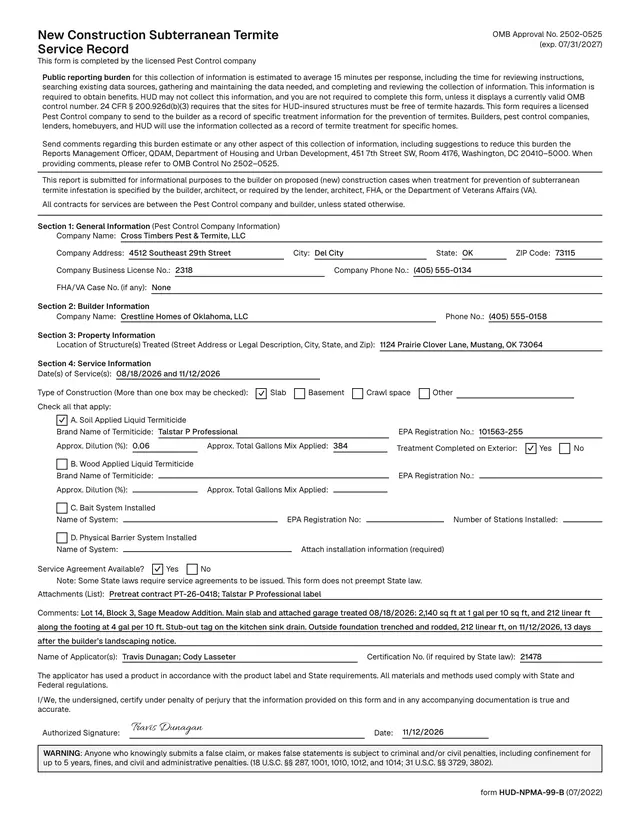
Builders often ask for the HUD-NPMA-99-B, the New Construction Subterranean Termite Service Record. The pest control company fills it out and gives it to the builder.
It asks for your company, business license number, the builder, the property, and the FHA or VA case number if there is one. Then the treatment by type: soil-applied liquid with brand, EPA Reg. No., approximate dilution, approximate total gallons, and whether the exterior was finished. Wood treatments, bait systems, and physical barriers have their own spots. The applicator signs under penalty of perjury.
The applicator’s certification number goes on the 99-B next to the signature. In Virginia, that’s the 7b certified applicator who did or supervised the work.
The builder fills out the HUD-NPMA-99-A, the builder’s guarantee to the buyer, and your 99-B goes with it when it applies. For your 99-B, the business license number is your VDACS license.
The 99-B also asks whether a service agreement is available to the buyer. If you sell renewals, say yes and have the terms ready. Check the OMB date in the corner, too: the current version runs through July 31, 2027.
Leave room for the next inspector
Virginia’s residential code adds a termite inspection rule in 13VAC5-63-210. In an unvented crawl space, the sill plate face stays clear, with a 1 to 2 inch gap below it along the top of any interior wall covering. Pier and curtain foundations keep the inside of the rim joist and sill clear, though removable fiberglass is allowed.
Tell the builder before the insulation crew shows up. The next person to look for termites in that crawl space is whoever writes the NPMA-33 at resale, and a foamed-over sill is a blind spot.
Bait stations don’t change this. The gap is about seeing termites, not stopping them.
Note on your record whether the gap was left. You’re on site before the walls get covered, and the builder may want proof later.
How do you keep each lot’s records straight?
A subdivision in Lynchburg might have 40 lots at different stages. Each one gets its own trips, its own records, and its own 99-B. Mixing two lots’ gallons is the most common mistake.
Slab trip. Date, “main slab,” square feet treated, product, EPA Reg. No., concentrate and water, and the sprayer you used.
Foundation and plumbing trip. If the label calls for treating along walls or around pipes coming up through the slab, log it as its own area.
Exterior trip. Linear feet around the house after grading, with the same items.
Each record lists the builder as the customer and the lot as the site address, which is how the rule splits those two lines. Send the 99-B the day the exterior is done. If a lot sits for months, keep it open until the last trip.
Noma specializes in the Virginia New Construction Termite Treatment Record (HUD-NPMA-99-B and 2VAC5-680-65). Noma schedules each trip by lot, techs log the work in the mobile app on site, and you invoice the builder with online payment when the lot is done. See how Noma schedules builder pretreats.
Frequentlyaskedquestions
Send this document in minutes, not an afternoon.
Other states
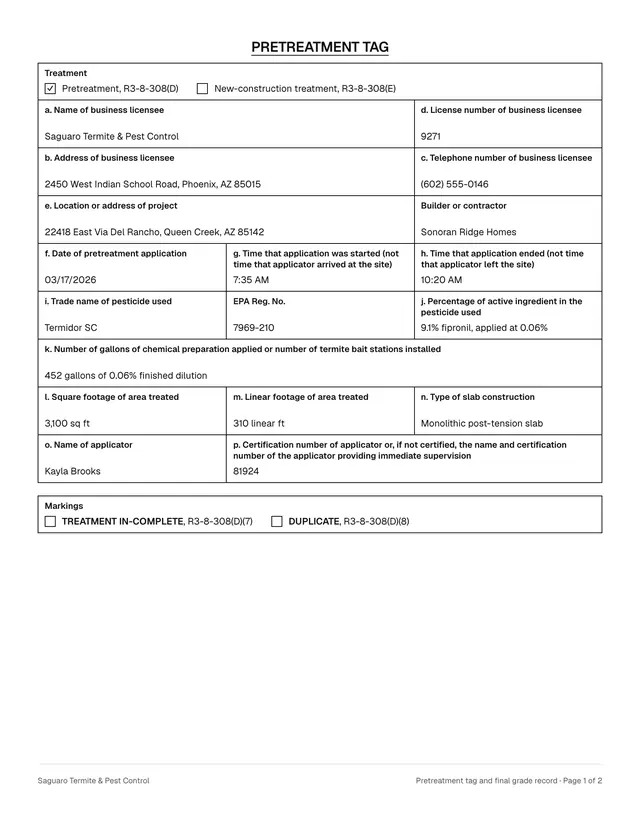
New construction treatment record templates- Arizona
Pretreatment Tag and Final Grade Record
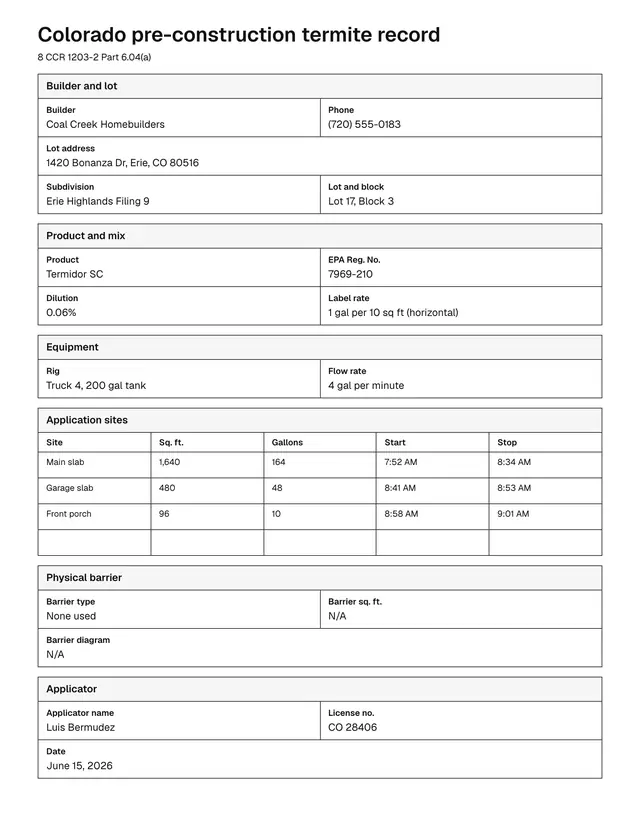
The treatment record for a new home’s termite pretreatment. - Colorado
Colorado pre-construction termite treatment record (Part 6.04(a))
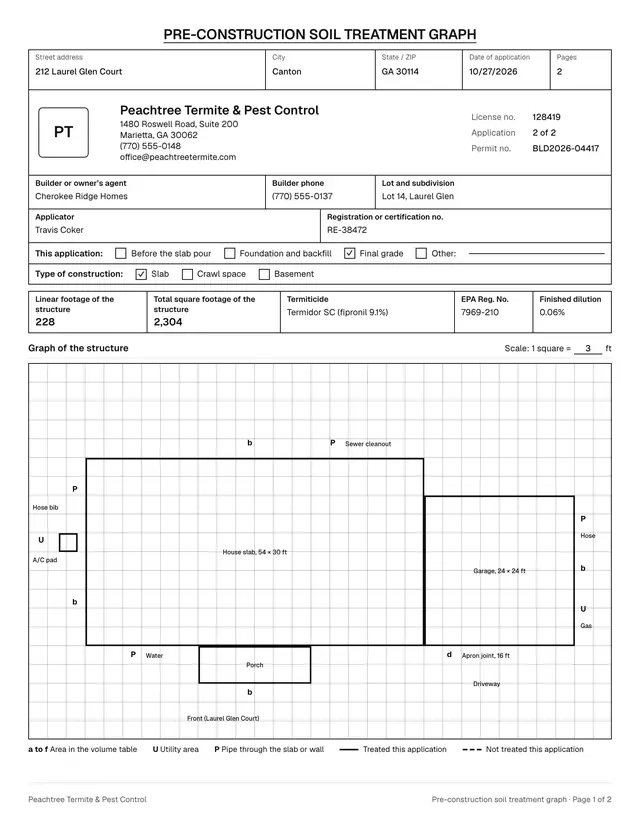
The treatment record for a new home’s termite pretreatment. - Georgia
Pre-Construction Soil Treatment Graph
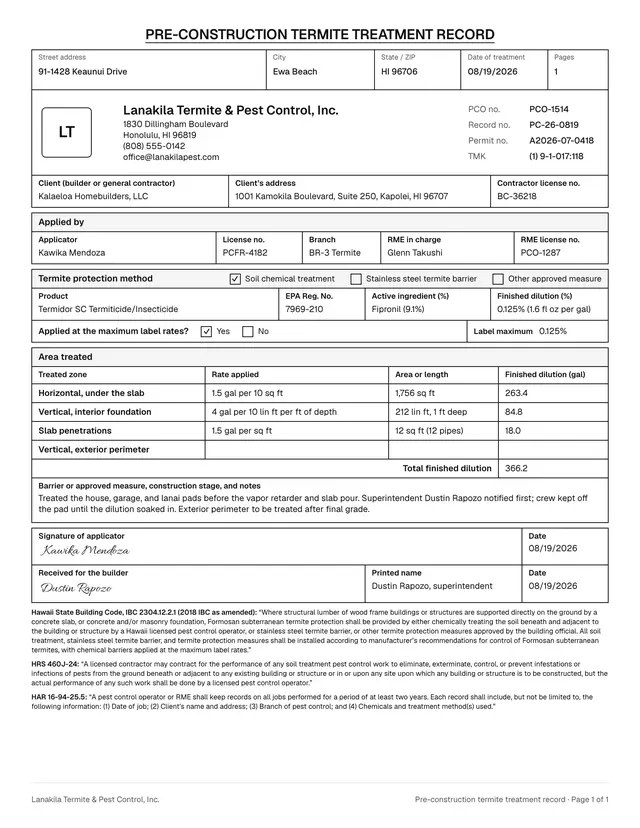
The treatment record for a new home’s termite pretreatment. - Hawaii
Pre-Construction Termite Treatment Record
The treatment record for a new home’s termite pretreatment. - Louisiana
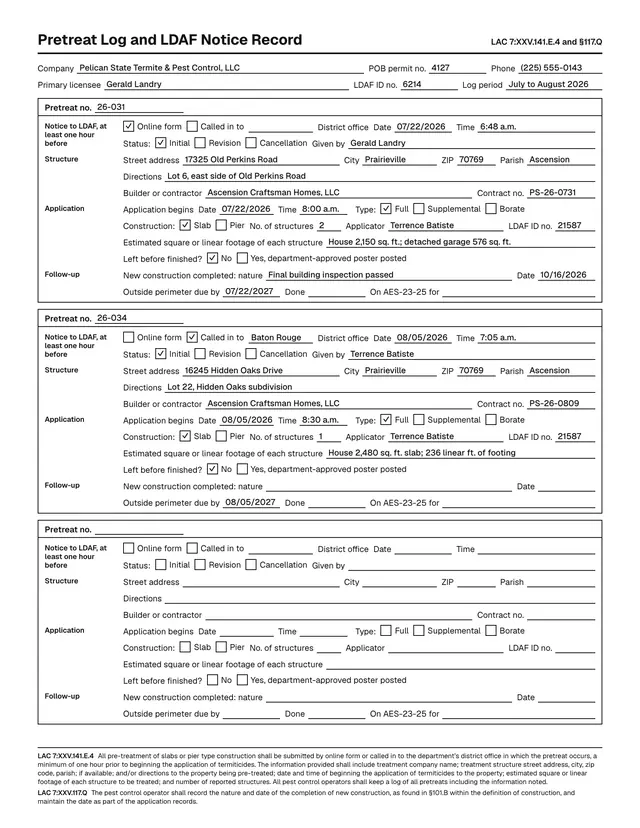
Pretreat Log and LDAF Notice Record
The treatment record for a new home’s termite pretreatment. - Mississippi
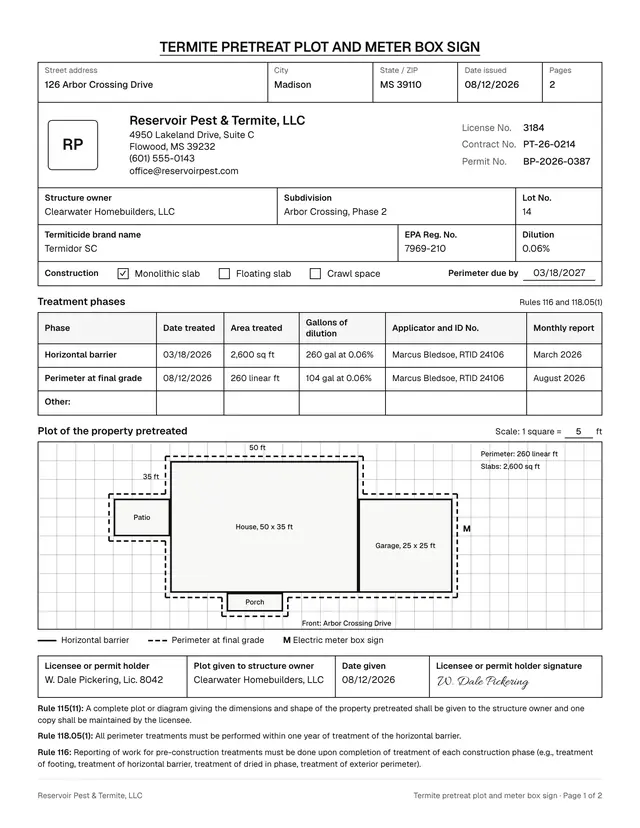
Termite Pretreat Plot and Meter Box Sign
The treatment record for a new home’s termite pretreatment. - Nevada
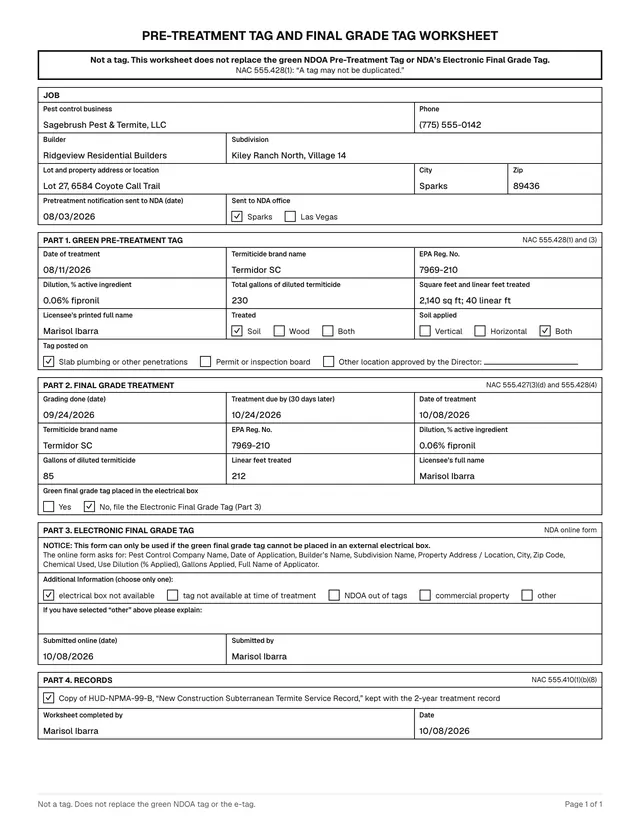
Pre-Treatment Tag and Final Grade Tag Worksheet
The treatment record for a new home’s termite pretreatment. - OklahomaHUD-NPMA-99-B
New Construction Subterranean Termite Service Record
The treatment record for a new home’s termite pretreatment. - Tennessee
Tennessee new construction termite pretreatment record
The treatment record for a new home’s termite pretreatment.