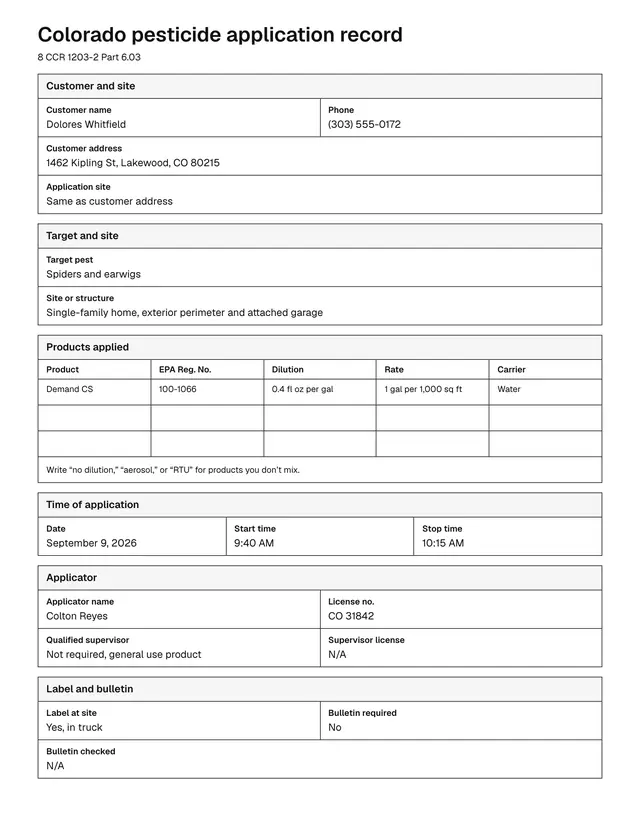
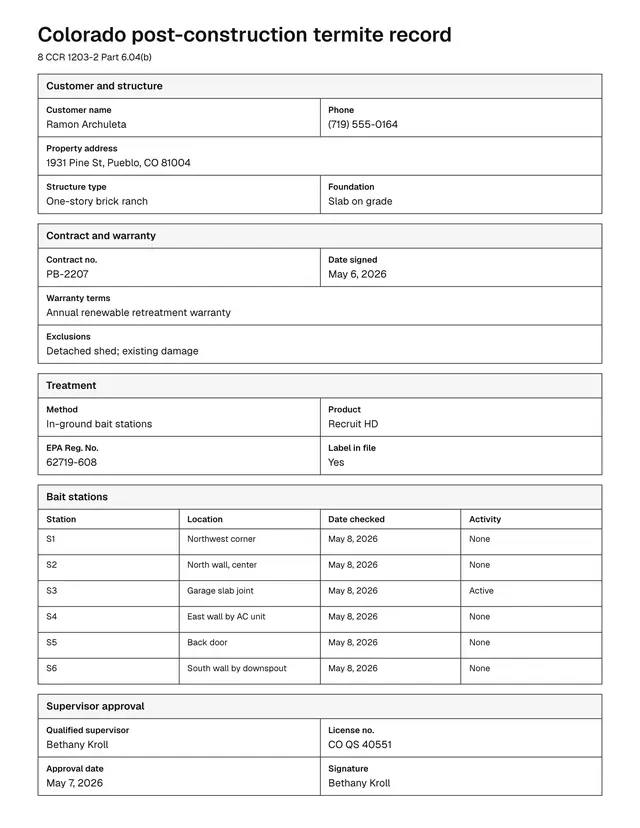
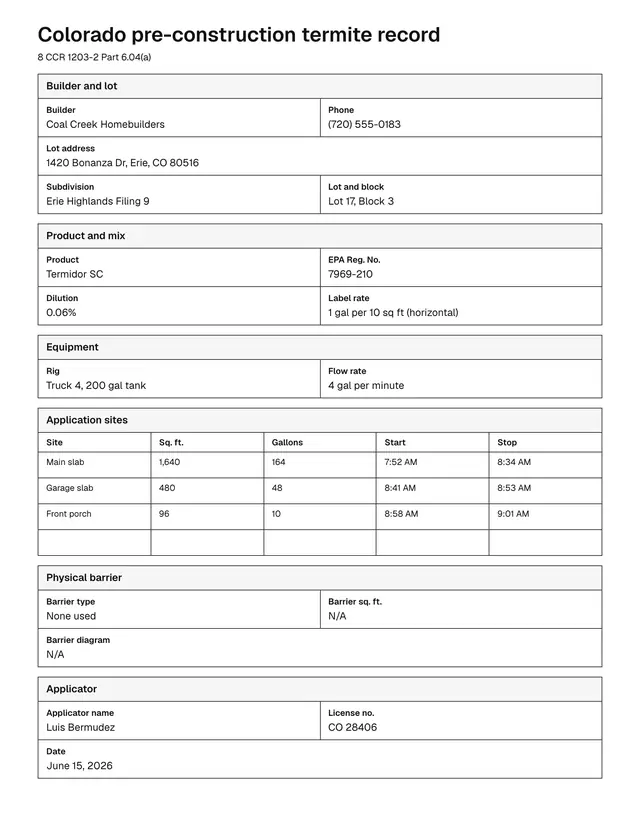
Colorado lawn pesticide posting sign (C.R.S. 35-10-112)
Spray a lawn or shrub bed in Colorado and you leave a sign behind. The statute sets the size, colors, and type sizes, and the rules say where it goes.
At a glance
- Law
- C.R.S. 35-10-112(2)
- Placement
- 8 CCR 1203-2 Part 13
- Sign
- At least 4 by 5 inches, black on bright yellow
- Registry notice
- 24 hours or more before
Completed example
Download PDFWhen you need a sign
Colorado’s posting rule lives in the statute, C.R.S. 35-10-112. If you’re a commercial, registered limited commercial, or registered public applicator making an application in any turf or ornamental category, you post a sign “at the time of application.” It goes at “any conspicuous point or points of entry to the property.”
Lawns, shrub beds, and ornamental trees all count. A weed spray on a homeowner’s front yard is the most common case. The same section also says cities and counties can’t pile on stricter notice rules, so the state rule is the rule everywhere in Colorado.
What the sign has to look like
The statute is specific. The sign must be water resistant and at least 4 inches tall by 5 inches wide. It uses black letters and symbols on a bright yellow background, with these four parts:
The warning. The word “WARNING” in at least 60-point bold type.
The message. “PESTICIDES APPLIED” in at least 24-point bold type.
The symbol. A circle at least 2 inches across with a slash over an adult, a child, and a dog.
Who did it. Your company name in at least 18-point bold type.
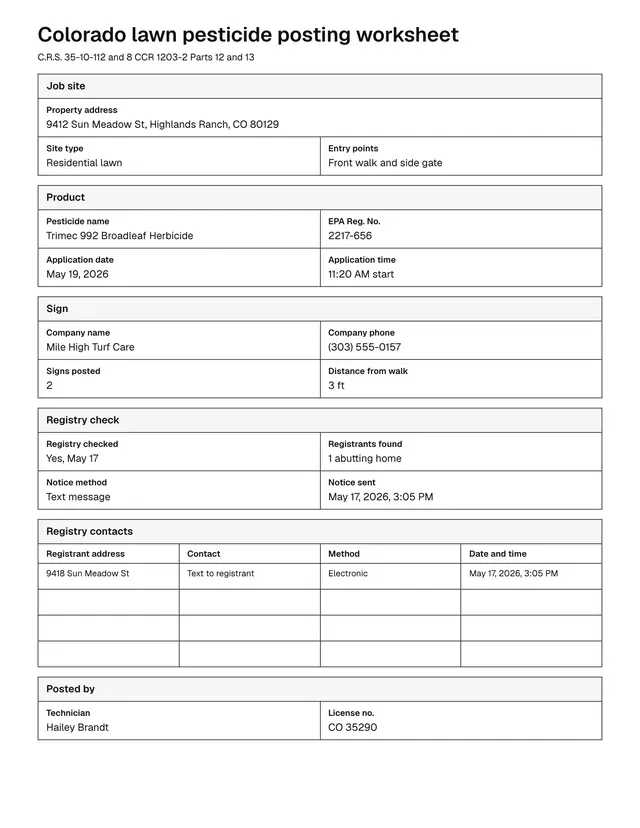
On a commercial property where the owner or the owner’s agent isn’t there, the statute adds more to the sign: your phone number, the pesticide name, and the date. For a broadleaf weed spray, that might read Trimec 992 Broadleaf Herbicide, EPA Reg. No. 2217-656.
Where to put it
Part 13 of 8 CCR 1203-2 covers placement. Part 13.02 sets the height: the bottom at least 18 inches above the ground and the top no higher than 48 inches. Part 13.03 says that on a lawn, the sign goes 2 to 5 feet in from the sidewalk. If there’s no sidewalk, measure from the road or the property line.
Bigger sites get more signs. Part 13.04 says parks, common areas, and similar spots get signs at the main entrances and inside the property. Golf courses post at the clubhouse and the first and tenth tees.
Snap a photo of each sign once it’s in the ground. If a neighbor complains that nothing was posted, a time-stamped photo showing the sign 3 feet off the sidewalk ends the argument fast.
The pesticide-sensitive registry
Colorado keeps a registry of people who have a doctor’s note saying pesticides affect their health. Registrations run out each November 1. You can see registered areas on DriftWatch, and the Department of Agriculture has the rest.
Part 12.06 says to give notice of the date, approximate time, and address before each turf or ornamental application to registrants who live on abutting property. You also notify a registrant when you treat their listed work or school address, and when their home is within 250 feet as shown in the Department’s database.
Part 12.07 sets the how. Calls, letters, or in-person notice must happen at least 24 hours ahead, and you need to confirm they got it. If you can’t confirm, put a notice on their door right before you spray. A text or email counts as electronic notice, and one is enough if nothing changes, but you must keep a record that you sent it. Voicemail doesn’t count as electronic notice.
Two more details from the statute catch people. Homes split by an alley still count as abutting. And registrants get standard signs from the Department to post on their own property, so a yellow registry sign next door is a strong hint to check the list.
How do you make registry calls on a busy route?
The 24-hour rule means tomorrow’s route has to be set today. If stops get shuffled the morning of, any registrant next door to a new stop didn’t get a day’s notice. Lock the next day’s list early, check it against the registry, and send your texts that afternoon. And while you’re at it, make sure your invoices still carry the Part 14.01 line saying commercial applicators are licensed by the Colorado Department of Agriculture.
Noma specializes in the Colorado pesticide posting notice (C.R.S. 35-10-112(2)). It doesn’t print the sign, but it keeps every lawn stop on the schedule early enough for 24-hour notices and sends invoices customers can pay online. See how Noma schedules lawn routes.
Frequentlyaskedquestions
Send this document in minutes, not an afternoon.
Other states
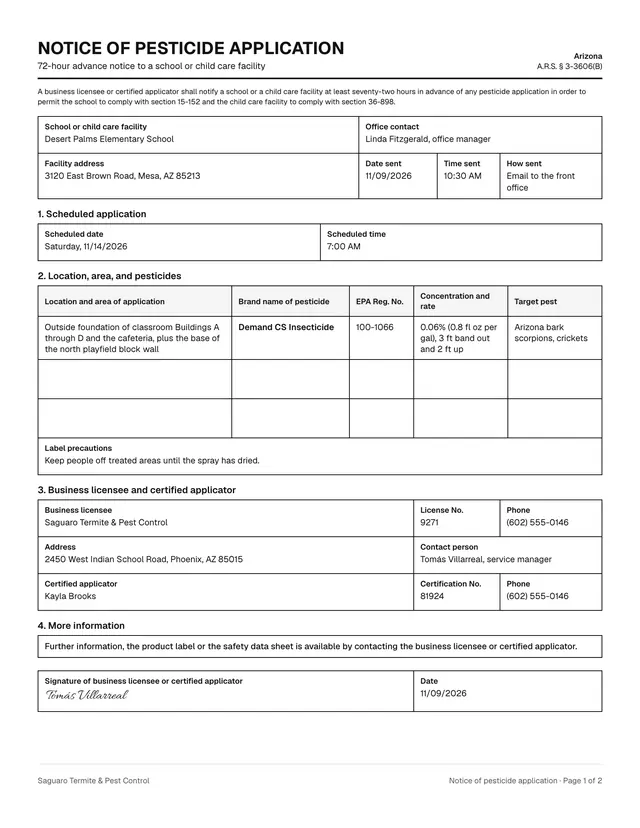
Chemical notice templates- Arizona
Notice of Pesticide Application
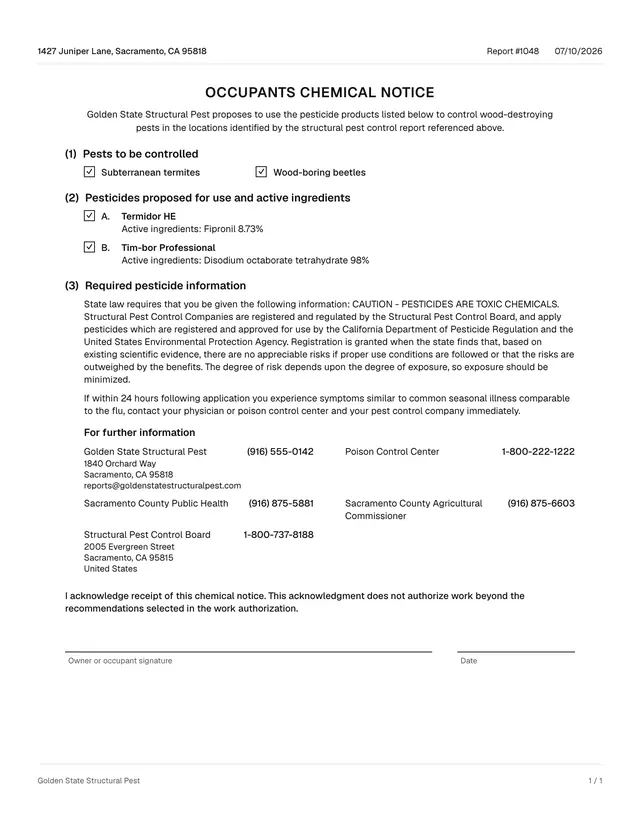
Warn people about a pesticide treatment. - California
Occupants Chemical Notice
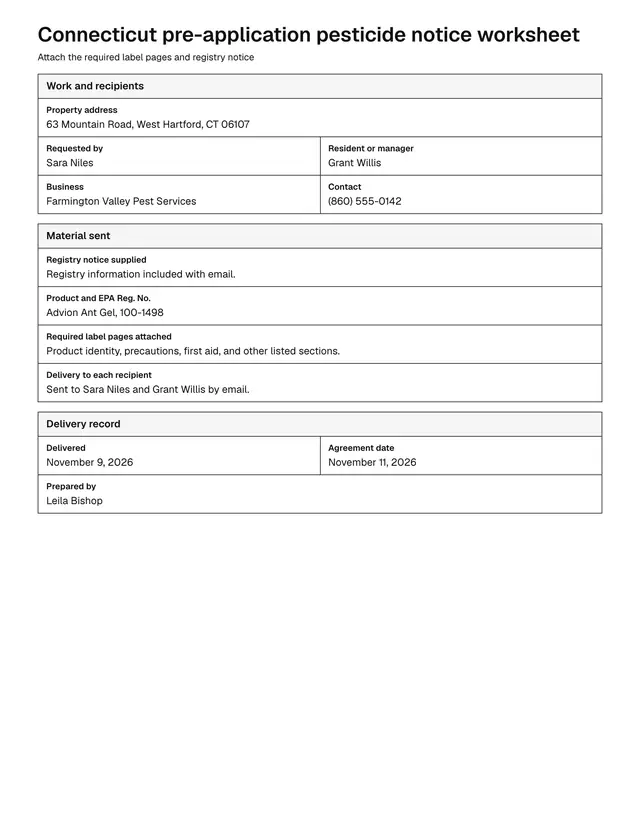
Warn people about a pesticide treatment. - Connecticut
Connecticut pre-application pesticide notice worksheet
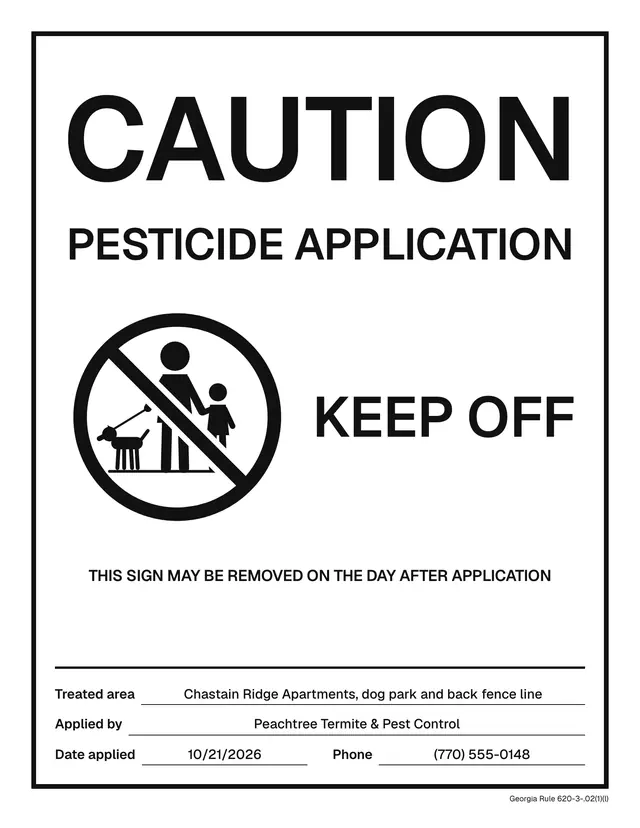
Warn people about a pesticide treatment. - Georgia
Pesticide Application Sign
Warn people about a pesticide treatment. - Illinois
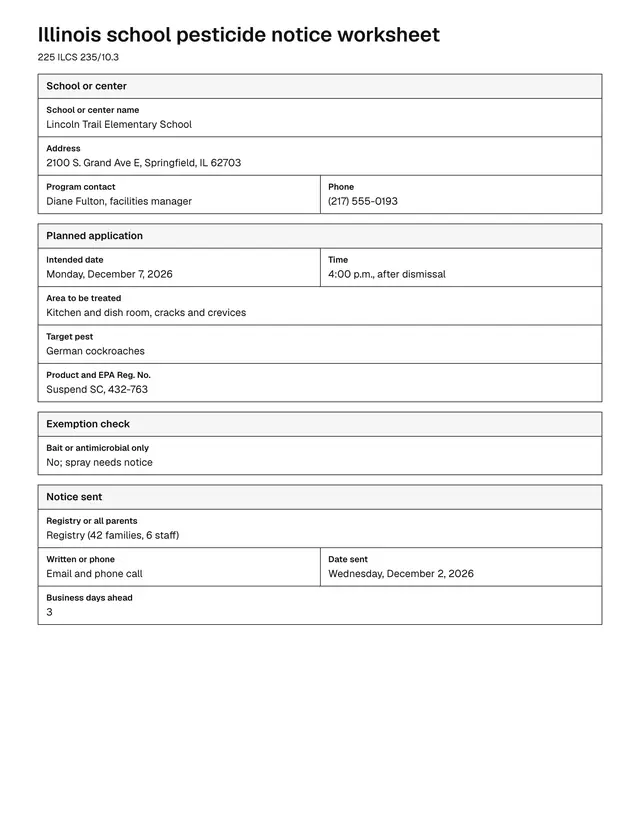
Illinois school pesticide notice (225 ILCS 235/10.3)
Warn people about a pesticide treatment. - Indiana
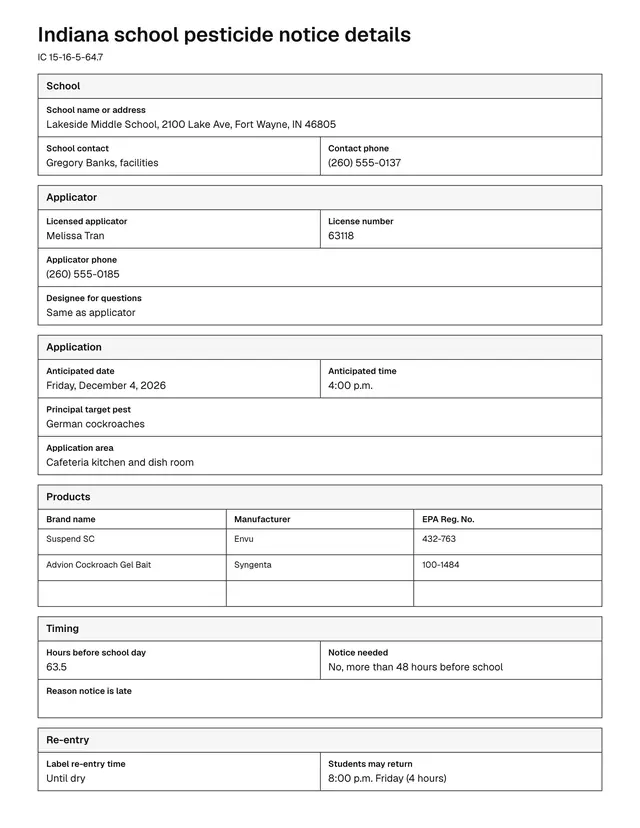
Indiana school pesticide notice (IC 15-16-5-64.7)
Warn people about a pesticide treatment. - Kentucky
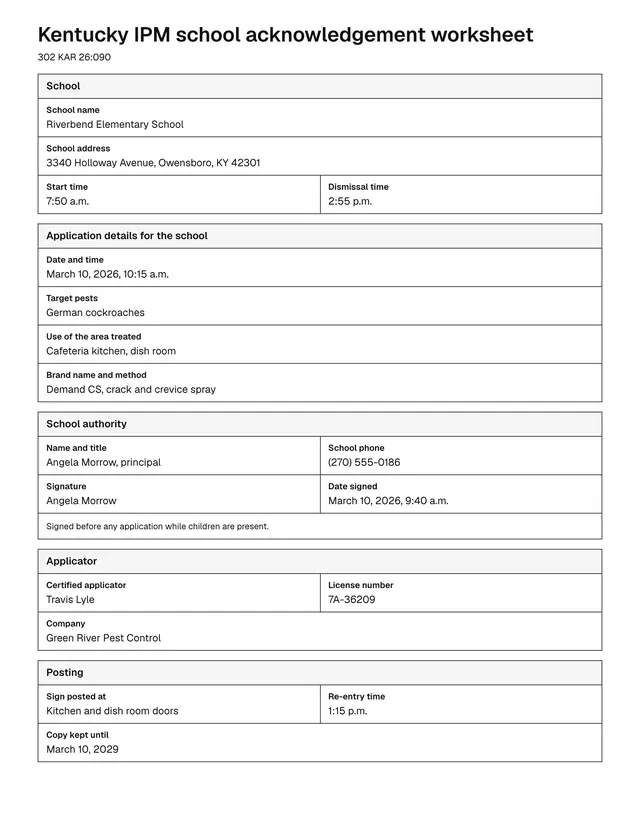
Kentucky IPM School Acknowledgement (302 KAR 26:090)
Warn people about a pesticide treatment. - Massachusetts
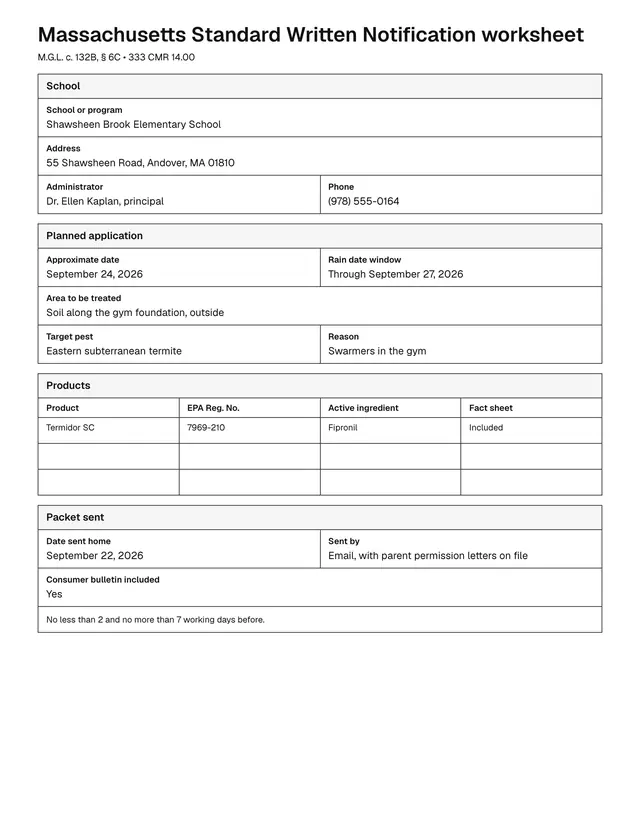
Massachusetts pesticide Standard Written Notification (333 CMR 14.07)
Warn people about a pesticide treatment. - Michigan
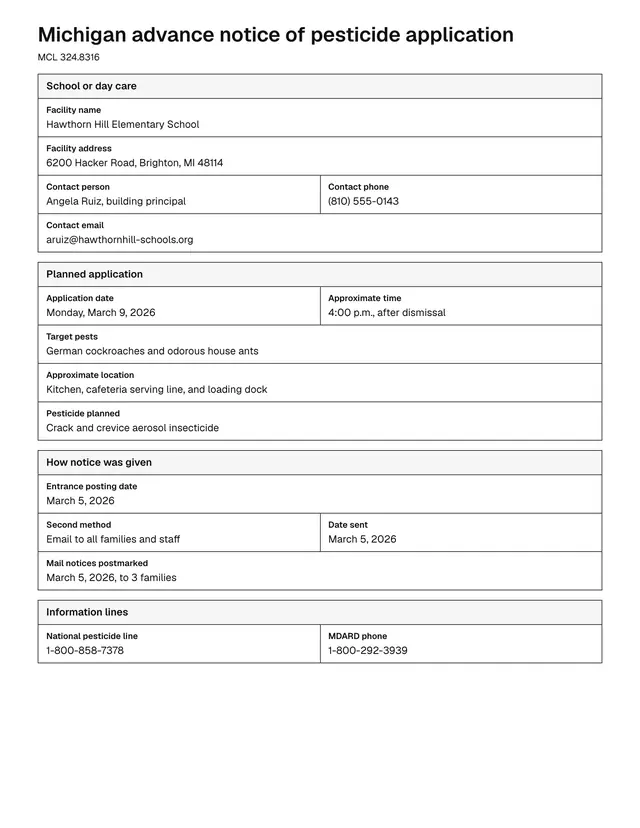
Michigan school and day care pesticide advance notice
Warn people about a pesticide treatment. - New Jersey
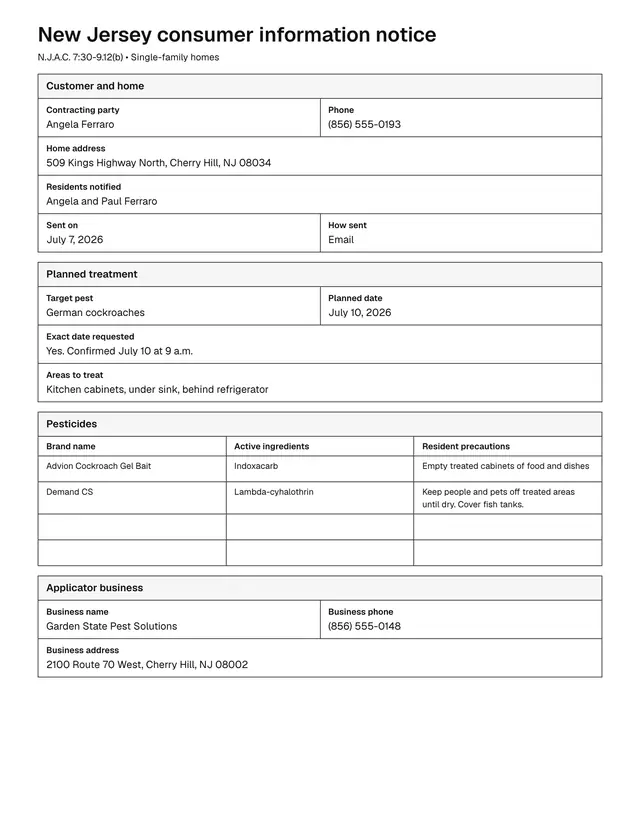
New Jersey consumer information notice for pest control (N.J.A.C. 7:30-9.12)
Warn people about a pesticide treatment. - New York
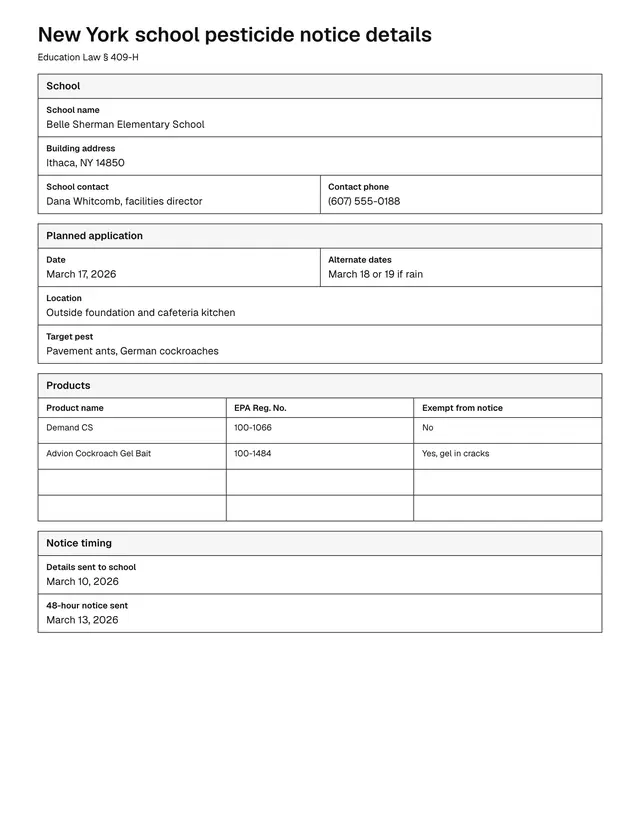
New York school pesticide notification (Education Law § 409-H)
Warn people about a pesticide treatment. - Oregon
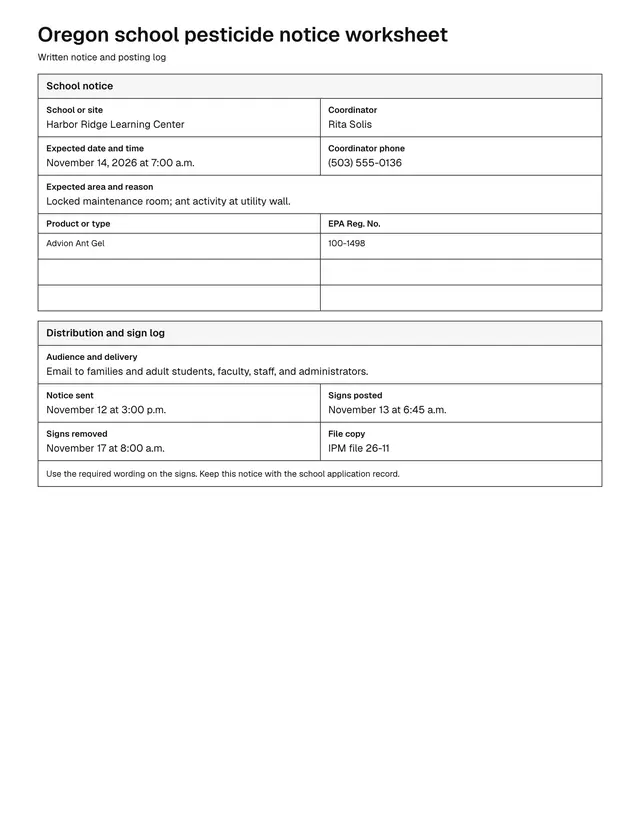
Oregon school pesticide notice worksheet
Warn people about a pesticide treatment. - Pennsylvania
Pennsylvania school pest control information sheet
Warn people about a pesticide treatment. - Texas
Notice of Pest Control Treatment
Warn people about a pesticide treatment. - Washington
Notice: Pesticide Application
Warn people about a pesticide treatment.