New Jersey consumer information notice for pest control (N.J.A.C. 7:30-9.12)
Before you treat a home for household or structural pests, New Jersey wants the people there to have a written notice in hand. Apartments, restaurants, and schools each add their own posting.
At a glance
- Rule
- N.J.A.C. 7:30-9.12
- When
- Before the application, with time for precautions
- How
- In writing or by email
- Covers
- Categories 7A to 7E, 8A, 8C, and 12A
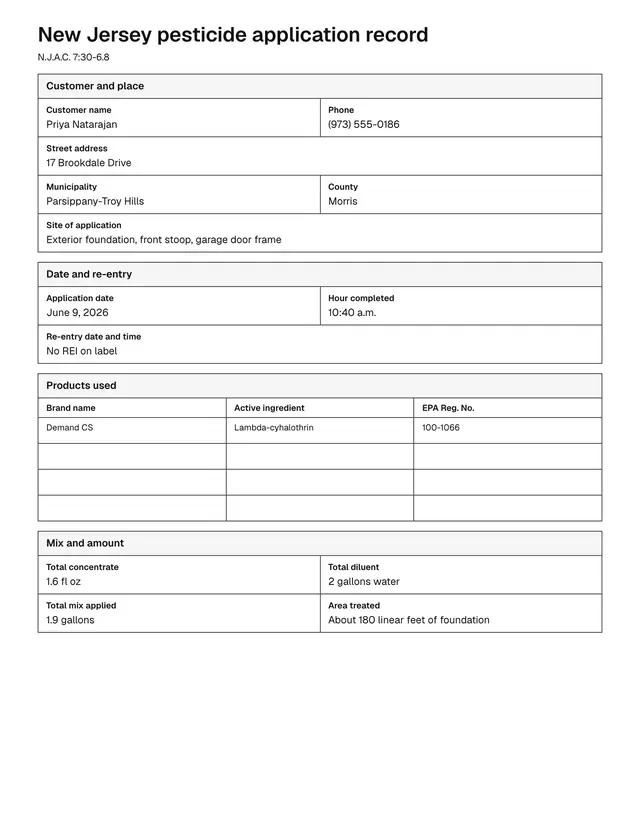
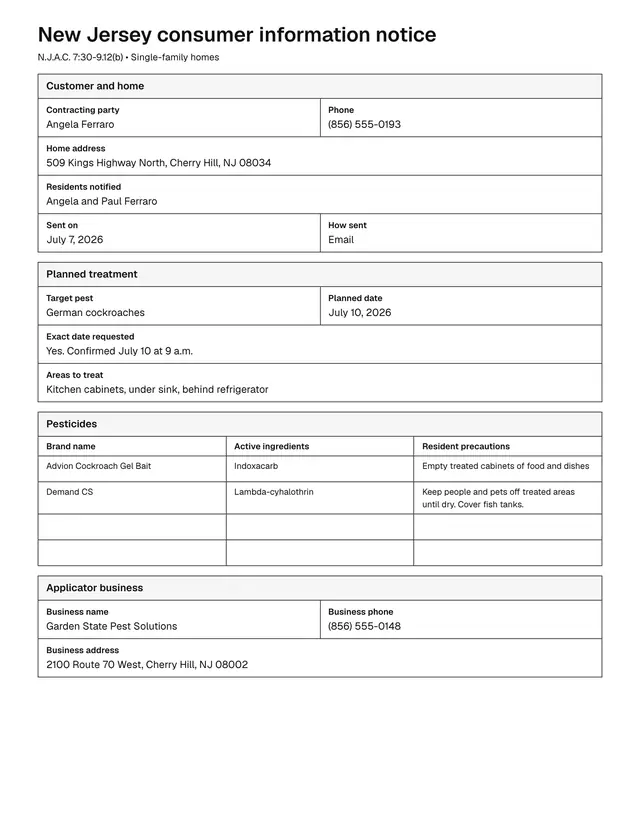
Completed example
Download PDFWhich notice fits the building?
N.J.A.C. 7:30-9.12 covers household and structural pest work, which means applicators in Categories 7A through 7E, 8A, 8C, and 12A and the people they supervise. It splits the notice by building type. Every type gets a written consumer information notice before the work. Apartments and commercial buildings add a posting on top.
Single-family homes. The notice goes to the contracting party and residents, in writing or by email, with enough time to take precautions. This is the version this page focuses on.
Apartment buildings. The contracting party, usually the landlord or manager, gets the notice. Each treated unit also gets a decal, posted before you start, inside a commonly used kitchen cabinet door. It must be at least 15 square inches, readable from three feet, and still readable 60 days later. It carries your business name and phone and this line: “As part of a good sanitation program, this facility may be treated with pesticides. See the manager or building administration for further information.” Hallways and laundry rooms count as commercial space.
Twins, townhouses, and shared air. If you use an aerosol or fog in a building attached to another occupied one, or one that shares an air handling system, the people next door get the same notice a single-family home gets. Crack and crevice work and flushing agents are exempt.
Restaurants, hotels, schools, and offices. The contracting party and building manager get the notice. Then you post a notice with the latest application date, the products, a contact, and the next planned date. The rule says where: next to the Health Department inspection card at a restaurant, at the main desk of a hotel, at the nurse’s station of a health care site, and on the central bulletin board at a school or house of worship. It can come down after 60 days if no more treatments are planned. Malls, stores, and airports also need “Pesticide Treated Area” signs at the entrances to treated areas during the work, except for crack and crevice treatments.
What the home notice has to say
Dates on request. A statement that the exact dates of application are available if the contracting party or residents ask. If they do ask, you have to tell them.
The products. Each pesticide’s brand name and the common chemical names of its active ingredients. You can send a list of possible products ahead of time, but then you leave written notice of the one you actually used.
Label safety steps. The label instructions that protect residents, listed for each product. Think leaving the house for a set time, or covering food, dishes, and fish tanks. If you show up and decide on a product whose precautions haven’t been done, the rule says the application “shall be rescheduled.”
Your business. Your name or business name, address, and phone number.
Three phone numbers. The National Pesticide Information Center for health questions, the New Jersey Poison Information and Education System for emergencies, and DEP’s Pesticide Control Program with the line “This number is for pesticide regulation information and pesticide complaints.”
Two statements. One says a copy of the label is available on request. The other is the sanitation paragraph, word for word: “Sanitation, as well as physical and biological control measures, should be considered as a part of a good pest control program. Pesticides may be used as another part of a good pest control program. Pesticides are substances used to control living organisms and vary in degree of toxicity.”
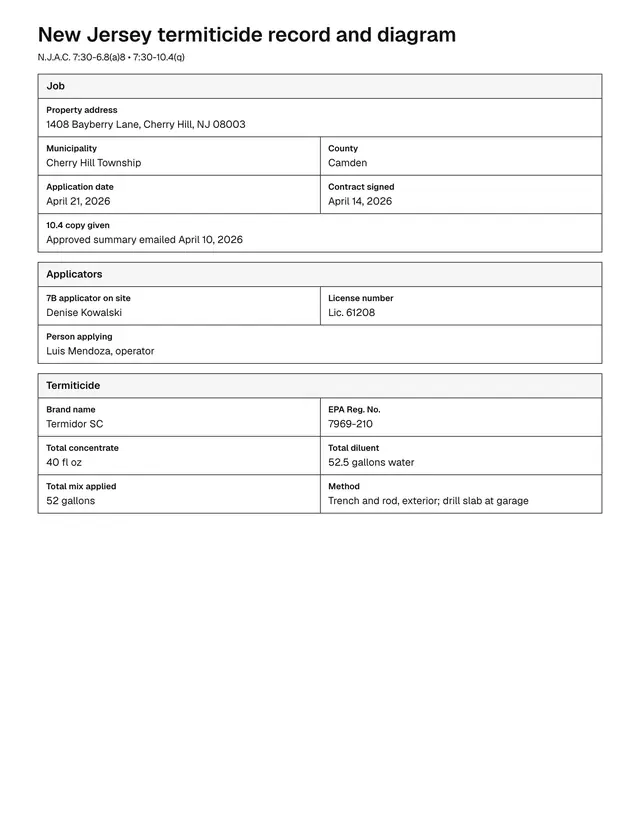
Termite jobs. Add a copy of N.J.A.C. 7:30-10.4 or a DEP-approved summary. Bait-only termite jobs can skip it.
How do you get it to them in time?
Timing is where most companies slip. The rule wants “sufficient time given to take appropriate precautions.” A notice handed over at the door, with the sprayer already in the tech’s hand, doesn’t give anyone time to move the fish tank or take the dog to a neighbor’s. Most companies send it right after booking and send it again when the product list changes.
Customers who don’t want the paperwork can sign the consumer information waiver, which uses wording the rule sets. A new owner of a house you treated during a sale can still ask you for the full notice. And whatever you end up using, the application record is the proof.
Noma specializes in the New Jersey Consumer Information Notice (N.J.A.C. 7:30-9.12). Upload your notice once as a reusable document, and each booked job can send it for e-signature right away, so residents have it days before the tech shows up. See how Noma sends notices when a job is booked.
Frequentlyaskedquestions
Send this document in minutes, not an afternoon.
Other states
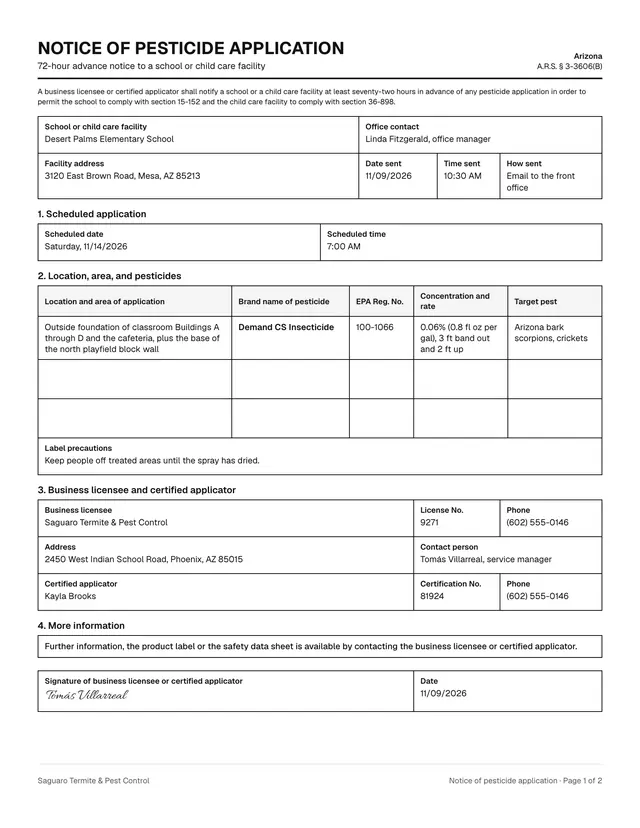
Chemical notice templates- Arizona
Notice of Pesticide Application
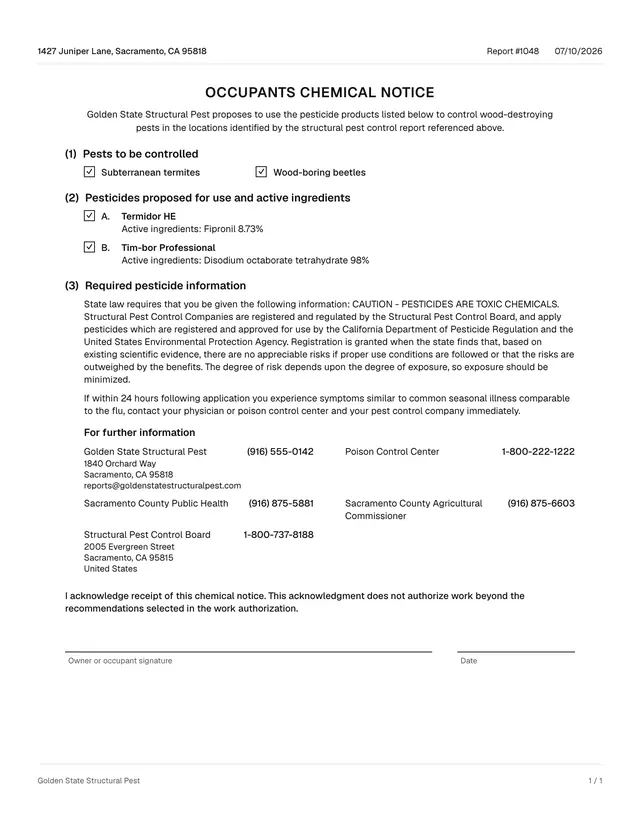
Warn people about a pesticide treatment. - California
Occupants Chemical Notice
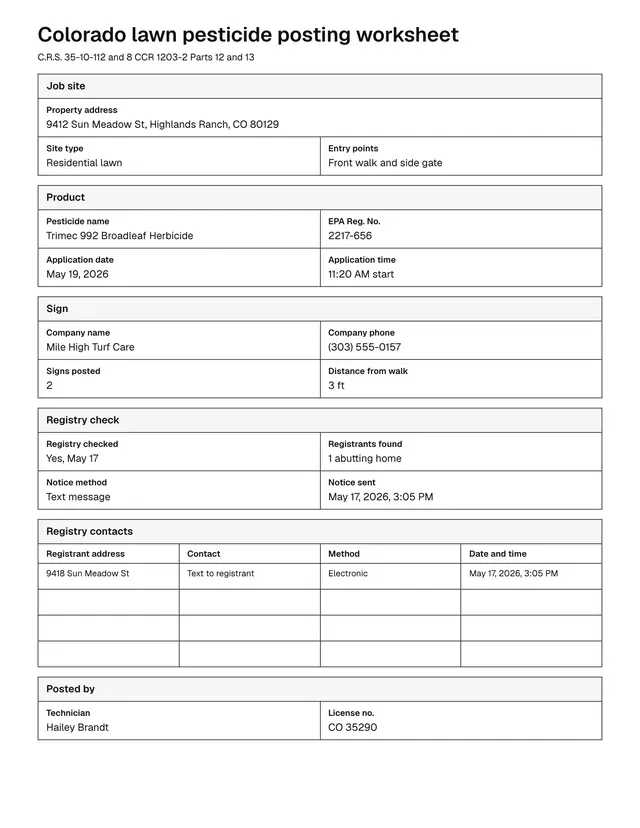
Warn people about a pesticide treatment. - Colorado
Colorado lawn pesticide posting sign (C.R.S. 35-10-112)
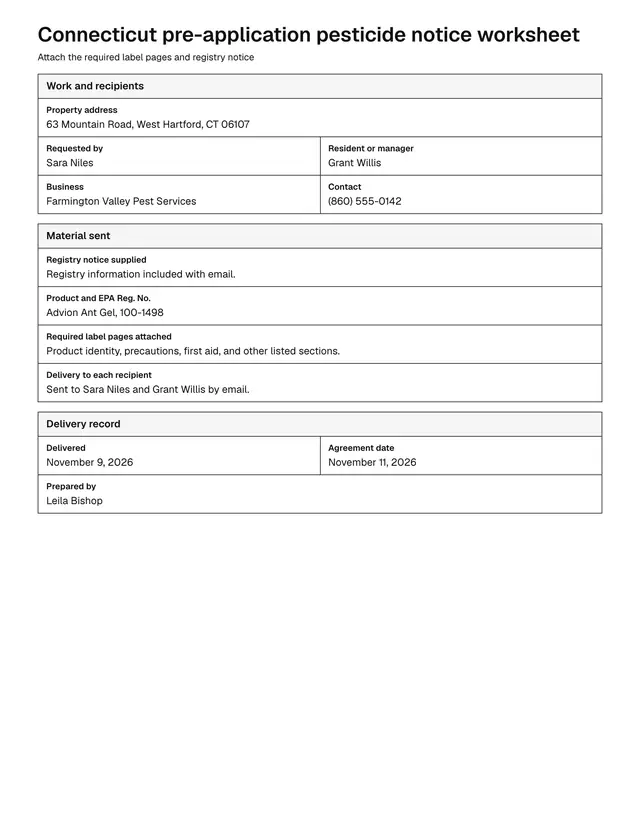
Warn people about a pesticide treatment. - Connecticut
Connecticut pre-application pesticide notice worksheet
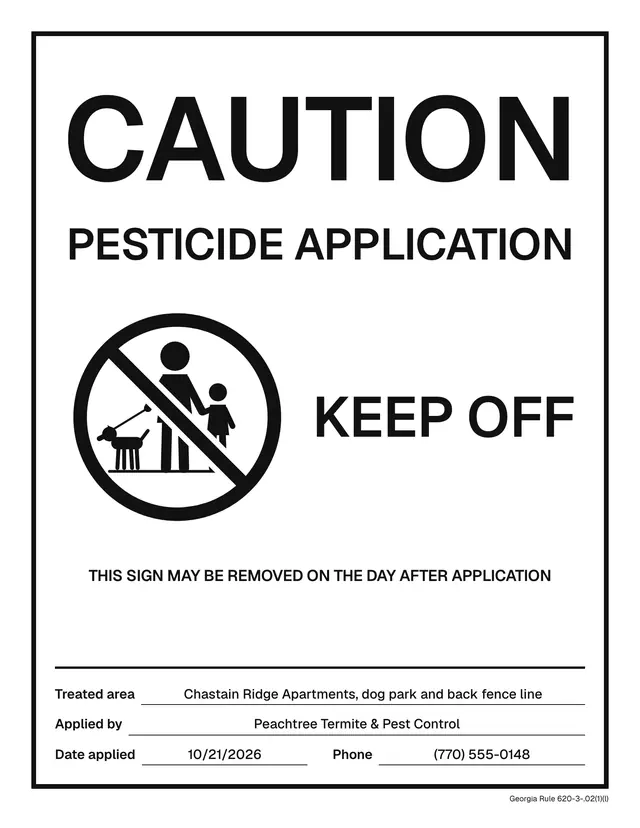
Warn people about a pesticide treatment. - Georgia
Pesticide Application Sign
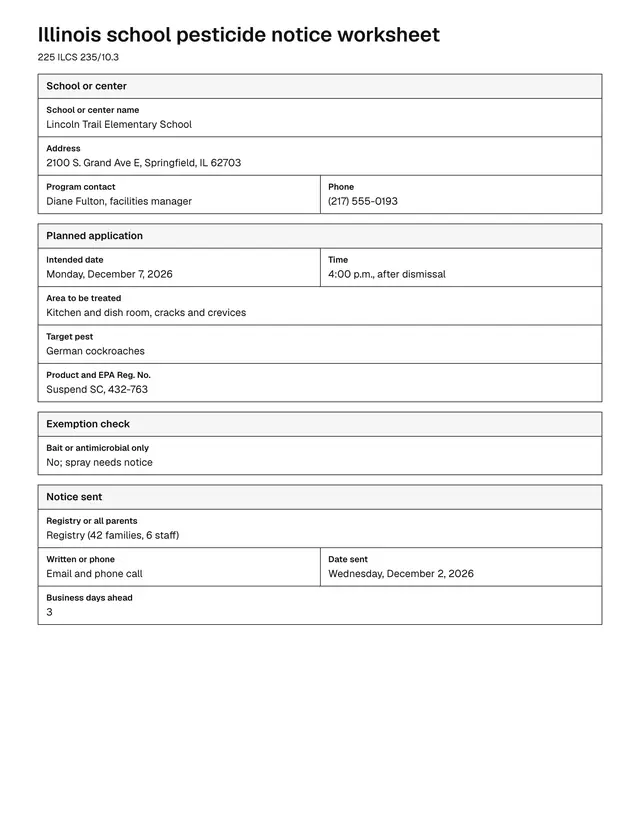
Warn people about a pesticide treatment. - Illinois
Illinois school pesticide notice (225 ILCS 235/10.3)
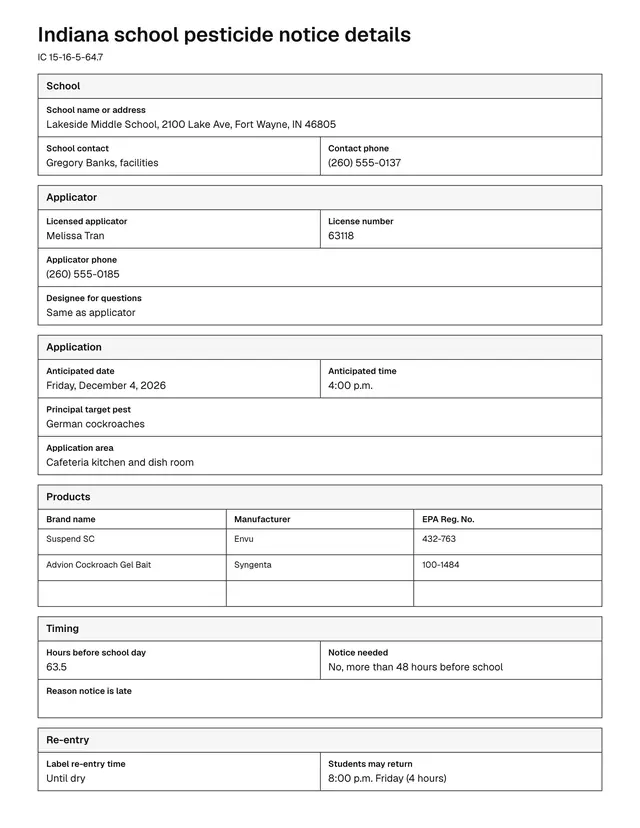
Warn people about a pesticide treatment. - Indiana
Indiana school pesticide notice (IC 15-16-5-64.7)
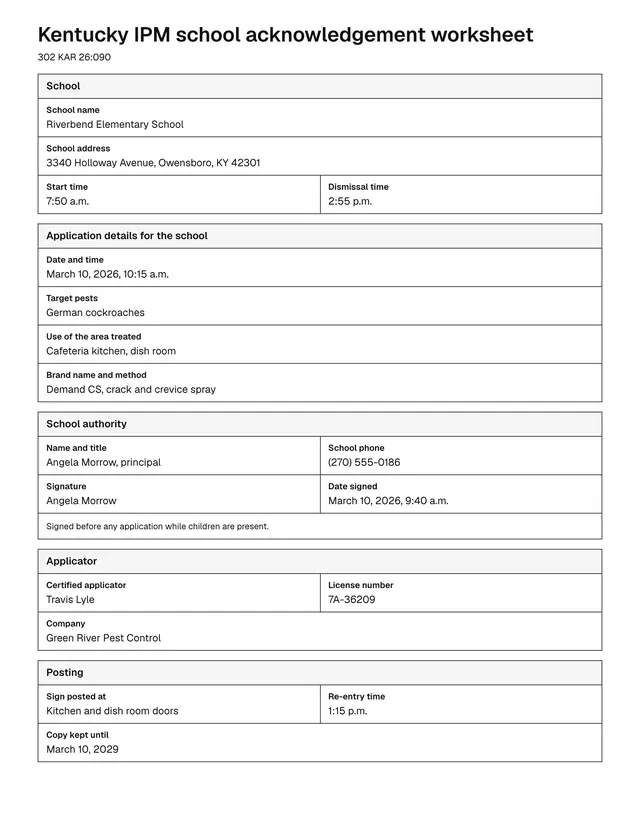
Warn people about a pesticide treatment. - Kentucky
Kentucky IPM School Acknowledgement (302 KAR 26:090)
Warn people about a pesticide treatment. - Massachusetts
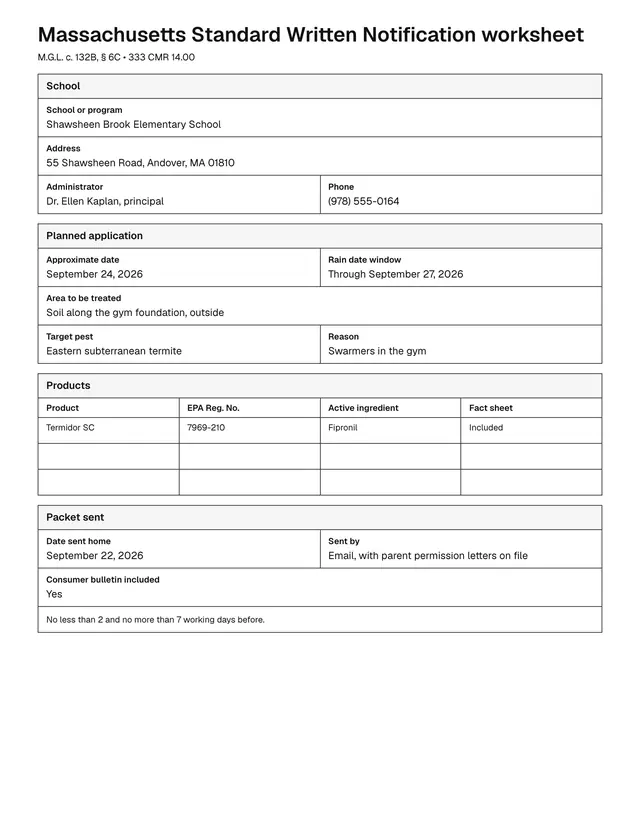
Massachusetts pesticide Standard Written Notification (333 CMR 14.07)
Warn people about a pesticide treatment. - Michigan
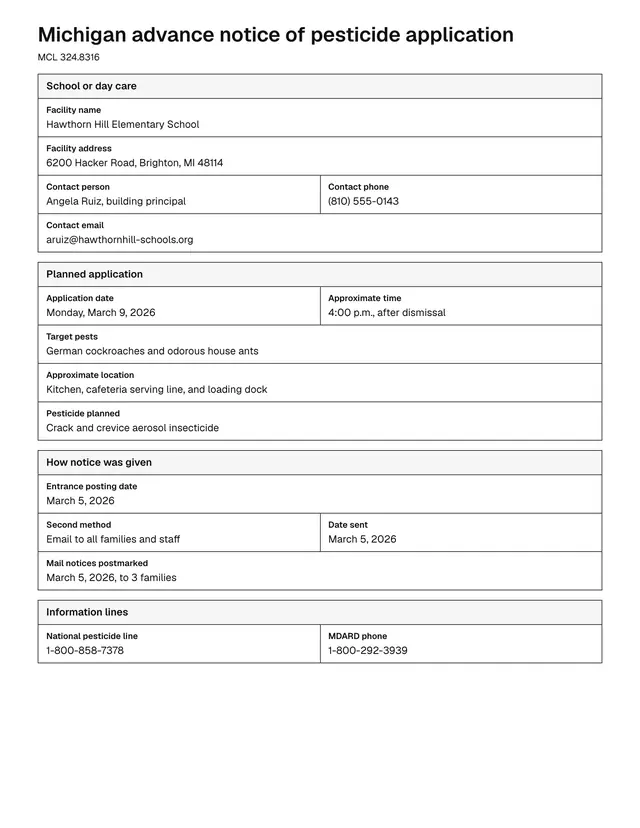
Michigan school and day care pesticide advance notice
Warn people about a pesticide treatment. - New York
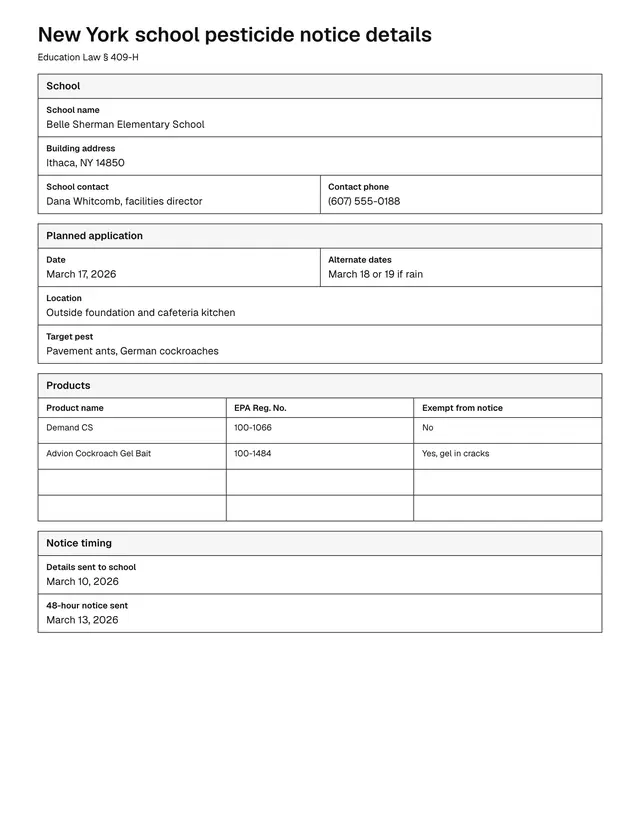
New York school pesticide notification (Education Law § 409-H)
Warn people about a pesticide treatment. - Oregon
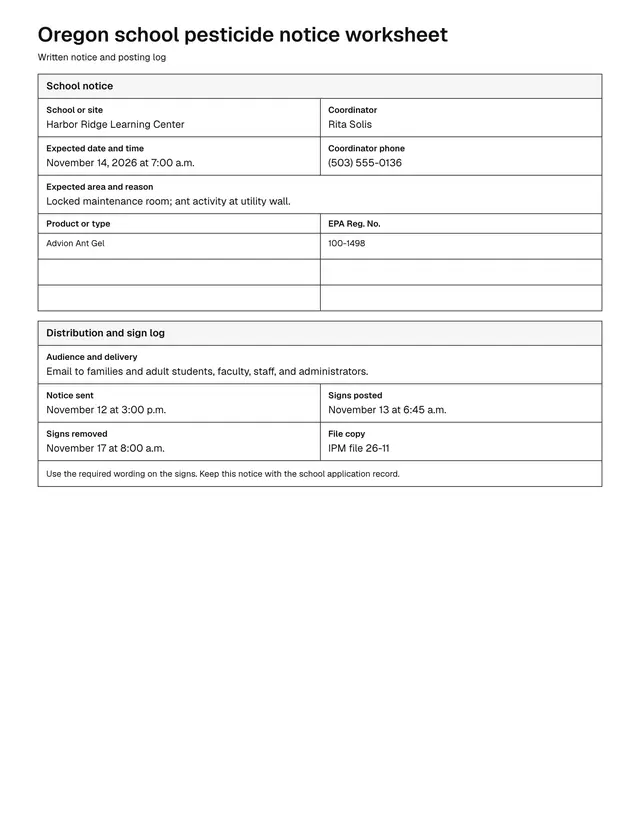
Oregon school pesticide notice worksheet
Warn people about a pesticide treatment. - Pennsylvania
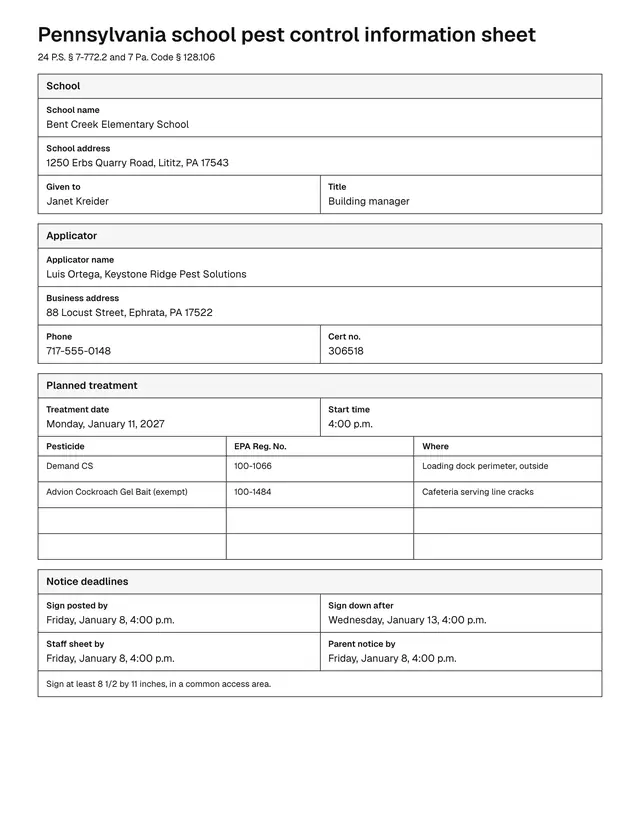
Pennsylvania school pest control information sheet
Warn people about a pesticide treatment. - Texas
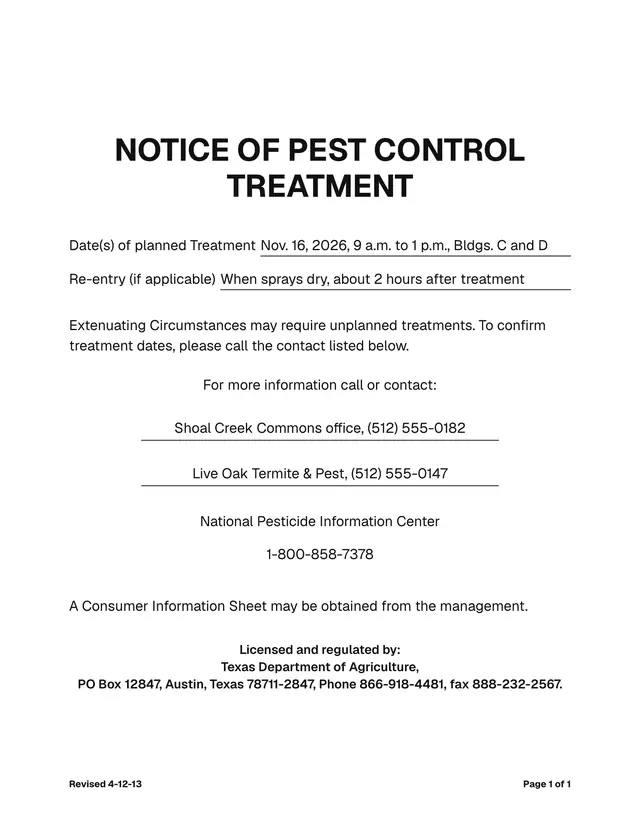
Notice of Pest Control Treatment
Warn people about a pesticide treatment. - Washington
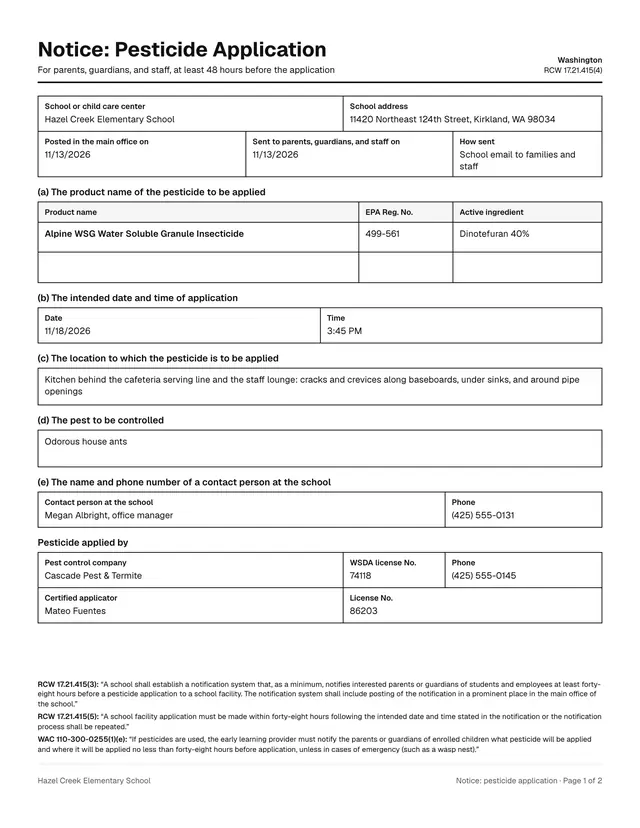
Notice: Pesticide Application
Warn people about a pesticide treatment.