Indiana school pesticide notice (IC 15-16-5-64.7)
Indiana schools send a pesticide notice to everyone on their registry at least 48 hours before an application. The notice names the applicator, the products, and the area.
At a glance
- Law
- IC 15-16-5-64.7
- Lead time
- At least 48 hours
- Re-entry
- Label time or 4 hours, whichever is longer
- Records
- 2 years (355 IAC 4-4-1)
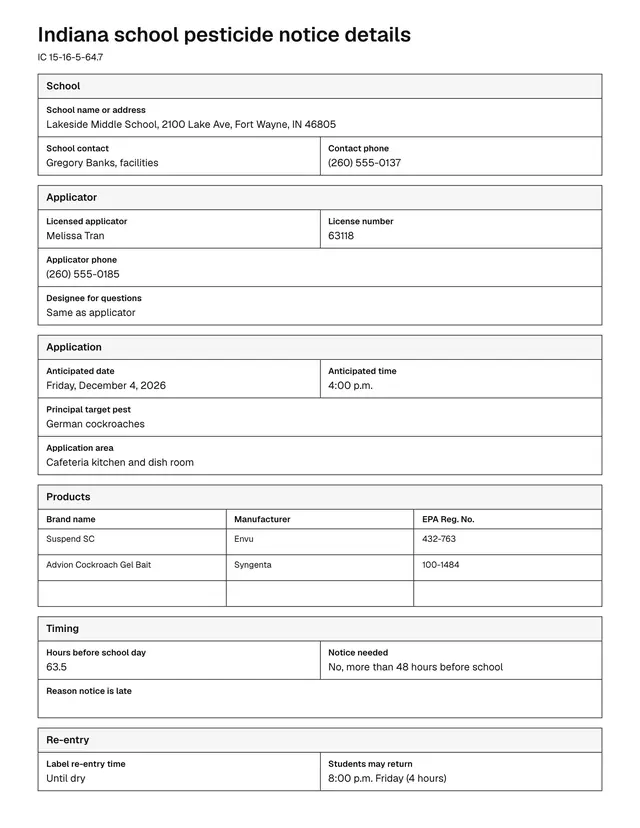
Completed example
Download PDFFrom a rule to a statute
Indiana’s school pesticide rules used to live in a state chemist rule, 357 IAC 1-16. Senate Enrolled Act 216 moved them into the Indiana Code effective July 1, 2024. OISC’s pesticide use at schools page lays out the new sections side by side.
Older guides still cite 357 IAC 1-16. If a school’s pest policy points there, show them the statute sections OISC lists now.
The law covers public and charter schools, nonpublic schools with more than one employee, the Indiana School for the Blind and Visually Impaired, and the Indiana School for the Deaf. School property means buildings the school owns or rents, plus the grounds around them.
The registry comes first. At the start of each school year, or when a student enrolls or transfers in, the school tells parents, guardians, and staff that they can join a pesticide notification registry. Anyone can ask to be added at any time during the year. The notice goes to the people on that list.
The eight things in the notice
The school sends the notice, but most of what’s in it comes from you. IC 15-16-5-64.7(d) lists eight items.
1. The school’s name or address. 2. The licensed commercial applicator responsible for the job, with their name, license number, and phone number. 3. A designee for questions, if that’s someone other than the applicator. 4. The anticipated date and time. 5. The principal target pest. 6. A description of the area. 7. Each pesticide’s manufacturer, EPA registration number, and brand name. 8. If the notice is late, an explanation of why.
Items 2 and 3 are why the school needs a real person from you. Give the licensed applicator who’s responsible for the job, not just the company name.
The timing rule has a built-in shortcut. Notice must go out at least 48 hours before the application, but no notice is needed for an application made “more than forty-eight (48) hours before a scheduled school day.” Say a Fort Wayne middle school’s cafeteria gets treated on a Friday at 4:00 p.m., and Monday classes start at 7:30 a.m. That’s 63 and a half hours. No notice required.
When you can spray and when kids can return
IC 15-16-5-64.5 bans pesticide applications on school property during regular school hours and during before school and after school programs held there. There are two exceptions: an observed pest that “poses an immediate health threat” to the students present, and an area outside that isn’t “immediately adjacent” to buildings students are in. Those exceptions also skip the advance notice, though item 8 is how the school explains it.
Students can’t go back into a treated area until the longer of two times has passed: the label’s re-entry time or four hours. Rodenticide bait can go in areas students can’t reach.
Storage has rules too. Pesticides kept at a school must be in the original or a clearly labeled service container, in a locked and marked area or cabinet, behind a solid wall from food storage, food service, and student areas. If your tech leaves bait refills in a janitor’s closet, that closet has to meet all three.
Licenses and records at schools
Pesticide work at a school needs a licensed commercial applicator, even general use products, under 355 IAC 4-1-1.1. There’s a narrow exception for gel baits, paste baits, and manufactured enclosed insecticide products, which school staff can place without a license.
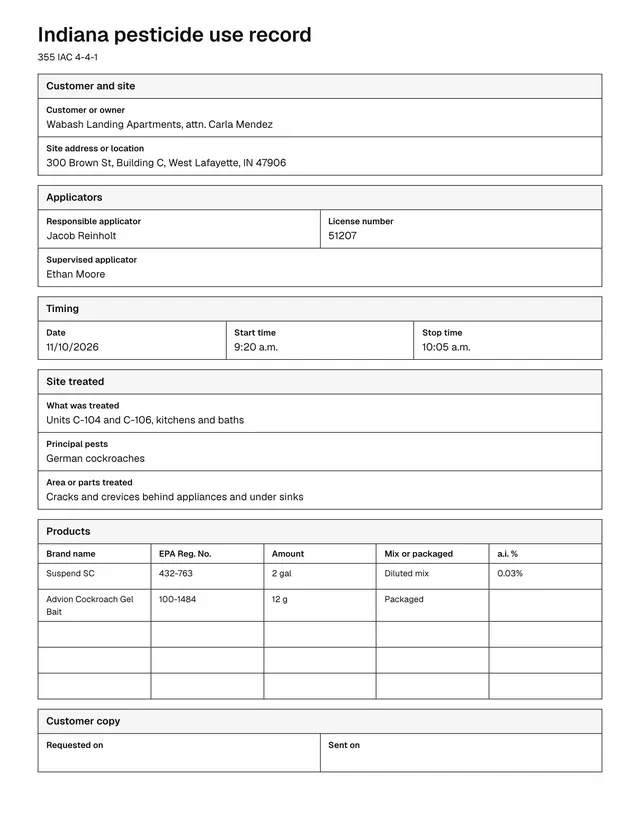
Records follow the same rule as other jobs, with one difference. Applicators at schools keep records of general use applications, not just restricted ones, under 355 IAC 4-4-1. That’s the same 13 items and two years covered on the Indiana pesticide use record page.
If a custodian places gel bait under that exception, it’s the school’s application, not yours, and it doesn’t go on your record.
How do you stay out of school hours?
Schedule around the bell. Friday after dismissal, school breaks, and early mornings before staff arrive are the easy windows. If a visit has to be on a school day, send the school your eight items a week ahead so its notice goes out well before the 48 hours.
Keep a copy of the school’s notice with your record, so the dates line up if anyone asks.
Noma specializes in the Indiana school pesticide notice (IC 15-16-5-64.7). Set each school’s visits on a recurring schedule outside school hours, and send the school its service agreement for e-signature before the year begins. See how Noma schedules school pest control.
Frequentlyaskedquestions
Send this document in minutes, not an afternoon.
Other states
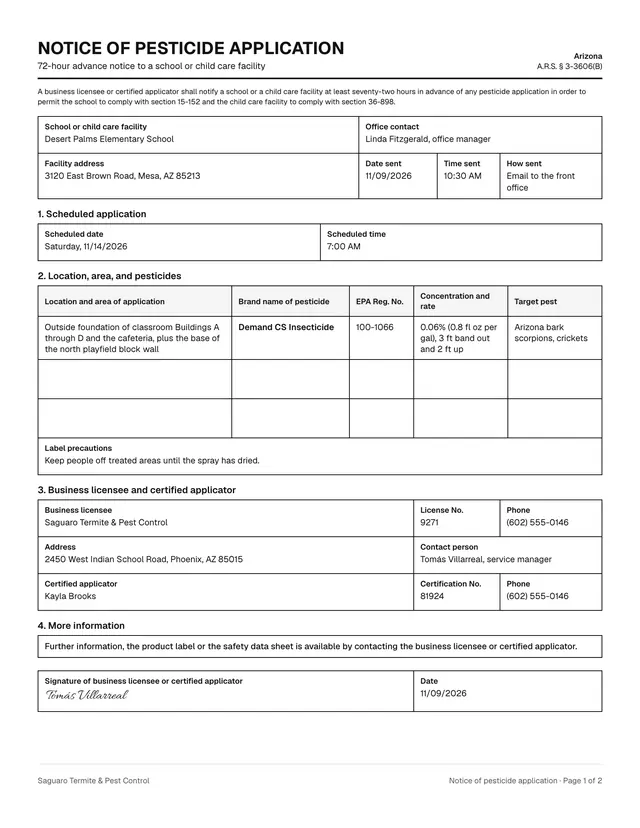
Chemical notice templates- Arizona
Notice of Pesticide Application
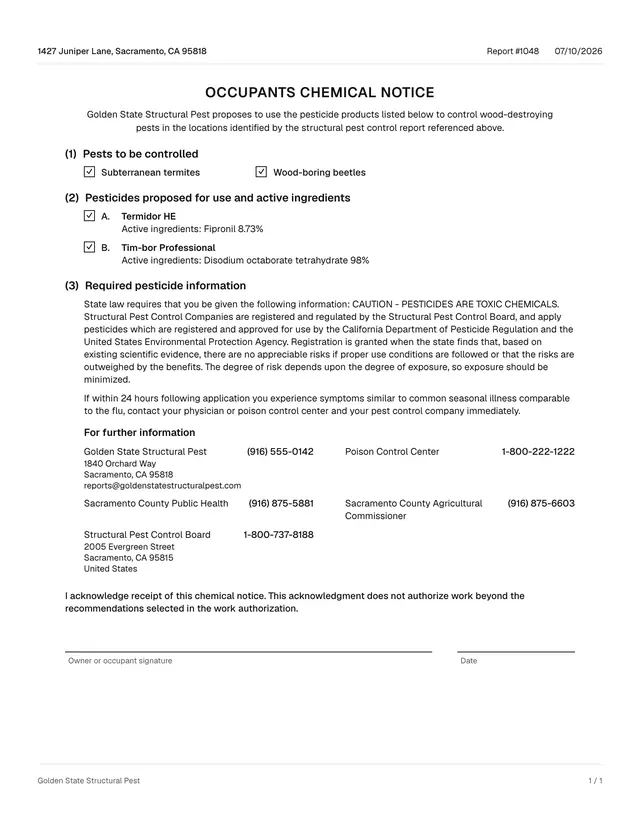
Warn people about a pesticide treatment. - California
Occupants Chemical Notice
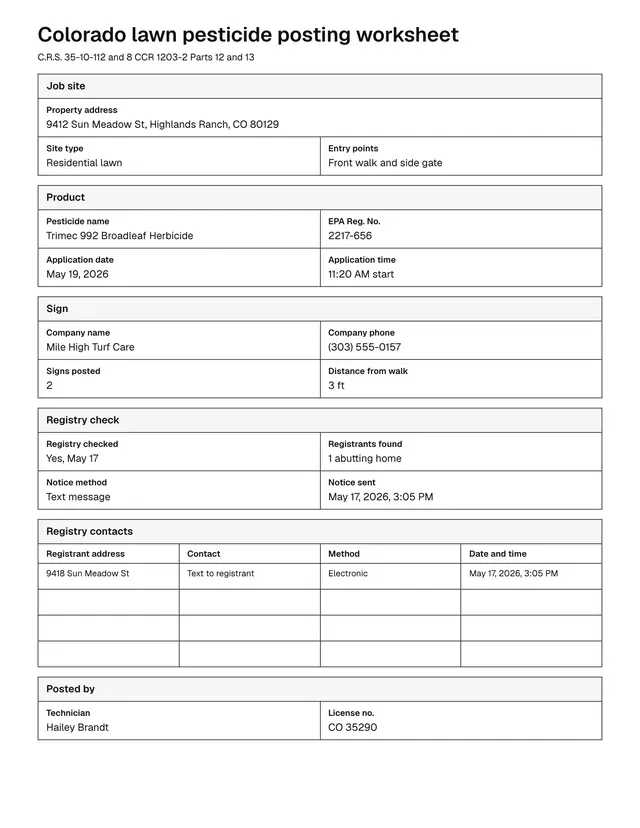
Warn people about a pesticide treatment. - Colorado
Colorado lawn pesticide posting sign (C.R.S. 35-10-112)
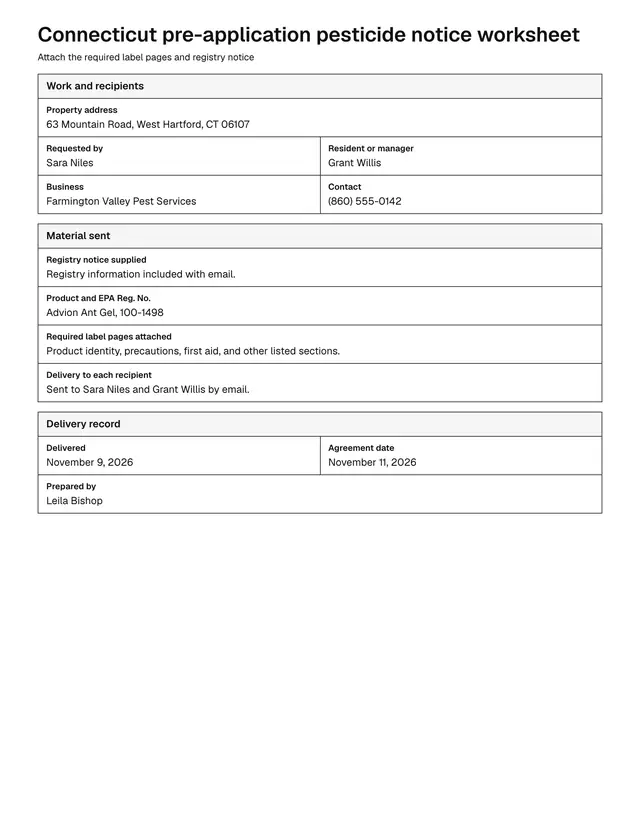
Warn people about a pesticide treatment. - Connecticut
Connecticut pre-application pesticide notice worksheet
Warn people about a pesticide treatment. - Georgia
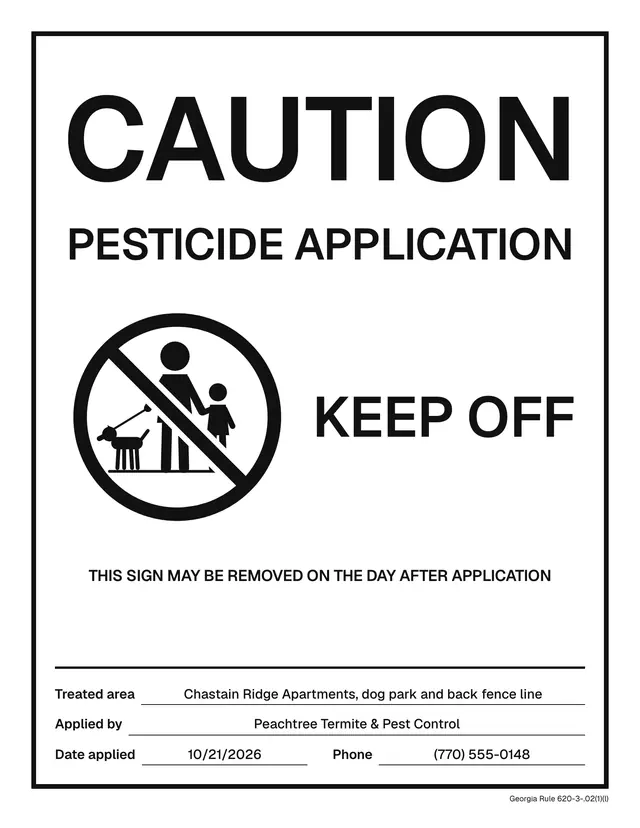
Pesticide Application Sign
Warn people about a pesticide treatment. - Illinois
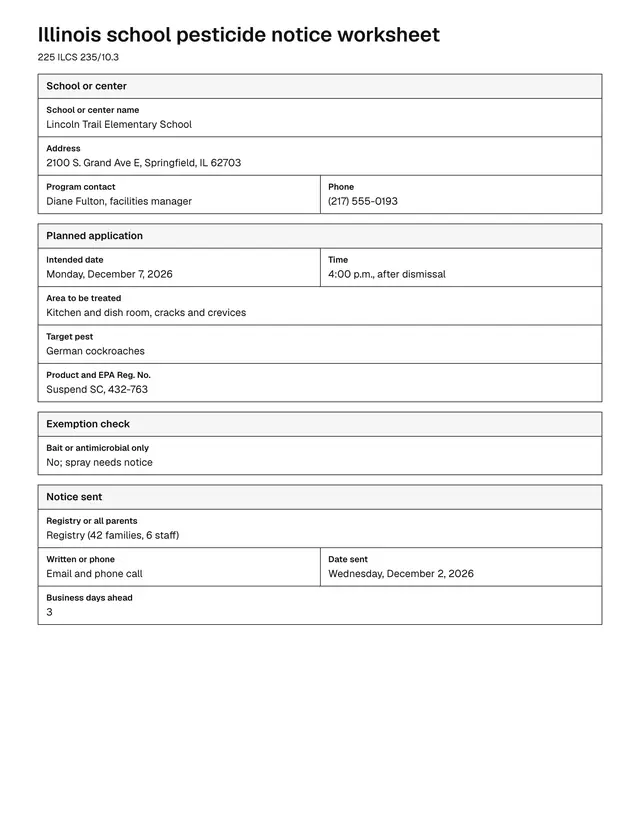
Illinois school pesticide notice (225 ILCS 235/10.3)
Warn people about a pesticide treatment. - Kentucky
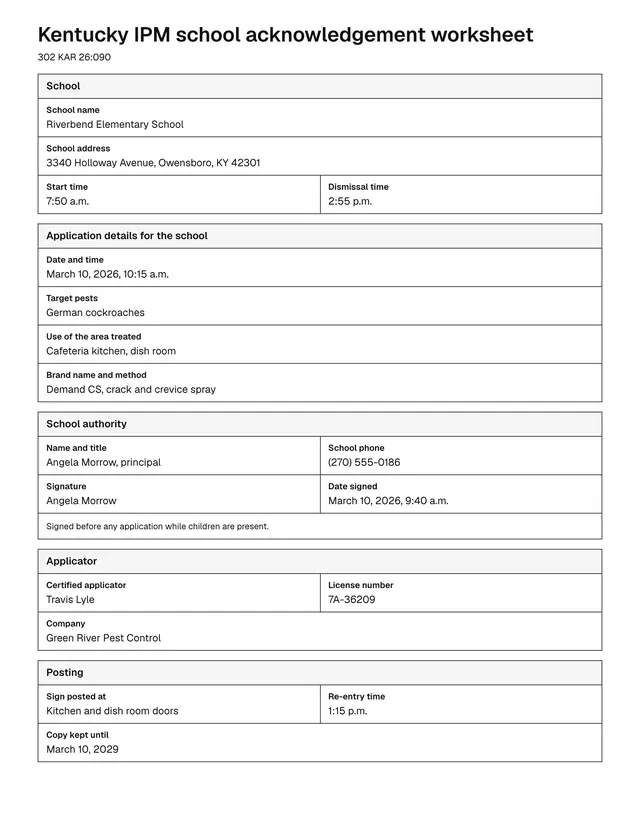
Kentucky IPM School Acknowledgement (302 KAR 26:090)
Warn people about a pesticide treatment. - Massachusetts
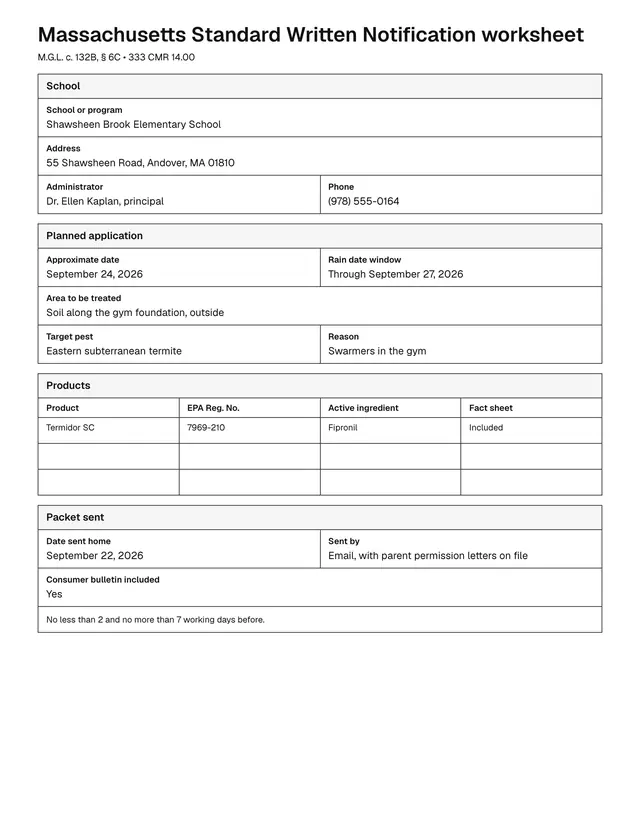
Massachusetts pesticide Standard Written Notification (333 CMR 14.07)
Warn people about a pesticide treatment. - Michigan
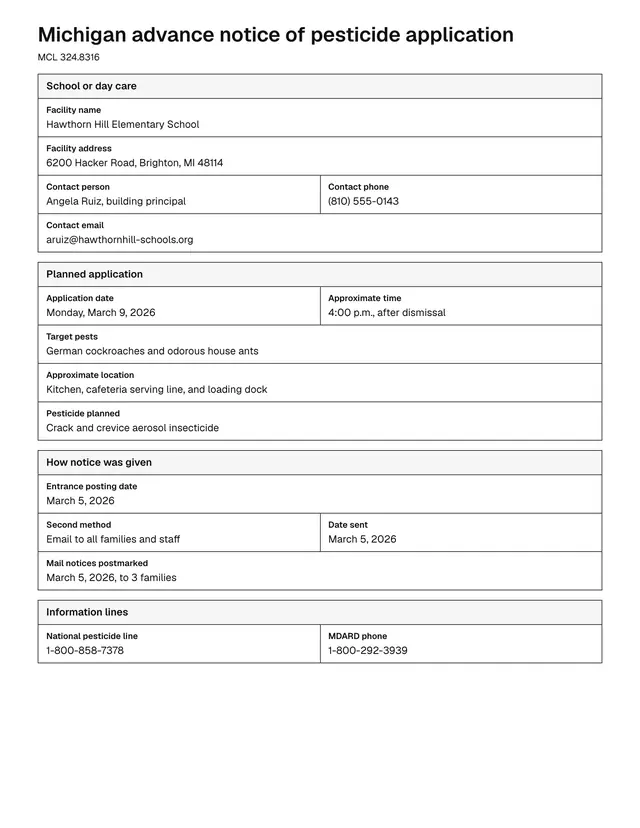
Michigan school and day care pesticide advance notice
Warn people about a pesticide treatment. - New Jersey
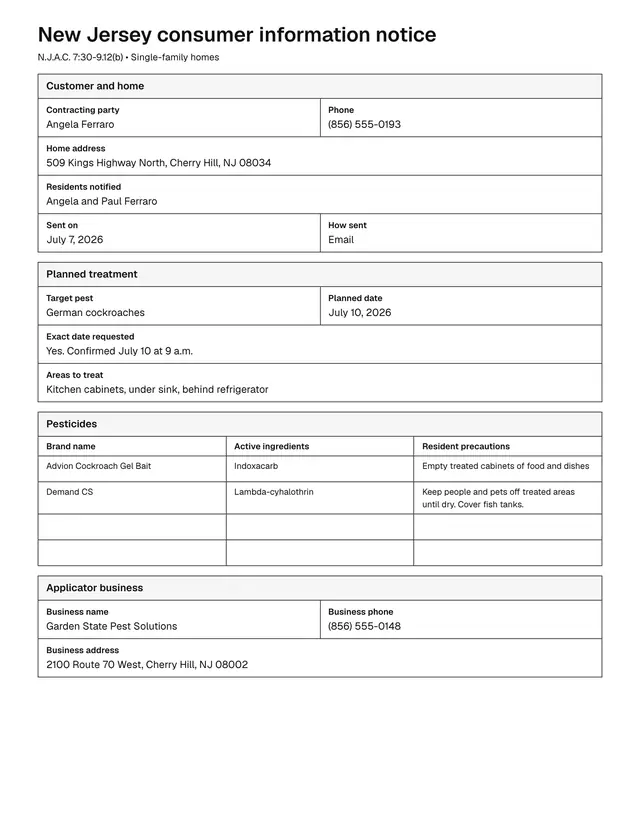
New Jersey consumer information notice for pest control (N.J.A.C. 7:30-9.12)
Warn people about a pesticide treatment. - New York
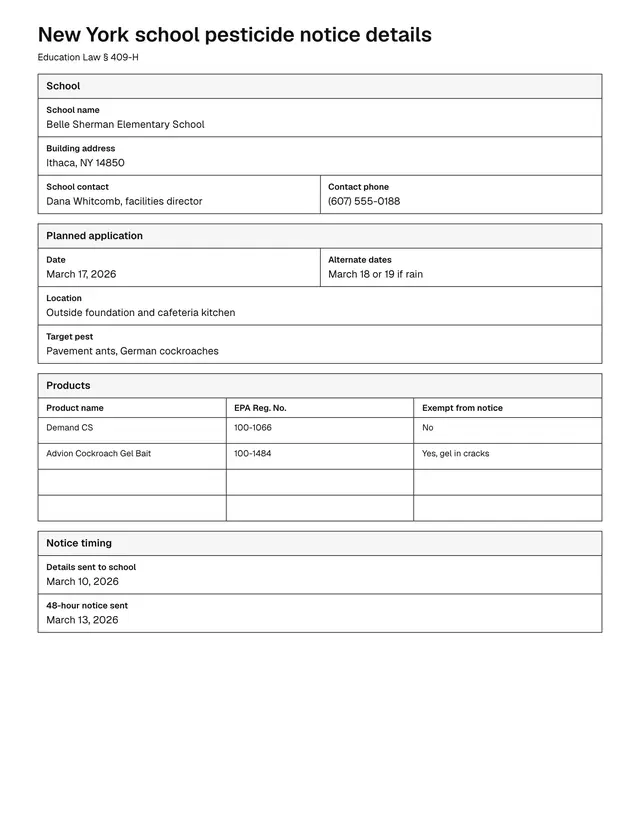
New York school pesticide notification (Education Law § 409-H)
Warn people about a pesticide treatment. - Oregon
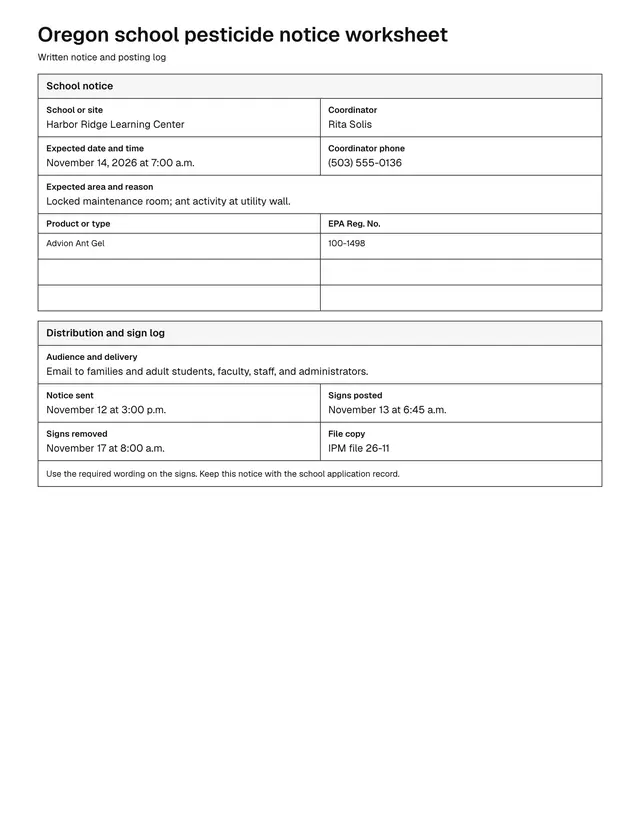
Oregon school pesticide notice worksheet
Warn people about a pesticide treatment. - Pennsylvania
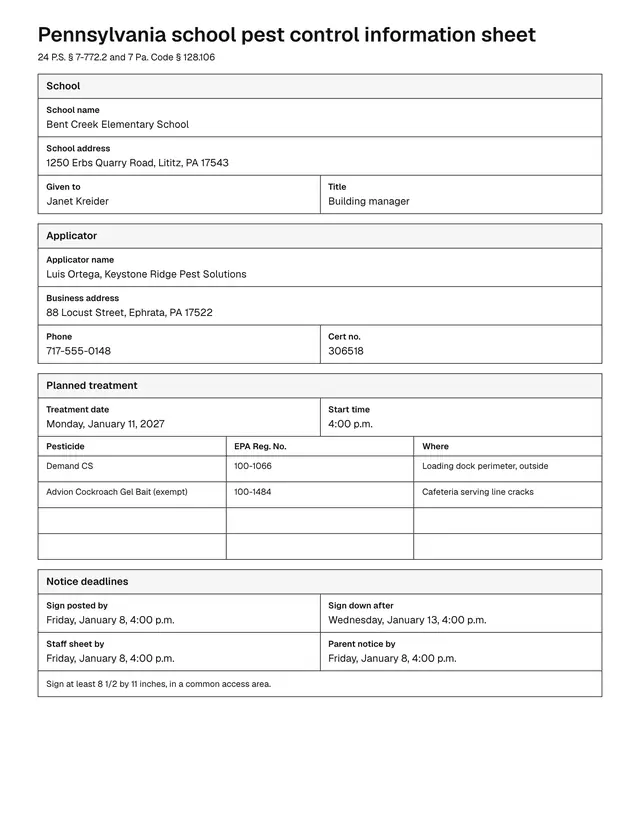
Pennsylvania school pest control information sheet
Warn people about a pesticide treatment. - Texas
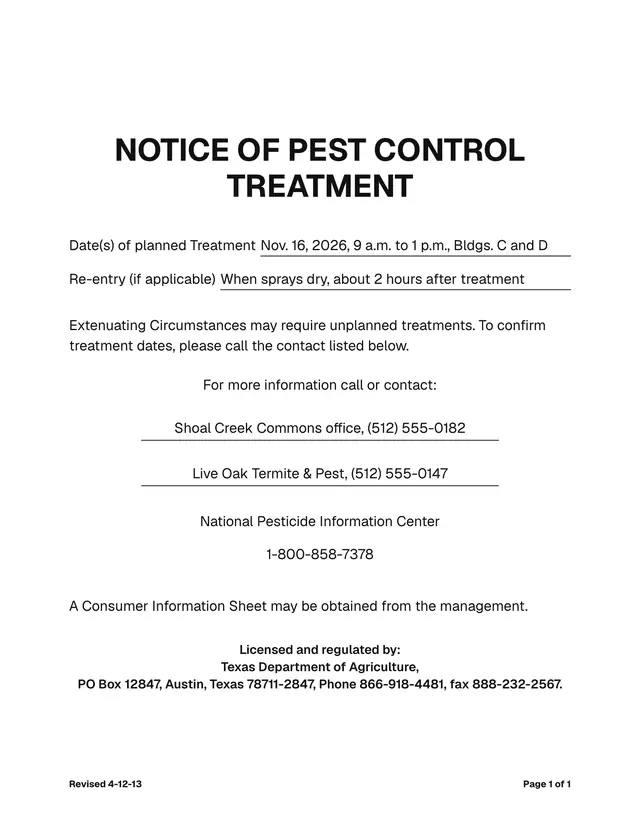
Notice of Pest Control Treatment
Warn people about a pesticide treatment. - Washington
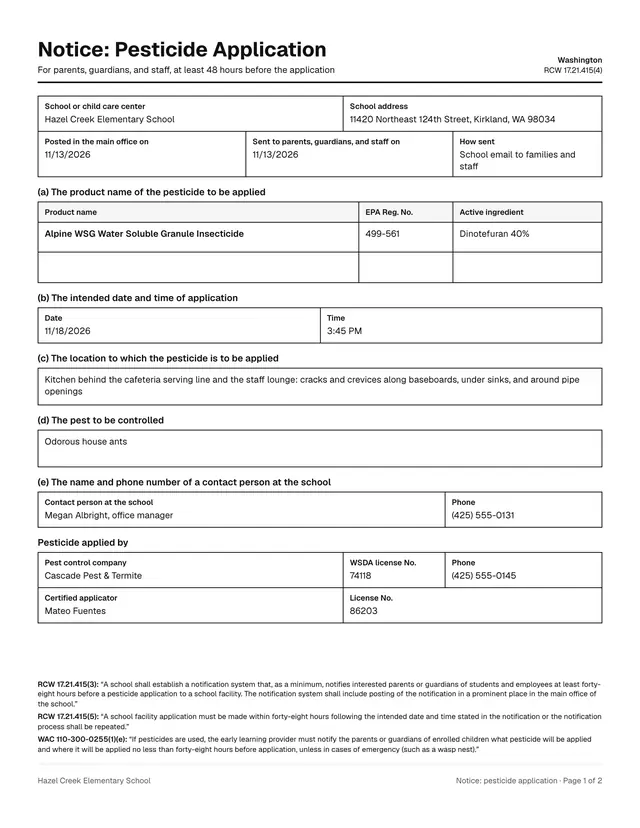
Notice: Pesticide Application
Warn people about a pesticide treatment.