Indiana termite treatment record and graph
A for-hire termite job in Indiana needs the usual 13-item record plus five extras under 355 IAC 4-4-1(d), including a graph of the structure and its dimensions down to the footing.
At a glance
- Rule
- 355 IAC 4-4-1(d)
- Keep
- At least 2 years
- Preconstruction
- Notify OISC 3 hours before
- Customer copy
- Within 30 days, if asked
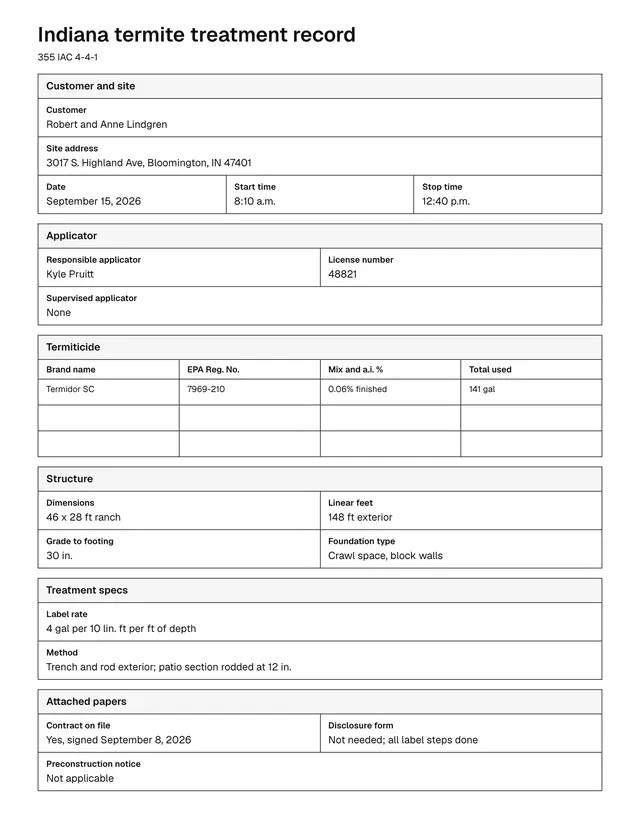
Completed example
Download PDFFive extras on top of the regular record
Every termite job starts with the same 13 items as any other application: customer, site, applicator and license number, date, start and stop times, what was treated, pests, area, brand name, EPA Reg. No., and amount. Section (d) of 355 IAC 4-4-1 then adds five more for termite work done for hire.
1. The contract. A copy of the contract, service agreement, or similar paper for the treated structure. The rule says the pricing in it is confidential. 2. A graph or diagram of the treated structure. 3. Dimensions of the structure, including the depth from grade to the top of the footing when you use soil-applied liquids. 4. Treatment specs for soil-applied liquids. 5. The customer disclosure form, signed, if you used one.
All of it is recorded on the day of the application and kept at least two years. If the customer asks, they get a copy within 30 days of the application date.
Under 355 IAC 4-4-2, the state chemist or an agent can ask to see these records, in writing or out loud. The contract and graph are also your proof when a buyer’s inspector asks about a past treatment.
Measuring a ranch in Bloomington
The footing depth is the item most records miss, and it drives the math. Here’s a worked example.
Say you’re treating a 46 by 28 foot ranch on a crawl space in Bloomington. The perimeter is 148 linear feet. You dig at a corner and find 30 inches from grade to the top of the footing. Using Termidor SC (EPA Reg. No. 7969-210) at 0.06%, the label rate is 4 gallons of finished mix per 10 linear feet per foot of depth. That’s 148 ÷ 10 × 4 × 2.5, or 148 gallons for the exterior.
Measure the footing depth at more than one corner if the lot slopes, and use the deeper side for the math.
Write it all down. The dimensions (46 × 28), the footing depth (30 inches), the rate, and the total gallons used are the treatment specs. If the crawl space piers got treated too, add their count and the gallons. If the actual total came out to 141 gallons because a patio blocked one stretch, write 141 and mark the patio on the graph.
The graph page on this sheet has a grid for that. Mark the front of the house, the foundation type, trenching, any drilling, and anything that blocked you.
Bait jobs are different. The footing depth and treatment specs only apply when you use soil-applied liquids, but the graph still does. Number each station on it.
The preconstruction call
New construction comes with a step that existing homes don’t. Under 355 IAC 4-5-2, a for-hire applicator planning a preconstruction treatment has to notify the state chemist at least three hours before the initial treatment. The only exception is when the customer didn’t give you enough notice.
The notice can go by web form, email, fax, text, or phone. It needs the address or coordinates, the date, the scheduled start time, and the estimated square footage. A builder in Carmel who calls at 7 a.m. for an 8 a.m. slab pour gives you less than three hours. Note that on the record so the gap is explained.
Preconstruction jobs don’t need a customer disclosure form, even if a label step is skipped. The rule carves them out.
When the disclosure joins the file
Sometimes a label step can’t be done. A finished basement might mean no drilling through the slab, or a well too close might mean no soil treatment on one side. On an initial treatment of an existing structure, Indiana wants that disclosed on a signed form before you treat. The termite control customer disclosure page covers how. Once it’s signed, a copy becomes part of this record under item 5.
If nothing was skipped, write “not needed” in that spot so the file is complete.
Where does the graph go after the truck?
Too often, into a folder nobody can find when the house sells. The buyer’s WDI inspector will ask for proof of treatment, and the seller will call you.
A homeowner who sells in five years will call you for these papers, not OISC.
Noma specializes in the Indiana termite treatment record and graph (355 IAC 4-4-1(d)). Draw the graph on the job from your phone, send the treatment contract for e-signature before you start, and schedule the yearly reinspection with its renewal invoice. See how Noma handles termite jobs.
Frequentlyaskedquestions
Send this document in minutes, not an afternoon.
Other states
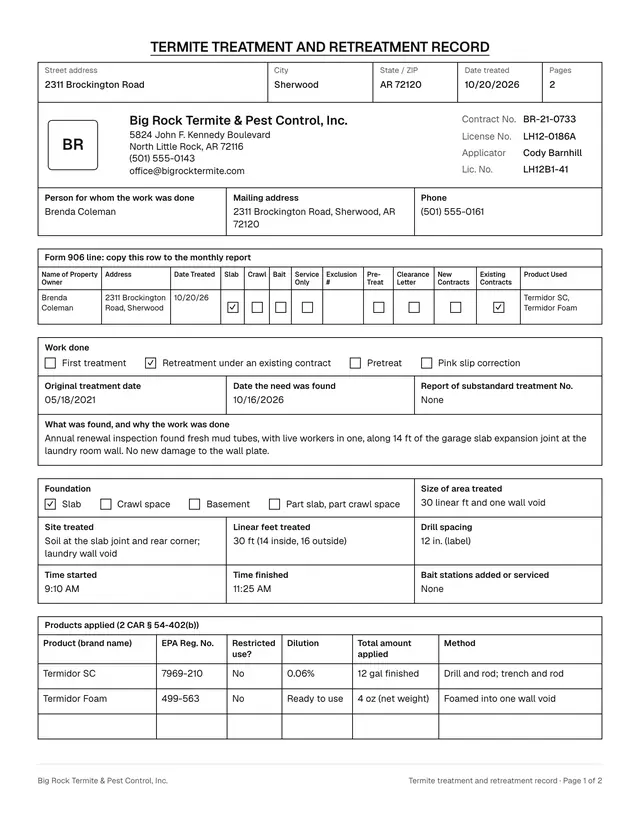
Termite treatment record templates- Arkansas
Termite Treatment and Retreatment Record
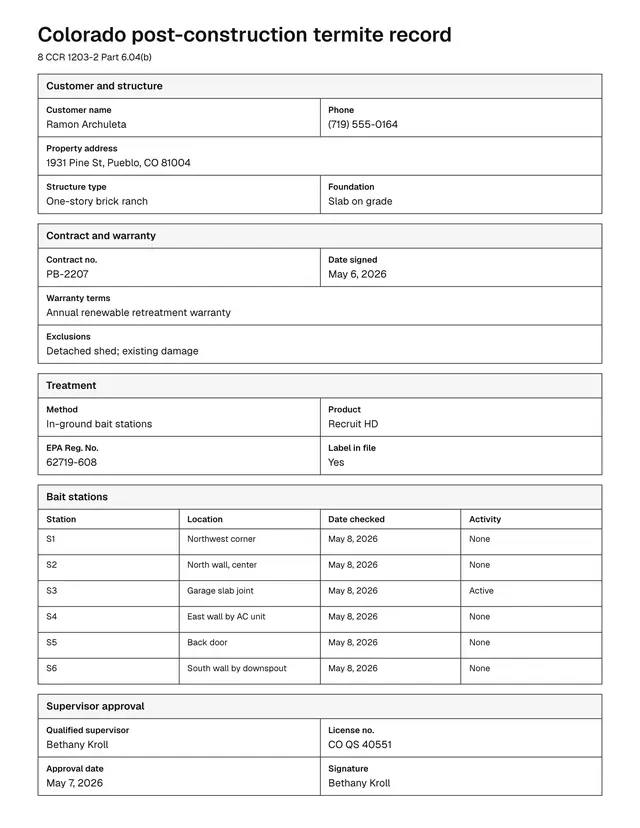
Record the termiticide, the amount, and the method for each job. - Colorado
Colorado post-construction termite treatment record (Part 6.04(b))
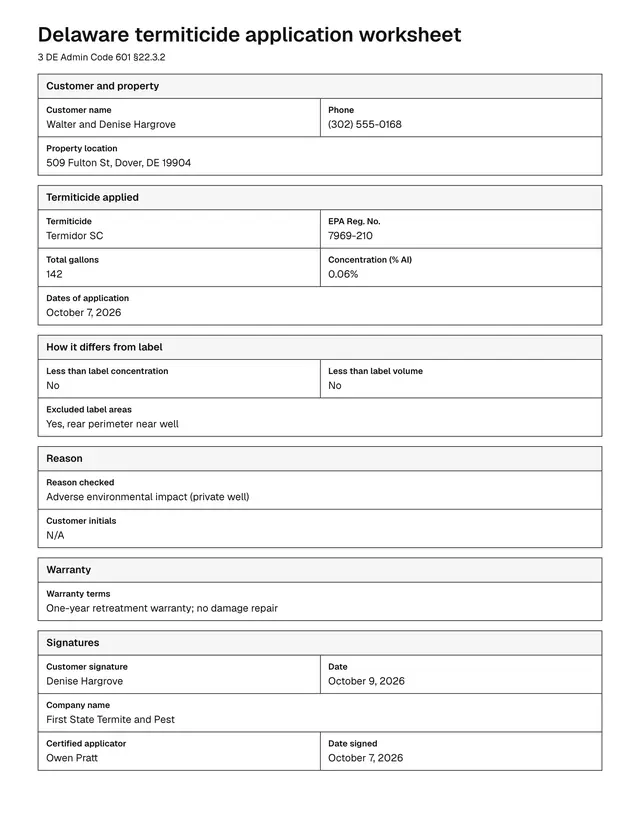
Record the termiticide, the amount, and the method for each job. - DelawareDocument # 65-01-06/01/09/02
Delaware Notice of Termiticide Application
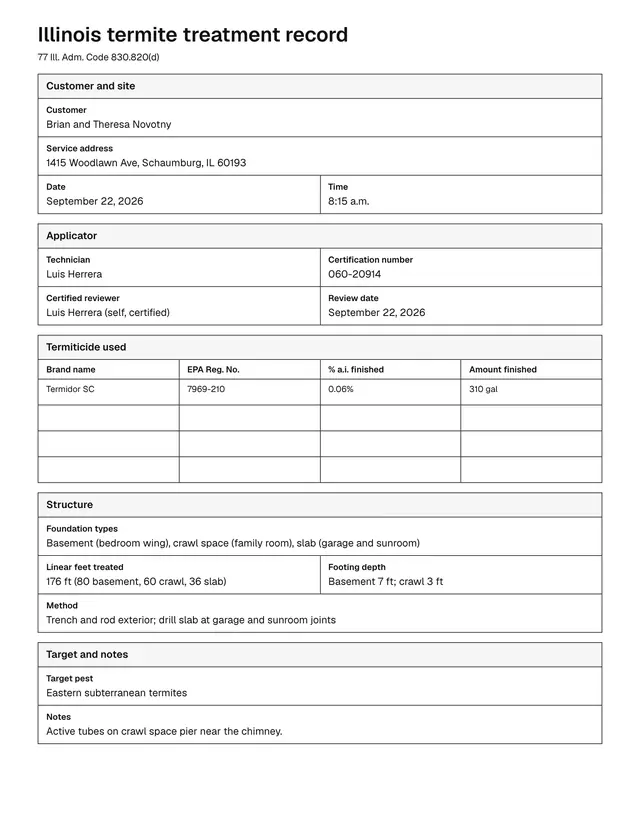
Record the termiticide, the amount, and the method for each job. - Illinois
Illinois termite treatment record and diagram
Record the termiticide, the amount, and the method for each job. - Kansas
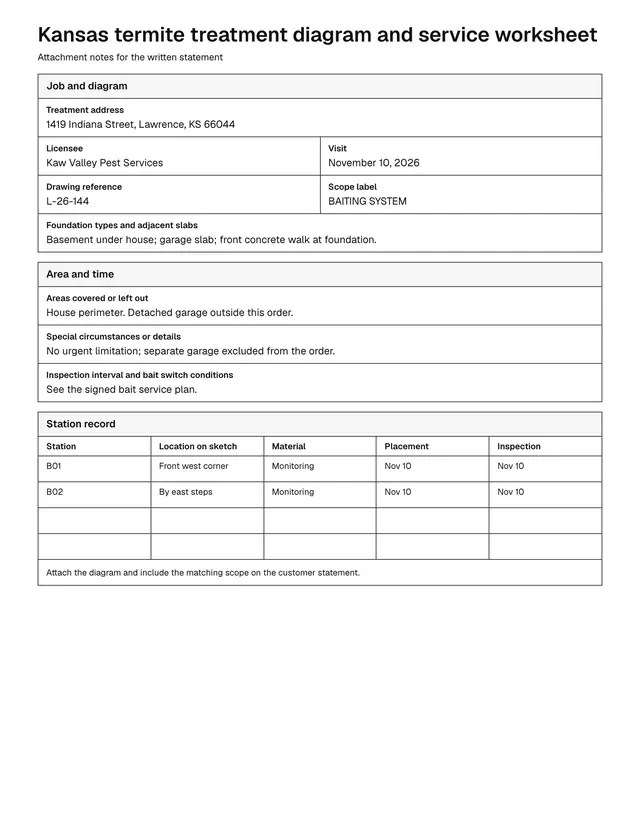
Kansas termite treatment diagram and service worksheet
Record the termiticide, the amount, and the method for each job. - Kentucky
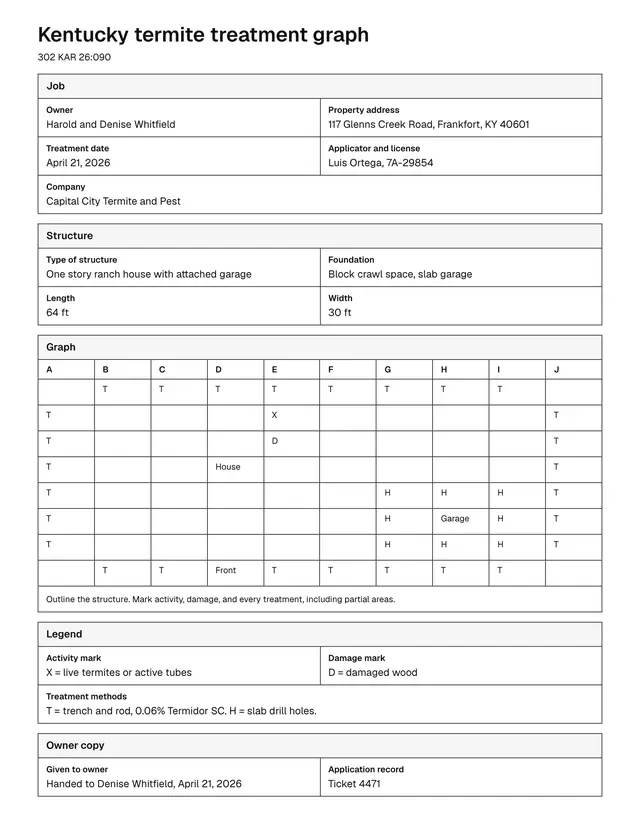
Kentucky termite treatment graph (302 KAR 26:090)
Record the termiticide, the amount, and the method for each job. - Louisiana
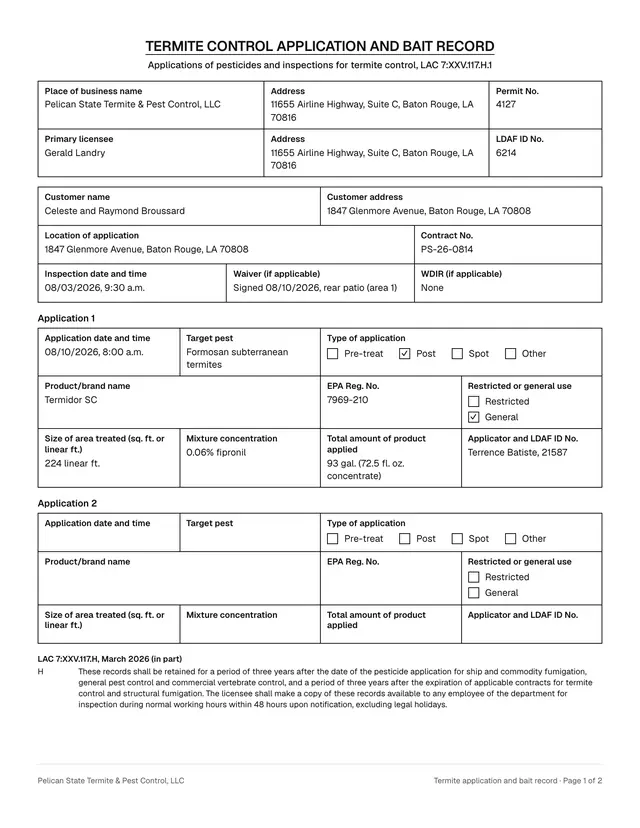
Termite Control Application and Bait Record
Record the termiticide, the amount, and the method for each job. - Maryland
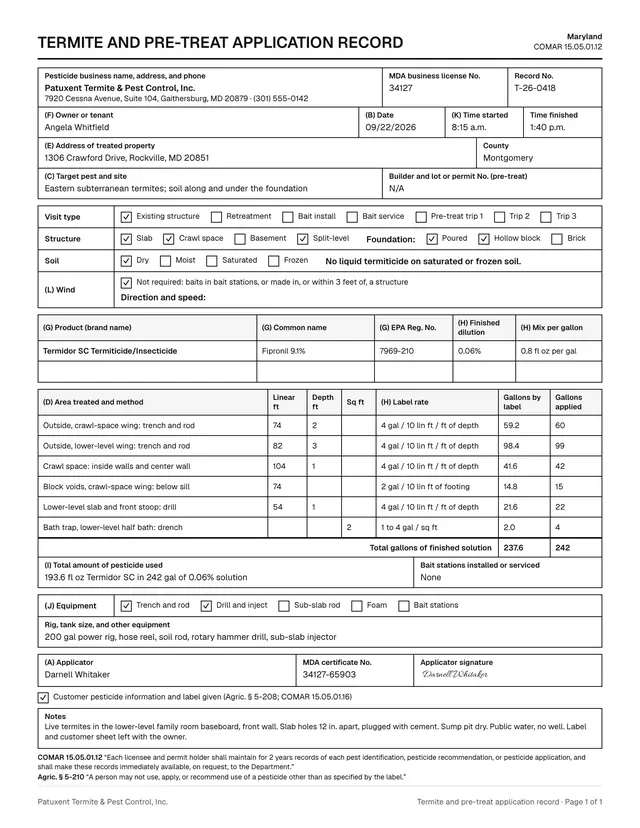
Termite and Pre-Treat Application Record
Record the termiticide, the amount, and the method for each job. - Mississippi
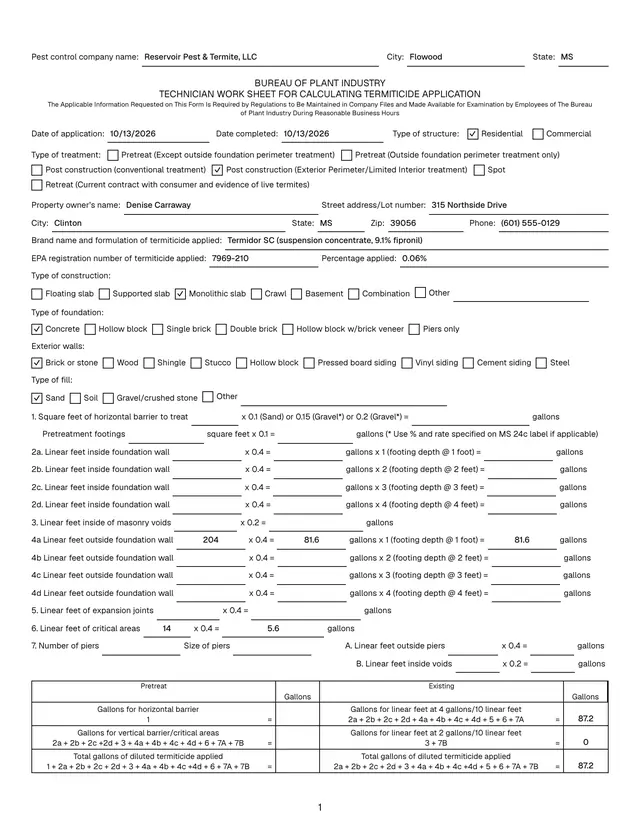
Technician Work Sheet for Calculating Termiticide Application
Record the termiticide, the amount, and the method for each job. - New Jersey
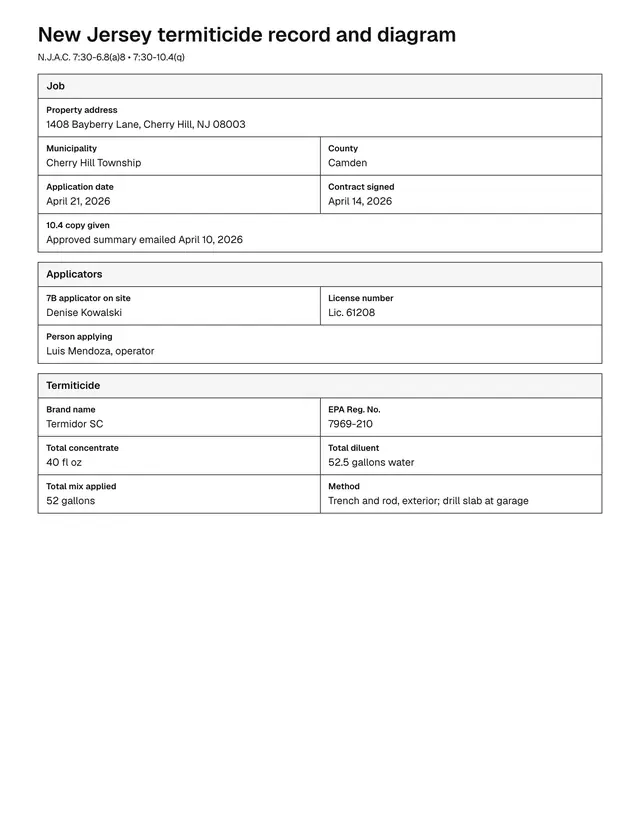
New Jersey termiticide record and diagram (N.J.A.C. 7:30-6.8 and 7:30-10.4)
Record the termiticide, the amount, and the method for each job. - Ohio
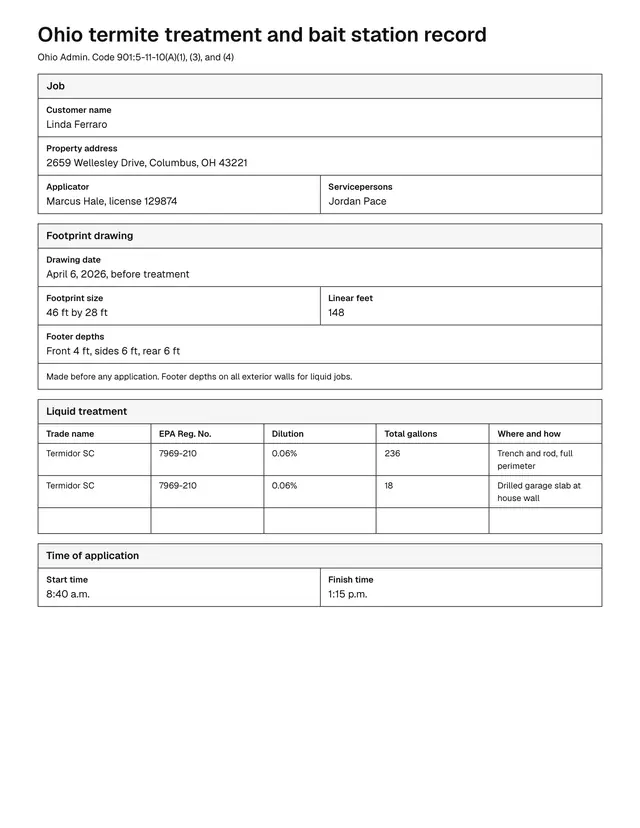
Ohio termite treatment and bait station record
Record the termiticide, the amount, and the method for each job. - Oklahoma
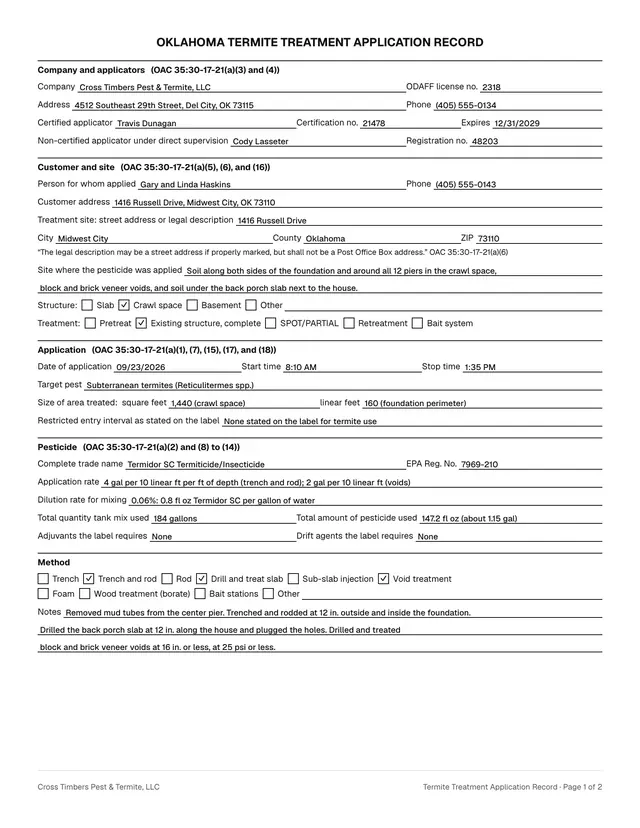
Oklahoma Termite Treatment Application Record
Record the termiticide, the amount, and the method for each job. - South Carolina
Record of Termiticide Use
Record the termiticide, the amount, and the method for each job.