Indiana termite control customer disclosure
When an initial termite treatment will skip a step the label requires, Indiana makes you disclose it on an OISC-approved form that the customer signs before you treat.
At a glance
- Rule
- 355 IAC 4-5-2
- Form
- OISC Termite Control Customer Disclosure
- Signed by
- Customer or authorized agent
- Kept
- With the termite record, 2 years
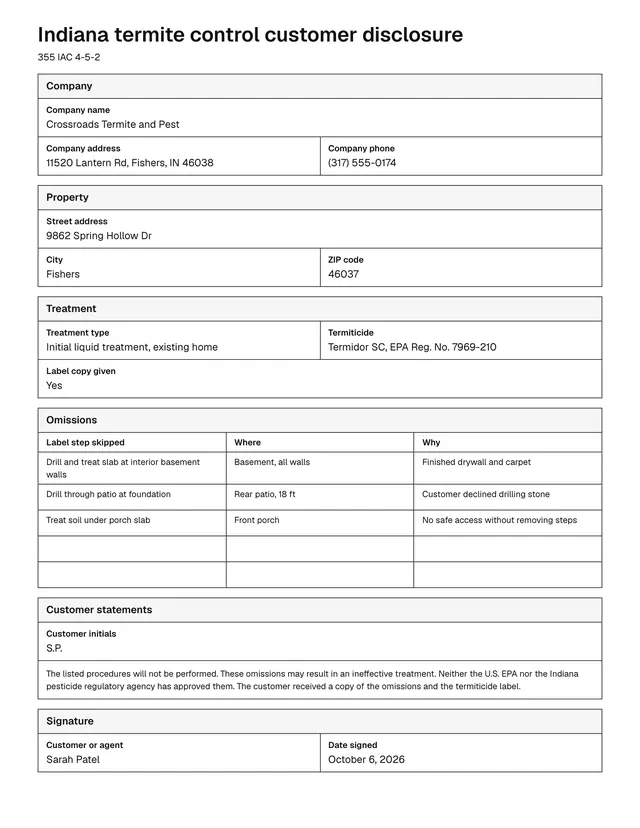
Completed example
Download PDFWhen Indiana requires it
Termiticide labels are detailed. They tell you to trench, rod, drill slabs, and treat voids in certain ways. When a house won’t let you do one of those steps, Indiana wants the customer to know and agree before you start. 355 IAC 4-5-2 says a commercial applicator treating for hire “must disclose to the customer any label-required procedures that will be omitted.”
The rule carves out two jobs: retreatments of previously treated structures, and preconstruction treatments. The OISC form words the retreatment exception more narrowly. It says the form isn’t required for “Retreatments of properties previously treated by this company.” So if you’re retreating a house another company treated, the safe move is to use the form.
The disclosure has to be on a written form approved by the state chemist, issued to the customer or their agent, and signed by them. OISC’s form is the approved one most companies use.
If every label step can be done, skip the form. It’s only for omissions. Preconstruction jobs skip it too, but they have their own rule: a notice to the state chemist at least three hours before the first treatment.
What the customer is agreeing to
The form is short, and it doesn’t soften anything. The customer signs four statements.
First, that the procedures listed “will not be performed as part of my termite control service.” Second, that they’re omissions from the label’s directions, “and that these omissions may result in an ineffective treatment.” Third, that “neither the U.S. Environmental Protection Agency nor the Indiana pesticide regulatory agency has approved these omissions.” Fourth, that they got a copy of the list of omissions and a copy of the termiticide label.
That third line gets a lot of questions. Walk the customer through it. It doesn’t mean you’re doing anything illegal by disclosing. It means the customer is accepting the risk of a partial job with eyes open.
Don’t reword the statements. The state chemist approves the form, so your copy should match OISC’s wording, with your company details filled in.
Writing a good omissions list
The list goes on page 2 of the form. Vague entries like “some areas not treated” protect nobody. Each line should say what step was skipped, where, and why.
Keep the label open when you write the list. Name each step the way the label does, like “drill and treat the slab,” not “inside work.”
Here’s how it might read for a Fishers two-story with a finished basement and a stone patio:
Line 1. “Drilling and treating the slab along the interior of the basement foundation walls. Basement is finished with drywall and carpet.” Line 2. “Drilling through the stone patio along the rear foundation. Customer declined drilling the stone.” Line 3. “Treating the soil under the front porch slab. No safe access without removing steps.”
Give the customer the termiticide label along with the form. It’s one of the two copies they’re acknowledging, and many homeowners have never seen one.
Signing, validity, and the file
The bottom of the OISC form says it plainly: “For this form to be valid, the customer or authorized agent must sign and date it.” An unsigned copy in the truck isn’t a disclosure. Get the signature before the initial treatment.
The form also needs your company name, address, and phone, and the property’s street address, city, and ZIP. Once it’s signed, it becomes part of the job. Under 355 IAC 4-4-1(d)(5), the signed disclosure is one of the five extra items on the Indiana termite treatment record, kept at least two years.
Date order matters. If OISC looks at the termite record, the signature date on the disclosure should come before the treatment date.
What if the customer is out of town?
Rentals and estate sales are common cases. The owner lives in another state, and the property manager has the keys but not the authority. The rule lets an authorized agent sign, but someone still has to sign before you treat.
An e-signature link the manager forwards to the owner works, as long as the owner signs before treatment day.
Noma specializes in the Indiana termite control customer disclosure (355 IAC 4-5-2). Upload the OISC form once as a reusable document, fill in the omissions for each job, and send it for e-signature as soon as the job is booked. See how Noma sends termite disclosures.
Frequentlyaskedquestions
Send this document in minutes, not an afternoon.
Other states
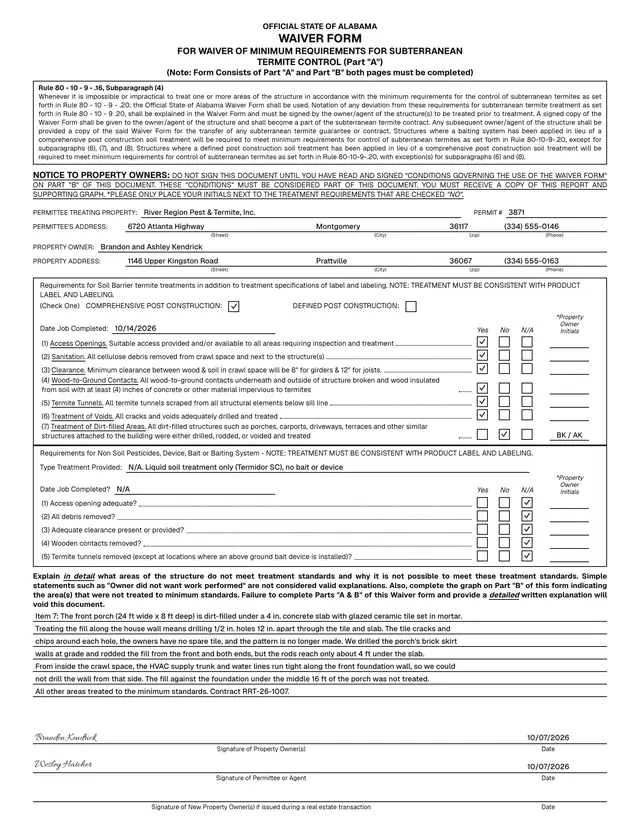
Treatment waiver templates- Alabama
Official State of Alabama Waiver Form
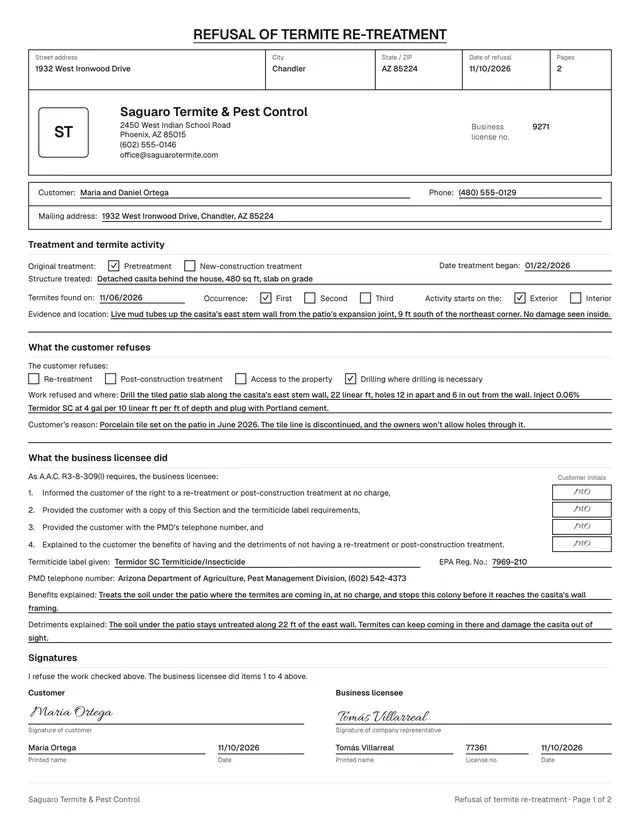
Owners sign off on termite work that won’t be done. - Arizona
Refusal of Termite Re-treatment
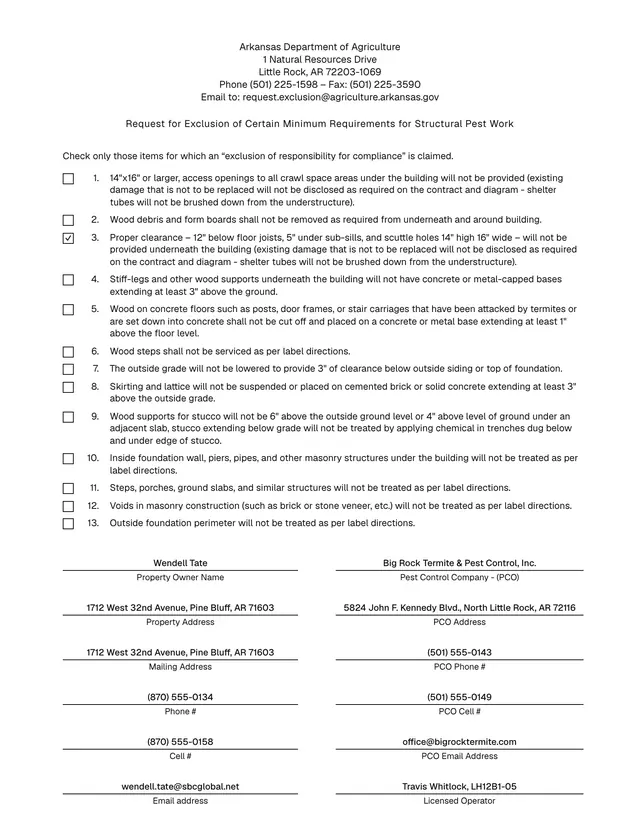
Owners sign off on termite work that won’t be done. - Arkansas
Request for Exclusion of Certain Minimum Requirements for Structural Pest Work
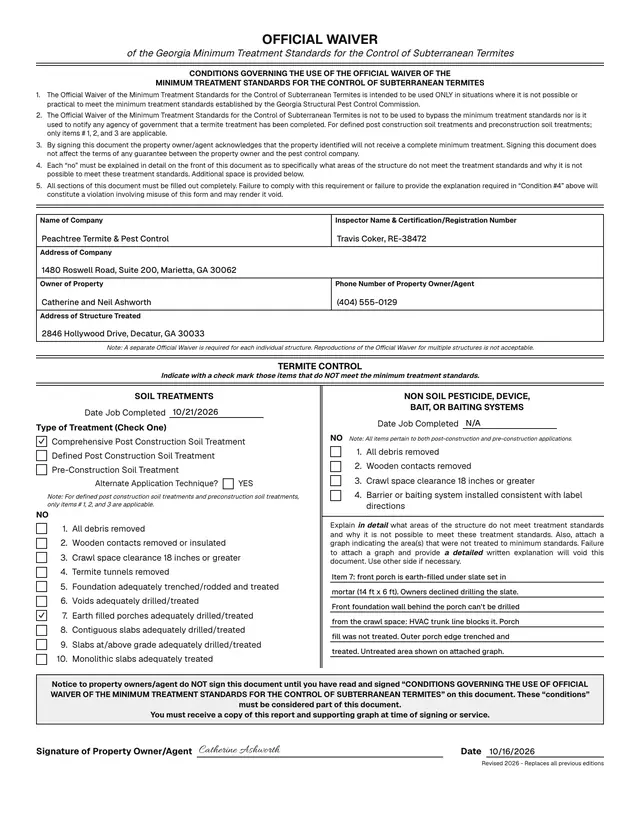
Owners sign off on termite work that won’t be done. - Georgia
Official Waiver of the Georgia Minimum Treatment Standards for the Control of Subterranean Termites
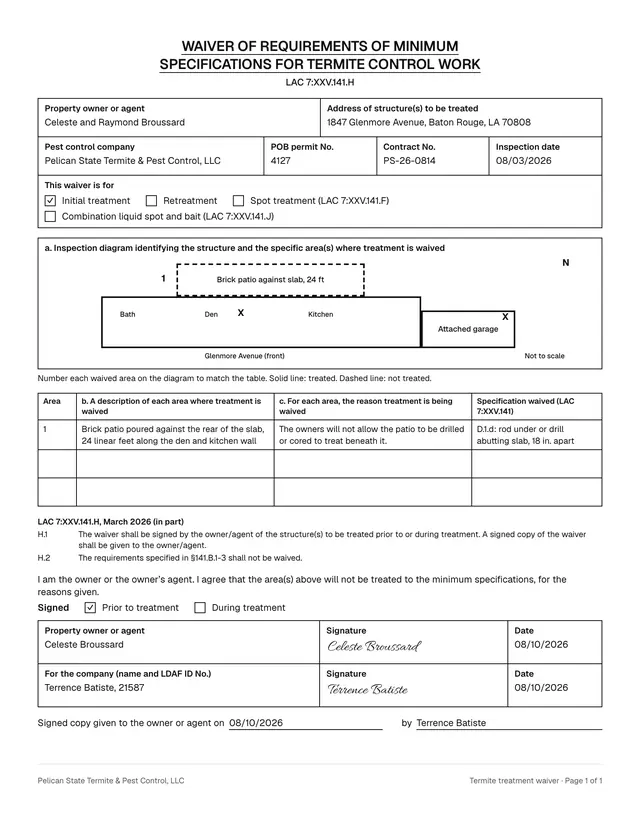
Owners sign off on termite work that won’t be done. - Louisiana
Waiver of Requirements of Minimum Specifications for Termite Control Work
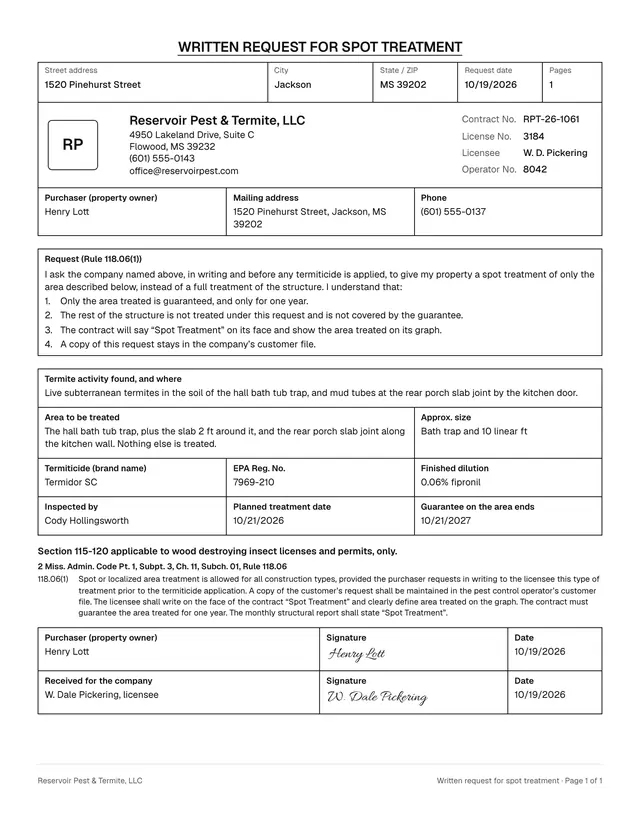
Owners sign off on termite work that won’t be done. - Mississippi
Written Request for Spot Treatment
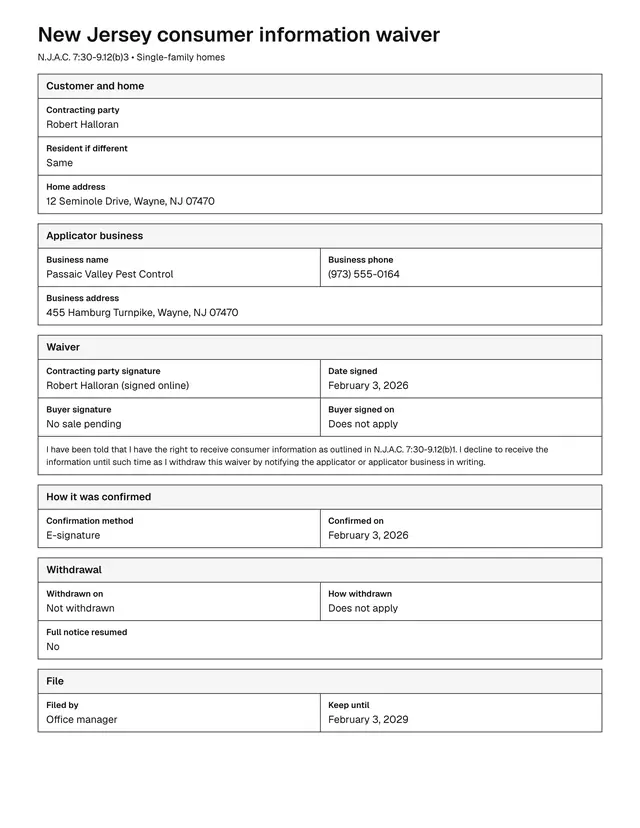
Owners sign off on termite work that won’t be done. - New Jersey
New Jersey consumer information waiver (N.J.A.C. 7:30-9.12(b)3)
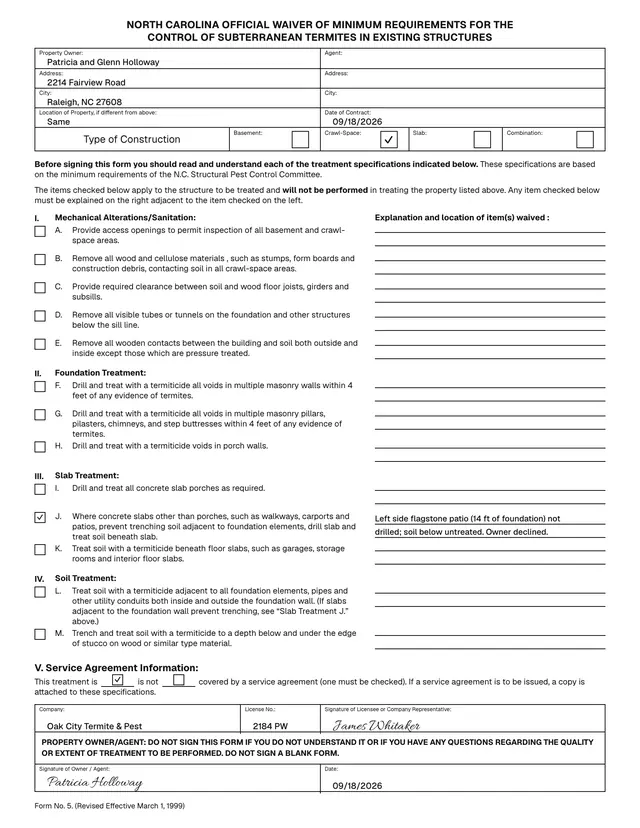
Owners sign off on termite work that won’t be done. - North CarolinaForm No. 5
North Carolina Official Waiver of Minimum Requirements
Owners sign off on termite work that won’t be done. - Oklahoma
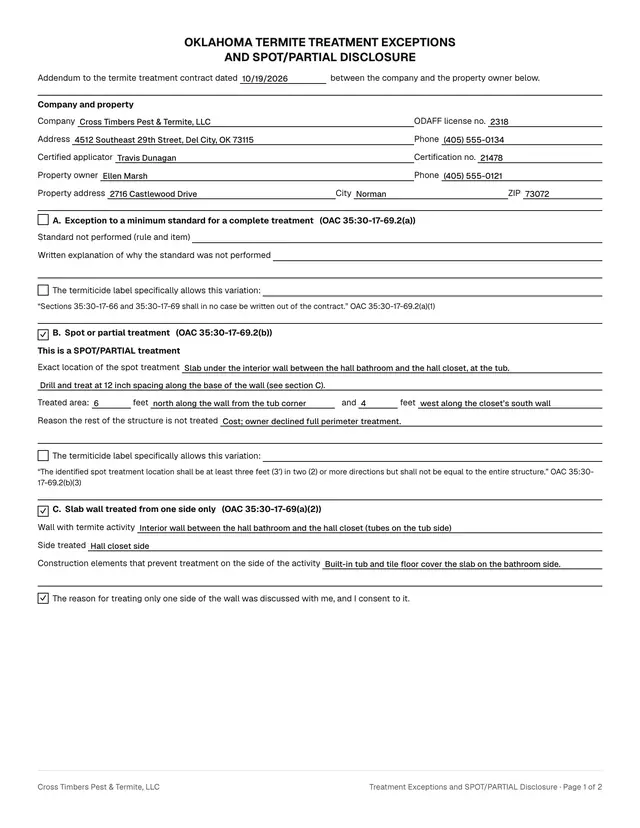
Oklahoma Termite Treatment Exceptions and SPOT/PARTIAL Disclosure
Owners sign off on termite work that won’t be done. - South Carolina
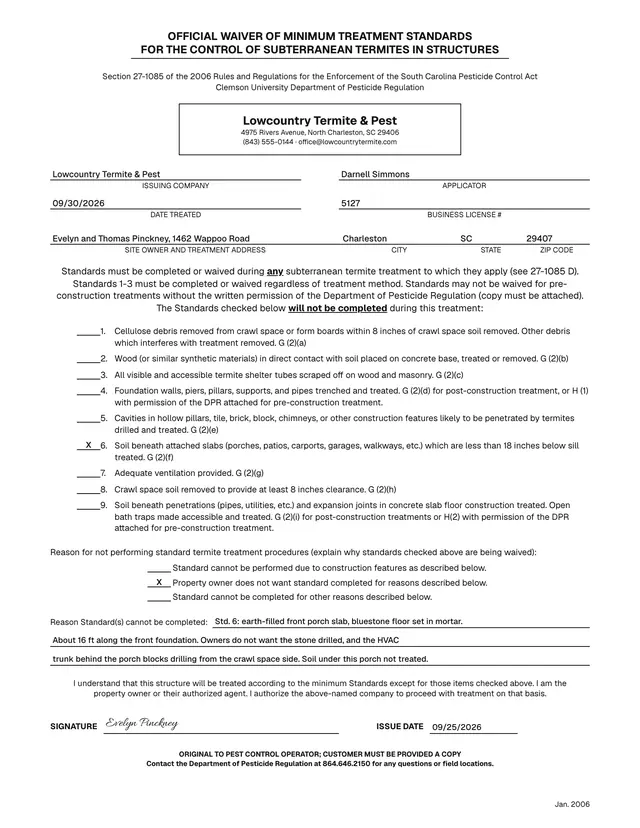
Official Waiver of Minimum Treatment Standards
Owners sign off on termite work that won’t be done. - Tennessee
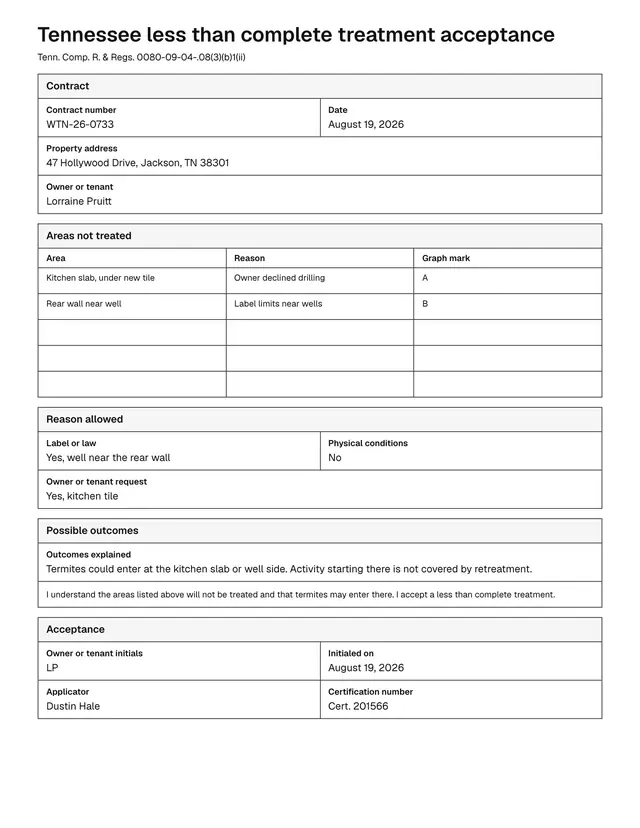
Tennessee less than complete termite treatment acceptance
Owners sign off on termite work that won’t be done.