Tennessee less than complete termite treatment acceptance
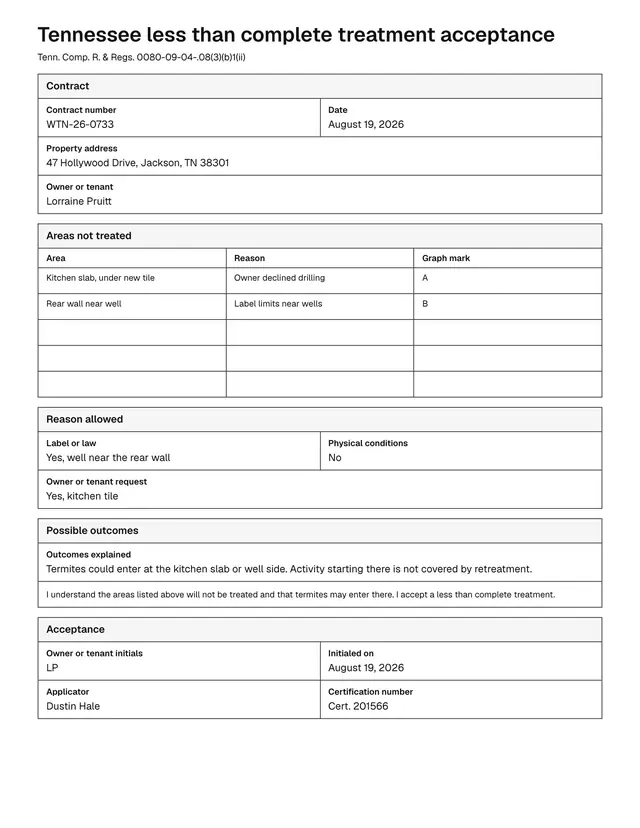
Tennessee doesn’t use the word waiver. Rule 0080-09-04-.08(3)(b)1(ii) lets you skip part of a termite job only after you explain the risk, the owner initials a bold-font note, and you mark the graph.
At a glance
- Rule
- 0080-09-04-.08(3)(b)1(ii)
- Printed in
- Bold font in the contract
- Initialed by
- Owner or tenant
- Graph
- Marks untreated areas
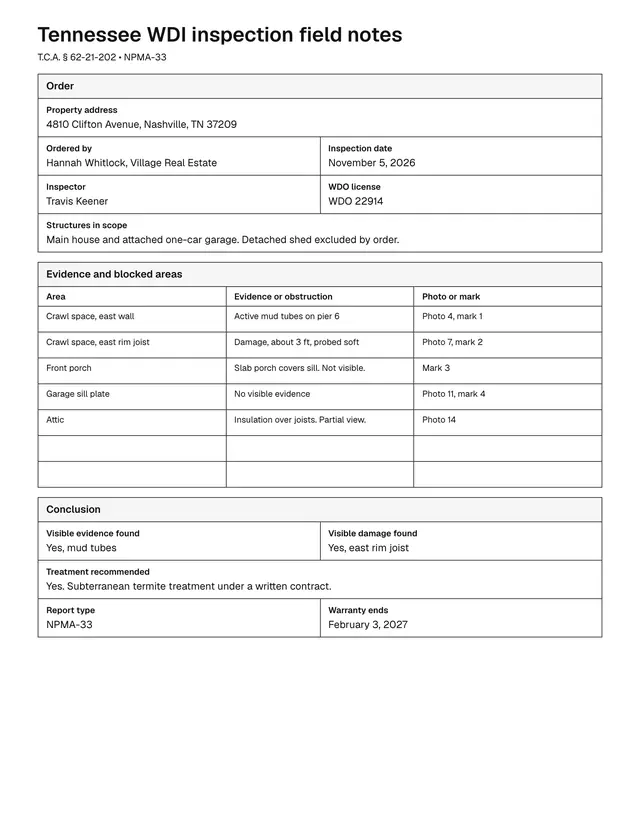
Completed example
Download PDFTennessee’s word for it
Search “termite waiver Tennessee” and you won’t find a state form. The rules call it a “less than complete treatment.” The customer’s acceptance isn’t a separate paper. It lives inside the termite contract.
Start with the default. Rule 0080-09-04-.09(1)(i) makes it a prohibited act to do less than a complete treatment, with three exceptions. The label or law allows it. A complete treatment is ill-advised or prevented by the building’s physical conditions. Or the owner or tenant asks for it.
Anything outside those three is a violation, signed paper or not. A customer can’t sign away a treatment you skipped just to save time.
That also means a TDA inspector reviewing the job looks at the contract. A separate signed sheet in a drawer doesn’t replace the bold note and initials inside it.
The three steps the rule requires
Part (3)(b)1(ii) of rule 0080-09-04-.08 spells out what has to happen before a partial job.
Explain the outcomes. The applicator tells the contracting party what could happen. Be plain: termites can enter through the untreated area, and the retreatment warranty may not cover activity that starts there.
Bold font, then initials. The customer’s acceptance is noted in bold font in the contract and initialed by the owner or tenant. Regular type in a long paragraph doesn’t meet it.
Mark the graph. The applicator marks the graph where the less than complete treatment will happen. Six months from now, that mark shows exactly which wall or slab section was left alone.
Keep the bold note short enough to read in one breath. One or two sentences, then the initials line.
Do all three before you treat. Initials added after the job read like a cover story.
How to write the outcomes
The rule says the applicator tells the customer the possible outcomes. It doesn’t say how. Put it in writing, right in the contract, so the explanation and the acceptance sit together.
Name the area. “Kitchen slab under new tile, graph mark A.”
Name the risk. “Termites can enter the house through untreated soil under this area.”
Name the coverage. Say whether your retreatment warranty covers activity that starts there. The rule doesn’t decide that. Your contract does.
Get the right initials. The rule names the owner or tenant. A property manager or a real estate agent isn’t on that list, so get the person who owns or lives in the home.
Where this comes up on real jobs
Most partial jobs fall into a handful of patterns. An owner won’t let you drill a new tile floor in a Jackson kitchen. A finished basement wall can’t be reached without tearing out drywall. Label directions limit work near a well or cistern. A tenant wants the garage done but not the rented side of a duplex.
In each case, write the reason in plain words next to the area. “Owner declined drilling of new tile in kitchen” is better than “customer request.” If the reason is physical, like a sealed crawl space with no access, say what blocked you.
The rule lets a tenant initial, but a tenant may not have the right to approve drilling the owner’s floor. When owner and tenant are different people, check who hired you before you start.
Don’t use it to cover a shortcut. If a tech skipped a wall because the hose didn’t reach, that isn’t one of the three exceptions. And if the owner later pulls up the tile or opens the wall, offer to finish the job and update the graph.
Keep it with the contract. Contracts stay on file for two years after they expire, so the acceptance does too.
What do you do when they call about the skipped area?
It happens. A swarm in the kitchen a year later, right over the tile the owner wouldn’t let you drill. The bold note, the initials, and the marked graph are what separate a customer choice from a missed treatment in a TDA review.
Pull the contract, the graph, and the application record together before you call back.
Check the graph before you answer. If the activity is somewhere you did treat, the warranty applies like it would on any other job.
Noma specializes in the Tennessee Less Than Complete Treatment Acceptance (Tenn. Comp. R. & Regs. 0080-09-04-.08(3)(b)1(ii)). Upload your acceptance once as a reusable document and send it for e-signature with the contract, and mark the untreated areas on a diagram drawn at the house. See how Noma handles partial treatments.
Frequentlyaskedquestions
Send this document in minutes, not an afternoon.
Other states
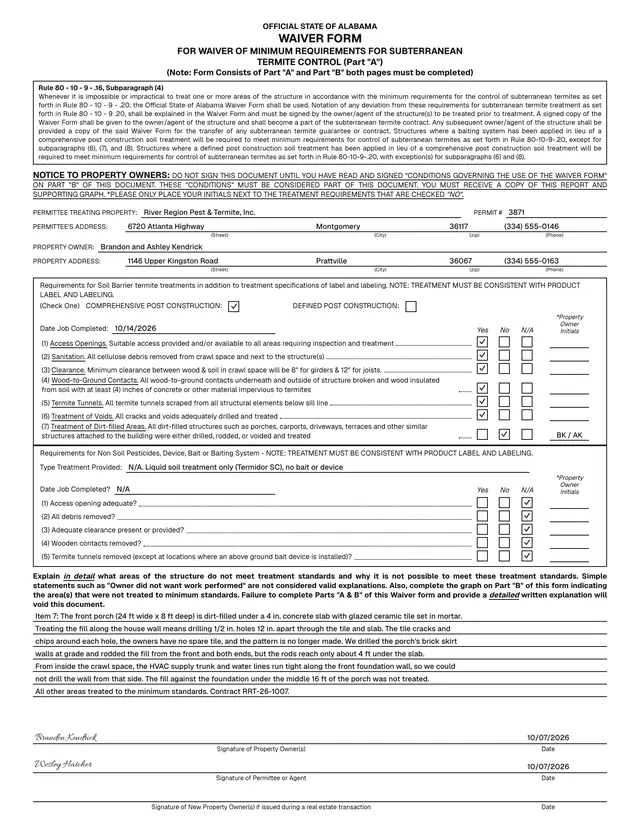
Treatment waiver templates- Alabama
Official State of Alabama Waiver Form
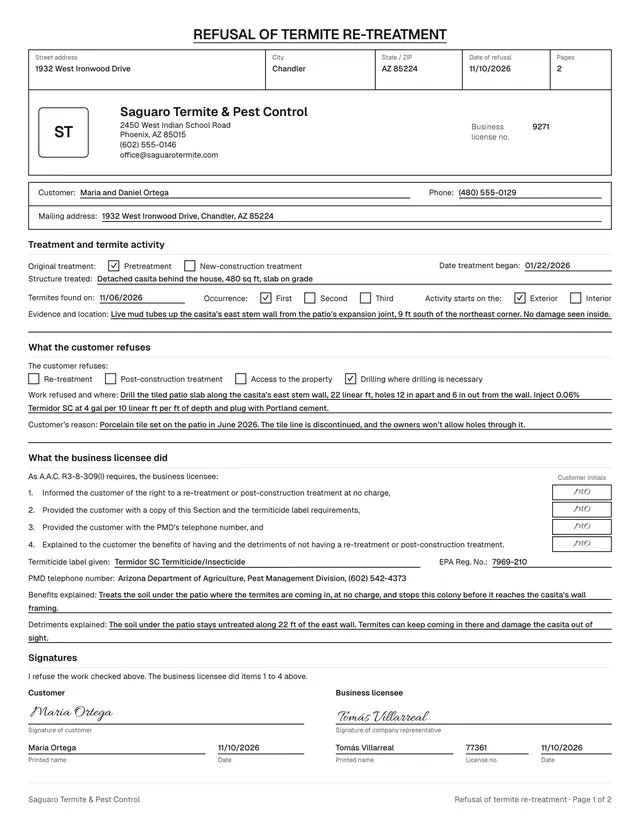
Owners sign off on termite work that won’t be done. - Arizona
Refusal of Termite Re-treatment
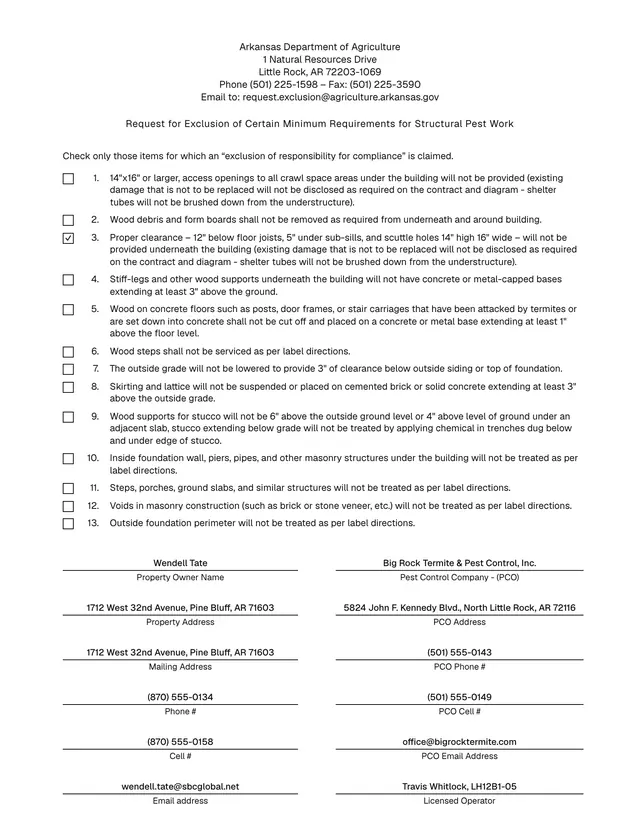
Owners sign off on termite work that won’t be done. - Arkansas
Request for Exclusion of Certain Minimum Requirements for Structural Pest Work
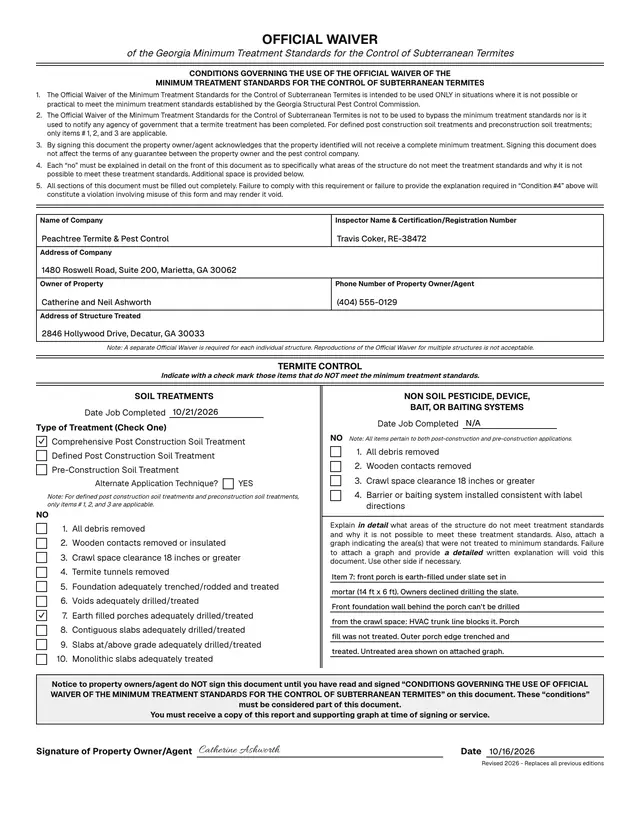
Owners sign off on termite work that won’t be done. - Georgia
Official Waiver of the Georgia Minimum Treatment Standards for the Control of Subterranean Termites
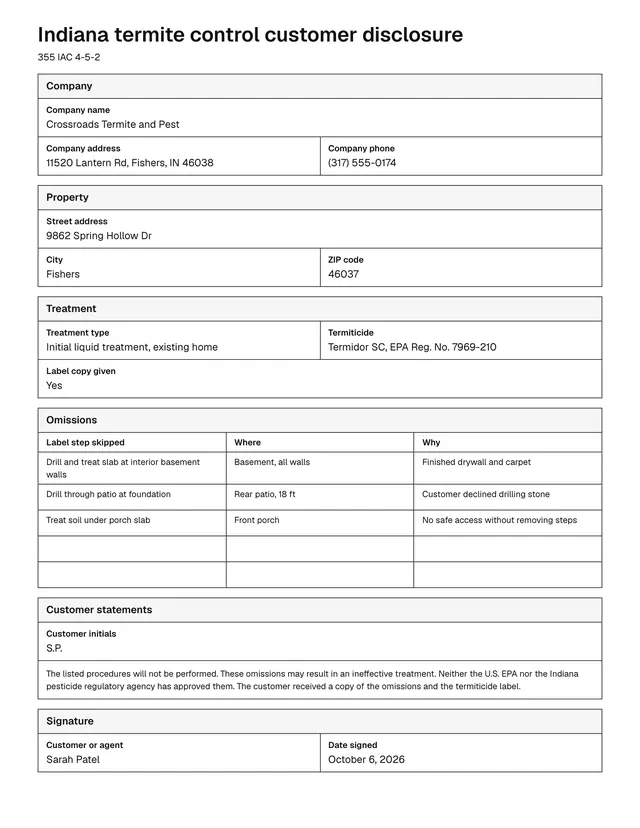
Owners sign off on termite work that won’t be done. - Indiana
Indiana termite control customer disclosure
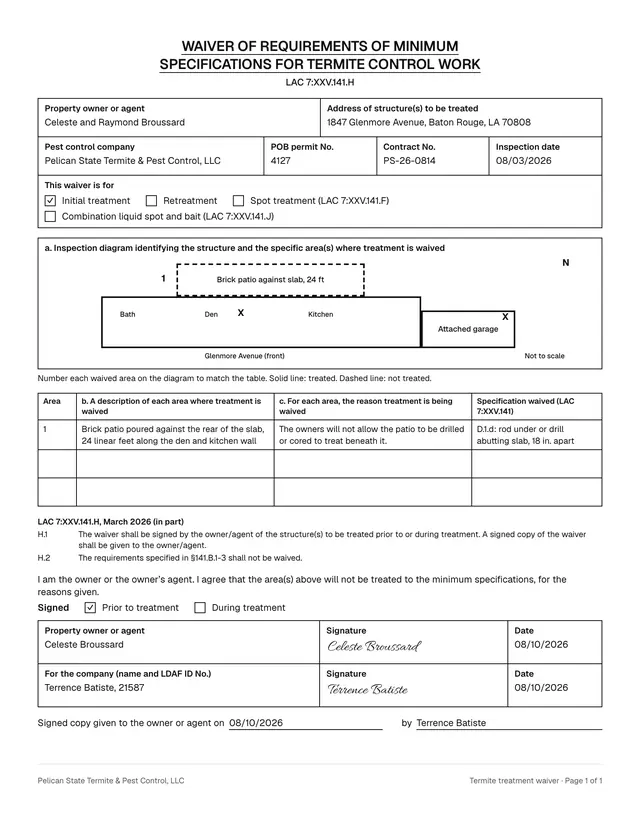
Owners sign off on termite work that won’t be done. - Louisiana
Waiver of Requirements of Minimum Specifications for Termite Control Work
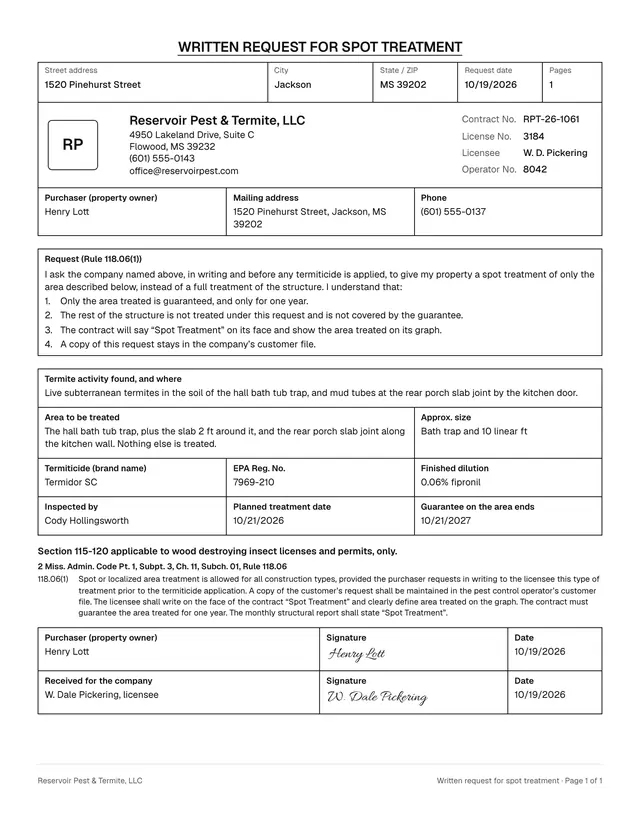
Owners sign off on termite work that won’t be done. - Mississippi
Written Request for Spot Treatment
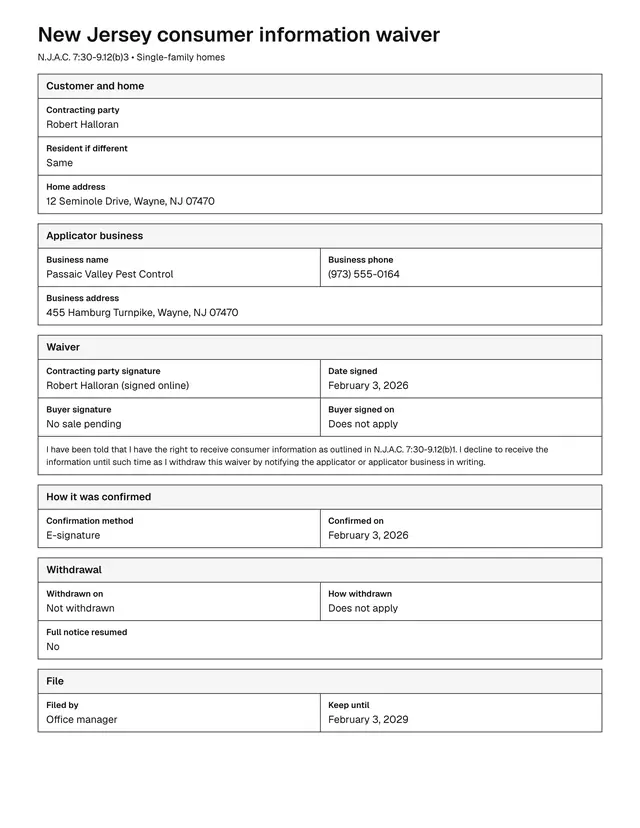
Owners sign off on termite work that won’t be done. - New Jersey
New Jersey consumer information waiver (N.J.A.C. 7:30-9.12(b)3)
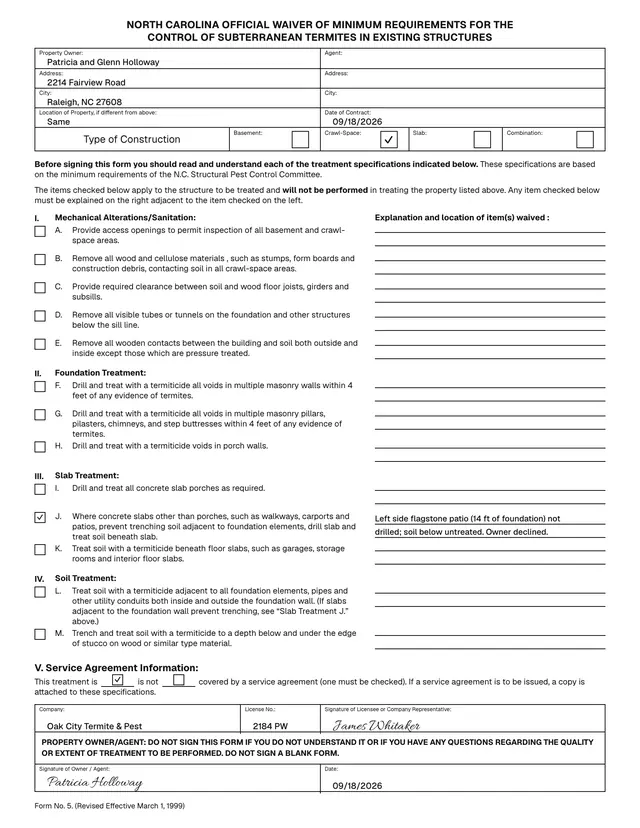
Owners sign off on termite work that won’t be done. - North CarolinaForm No. 5
North Carolina Official Waiver of Minimum Requirements
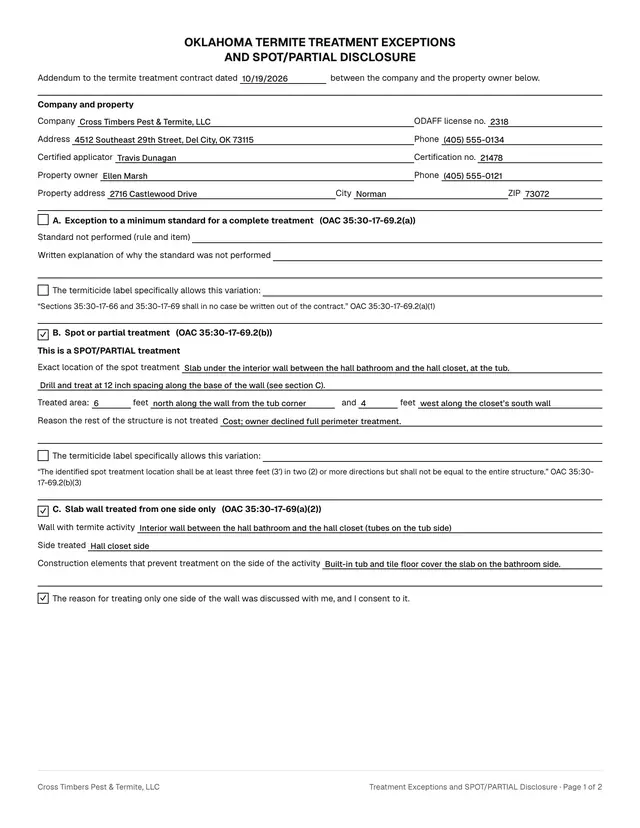
Owners sign off on termite work that won’t be done. - Oklahoma
Oklahoma Termite Treatment Exceptions and SPOT/PARTIAL Disclosure
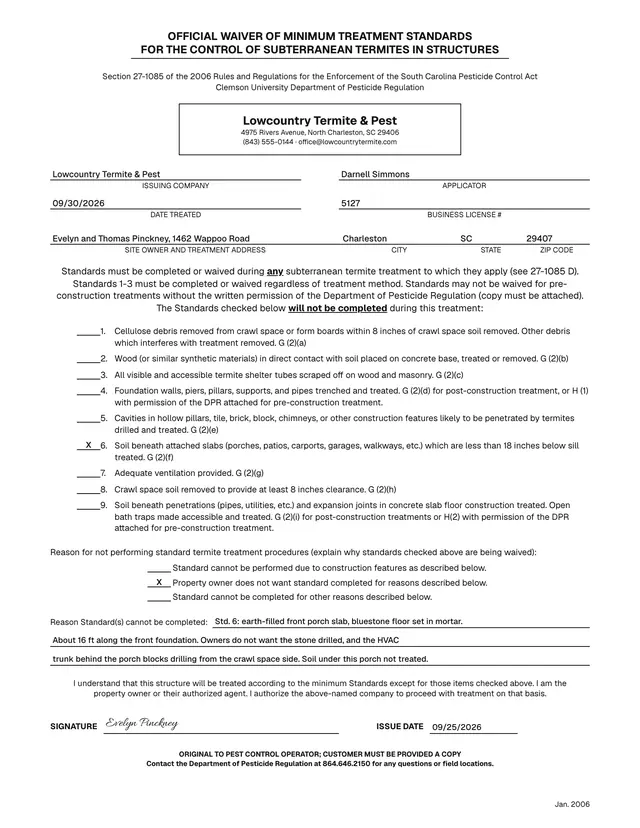
Owners sign off on termite work that won’t be done. - South Carolina
Official Waiver of Minimum Treatment Standards
Owners sign off on termite work that won’t be done.