Illinois termite treatment record and diagram
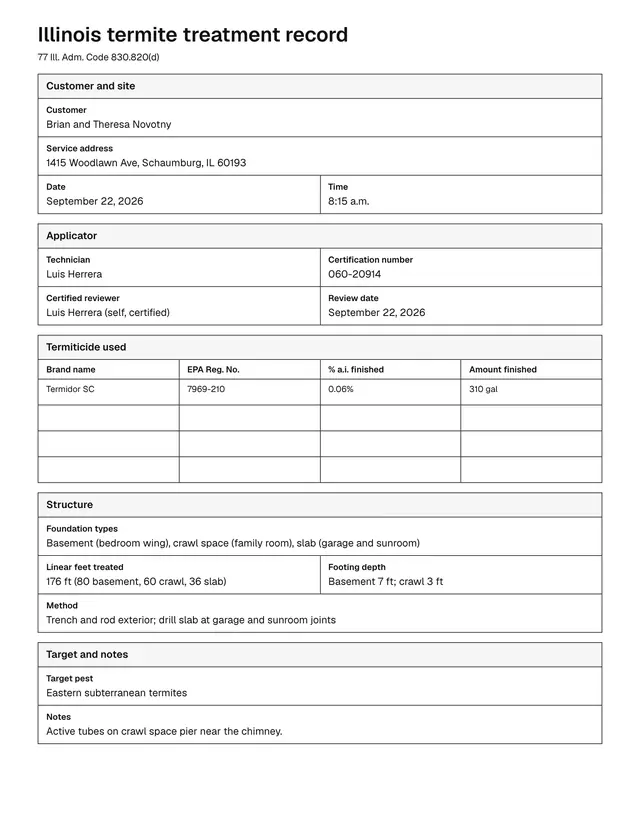
Illinois adds one item to the regular application record for termite work: a diagram showing foundation types and accurate dimensions of every part of the structure you treat.
At a glance
- Rule
- 77 Ill. Adm. Code 830.820(d)(6)
- Diagram
- Foundation types and accurate dimensions
- Keep
- 2 years at the business location
- Customer copy
- When the owner, manager, or tenant asks
Completed example
Download PDFWhat 830.820 adds for termite jobs
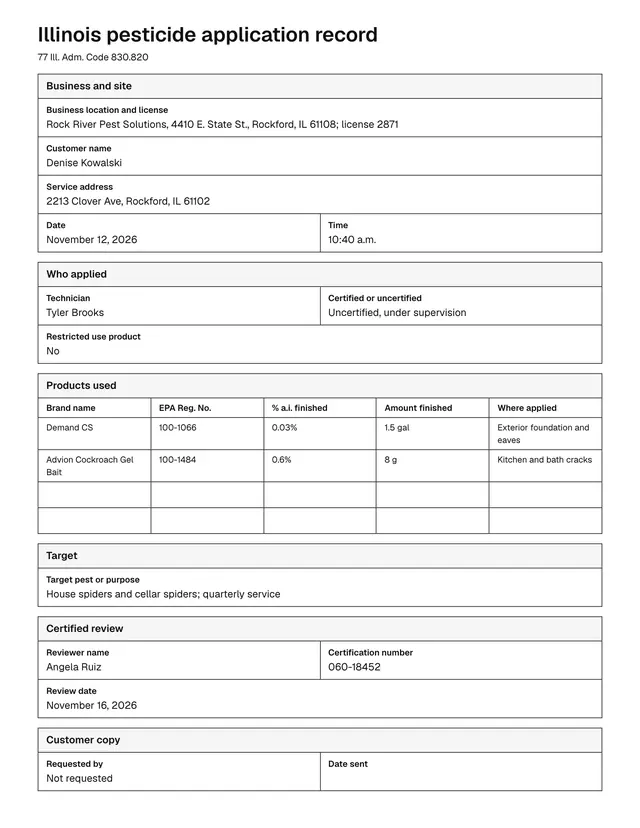
A termite job in Illinois starts with the same record as any other application. That means customer and site, technician, date and time, target pest, and for each product the brand name, EPA Reg. No., percent active ingredient in the finished product, and an amount within 10 percent. The application record page walks through those.
Then section 830.820(d)(6) adds one item: “For termite control treatments, a diagram showing foundation types and accurate dimensions of all portions of the structures being treated.” That’s it. No state form, no set scale. But the two words that matter are “all portions.”
Who does the work matters too. The business location needs a yearly IDPH license, and the applicator has to be a certified technician or work under one. That’s why the record sheet has a line for the certified reviewer.
Drawing a diagram that holds up
Plenty of Illinois houses have more than one foundation. Take a 1960s split-level in Schaumburg. The bedrooms sit over a basement, the family room is over a crawl space, and the garage and a later sunroom are on slabs. A box labeled “house, 52 x 30” misses three of the four parts.
Split the footprint. Draw each part with its own foundation type: basement, crawl space, slab, or a porch on piers. Write the real measurements. Use a tape or a laser, not a guess from the listing. Mark the work. Show trenching, drill holes through slabs, rodding under walks, and bait station numbers. Show the front. Put the street or a north arrow on the page so the next tech can turn it the right way.
The graph page on this sheet has a grid for that. One square equal to two feet works for most houses around here.
Mark what was in the way, too. A finished basement wall you couldn’t drill or a deck over the trench line explains why one side looks different. The next tech, or the next inspector, will want to know.
Getting the product line right
Termiticide amounts are where the 10 percent rule gets tested. Say you treat that Schaumburg basement with Termidor SC (EPA Reg. No. 7969-210) at 0.06%. Follow the label’s rate for linear feet and footing depth, then write the total finished gallons you actually used. If the tank gauge says 310 gallons, the record says 310, not “one tank.”
The label sets the rate, not the state. Termidor SC’s label calls for 4 gallons of finished mix per 10 linear feet per foot of depth to the footing. A 7 foot basement wall takes far more than a 3 foot crawl wall, so the total on the record should reflect both.
Write the percent of active ingredient in the finished mix, not the concentrate. And if a tech without a certification did the job, the certified tech’s review still has to be documented, with their name, certification number, and the dates of service (830.820(c)).
Who reads the diagram later
Three people, usually. IDPH can ask for it during a routine inspection of your location. The homeowner, manager, or a tenant can ask for a copy under 830.820(f), and you have to provide it.
The third reader shows up when the house sells. The buyer’s termite inspector will see old drill holes or a bait station and ask for proof. NPMA’s guidelines say that without documentation of a treatment by a licensed company, the inspector should recommend treatment. A clean record and diagram can save the seller a second treatment. That’s the Illinois termite inspection report side of the same house.
If the customer keeps a yearly service agreement, put the end date on the record. That’s the date the buyer’s inspector writes in Section V of the NPMA-33.
Where does the diagram live when the house sells in 2031?
On paper, often nowhere. The tech’s graph sheet ends up in a box, the box gets moved, and five years later the office can’t find it when the seller calls. The rule only asks for two years, but your customers will need it longer.
A homeowner selling in five years will call you, not IDPH.
Noma specializes in the Illinois termite treatment record and diagram (77 Ill. Adm. Code 830.820(d)(6)). Draw the structure diagram on the job from your phone, and schedule the yearly reinspection and renewal invoice in the same place. See how Noma handles termite jobs.
Frequentlyaskedquestions
Send this document in minutes, not an afternoon.
Other states
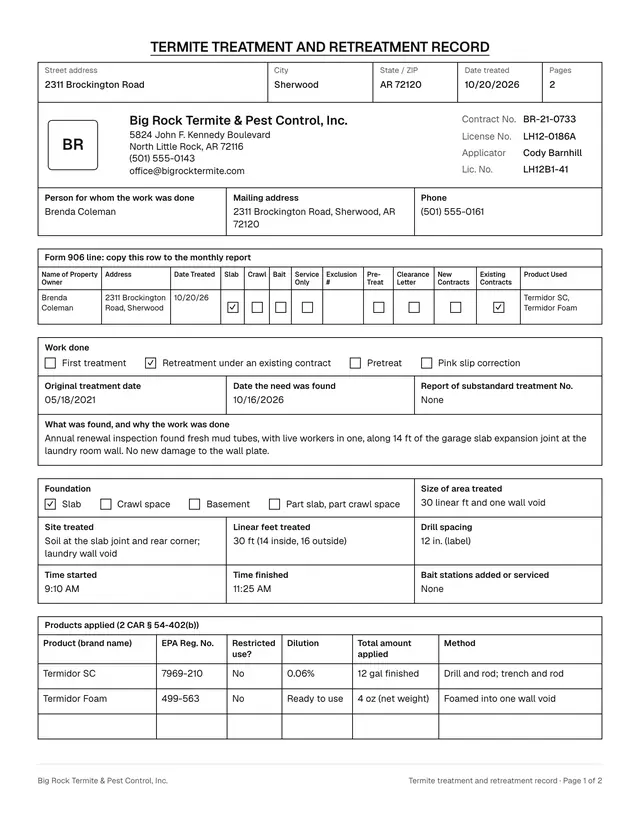
Termite treatment record templates- Arkansas
Termite Treatment and Retreatment Record
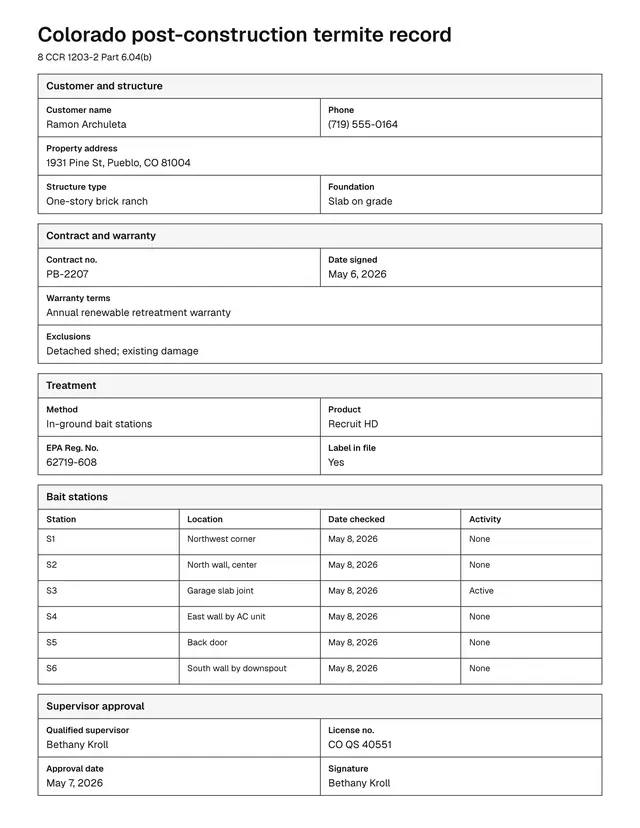
Record the termiticide, the amount, and the method for each job. - Colorado
Colorado post-construction termite treatment record (Part 6.04(b))
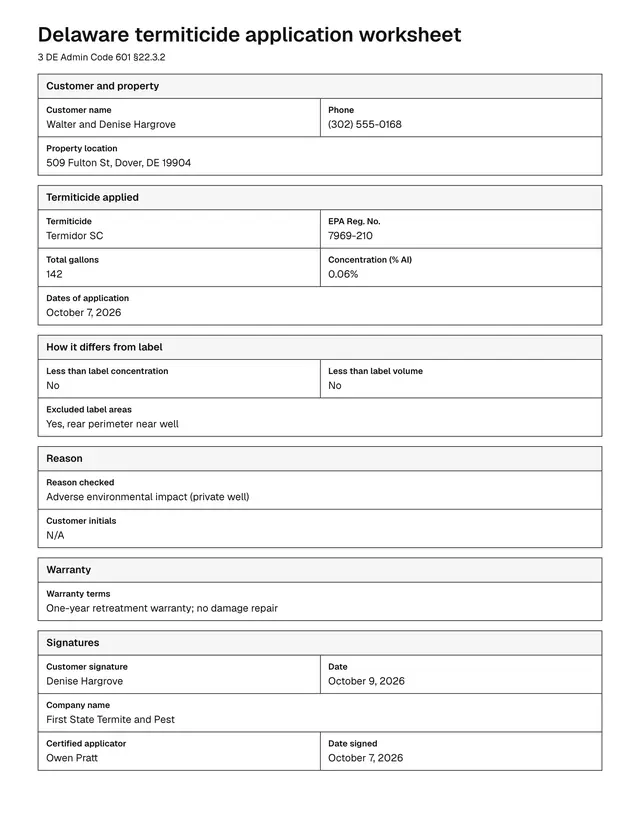
Record the termiticide, the amount, and the method for each job. - DelawareDocument # 65-01-06/01/09/02
Delaware Notice of Termiticide Application
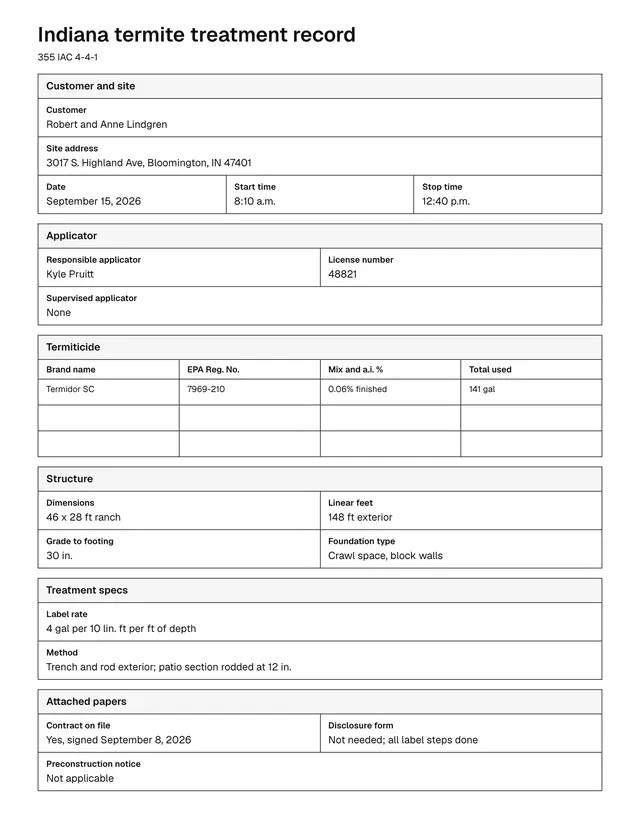
Record the termiticide, the amount, and the method for each job. - Indiana
Indiana termite treatment record and graph
Record the termiticide, the amount, and the method for each job. - Kansas
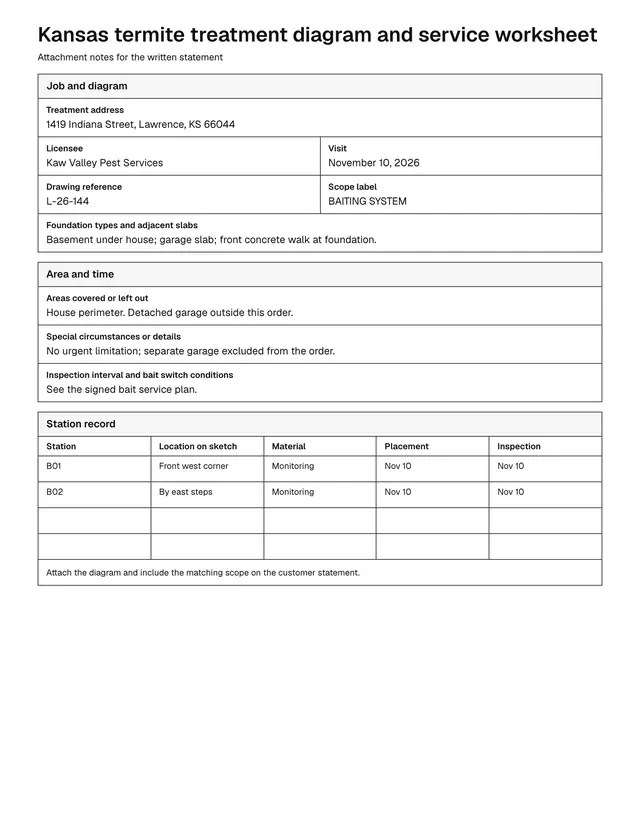
Kansas termite treatment diagram and service worksheet
Record the termiticide, the amount, and the method for each job. - Kentucky
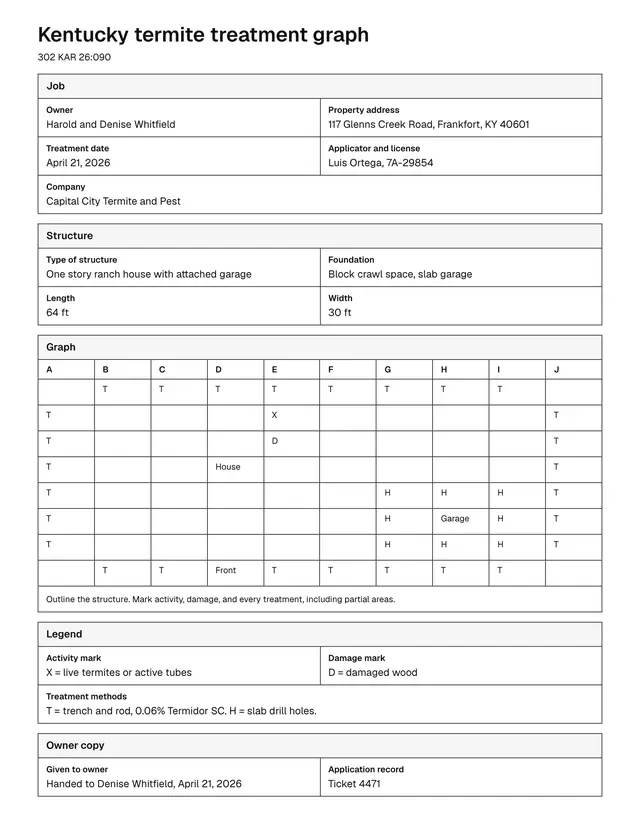
Kentucky termite treatment graph (302 KAR 26:090)
Record the termiticide, the amount, and the method for each job. - Louisiana
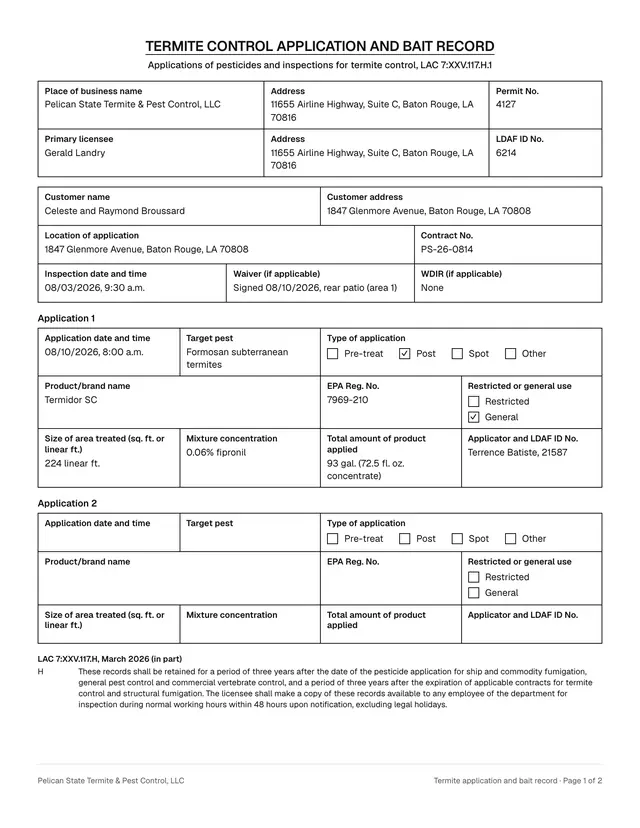
Termite Control Application and Bait Record
Record the termiticide, the amount, and the method for each job. - Maryland
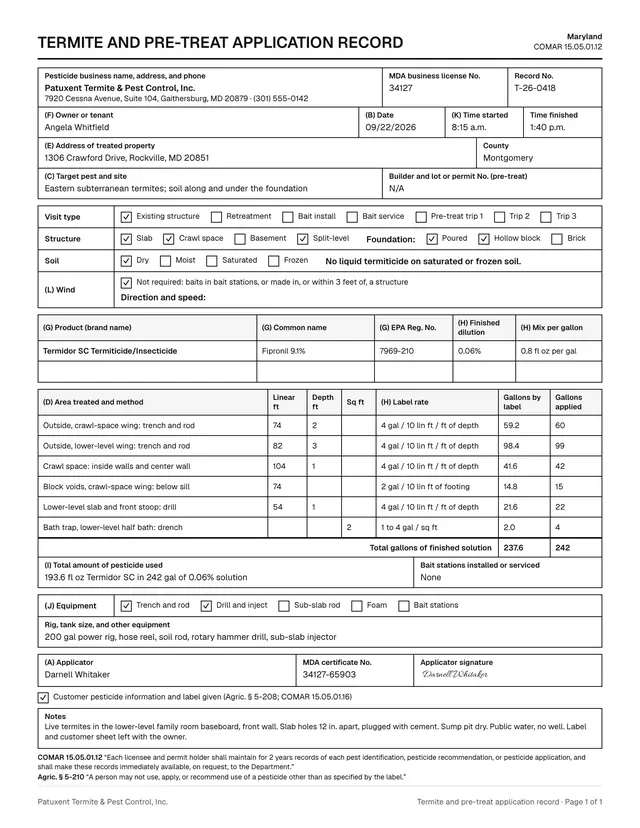
Termite and Pre-Treat Application Record
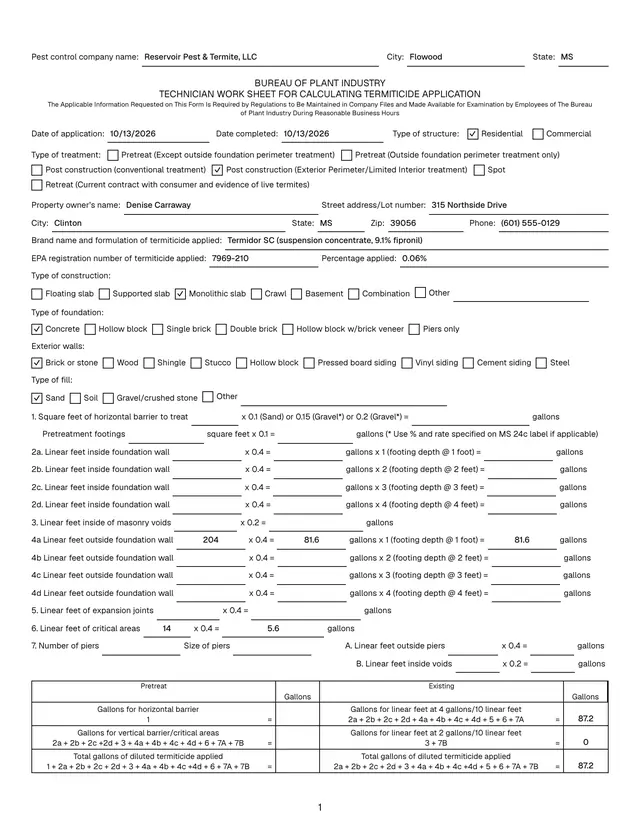
Record the termiticide, the amount, and the method for each job. - Mississippi
Technician Work Sheet for Calculating Termiticide Application
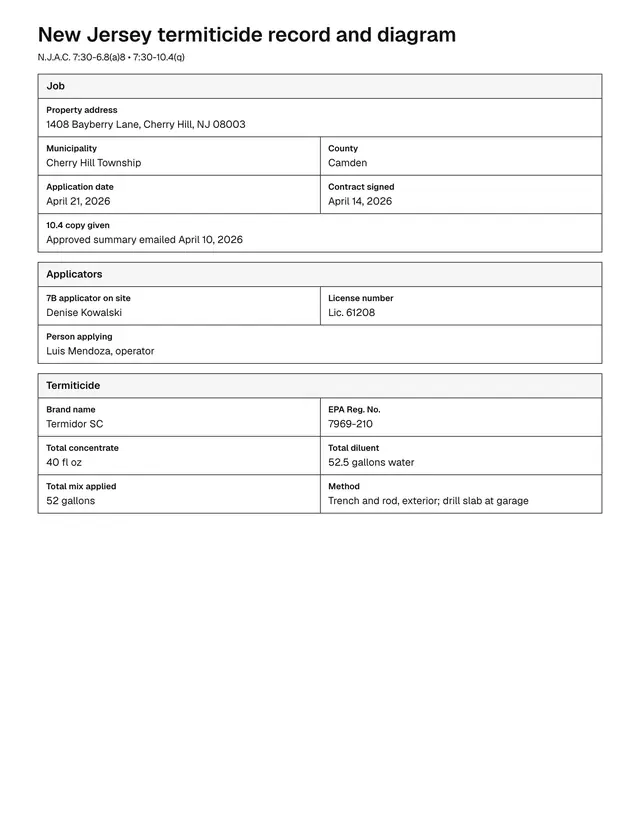
Record the termiticide, the amount, and the method for each job. - New Jersey
New Jersey termiticide record and diagram (N.J.A.C. 7:30-6.8 and 7:30-10.4)
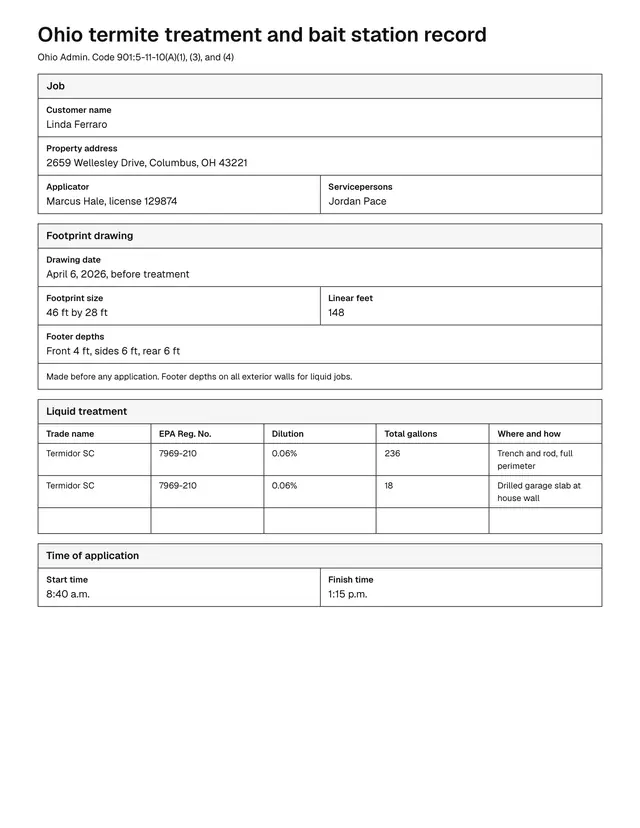
Record the termiticide, the amount, and the method for each job. - Ohio
Ohio termite treatment and bait station record
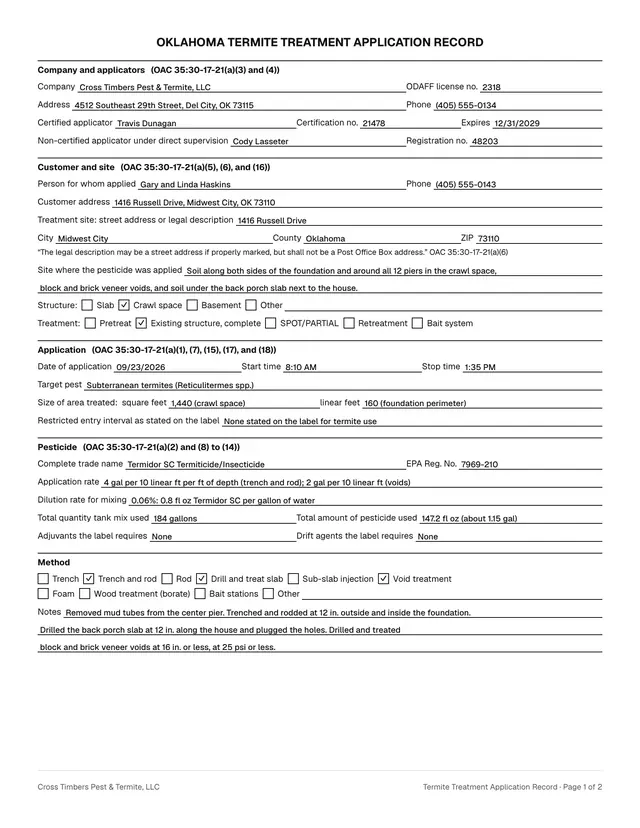
Record the termiticide, the amount, and the method for each job. - Oklahoma
Oklahoma Termite Treatment Application Record
Record the termiticide, the amount, and the method for each job. - South Carolina
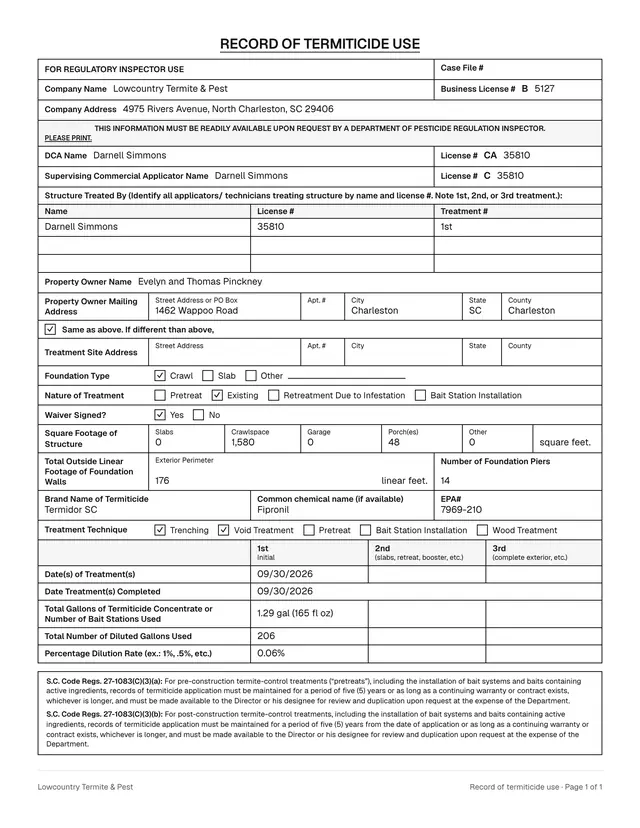
Record of Termiticide Use
Record the termiticide, the amount, and the method for each job.