Delaware Notice of Termiticide Application
When a Delaware termite job falls short of a full label treatment, the customer gets the Department of Agriculture’s Notice of Termiticide Application within 14 days. Section 22 of 3 DE Admin Code 601 says what goes on it.
At a glance
- Rule
- 3 DE Admin Code 601 §22.3.2
- Deadline
- Within 14 days of the application
- Keep for
- 2 years
- Form
- Document # 65-01-06/01/09/02
Completed example
Download PDFFull treatment is the default
Section 22.3 of 3 DE Admin Code 601 says termiticides “shall be used to establish a continuous chemical barrier in all applicable and labeled areas,” at no less than the label’s minimum concentration and volume. That’s the baseline for every soil treatment in Delaware.
The rule then allows less, but only for set reasons. Section 22.3.1 lists them: the full rate could harm the environment, like near a well, a footing drain that empties into water, or a high water table. Structural barriers or soil conditions block the full volume or limit access. Or the customer asks for less, or the certified applicator recommends it.
Two more rules frame the job. Section 22.4 says a commercial applicator certified in subcategory 7.7.2, Wood Destroying Pest Control, must be at the site. And Section 22.1 says all of this is about soil treatment. Baits, dusts, aerosols, and fumigants aren’t covered.
What goes on the notice
Any time you go below full treatment, section 22.3.2 says the customer or their agent gets certain information in writing within 14 days, on a form the Department approves. That form is the Notice of Termiticide Application, Document # 65-01-06/01/09/02.
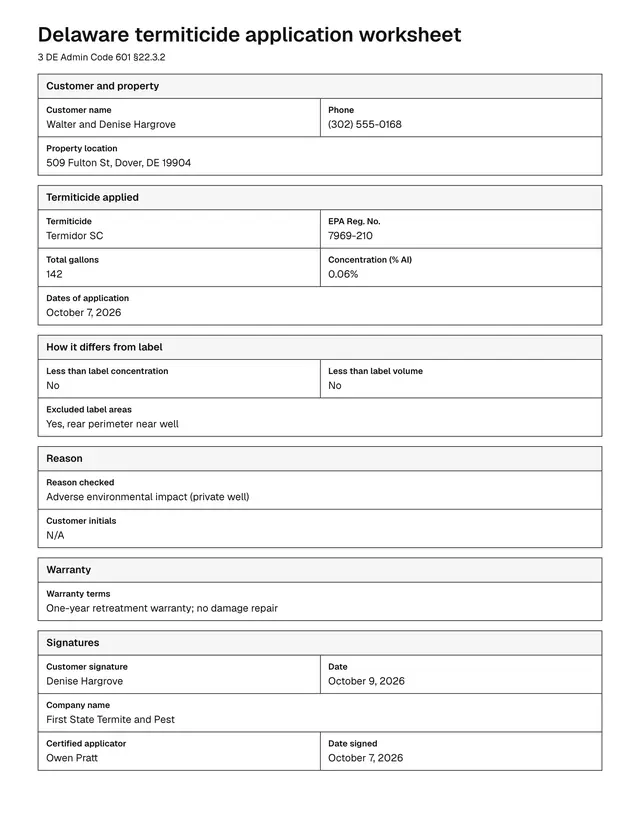
What you applied. The property location, the termiticide, its EPA Reg. No., the actual volume applied in total gallons, the concentration as percent active ingredient, and the dates of application.
How it fell short. Check boxes for less than label concentration, less than label volume, or label areas left out.
Why. Check the reason: adverse environmental impact, structural barriers that limited access, structural or soil conditions, retreatment of a limited active area, the customer asked for less, or the applicator recommended it. If the customer asked, they initial that line.
Signatures. The customer or agent signs with title and date. Your company name goes on it, and the certified applicator signs and dates it.
Attachments. A diagram showing treated areas, known well heads, and visible termite activity. The label, if the customer asks for it. And the warranty, guarantee, or service agreement terms, or a statement that there isn’t one.
An example from Dover
Say you’re treating a 1960s ranch on a crawl space in Dover with live tubes on two piers. There’s a private well 30 feet off the back porch, and you don’t want to trench termiticide right next to it. Section 22.3.1.1 names a well as an example of exactly this. You use Termidor SC, EPA Reg. No. 7969-210, mixed to 0.06%.
You treat the full perimeter and piers at label volume, except the stretch near the well, which you skip. On the notice, you check “excluded label areas” and the environmental reason. You write the total gallons you actually applied, not the gallons a full job would have taken. The diagram shows the treated perimeter, the skipped stretch, the well head, and the two active piers. You attach your one-year retreatment warranty.
The customer signs, you sign, and the whole package goes to them within 14 days. You can check any product’s label in the EPA label search.
Copies, records, and pretreats
The form is built for three copies: the original to the customer, copy 1 to the applicator, and copy 2 for a duplicate file. Section 22.3.2.5.2 says you keep completed copies for 2 years from the date of application, and 22.3.2.5.3 says the Department can ask to see them.
Pre-construction work is different. Section 22.6 says pretreats follow the label and EPA PR Notice 96-7, and no pretreat goes below the label’s dosage or concentration. The notice itself says the same thing: all pre-construction treatments must be done at full label volume and concentration. So a partial pretreat isn’t an option.
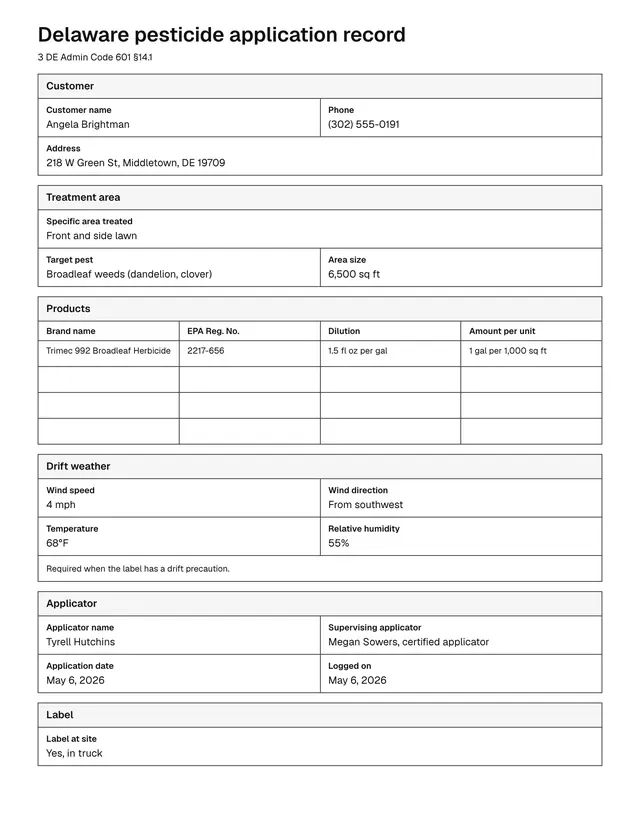
You still need the regular job record too. See the Delaware application record for what section 14.1 asks for.
How do you get the customer’s signature without a second trip?
The notice needs the customer’s signature, and sometimes their initials on the “customer requested” line. If the homeowner isn’t home on treatment day, that turns into a second visit or a stack of mailed forms that never come back.
Noma specializes in the Delaware Notice of Termiticide Application (3 DE Admin Code 601 §22.3.2). Upload the notice once as a reusable document and send it for e-signature on each job, and draw the treatment diagram on the job so it’s ready to attach. See how Noma gets termite notices signed.
Helpful resources
Frequentlyaskedquestions
Send this document in minutes, not an afternoon.
Other states
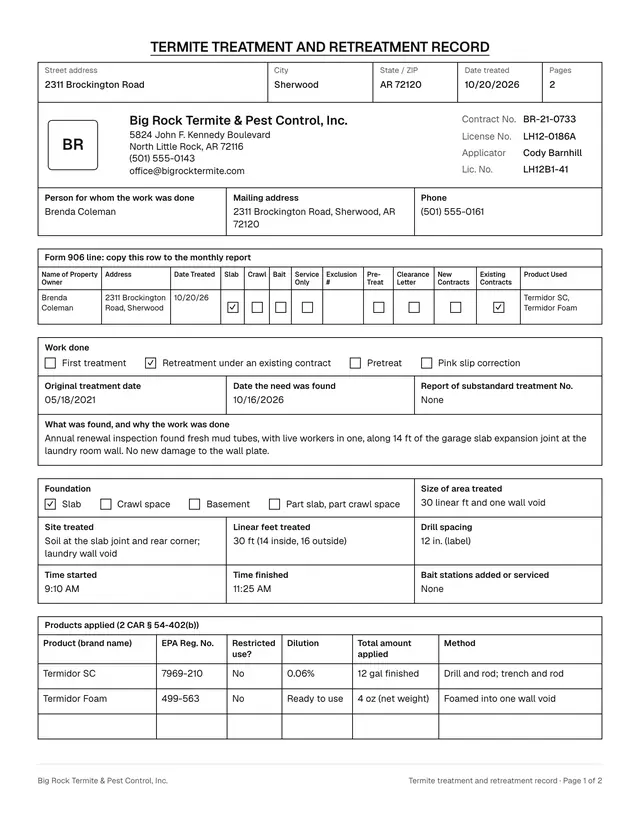
Termite treatment record templates- Arkansas
Termite Treatment and Retreatment Record
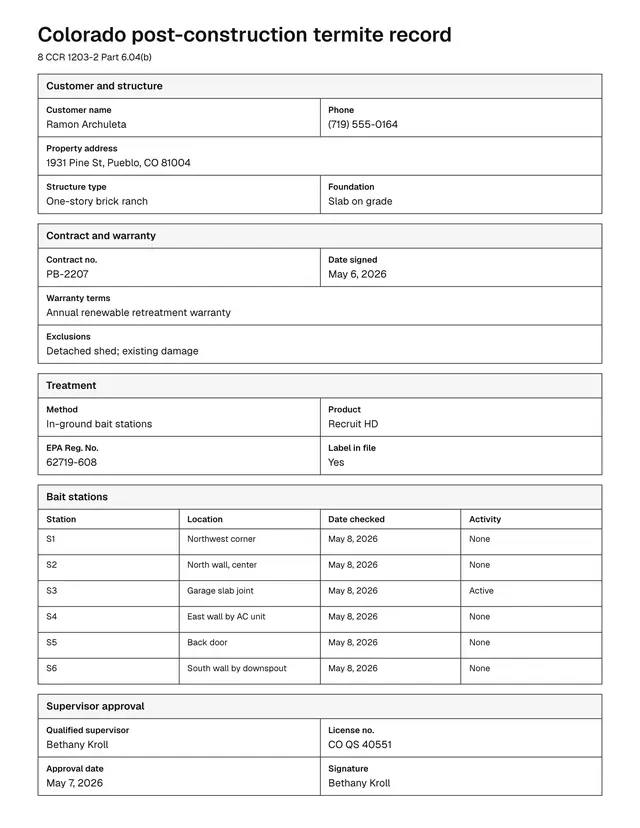
Record the termiticide, the amount, and the method for each job. - Colorado
Colorado post-construction termite treatment record (Part 6.04(b))
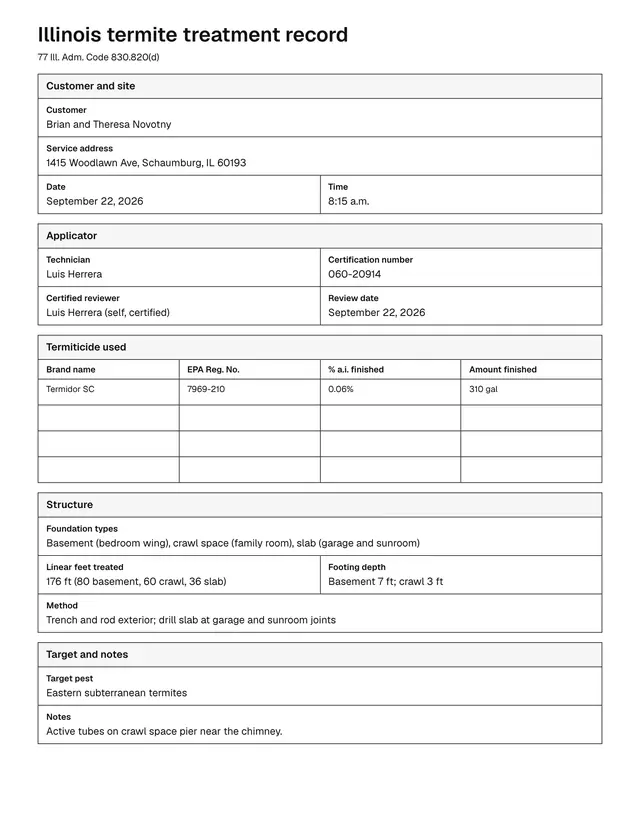
Record the termiticide, the amount, and the method for each job. - Illinois
Illinois termite treatment record and diagram
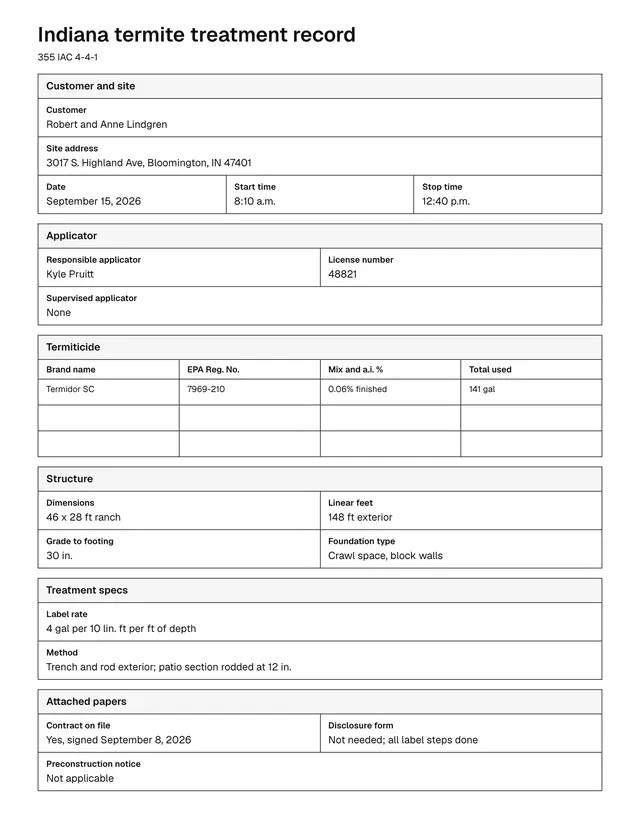
Record the termiticide, the amount, and the method for each job. - Indiana
Indiana termite treatment record and graph
Record the termiticide, the amount, and the method for each job. - Kansas
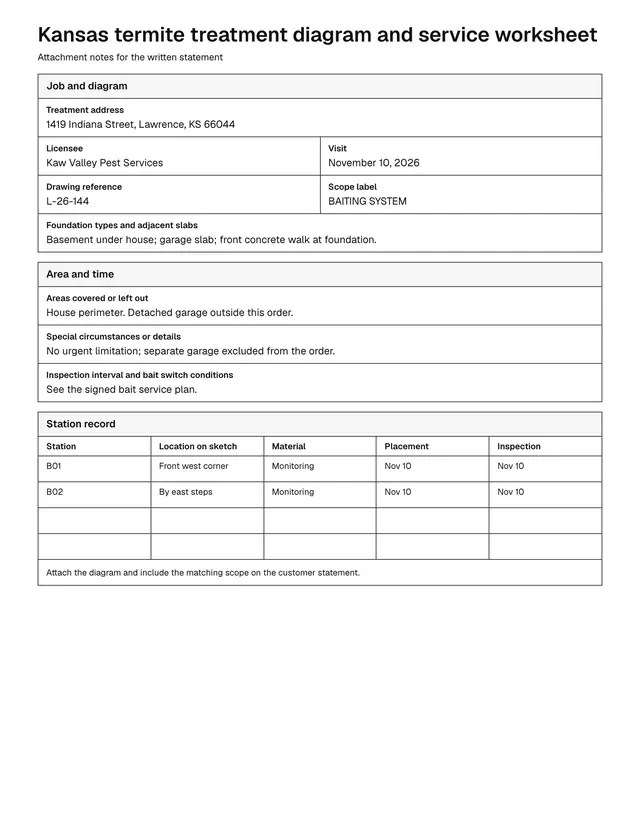
Kansas termite treatment diagram and service worksheet
Record the termiticide, the amount, and the method for each job. - Kentucky
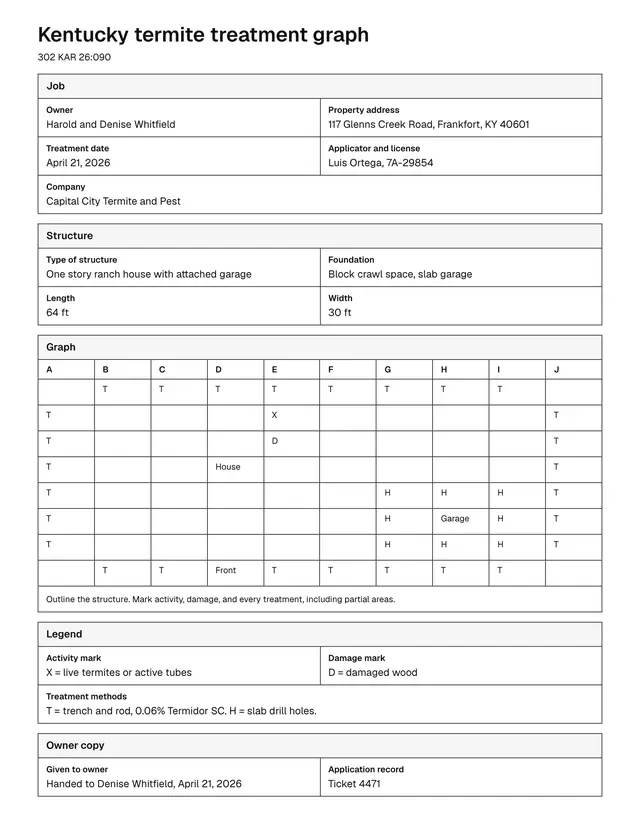
Kentucky termite treatment graph (302 KAR 26:090)
Record the termiticide, the amount, and the method for each job. - Louisiana
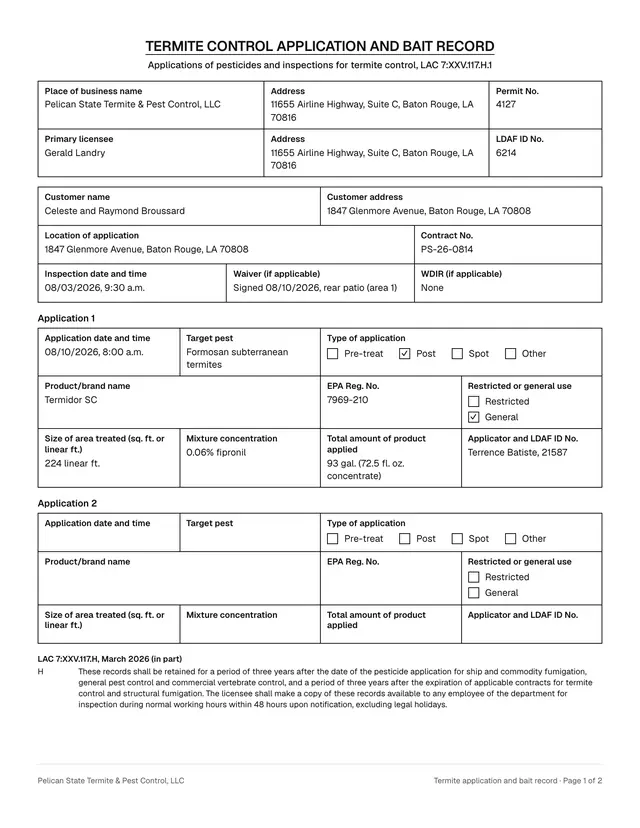
Termite Control Application and Bait Record
Record the termiticide, the amount, and the method for each job. - Maryland
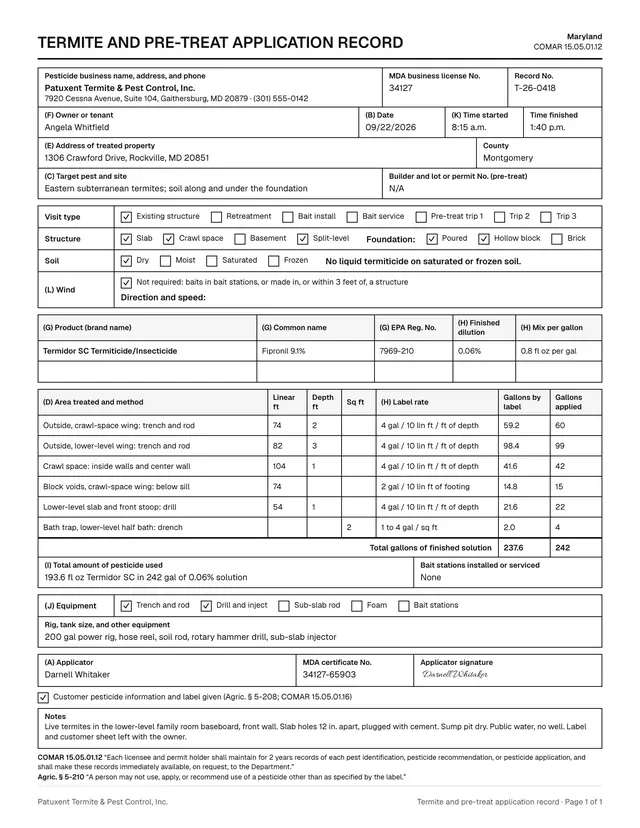
Termite and Pre-Treat Application Record
Record the termiticide, the amount, and the method for each job. - Mississippi
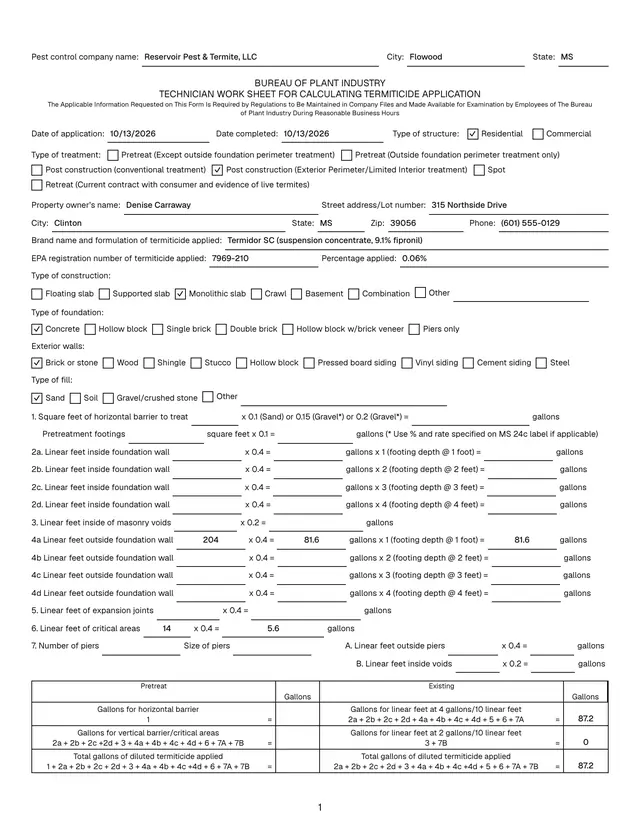
Technician Work Sheet for Calculating Termiticide Application
Record the termiticide, the amount, and the method for each job. - New Jersey
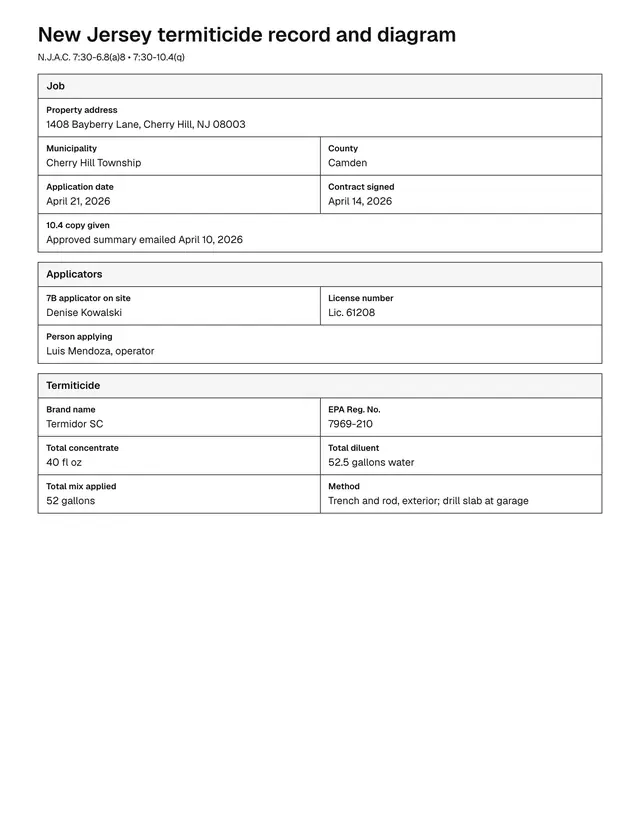
New Jersey termiticide record and diagram (N.J.A.C. 7:30-6.8 and 7:30-10.4)
Record the termiticide, the amount, and the method for each job. - Ohio
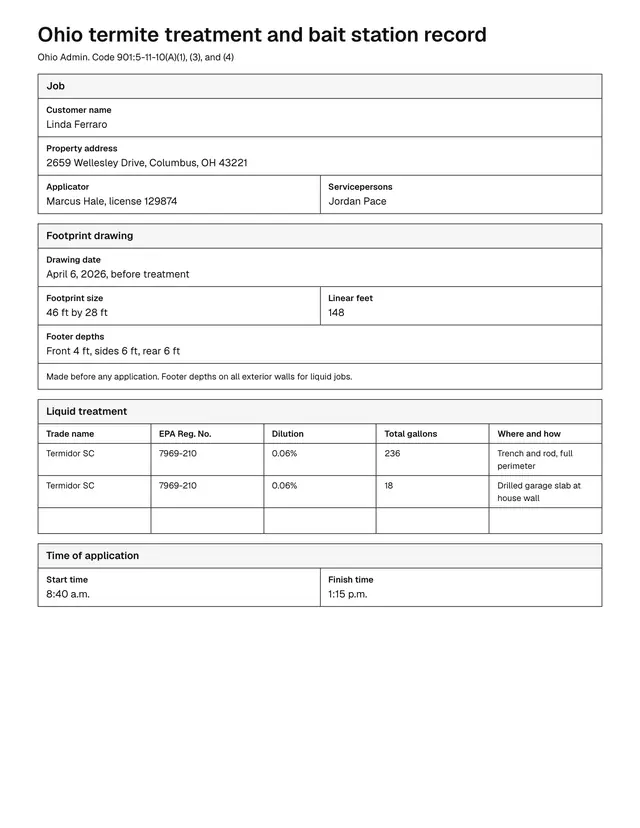
Ohio termite treatment and bait station record
Record the termiticide, the amount, and the method for each job. - Oklahoma
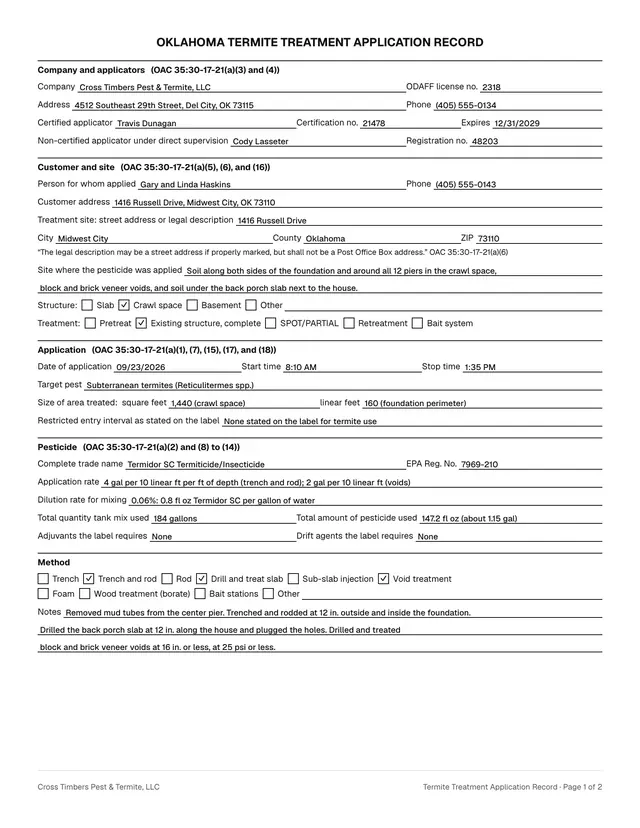
Oklahoma Termite Treatment Application Record
Record the termiticide, the amount, and the method for each job. - South Carolina
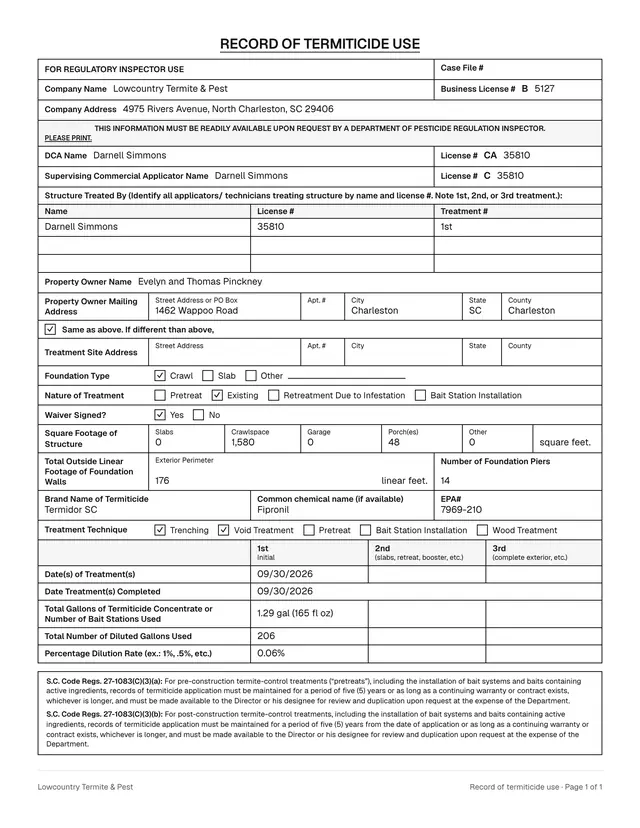
Record of Termiticide Use
Record the termiticide, the amount, and the method for each job.