Delaware pesticide application record (3 DE Admin Code 601 §14.1)
Delaware wants each commercial pesticide job logged within 24 hours and kept for two years. Section 14.1 of the state’s pesticide rules lists what the log needs, including weather when the label warns about drift.
At a glance
- Rule
- 3 DE Admin Code 601 §14.1
- Log within
- 24 hours of the application
- Keep for
- 2 years
- Agency
- Delaware Department of Agriculture
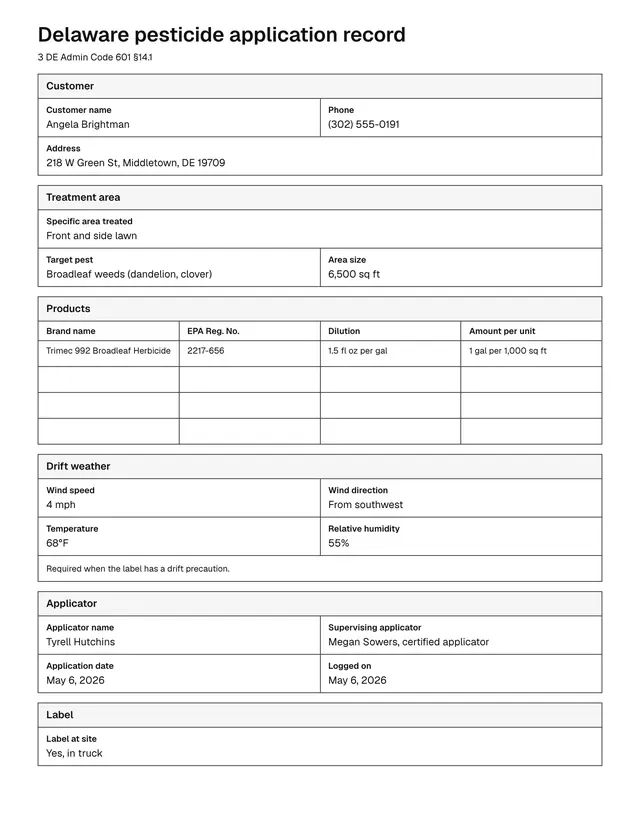
Completed example
Download PDFWhat Delaware wants on file
Section 14.1 of 3 DE Admin Code 601 says commercial applicators shall, “for a period of 2 years from the date of application, keep records detailing the application of any pesticides.” Any pesticide, not just restricted use products. A perimeter spray, a lawn weed control round, and a termite job all need a record.
Section 21.4 adds a point for sensitive sites. General use pesticide jobs in schools, apartment buildings, nursing homes, hospitals, and child day-care centers are recorded the same way, under 14.1.
Field by field
Brand name, always. Section 14.1.1 requires the brand name of every product. For a restricted use pesticide, or a product used under the federal Worker Protection Standard in 40 CFR Part 170, you also record the EPA registration number “at or before the time of application.” Most residential jobs aren’t either one, but writing the number costs you nothing and settles any question later.
Dilution and amount per unit. Section 14.1.2 wants, when it applies, the dilution rate and how much mixed material went down per unit. The rule’s own examples are “gallons/acre, lbs./acre.” For lawns, per 1,000 square feet is common.
Date, place, and customer. Section 14.1.3 asks for the date, the specific area treated, and the name and address of who it was for. Notice there’s no time of day here. Delaware asks for the date, not a start or stop time.
Pest, site, and size. Section 14.1.4 wants the pest, the crop or site, and the size of the treated area.
Who applied it. Section 14.1.5 asks for the applicator’s name. If a registered service employee did the work, add the certified applicator responsible for supervising them.
The weather box most people skip
Section 14.1.6 is the one that makes Delaware records different. When the label advises precautions about drift, you record on-site weather: wind speed and direction, temperature, and relative humidity.
Liquid lawn herbicides are the usual case. Say you’re spraying Trimec 992 Broadleaf Herbicide, EPA Reg. No. 2217-656, on a front yard in Middletown. If its label has drift precautions, write down something like 4 mph from the southwest, 68°F, and 55% humidity, taken at the site. A handheld weather meter in the truck is the easy way. A phone app reading from the airport isn’t the same as the yard you’re standing in.
You can look up any label in the EPA label search to check whether it carries drift language.
The label, the neighbors, and the 24-hour rule
Section 14.1.7 says you must have a copy of the label at the application site. It also says that if a person “at or adjacent to the application site” asks, you give them any information on the label. That’s the neighbor leaning over the fence asking what you just sprayed.
Section 14.1.8 sets the timing. Records must be “logged immediately or within 24 hours of completion of the pesticide application,” unless there’s good cause. Writing up Monday’s route on Thursday breaks the rule even if every detail is right.
Put it all together and one lawn stop reads like this: Angela Brightman, 218 W Green St, Middletown. May 6. Front and side lawn, 6,500 square feet, broadleaf weeds. Trimec 992 Broadleaf Herbicide, 2217-656, 1.5 fl oz per gallon, 1 gallon per 1,000 square feet. Wind 4 mph from the southwest, 68°F, 55% humidity. Tyrell Hutchins, supervised by Megan Sowers. Logged the same day.
Note what section 14.1 doesn’t ask for. There’s no time of day, no customer signature, and no copy that has to go to the customer. It’s your office record, kept for the Department.
How do you hit 24 hours on a 20-stop day?
The risk isn’t that techs skip records. It’s that they save them for the end of the day, then the end of the week. By then the wind reading is a guess. The fix is logging at the stop, before the truck moves, while the weather meter is still in hand.
Noma specializes in the Delaware pesticide application record (3 DE Admin Code 601 §14.1). Your techs work each stop from the app on their phones, and Noma keeps the route on the schedule and sends invoices customers can pay online. See how Noma runs pest and lawn routes.
Frequentlyaskedquestions
Send this document in minutes, not an afternoon.
Other states
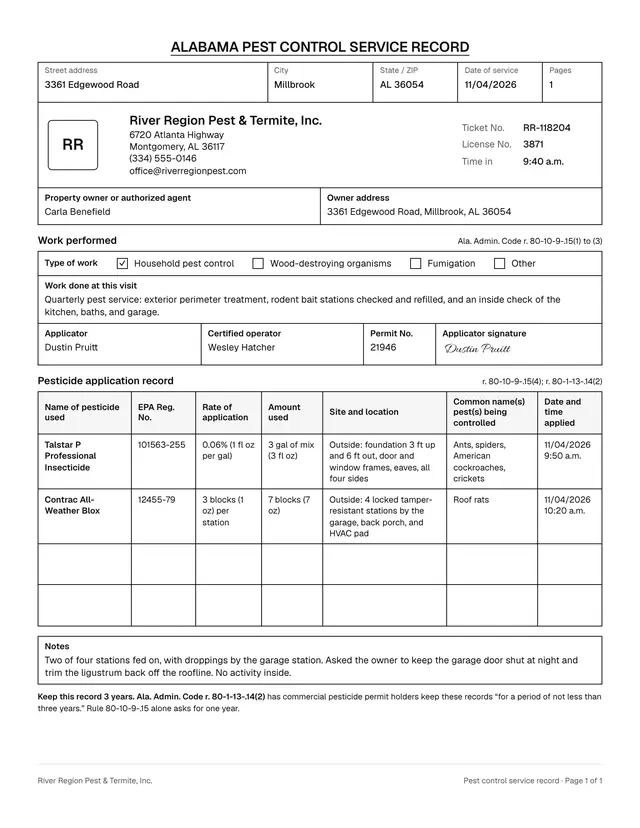
After-treatment notice templates- Alabama
Alabama Pest Control Service Record
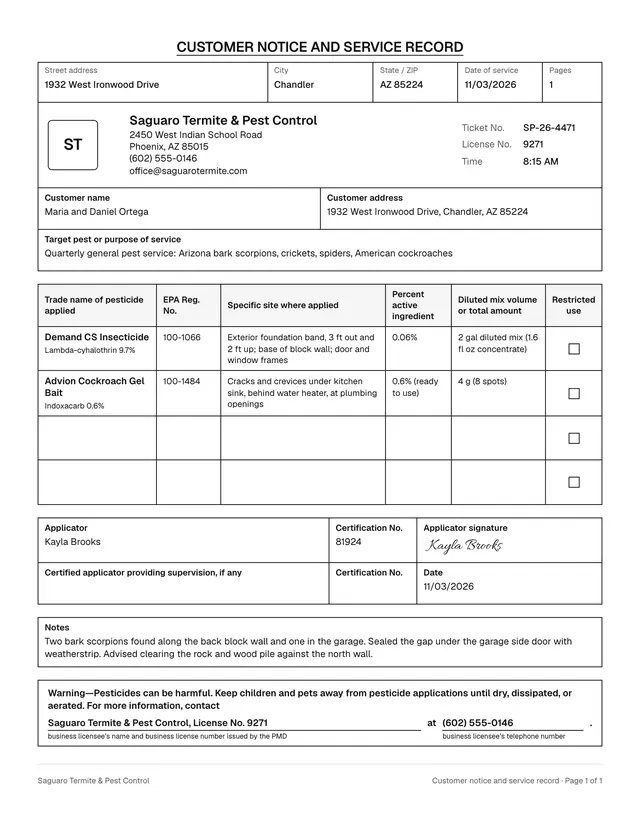
Record each pesticide applied at a service visit. - Arizona
Customer Notice and Service Record
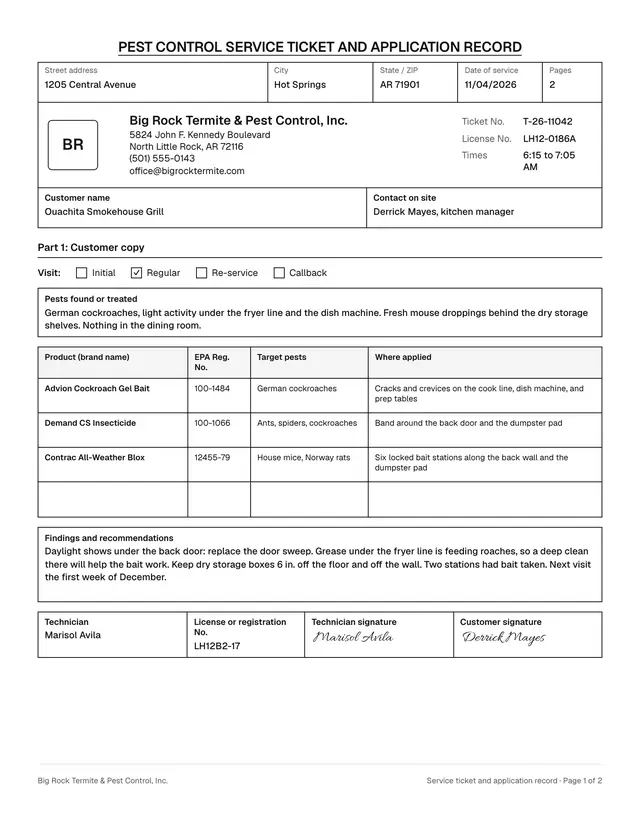
Record each pesticide applied at a service visit. - Arkansas
Pest Control Service Ticket and Application Record
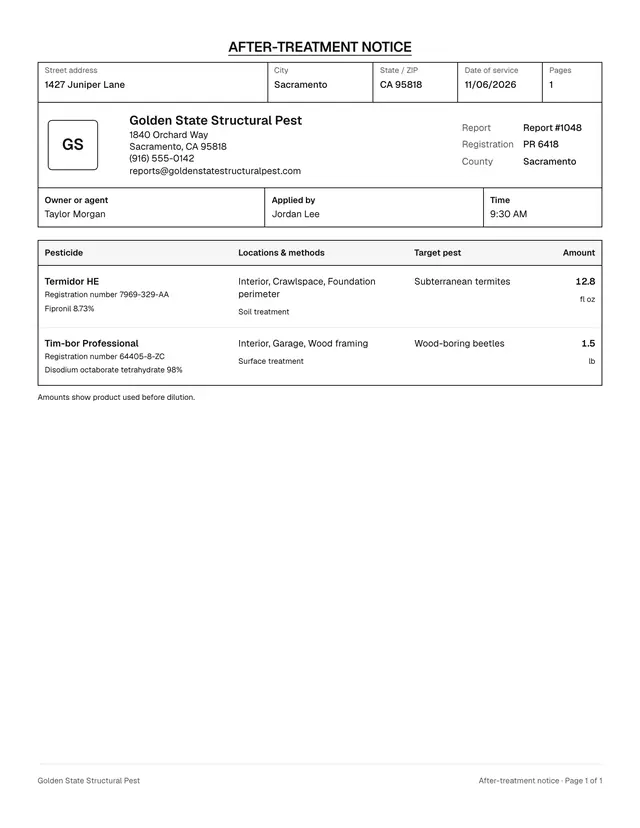
Record each pesticide applied at a service visit. - California
After-Treatment Notice
Record each pesticide applied at a service visit. - Colorado
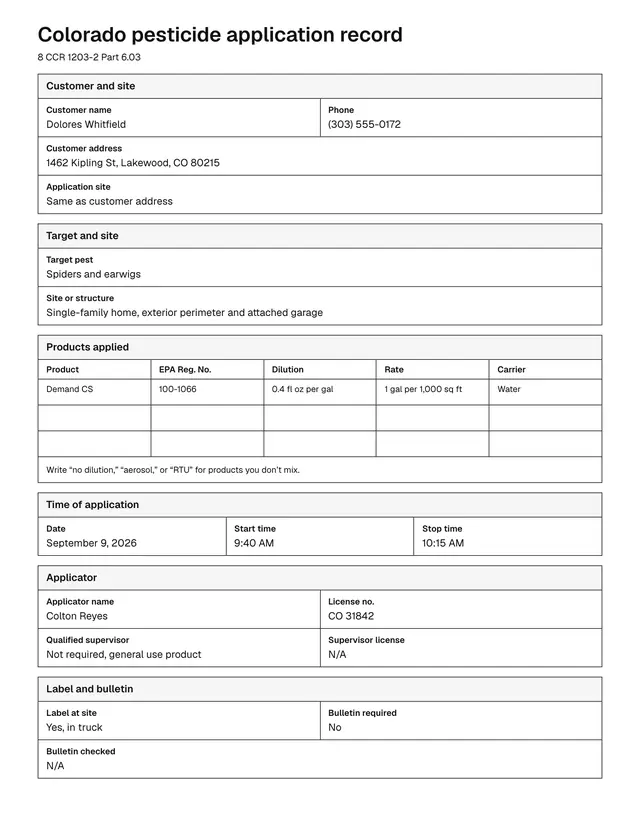
Colorado commercial pesticide application record
Record each pesticide applied at a service visit. - Connecticut
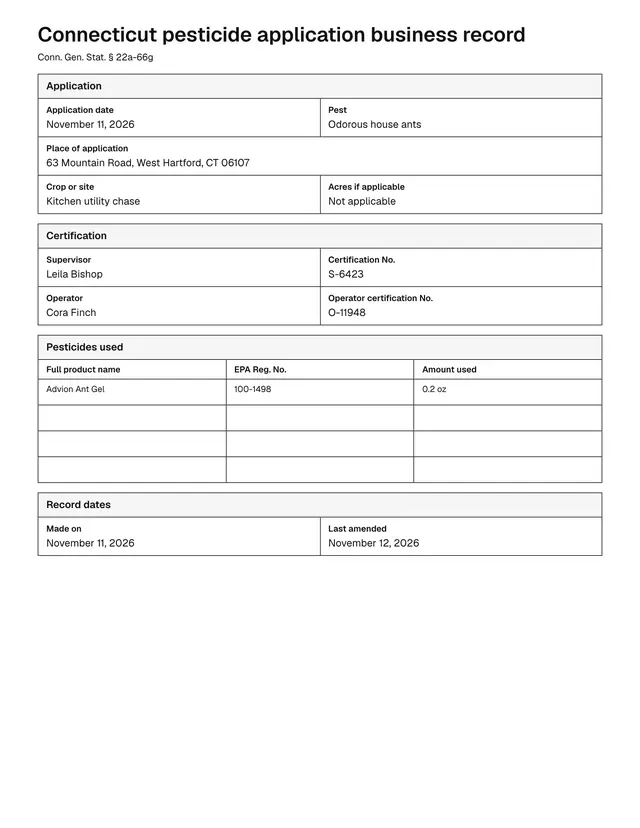
Connecticut pesticide application business record
Record each pesticide applied at a service visit. - Georgia
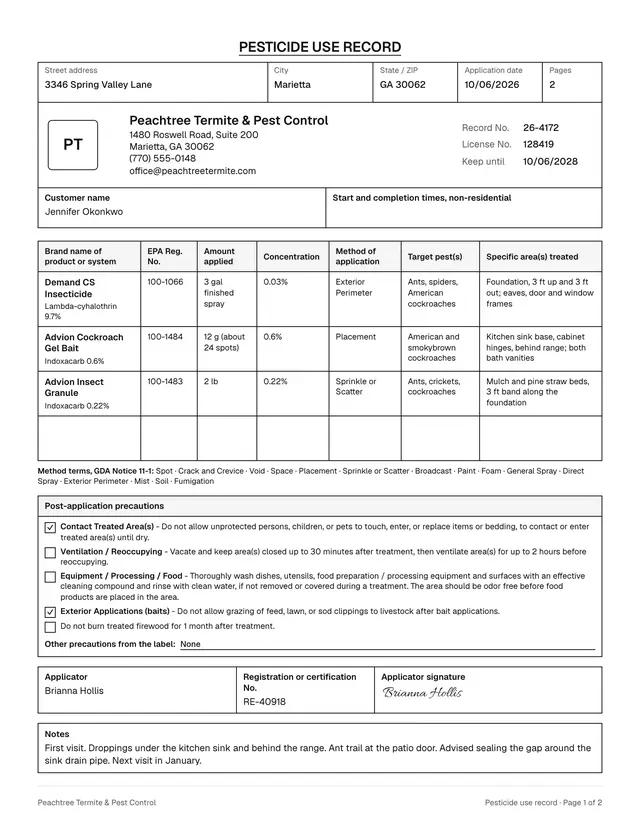
Pesticide Use Record
Record each pesticide applied at a service visit. - Hawaii
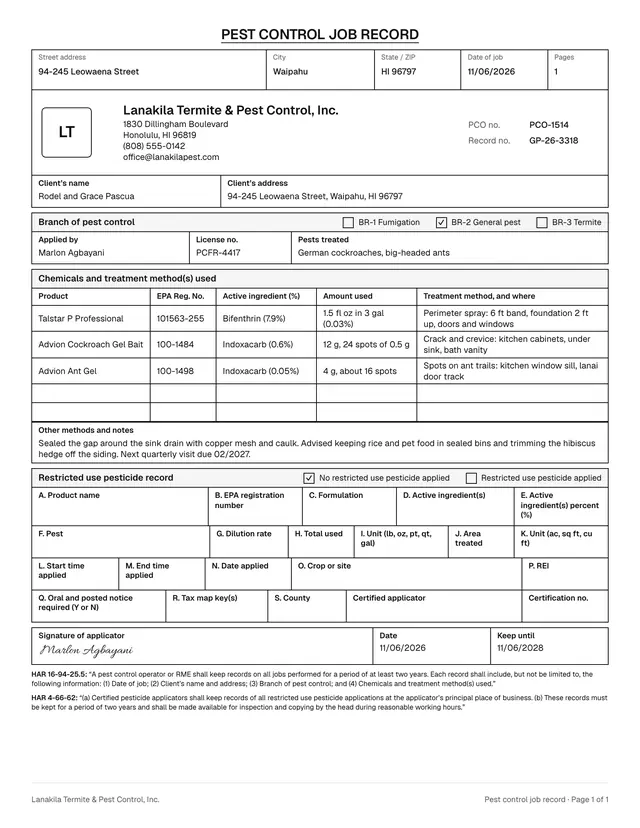
Pest Control Job Record
Record each pesticide applied at a service visit. - Illinois
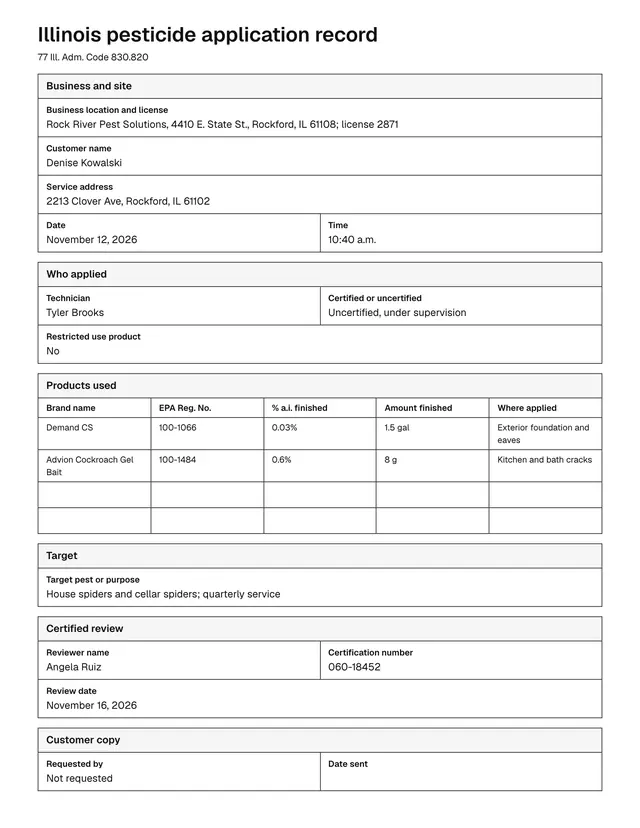
Illinois structural pest control application record
Record each pesticide applied at a service visit. - Indiana
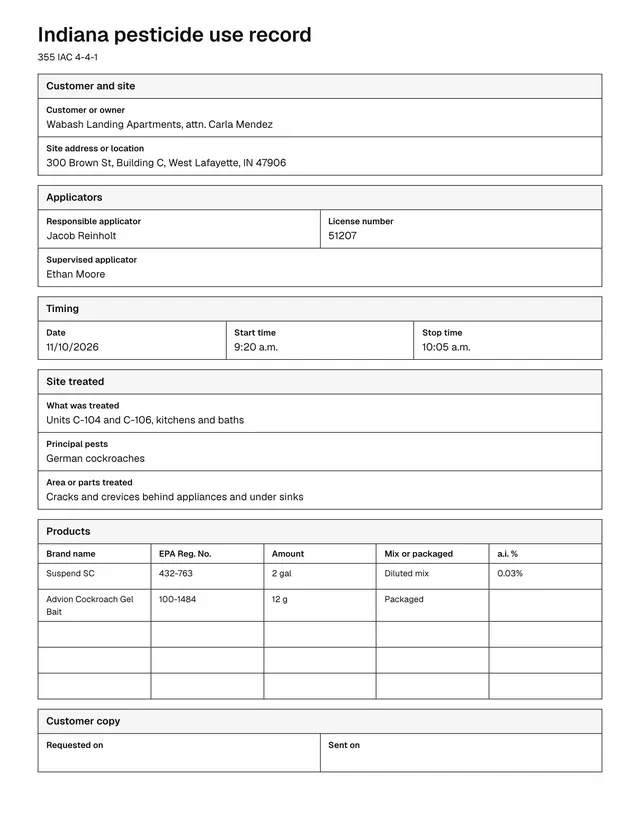
Indiana commercial applicator pesticide use record
Record each pesticide applied at a service visit. - Iowa
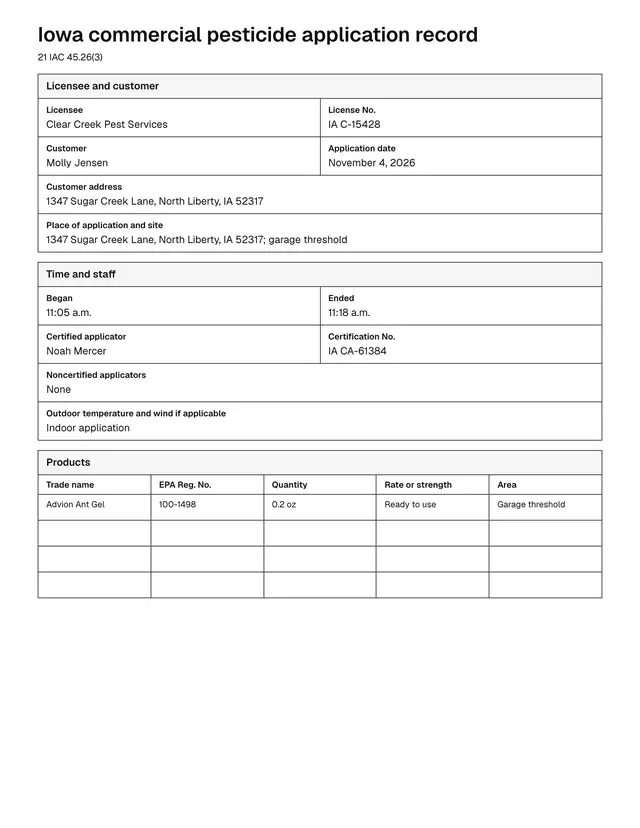
Iowa commercial pesticide application record
Record each pesticide applied at a service visit. - Kansas
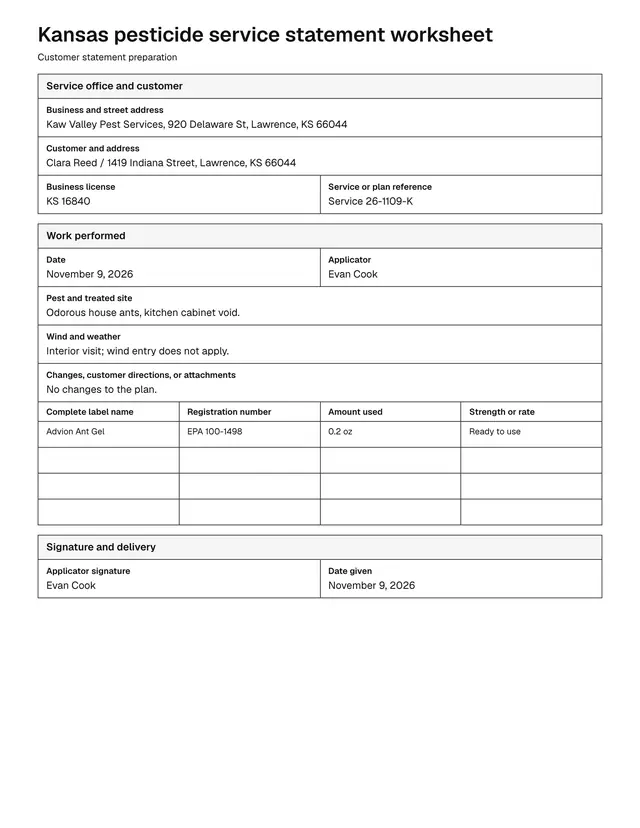
Kansas pesticide service statement worksheet
Record each pesticide applied at a service visit. - Kentucky
Kentucky pesticide application record (302 KAR 26:030)
Record each pesticide applied at a service visit. - Louisiana
General Pest Application Record
Record each pesticide applied at a service visit. - Maryland
Pesticide Application Record and Customer Pesticide Information
Record each pesticide applied at a service visit. - Massachusetts
Massachusetts pesticide application record (333 CMR 10.14)
Record each pesticide applied at a service visit. - Michigan
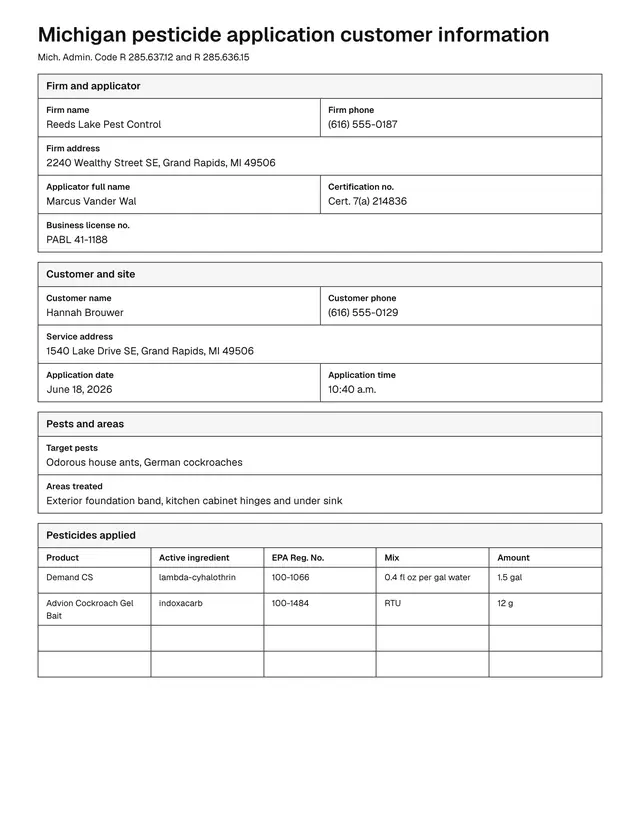
Michigan pesticide customer information receipt
Record each pesticide applied at a service visit. - Mississippi
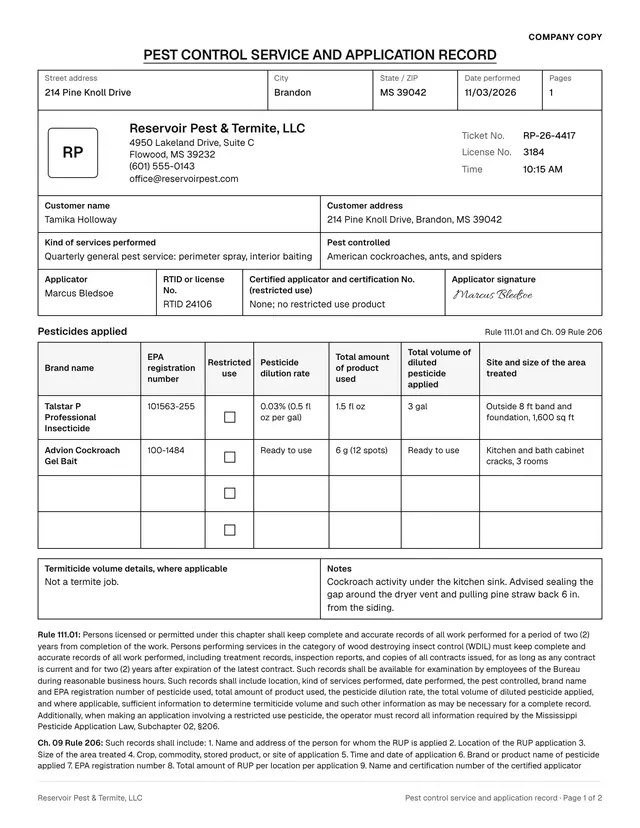
Pest Control Service and Application Record
Record each pesticide applied at a service visit. - Missouri
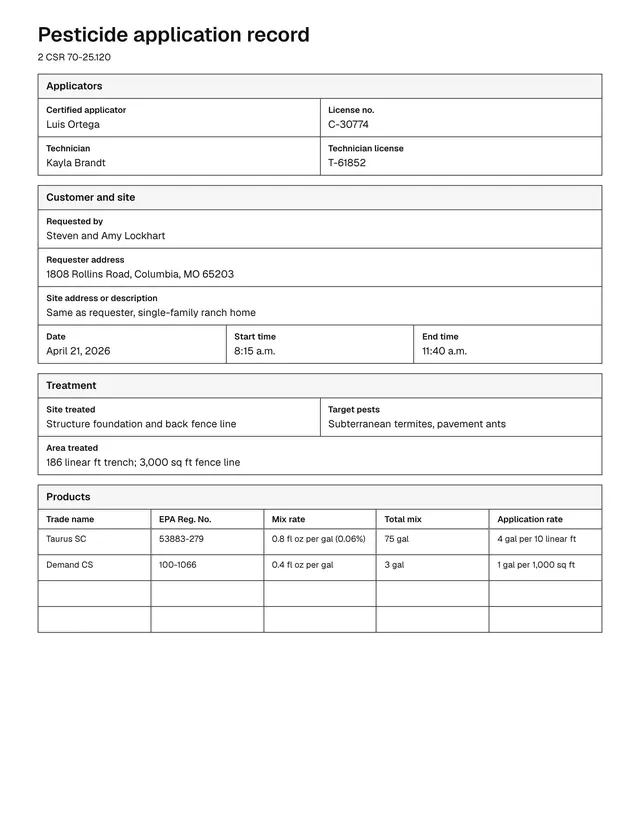
Missouri pesticide application record (2 CSR 70-25.120)
Record each pesticide applied at a service visit. - Nevada
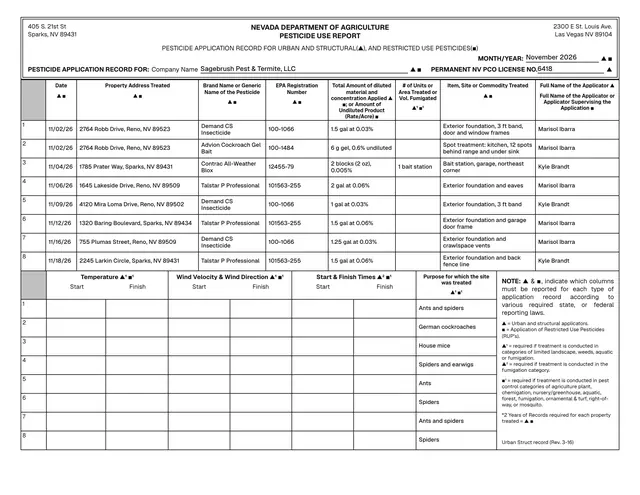
Pesticide Application Record for Urban and Structural and Restricted Use Pesticides
Record each pesticide applied at a service visit. - New Jersey
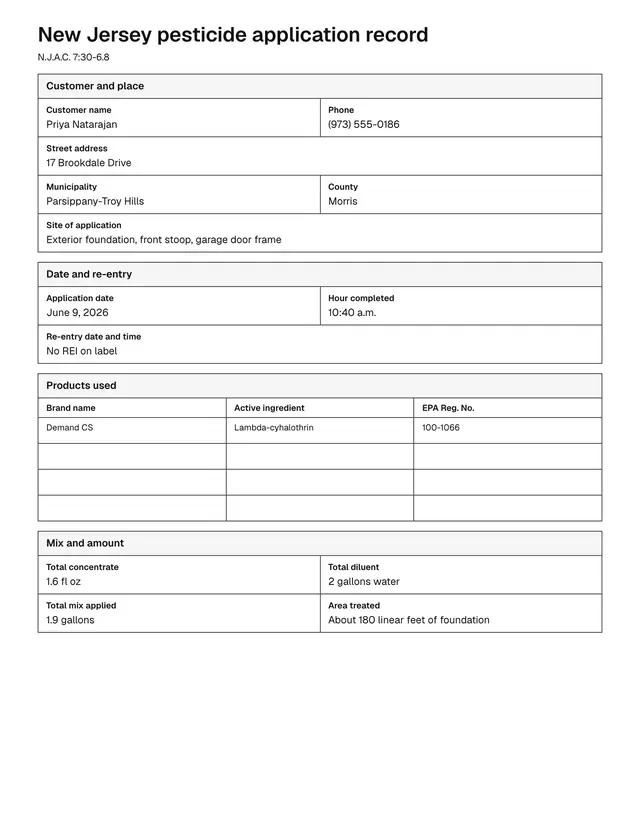
New Jersey pesticide application record (N.J.A.C. 7:30-6.8)
Record each pesticide applied at a service visit. - New Mexico
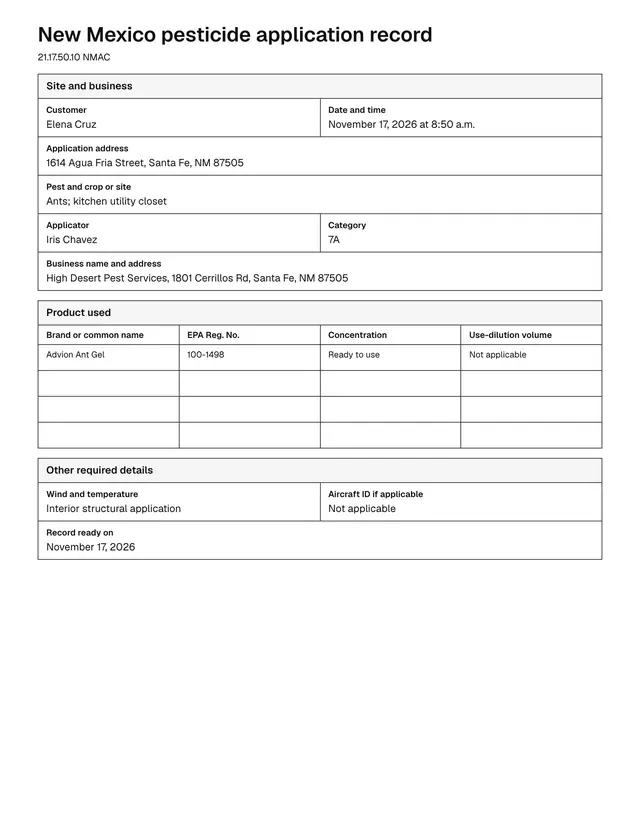
New Mexico pesticide application record
Record each pesticide applied at a service visit. - New York
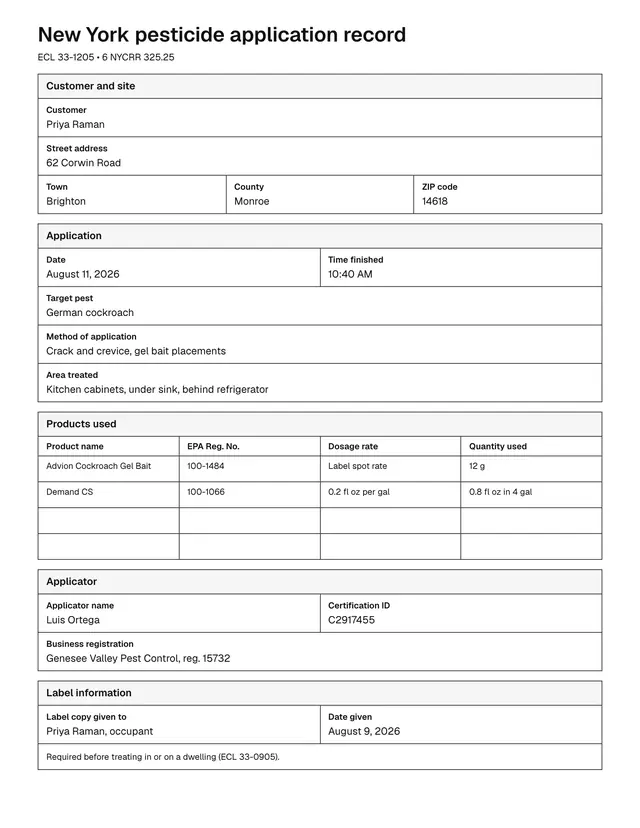
New York pesticide application record (6 NYCRR 325.25)
Record each pesticide applied at a service visit. - North Carolina
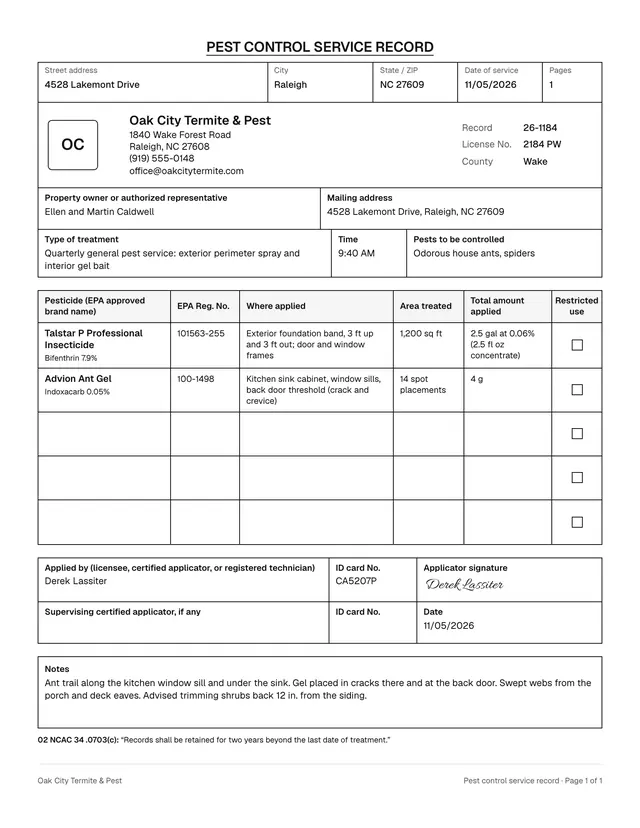
Pest Control Service Record
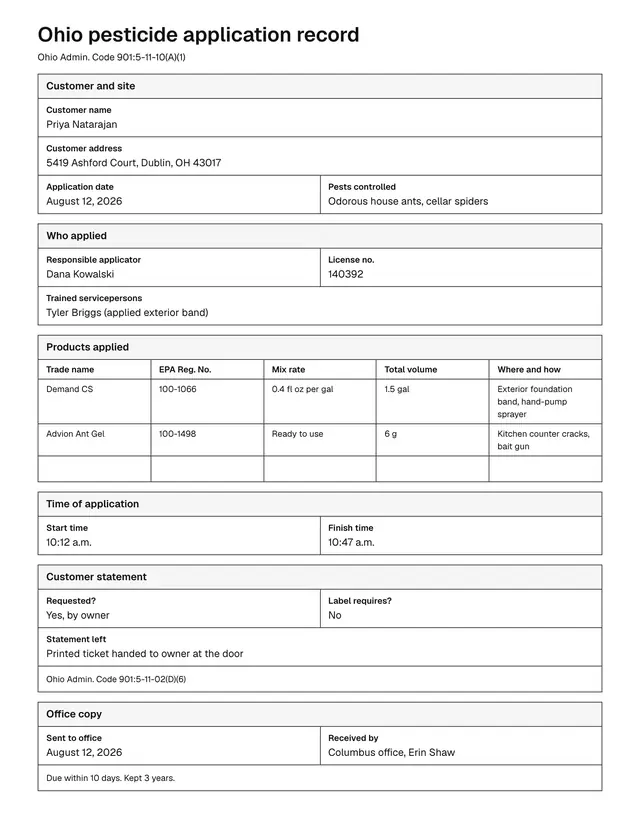
Record each pesticide applied at a service visit. - Ohio
Ohio pesticide application record
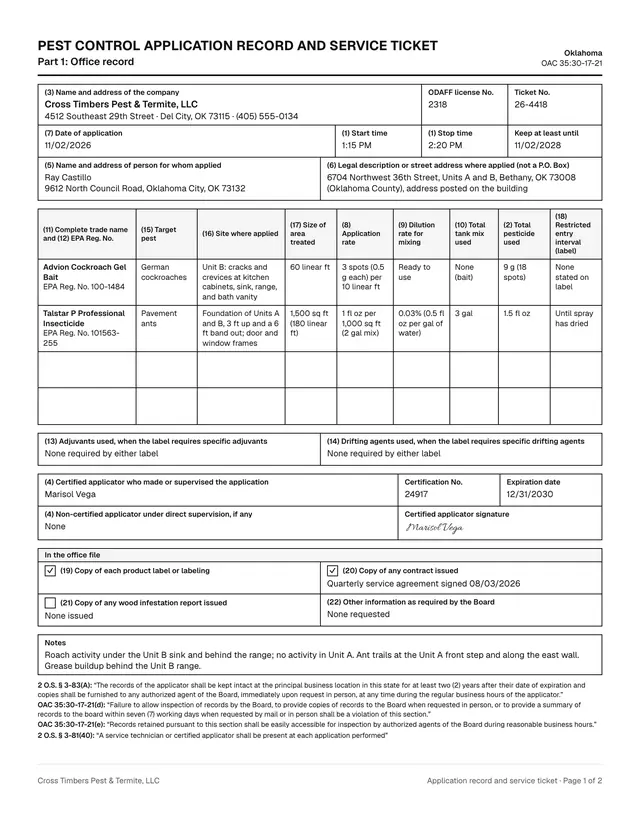
Record each pesticide applied at a service visit. - Oklahoma
Pest Control Application Record and Service Ticket
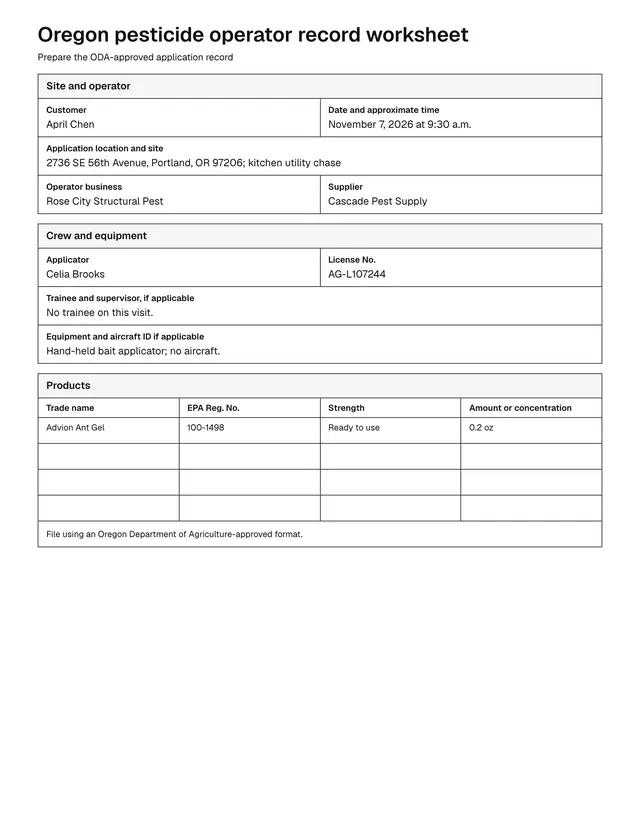
Record each pesticide applied at a service visit. - Oregon
Oregon pesticide operator record worksheet
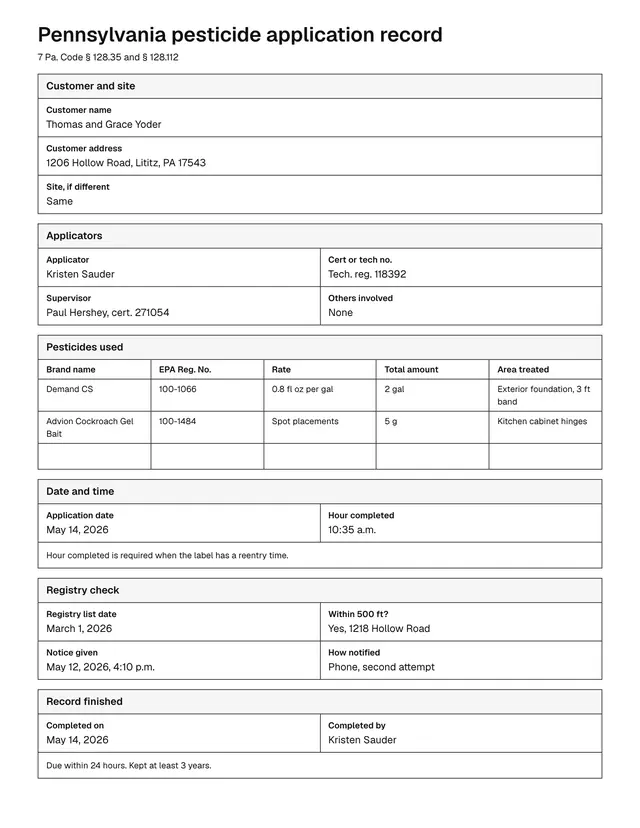
Record each pesticide applied at a service visit. - Pennsylvania
Pennsylvania pesticide application record
Record each pesticide applied at a service visit. - South Carolina
Pest Control Service Record
Record each pesticide applied at a service visit. - Tennessee
Tennessee pesticide application record
Record each pesticide applied at a service visit. - Texas
Pest Control Use Record
Record each pesticide applied at a service visit. - Utah
Utah commercial pesticide service worksheet
Record each pesticide applied at a service visit. - Virginia
Virginia pesticide application record
Record each pesticide applied at a service visit. - Washington
Pesticide Application Record
Record each pesticide applied at a service visit. - Wisconsin
Wisconsin commercial pesticide application record
Record each pesticide applied at a service visit.