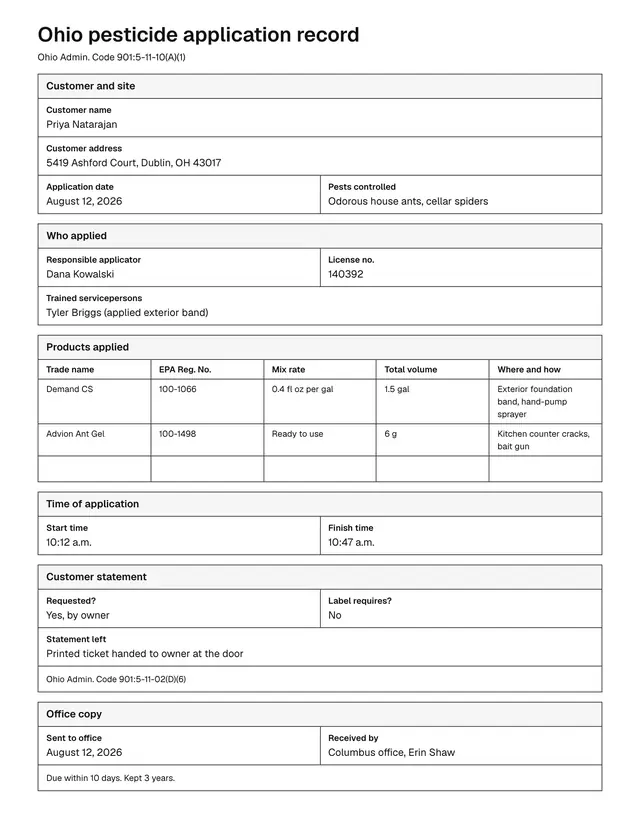
Ohio pesticide application record
Ohio wants this record written in English on the day of the application, with start and stop times. Rule 901:5-11-02 adds a written statement for the customer when they ask for one.
At a glance
- Rule
- Ohio Admin. Code 901:5-11-10(A)(1)
- Written
- On the date of application
- To office
- Within 10 days
- Kept for
- 3 years
Completed example
Download PDFOhio’s service ticket has a clock on it
Ohio’s structural record rule is short and strict. Ohio Admin. Code 901:5-11-10 says applicators working on “structures and their contents” must record eight items “in English, on the date of application.” Not the next morning, and not when the office catches up.
The eight items are the responsible commercial applicator and any trained servicepersons, the customer’s name and address, the date, the pests, where and how each product went down, the trade name and EPA Reg. No., the mix and total volume, and the time. The time part is the one people miss. Ohio wants when you started applying and when you finished.
Lawn crews work under a different paragraph with wind and temperature on it, and posting rules of their own. This page is for the inside-and-around-the-house work: ants, roaches, spiders, rodents, and general pest accounts.
Does the customer get a copy?
Not automatically. A lot of people see paragraph (A)(6) of the record rule and think every customer gets a copy within thirty days. Read the categories it lists. They’re the farm ones: agronomic crops, fruit and vegetables, ag weeds, tobacco suckers, and soil fumigation. Structural pest control isn’t on that list.
The rule that does reach a homeowner is 901:5-11-02(D)(6). Every pesticide applicator must give “each customer and resident of the applied property if requested, or required by the pesticide label, a printed or legibly written statement of the pesticide applied, the amount applied, the date of application.” So if a tenant in a Dublin duplex asks what you sprayed, they get it in writing. Same if the label calls for it.
Most Ohio companies leave a ticket at every stop anyway. It costs nothing, and it answers the “what did you spray near my dog” call before the phone rings.
Filling it out at the truck
Name everyone on the job. The record lists the responsible commercial applicator first, then any trained servicepersons who sprayed under their direct supervision. If a new hire held the wand, their name goes on it.
One row per product. Copy the trade name and EPA Reg. No. off the label, like Demand CS at 100-1066. Then the mix (0.4 fl oz per gallon), the total volume you put out (1.5 gallons), and where and how it went: “exterior foundation band, 3 ft up and 3 ft out, hand-pump sprayer.” The EPA label search is the fastest way to confirm a number when a label is torn.
Write the pests, not a category. “Odorous house ants and cellar spiders” tells the next tech something. “General pest” doesn’t.
Clock in and clock out. Note the time you started applying and the time you finished. If a storm rolls in and you stop halfway, write the time you quit for the day.
Ten days to the office, three years in the file
Paragraph (A)(5) gives you ten days after the job to get a copy to the registered pesticide business location you work from. If your employer isn’t a pesticide business, like a hospital or school district with its own applicator, it goes to the employer. Paragraphs (B) and (C) then make the business keep the records for three years and show them to the Director.
One more file lives next to these. The business also keeps written proof that each trained serviceperson read the ODA trainee manual or got equivalent training before they first touched a pesticide. That one is kept three years after the employee leaves.
If something goes wrong, the record is your starting point. Rule 901:5-11-02(D)(4) makes you call the Department of Agriculture within 48 hours of learning about a human illness that needed a doctor and may be tied to your pesticide, then send a written report within seven days. Property damage over $500 gets a written report within ten days. A clean, same-day ticket with times and amounts makes that report far easier.
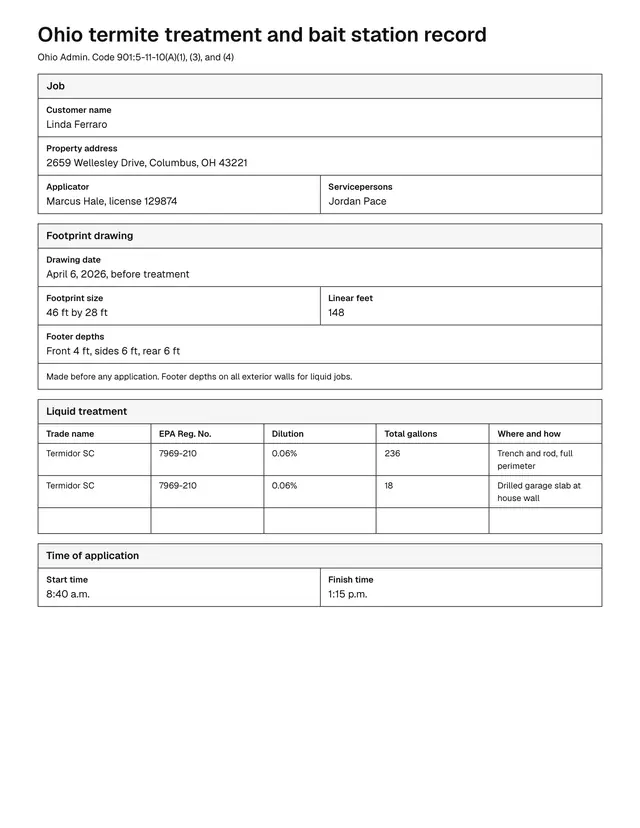
Termite jobs ask for more, including a footprint drawing before you start. That’s on the Ohio termite treatment and bait record.
Do your routes repeat every month?
Most general pest accounts in Ohio are monthly or quarterly. That’s a lot of nearly identical tickets, and each one has to be done the same day and findable for three years.
Noma specializes in the Ohio pesticide application record (Ohio Admin. Code 901:5-11-10). It schedules the repeat visits, sends the invoices, and takes payment online, and your techs run the day from the phone app. See how Noma runs recurring pest service.
Frequentlyaskedquestions
Send this document in minutes, not an afternoon.
Other states
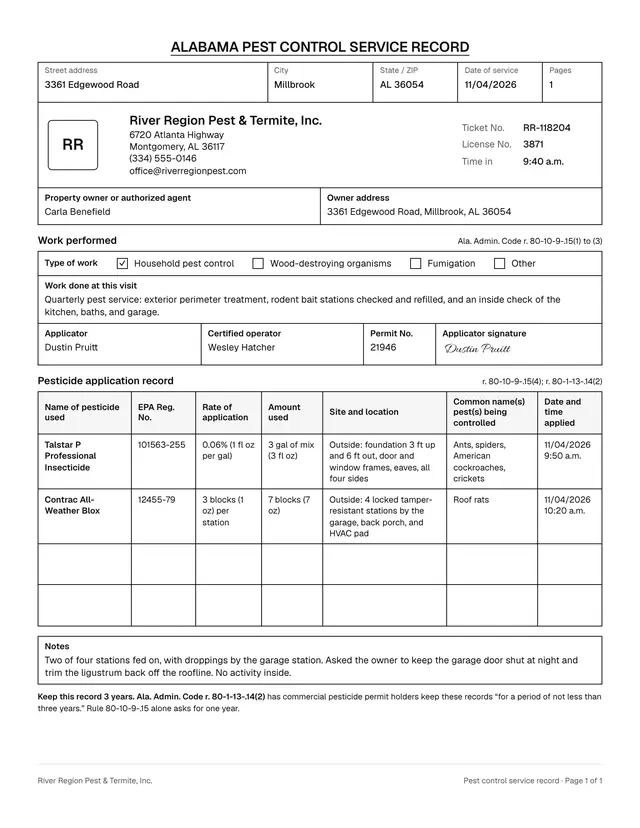
After-treatment notice templates- Alabama
Alabama Pest Control Service Record
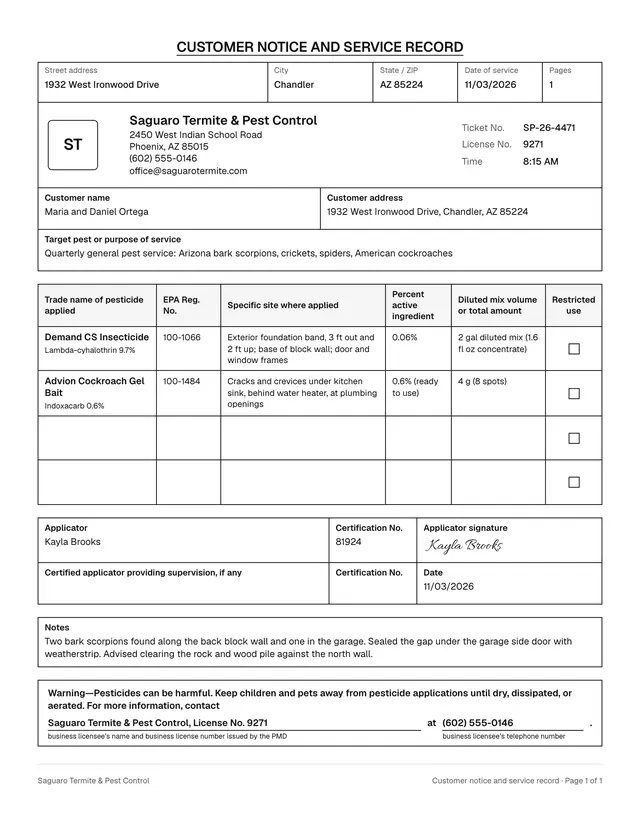
Record each pesticide applied at a service visit. - Arizona
Customer Notice and Service Record
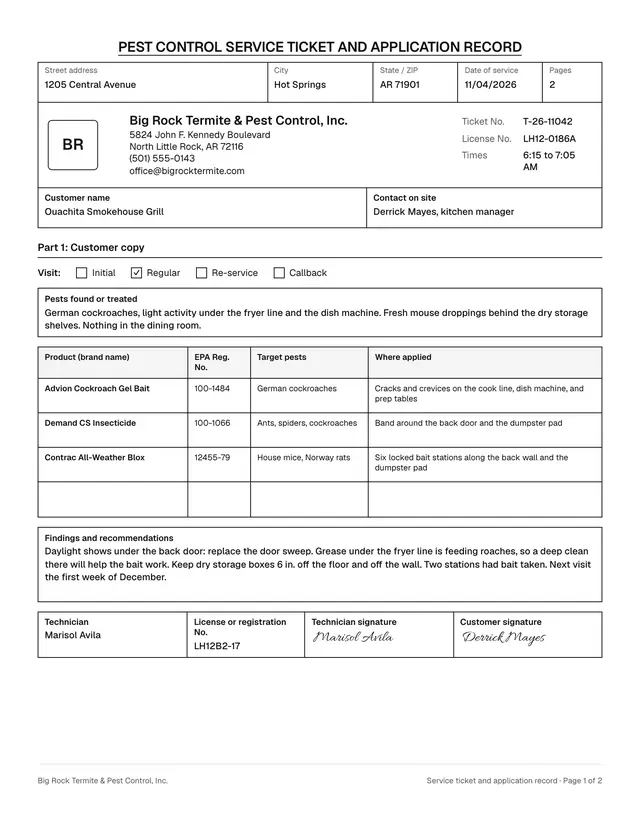
Record each pesticide applied at a service visit. - Arkansas
Pest Control Service Ticket and Application Record
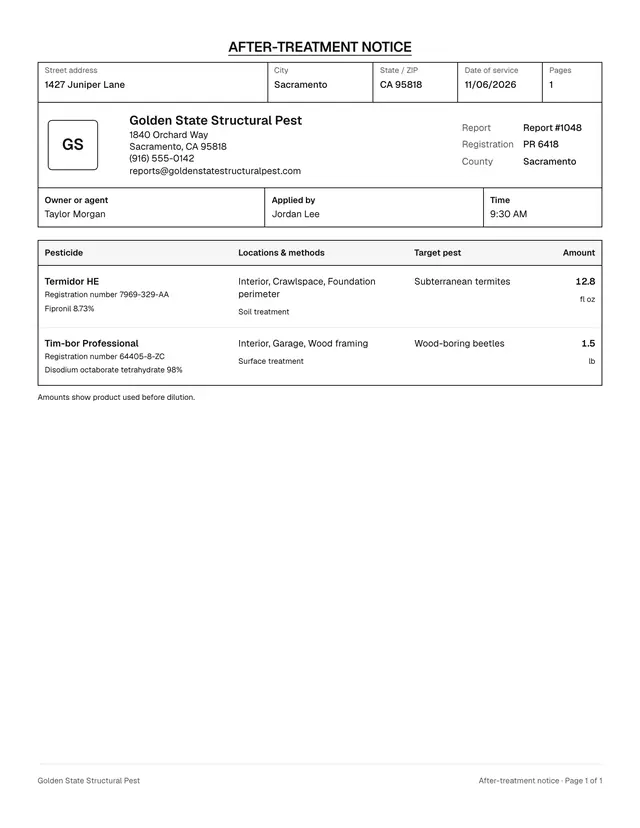
Record each pesticide applied at a service visit. - California
After-Treatment Notice
Record each pesticide applied at a service visit. - Colorado
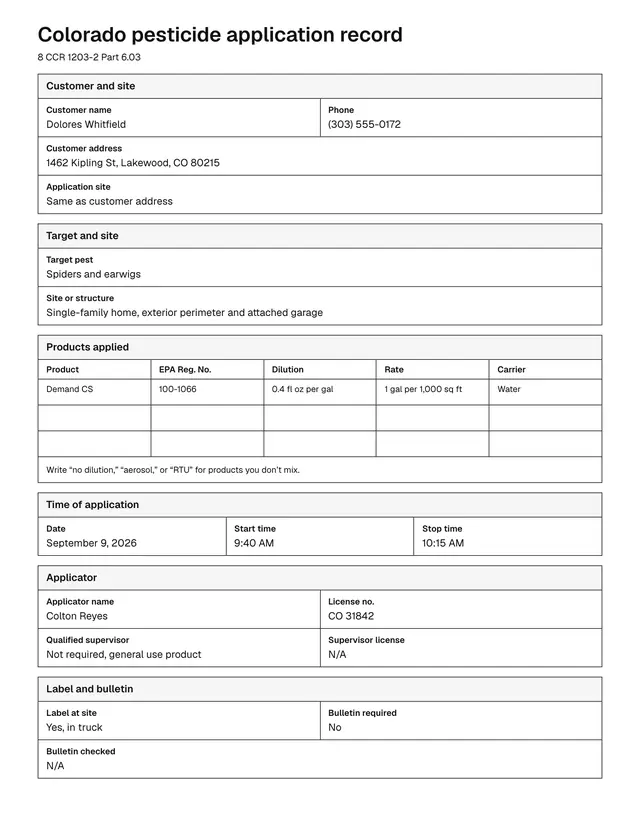
Colorado commercial pesticide application record
Record each pesticide applied at a service visit. - Connecticut
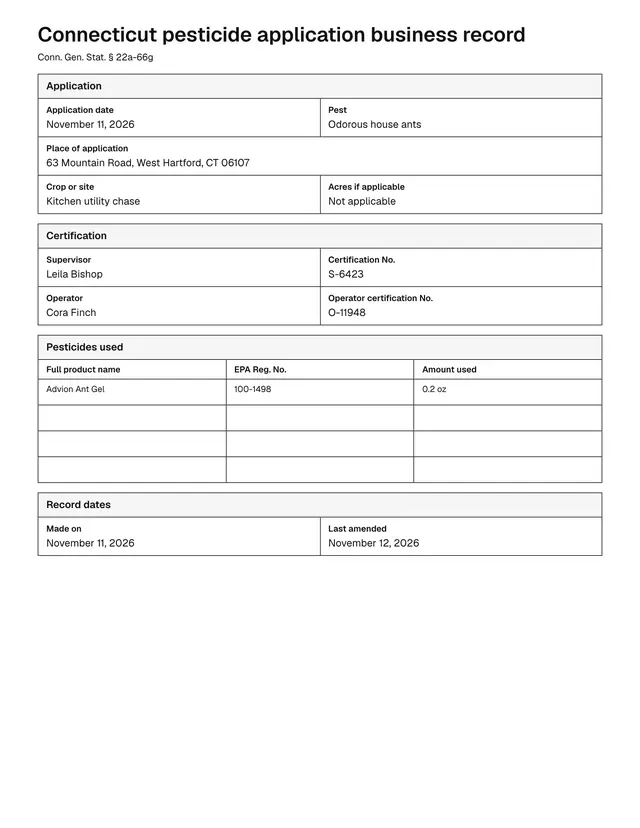
Connecticut pesticide application business record
Record each pesticide applied at a service visit. - Delaware
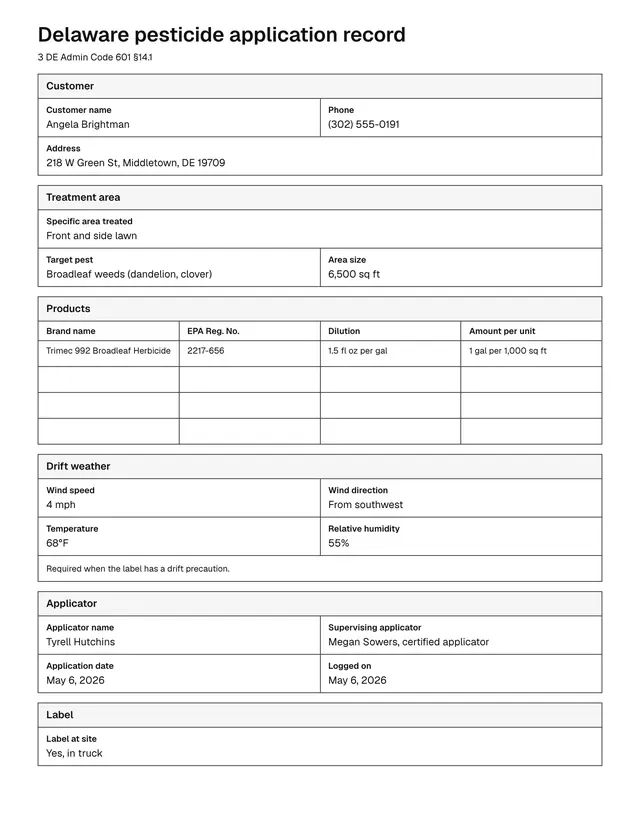
Delaware pesticide application record (3 DE Admin Code 601 §14.1)
Record each pesticide applied at a service visit. - Georgia
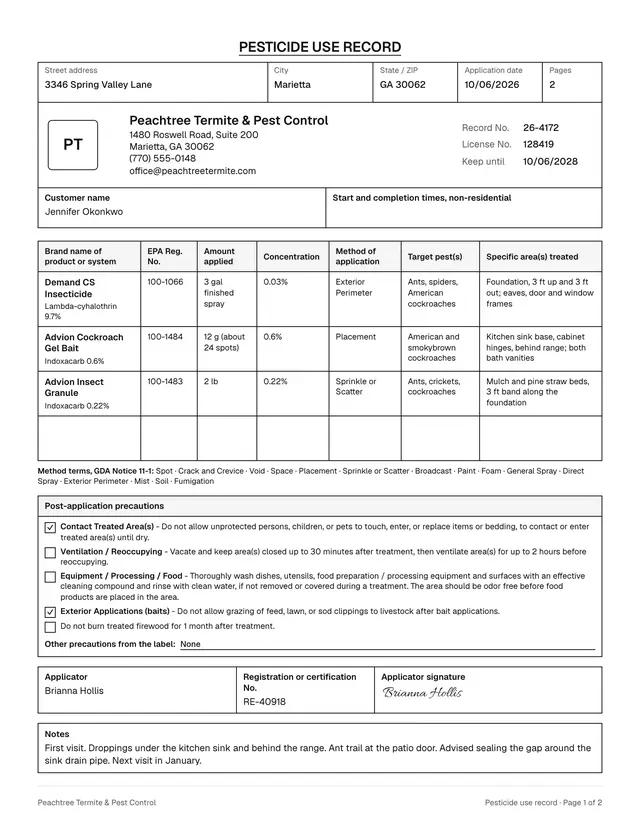
Pesticide Use Record
Record each pesticide applied at a service visit. - Hawaii
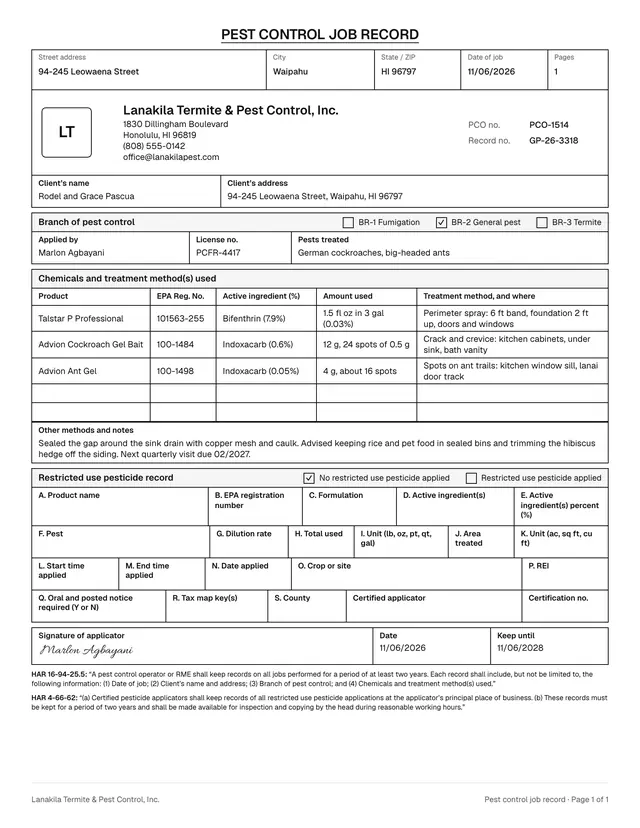
Pest Control Job Record
Record each pesticide applied at a service visit. - Illinois
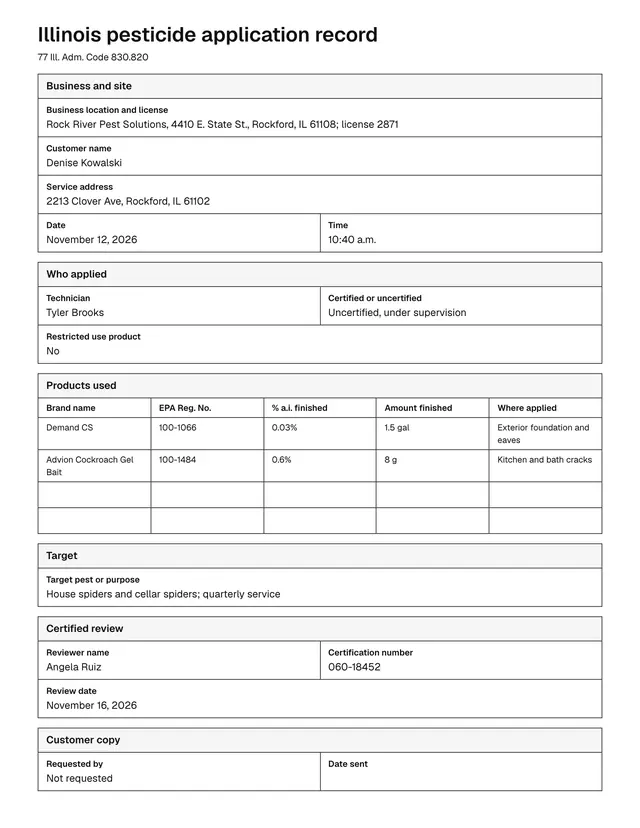
Illinois structural pest control application record
Record each pesticide applied at a service visit. - Indiana
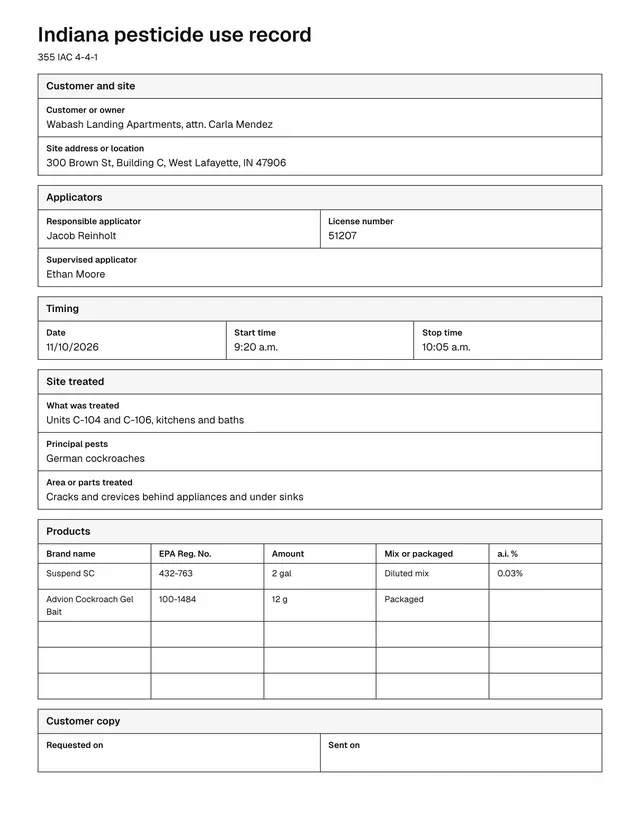
Indiana commercial applicator pesticide use record
Record each pesticide applied at a service visit. - Iowa
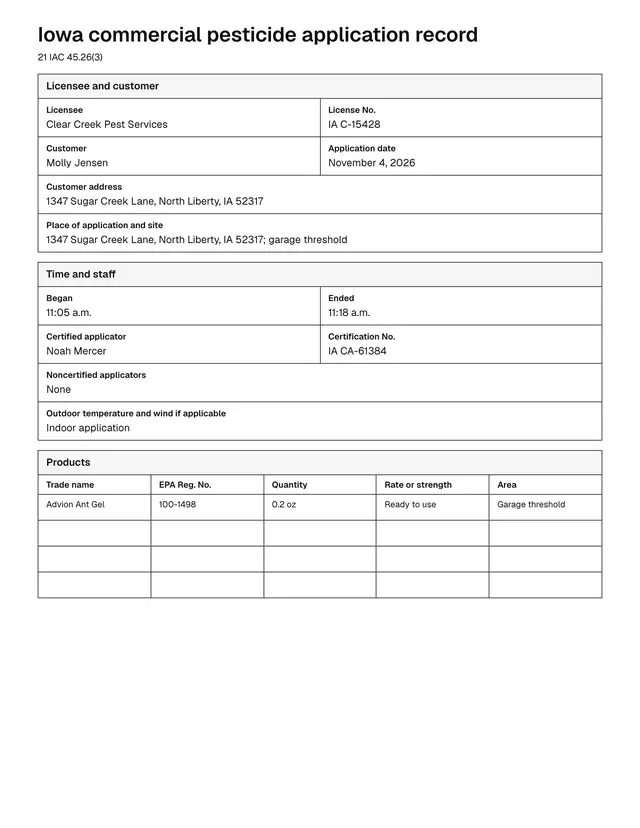
Iowa commercial pesticide application record
Record each pesticide applied at a service visit. - Kansas
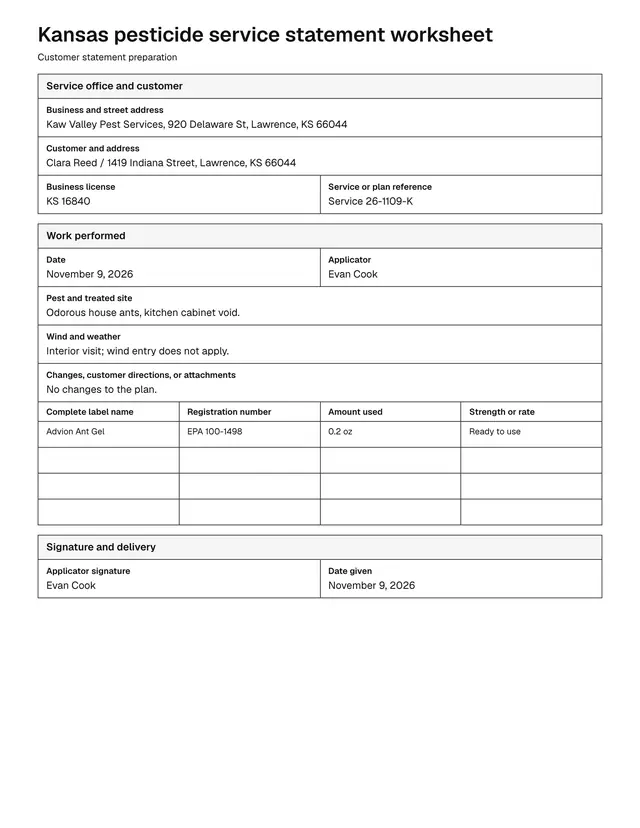
Kansas pesticide service statement worksheet
Record each pesticide applied at a service visit. - Kentucky
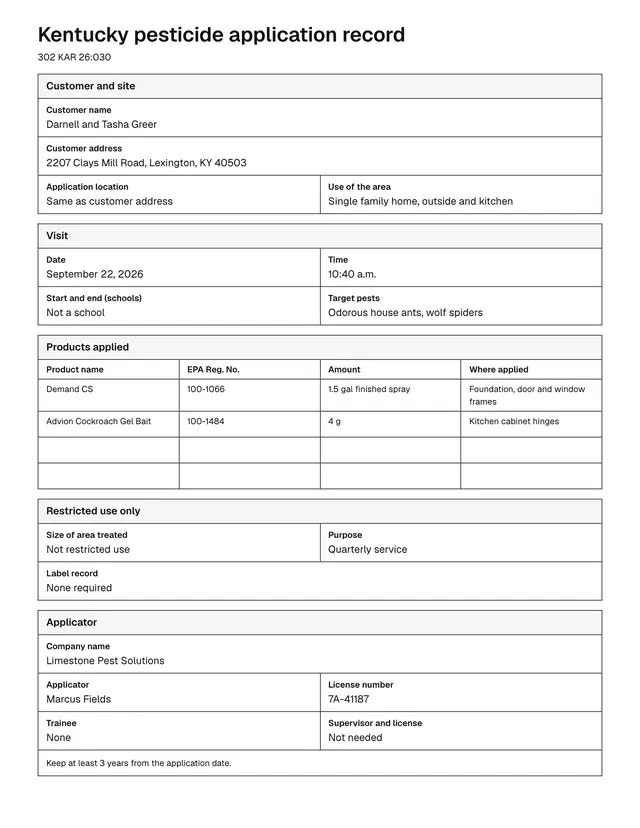
Kentucky pesticide application record (302 KAR 26:030)
Record each pesticide applied at a service visit. - Louisiana
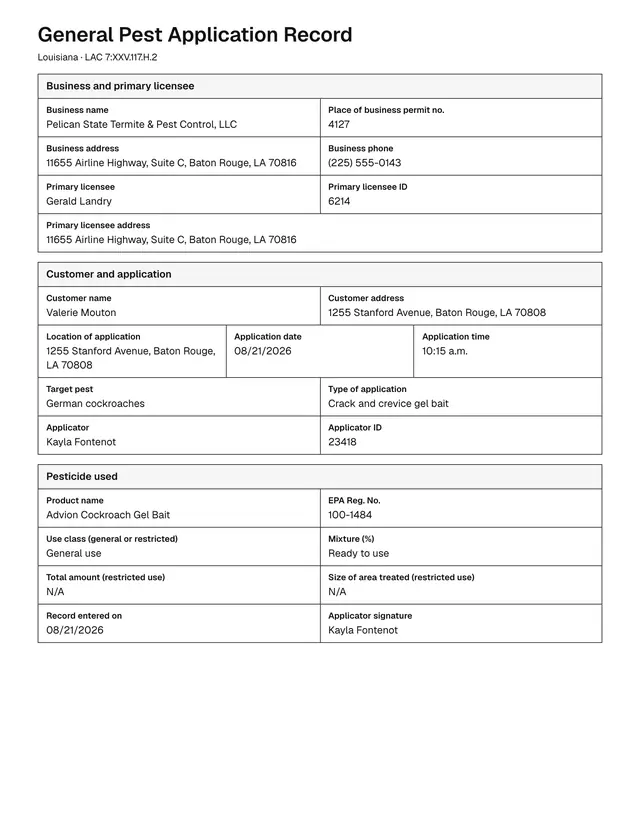
General Pest Application Record
Record each pesticide applied at a service visit. - Maryland
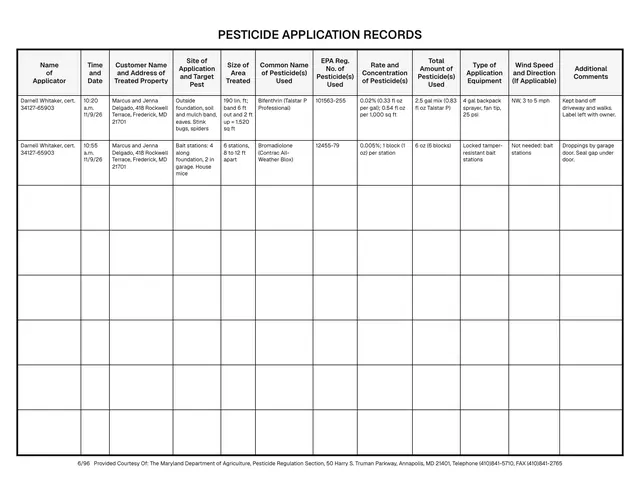
Pesticide Application Record and Customer Pesticide Information
Record each pesticide applied at a service visit. - Massachusetts
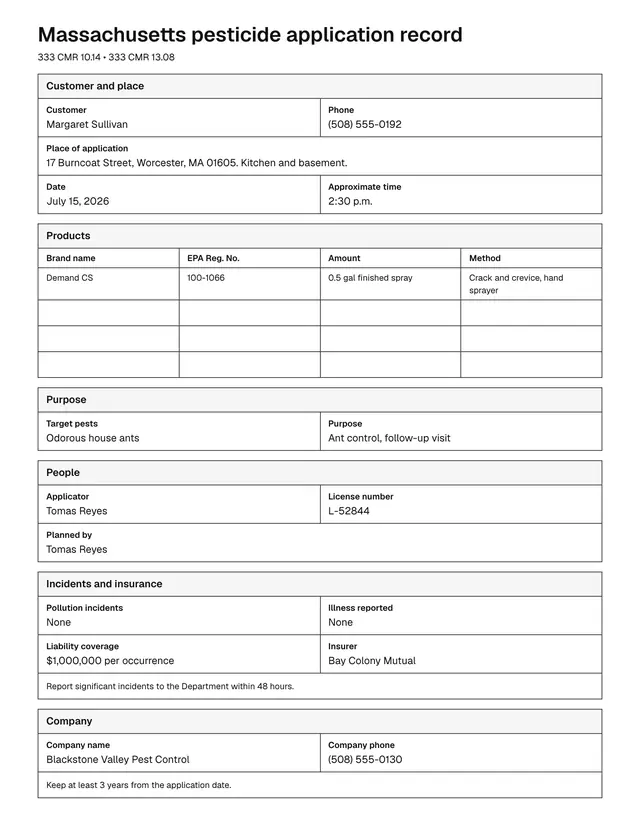
Massachusetts pesticide application record (333 CMR 10.14)
Record each pesticide applied at a service visit. - Michigan
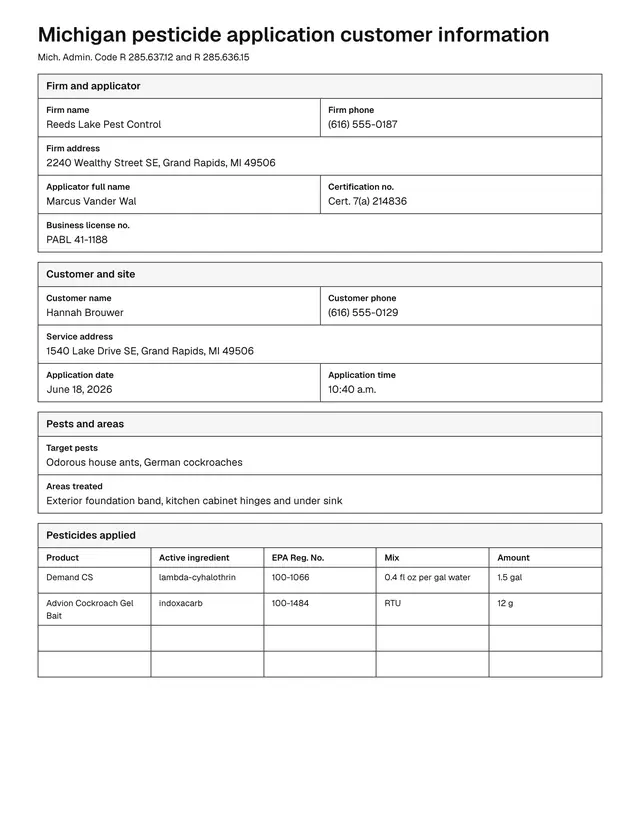
Michigan pesticide customer information receipt
Record each pesticide applied at a service visit. - Mississippi
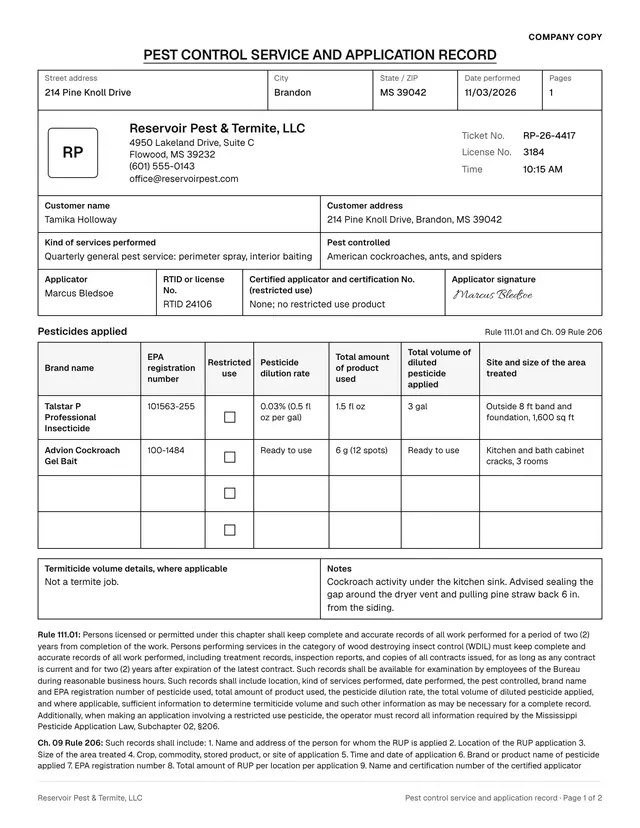
Pest Control Service and Application Record
Record each pesticide applied at a service visit. - Missouri
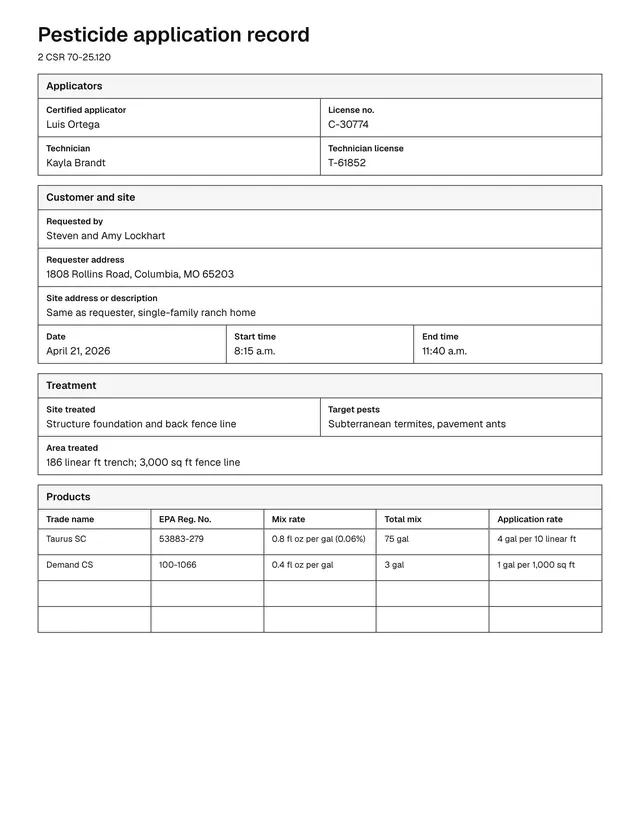
Missouri pesticide application record (2 CSR 70-25.120)
Record each pesticide applied at a service visit. - Nevada
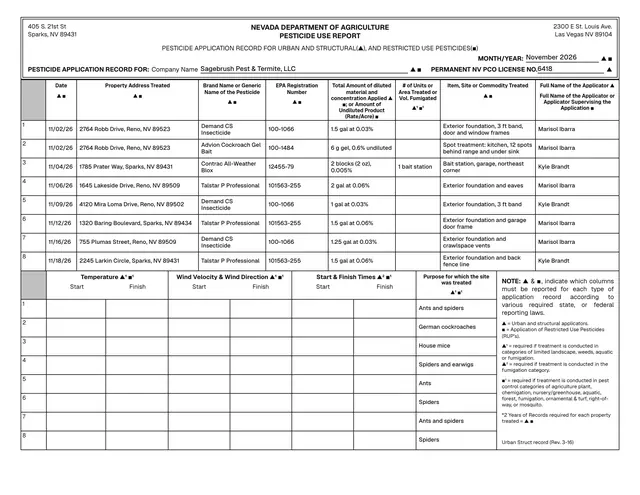
Pesticide Application Record for Urban and Structural and Restricted Use Pesticides
Record each pesticide applied at a service visit. - New Jersey
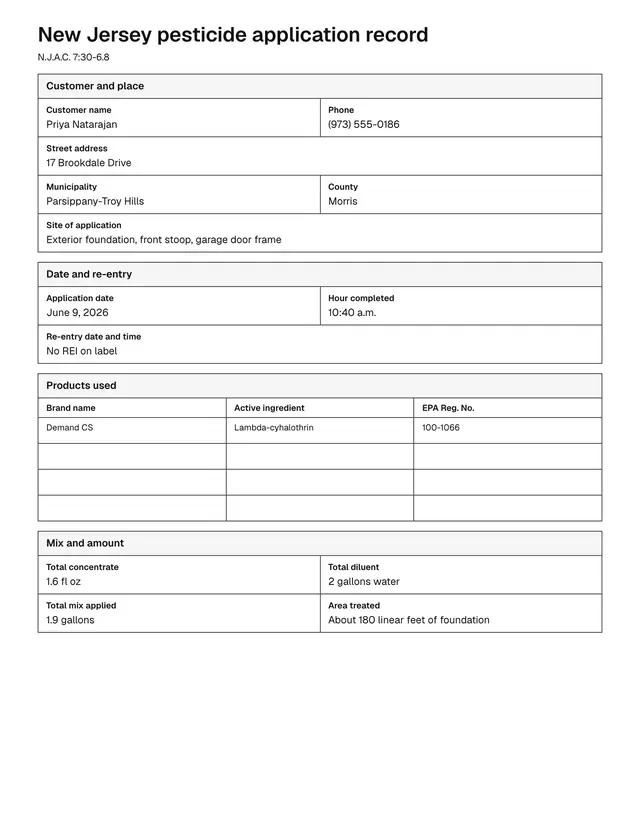
New Jersey pesticide application record (N.J.A.C. 7:30-6.8)
Record each pesticide applied at a service visit. - New Mexico
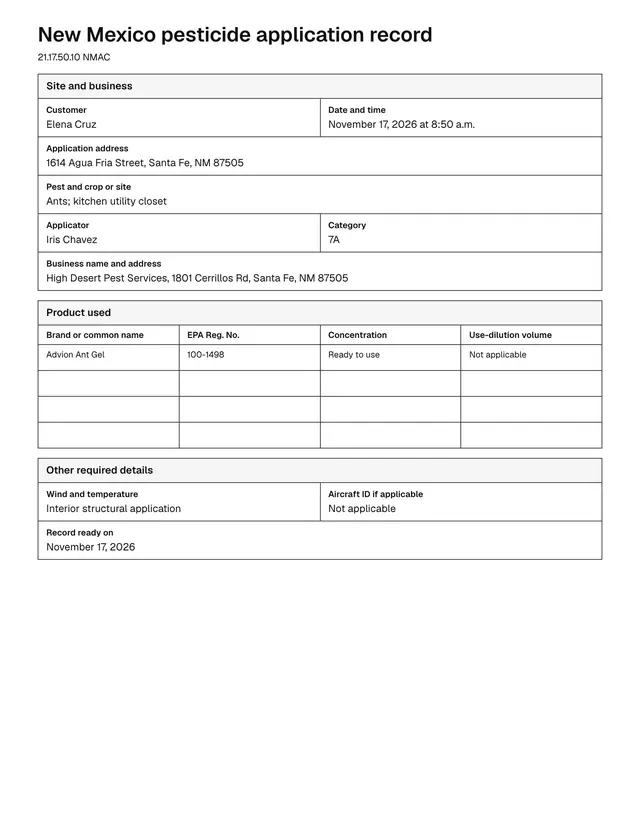
New Mexico pesticide application record
Record each pesticide applied at a service visit. - New York
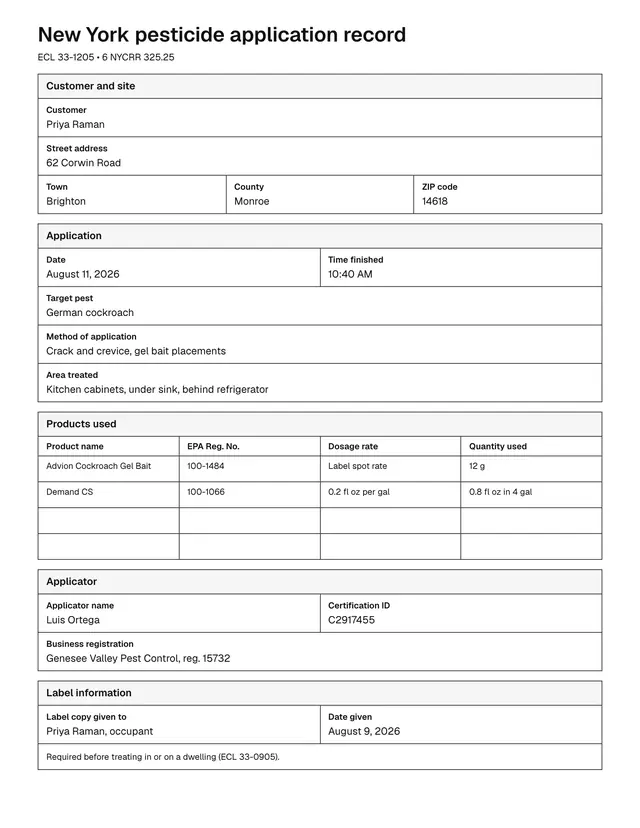
New York pesticide application record (6 NYCRR 325.25)
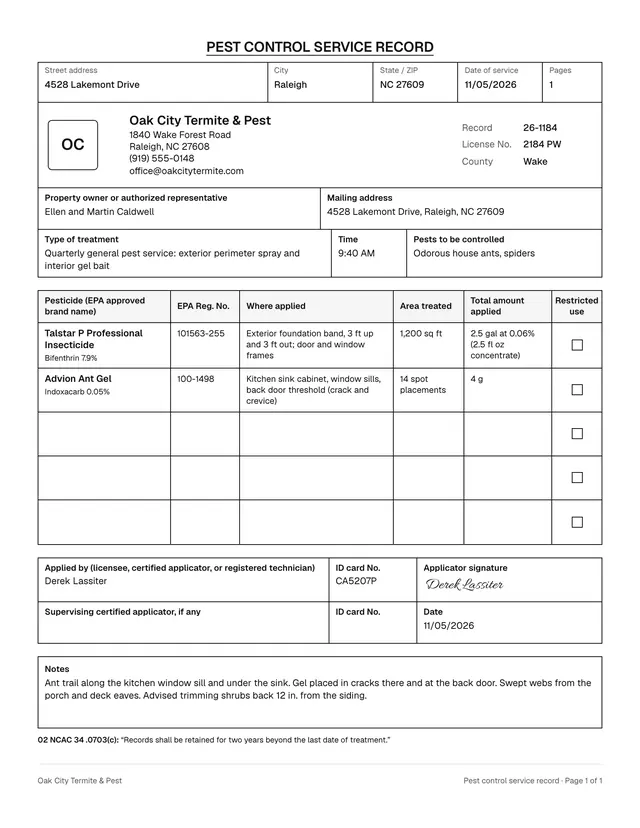
Record each pesticide applied at a service visit. - North Carolina
Pest Control Service Record
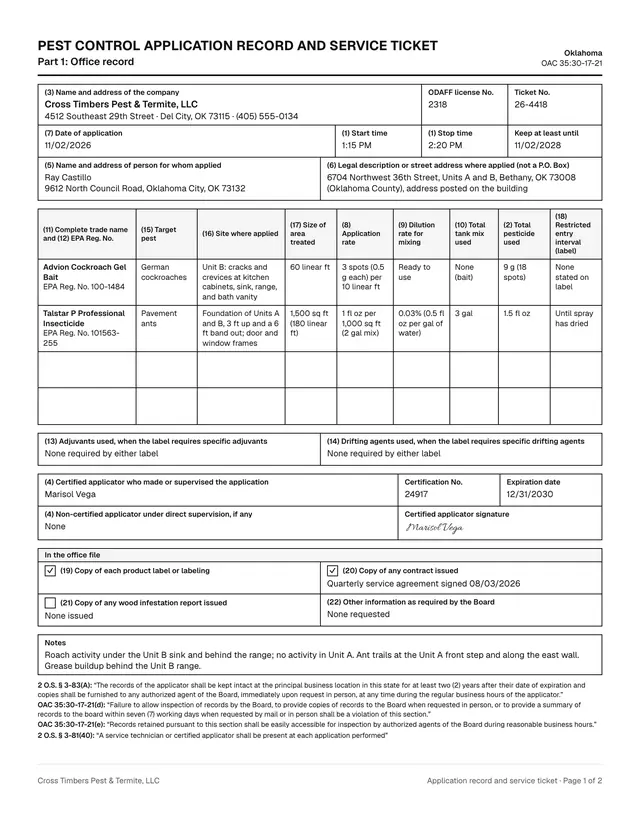
Record each pesticide applied at a service visit. - Oklahoma
Pest Control Application Record and Service Ticket
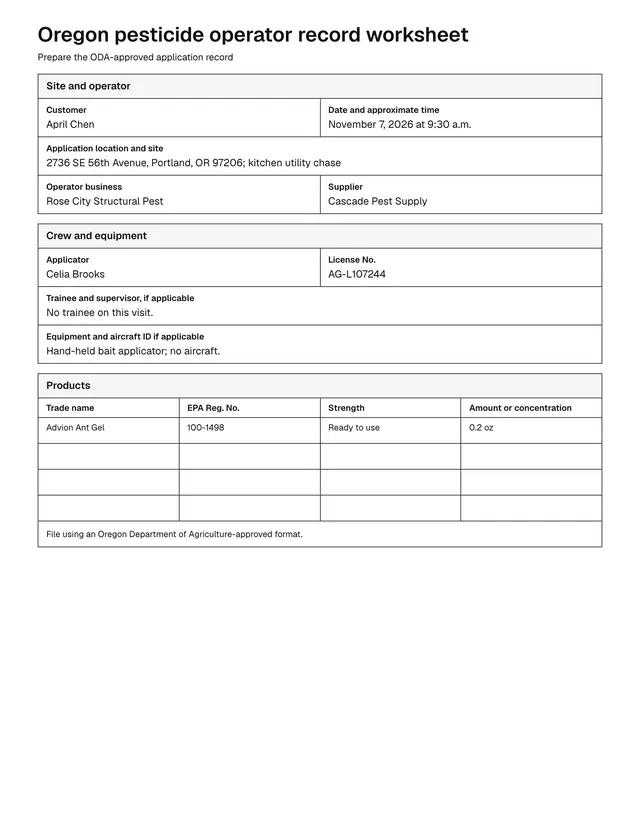
Record each pesticide applied at a service visit. - Oregon
Oregon pesticide operator record worksheet
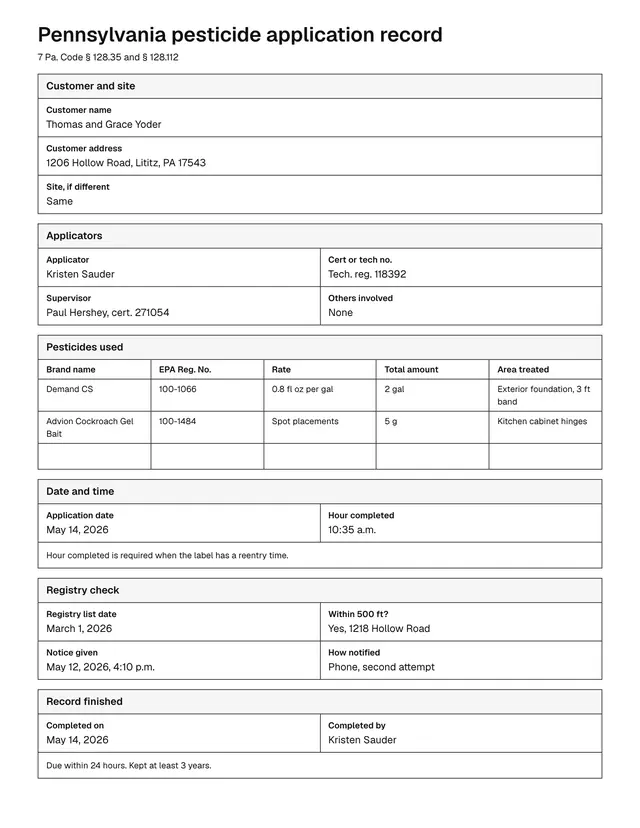
Record each pesticide applied at a service visit. - Pennsylvania
Pennsylvania pesticide application record
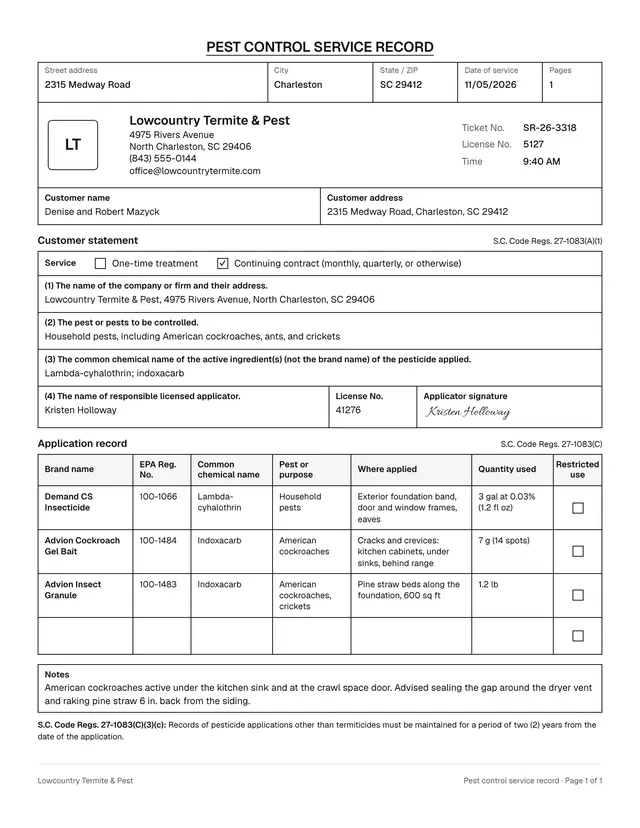
Record each pesticide applied at a service visit. - South Carolina
Pest Control Service Record
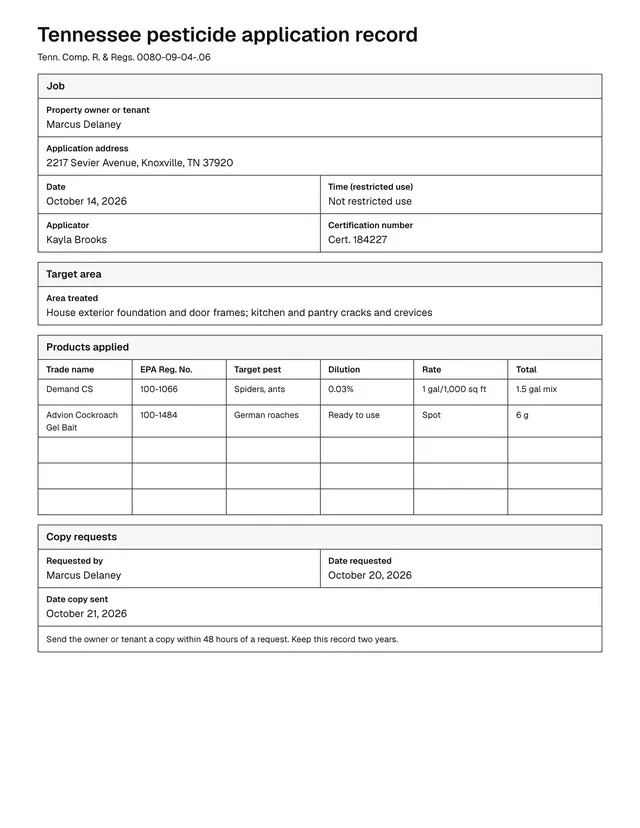
Record each pesticide applied at a service visit. - Tennessee
Tennessee pesticide application record
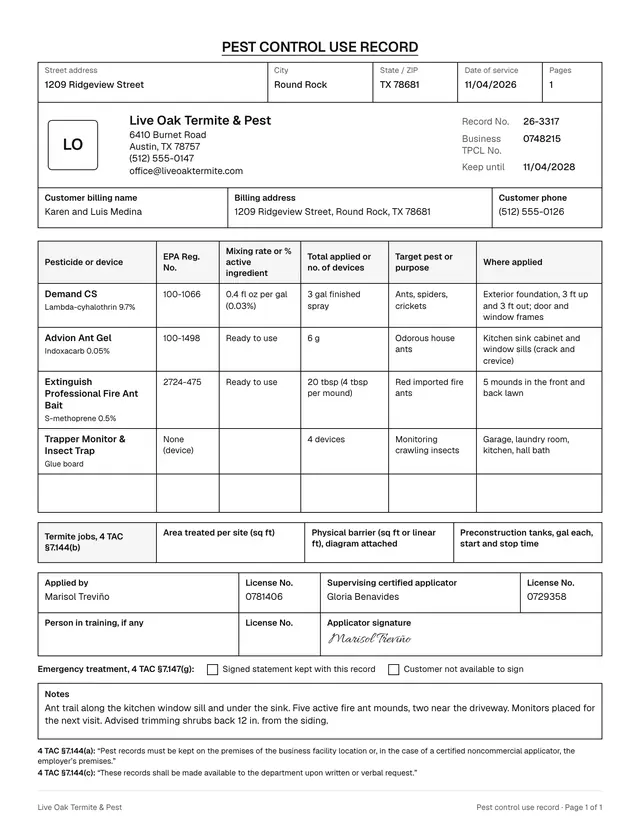
Record each pesticide applied at a service visit. - Texas
Pest Control Use Record
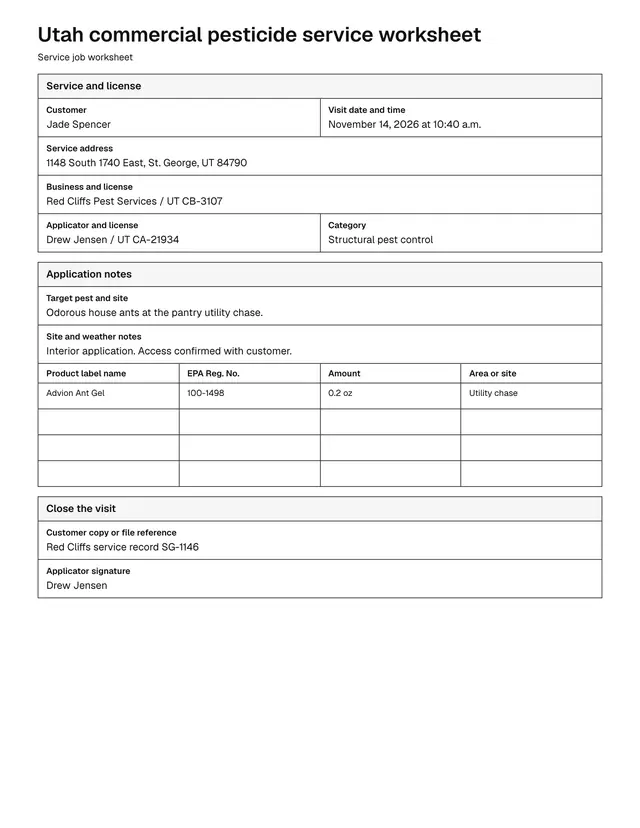
Record each pesticide applied at a service visit. - Utah
Utah commercial pesticide service worksheet
Record each pesticide applied at a service visit. - Virginia
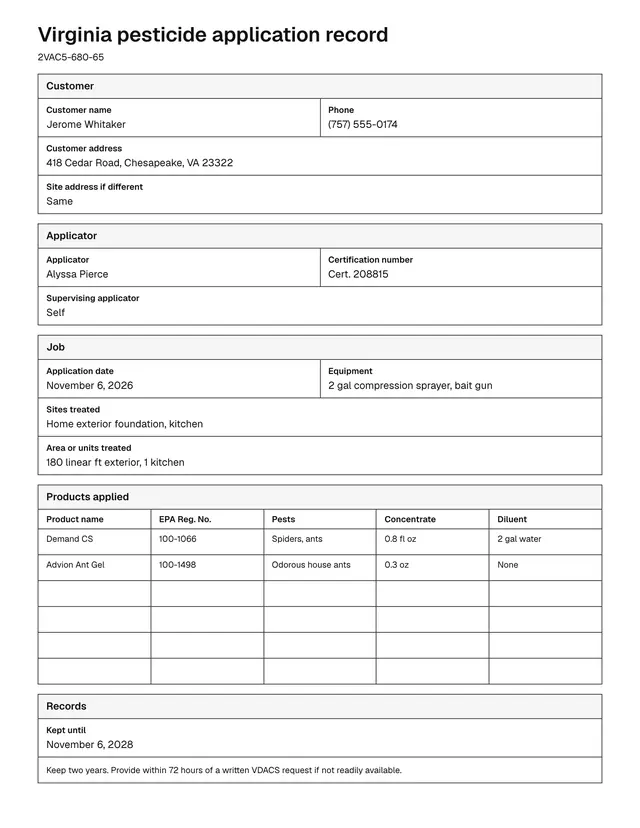
Virginia pesticide application record
Record each pesticide applied at a service visit. - Washington
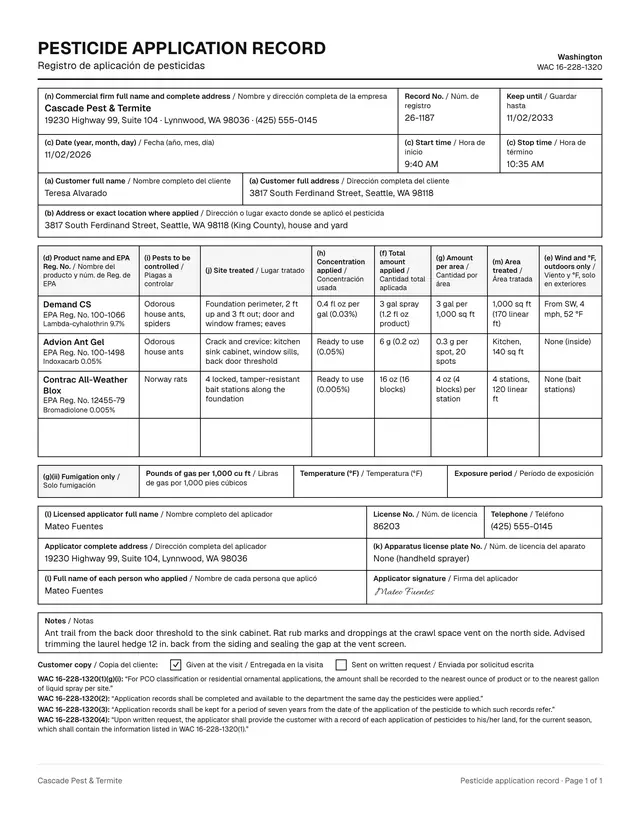
Pesticide Application Record
Record each pesticide applied at a service visit. - Wisconsin
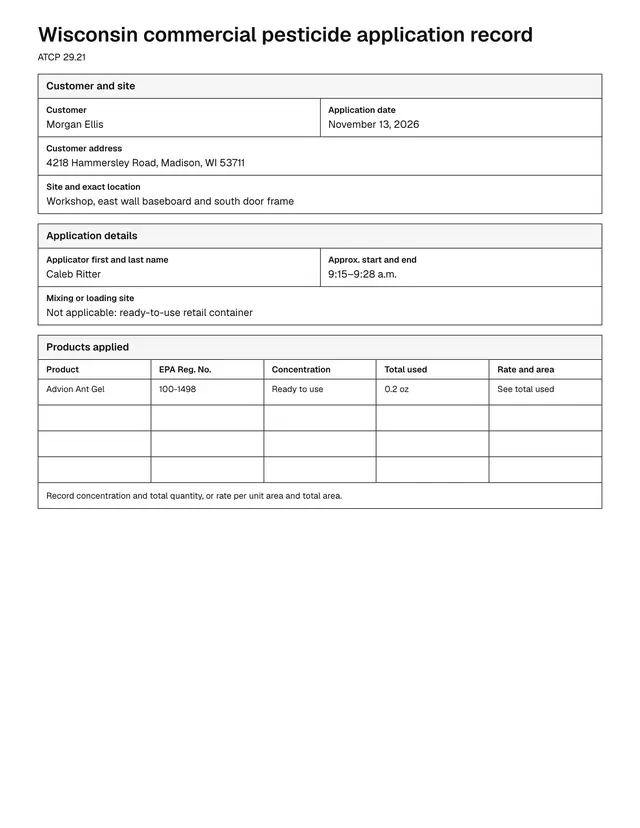
Wisconsin commercial pesticide application record
Record each pesticide applied at a service visit.