New Jersey pesticide application record (N.J.A.C. 7:30-6.8)
New Jersey wants every commercial pesticide application written down within 24 hours, right down to the mix recipe. Here’s what each line asks for and how long the record stays in your files.
At a glance
- Rule
- N.J.A.C. 7:30-6.8
- Write it
- No later than 24 hours after the application
- Keep it
- 3 years (termite jobs 5 years)
- Customer copy
- When the customer asks in writing
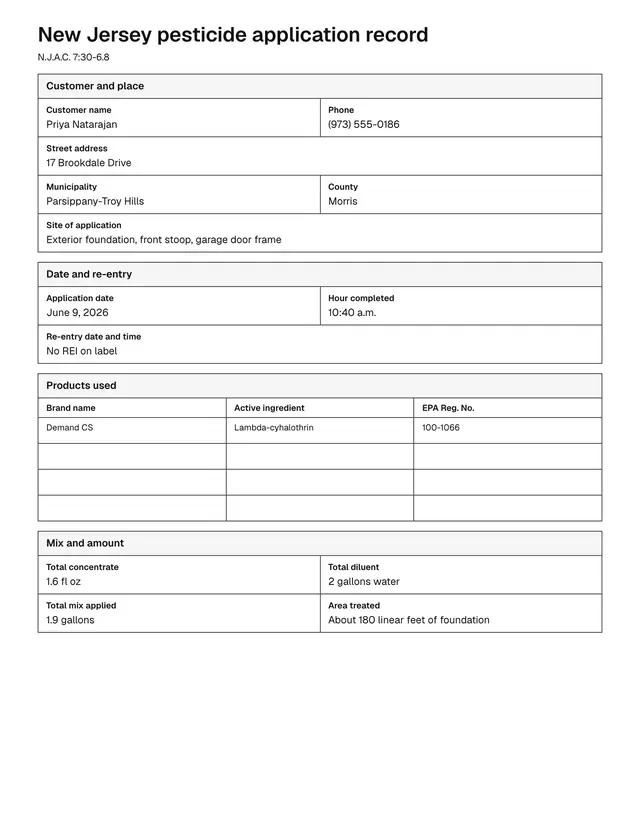
Completed example
Download PDFThe record DEP asks for first
When DEP’s Pesticide Control Program visits a shop, the application records are usually the first thing on the table. N.J.A.C. 7:30-6.8 says what goes in them, and it asks for more than most states do. On top of the product and the address, New Jersey wants the mix “recipe,” the size of the area when the label gives a rate per area, and the hour you finished when the label has a restricted-entry interval.
The rule covers each application a commercial applicator makes “or under his or her direct supervision.” So the jobs your licensed operators run land on the record too. A business can hold the records for all its applicators, which is how most companies do it.
How fast, and how long?
Write it “as soon as possible, but no later than 24 hours after application.” On a full route that’s tight. Most techs finish each record in the truck before they pull out of the driveway.
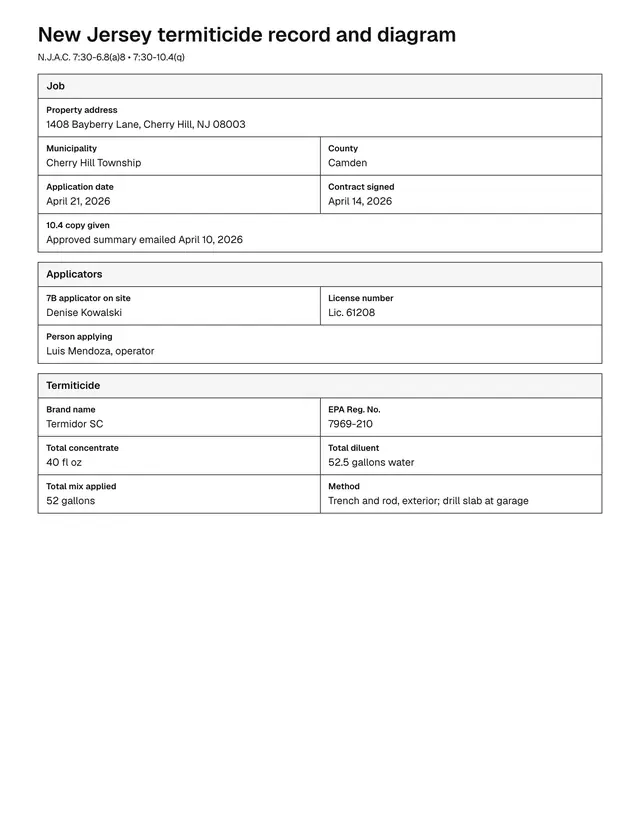
Keep each record at least three years. Termite work is longer: “all records of termiticide applications shall be kept for a minimum of five years.” Those jobs also need a drawing of the building, which the termite treatment record page covers.
Records go to DEP “immediately” when it asks, and to medical staff in an emergency. A customer gets a copy only after a written request. Plenty of companies leave one at the door anyway, since it answers the “what did you spray?” call before it happens.
Line by line
Date, and sometimes the hour. Every record needs the date. If the label lists a restricted-entry interval, also write the hour you finished and when people can go back in. That hour is what starts the clock.
The place, three ways. Write the specific street address, the municipality, and the county. “Parsippany-Troy Hills, Morris County” is right. Just “Parsippany” isn’t. On a big site with no street number, a map or written location description can stand in.
Product details from the label. List the brand name, the active ingredients, and the EPA Reg. No. For Demand CS that’s lambda-cyhalothrin and EPA Reg. No. 100-1066. If a number on an old label looks off, look it up in EPA’s product label system.
The recipe and the total. The recipe is the total concentrate plus the total diluent, like 1.6 fl oz of Demand CS in 2 gallons of water. Then write how much finished mix went down on this job. If the label gives a rate per 1,000 square feet, add the square footage you treated.
Who and where. Write the full name and license number of the person who made the application, or a code from your list of applicators. If a handler did the work, their full name goes on it too. Then the site, like “kitchen baseboards” or “exterior foundation.”
Two lists that live outside the ticket
Section 6.8(b) asks for two more things in writing. The first is a master list of every pesticide your crew uses, with names, active ingredients (common chemical names), and EPA numbers. If every ticket already shows all three, the tickets cover it.
The second is a log of the on-the-job training your operators and applicators get. Keep it apart from the job records, or mark it so you can pull it fast when DEP asks.
Products used under a Section 18 exemption, a 24(c) special local need label, or an experimental use permit need the matching number on the record too. It’s rare for household pest work, but it does happen with some turf and termite products.
What happens when a customer asks months later?
It usually starts with a neighbor complaint or a sick pet. A customer in Morristown emails in August asking what you sprayed in May. A written request means you owe them a copy of that record, and you want to find it in minutes, not by digging through a box of carbon copies sorted by month.
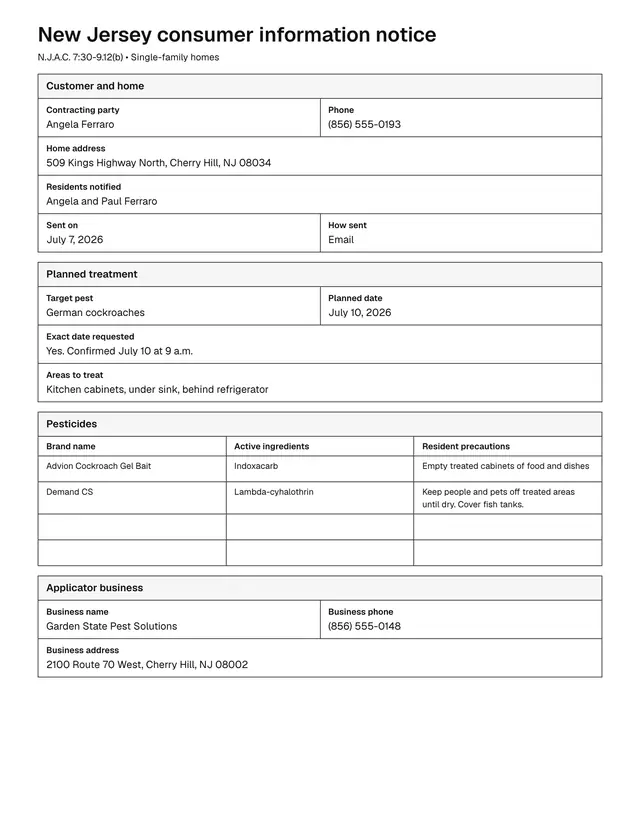
At a house, the consumer information notice told them what you might use before you came. The application record is the proof of what you actually used. When the two match, most of these calls end quickly.
Noma specializes in the New Jersey Pesticide Application Record (N.J.A.C. 7:30-6.8). It runs the route around that record: booked jobs, recurring visits on a schedule, invoices, and online payments, with the mobile app in the tech’s hand at every stop. See how Noma runs pest control routes.
Frequentlyaskedquestions
Send this document in minutes, not an afternoon.
Other states
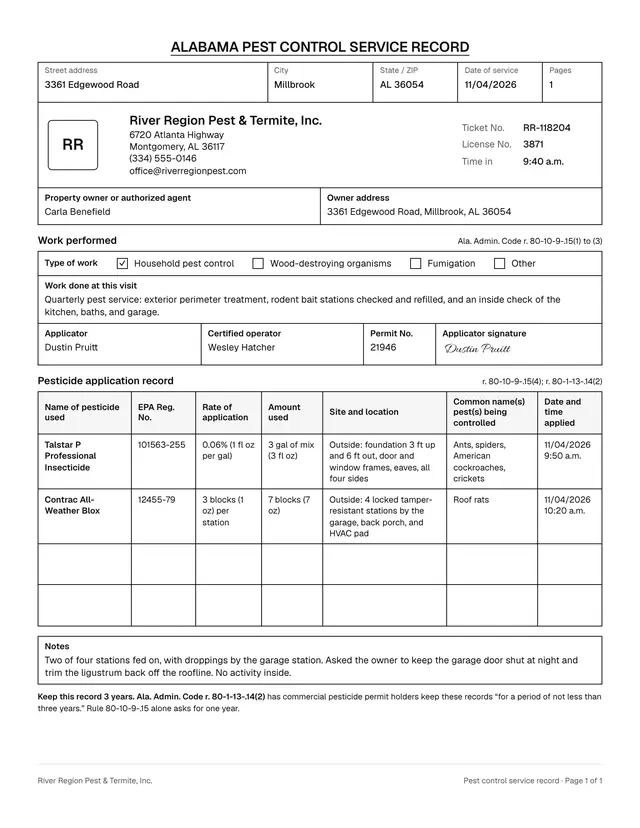
After-treatment notice templates- Alabama
Alabama Pest Control Service Record
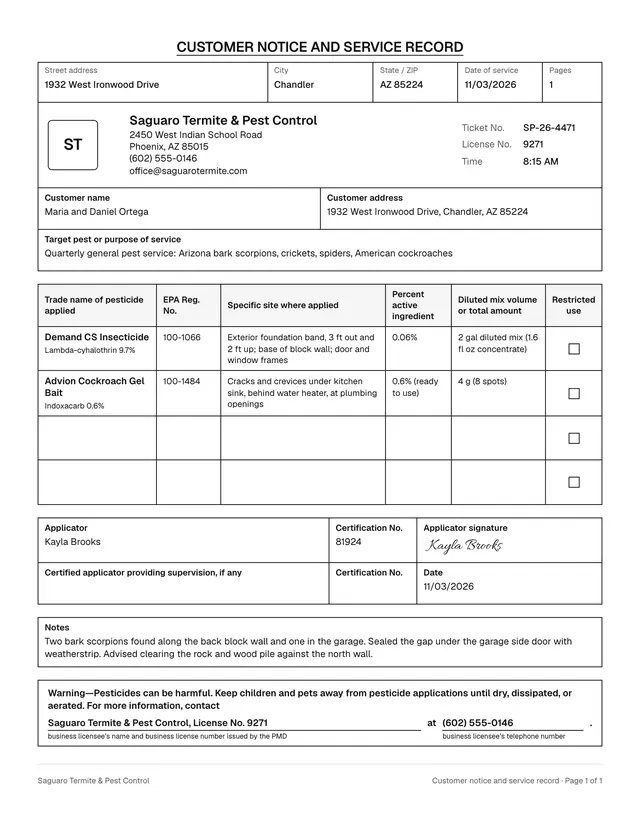
Record each pesticide applied at a service visit. - Arizona
Customer Notice and Service Record
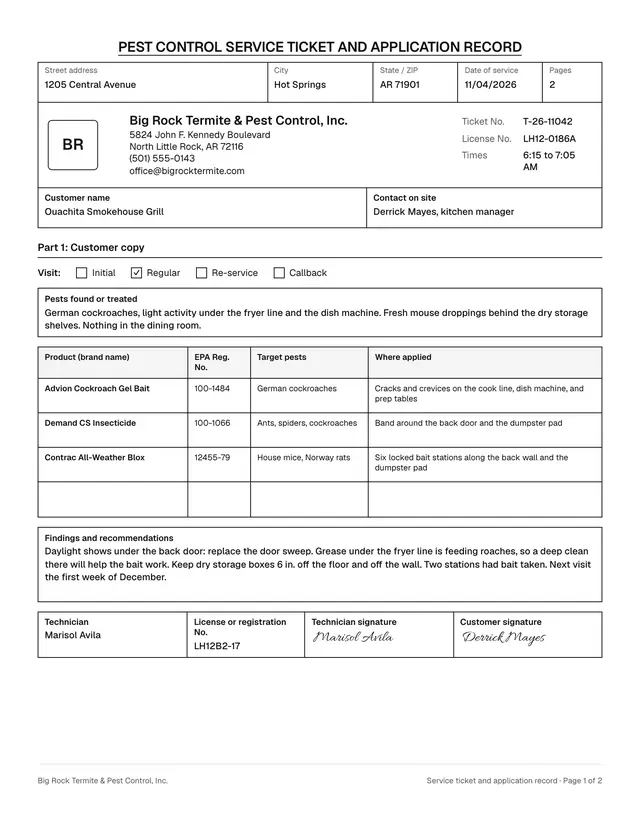
Record each pesticide applied at a service visit. - Arkansas
Pest Control Service Ticket and Application Record
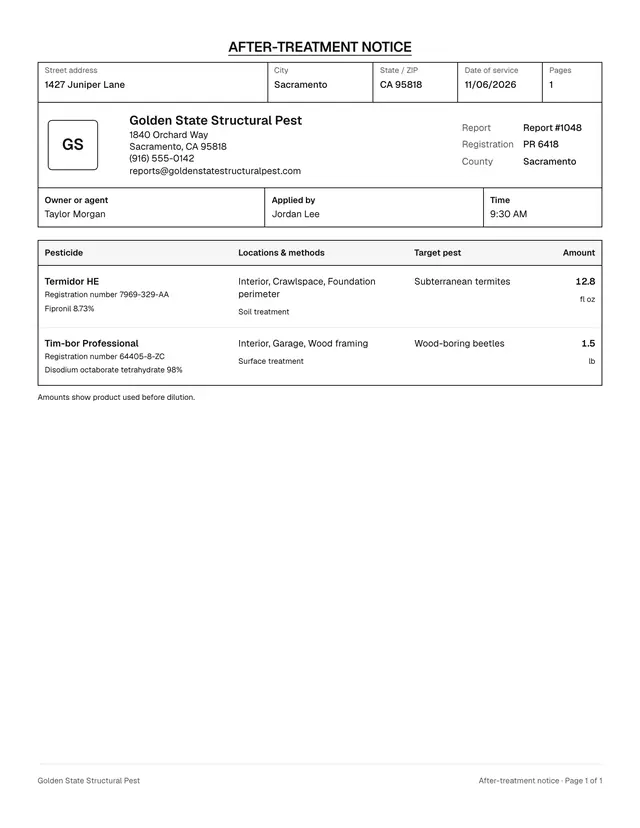
Record each pesticide applied at a service visit. - California
After-Treatment Notice
Record each pesticide applied at a service visit. - Colorado
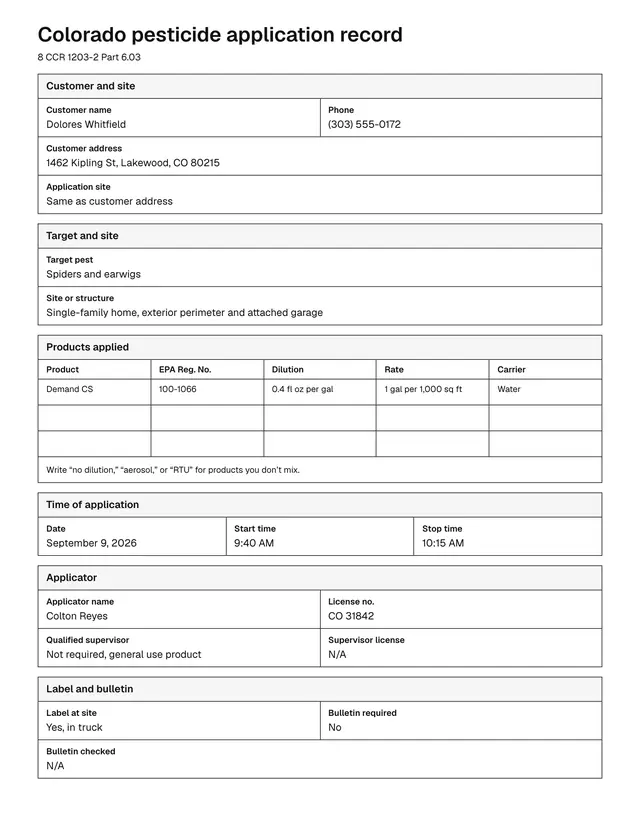
Colorado commercial pesticide application record
Record each pesticide applied at a service visit. - Connecticut
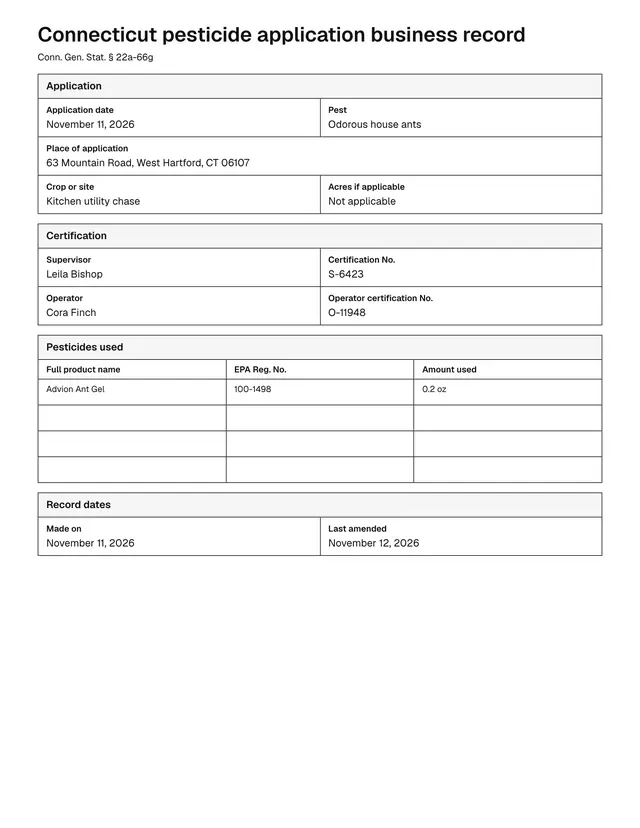
Connecticut pesticide application business record
Record each pesticide applied at a service visit. - Delaware
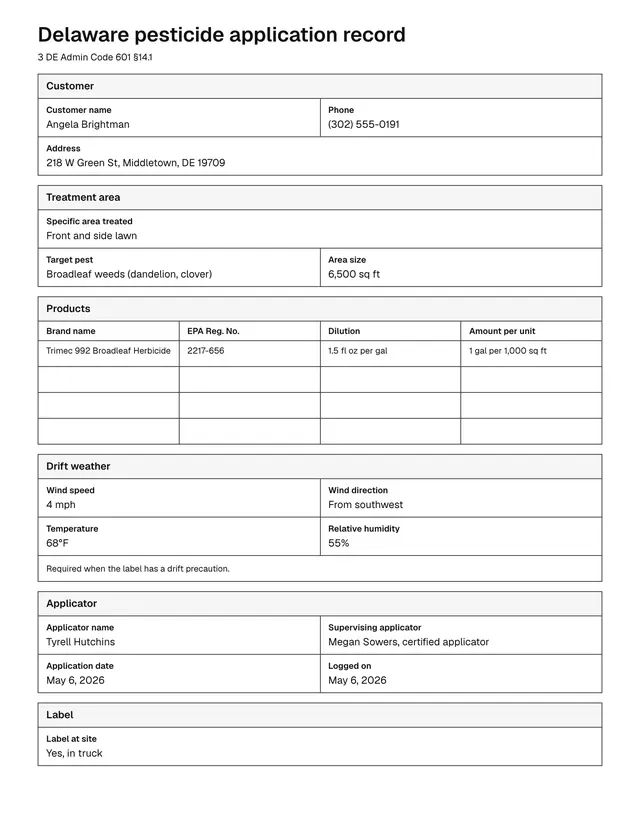
Delaware pesticide application record (3 DE Admin Code 601 §14.1)
Record each pesticide applied at a service visit. - Georgia
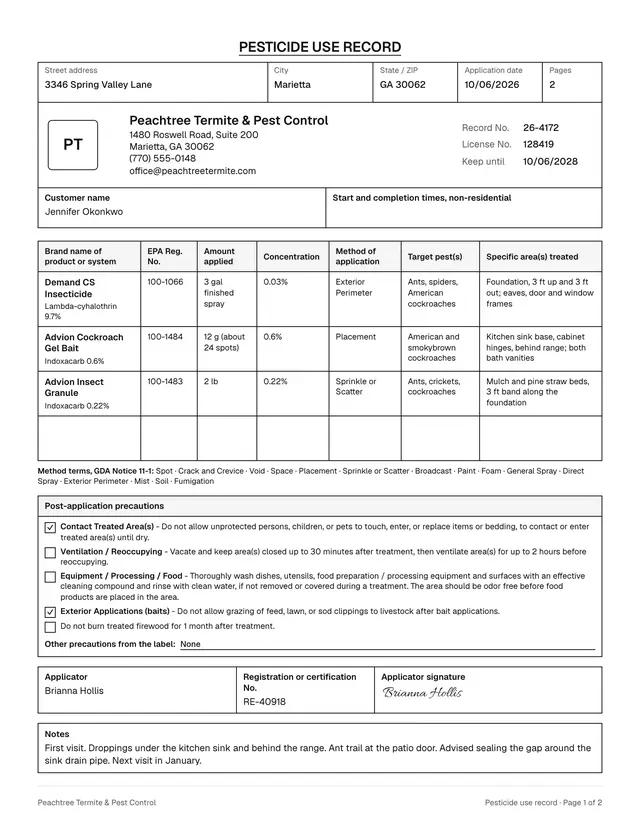
Pesticide Use Record
Record each pesticide applied at a service visit. - Hawaii
Pest Control Job Record
Record each pesticide applied at a service visit. - Illinois
Illinois structural pest control application record
Record each pesticide applied at a service visit. - Indiana
Indiana commercial applicator pesticide use record
Record each pesticide applied at a service visit. - Iowa
Iowa commercial pesticide application record
Record each pesticide applied at a service visit. - Kansas
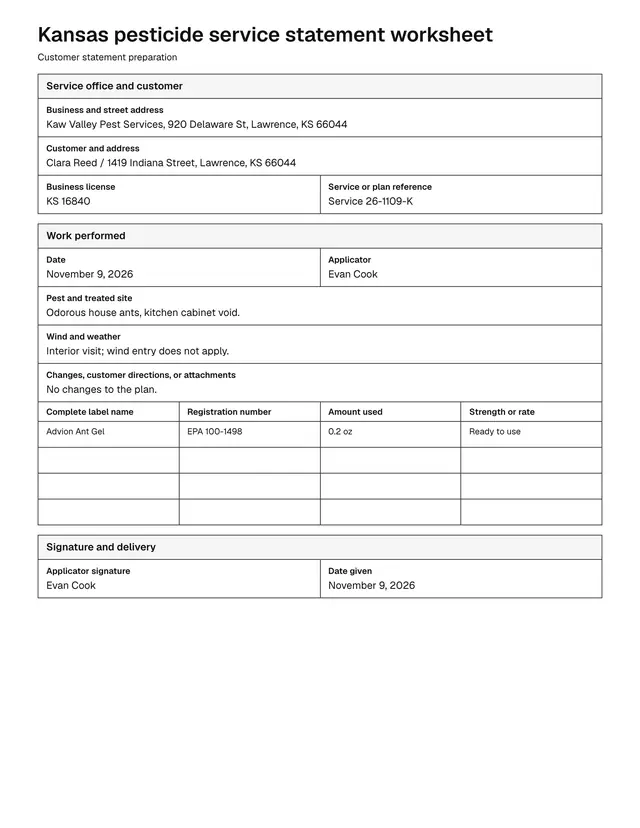
Kansas pesticide service statement worksheet
Record each pesticide applied at a service visit. - Kentucky
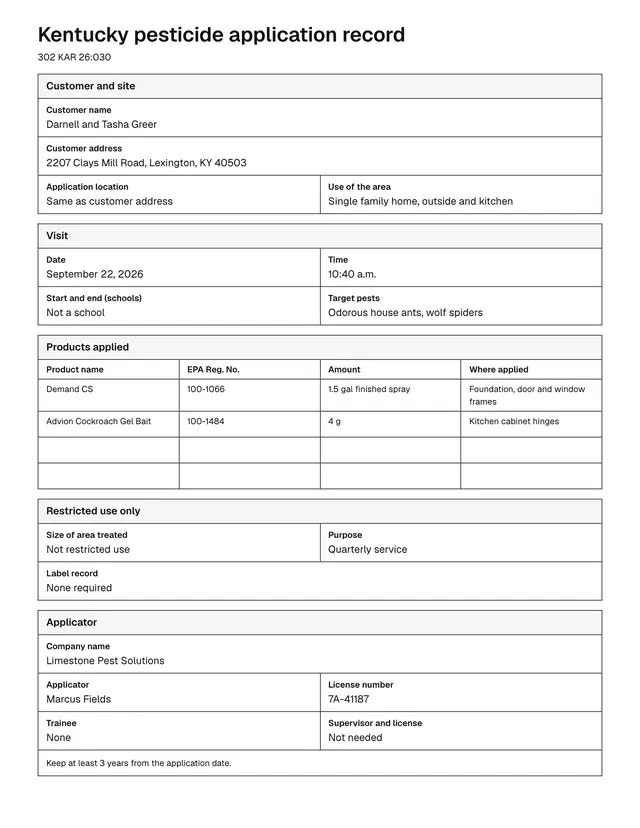
Kentucky pesticide application record (302 KAR 26:030)
Record each pesticide applied at a service visit. - Louisiana
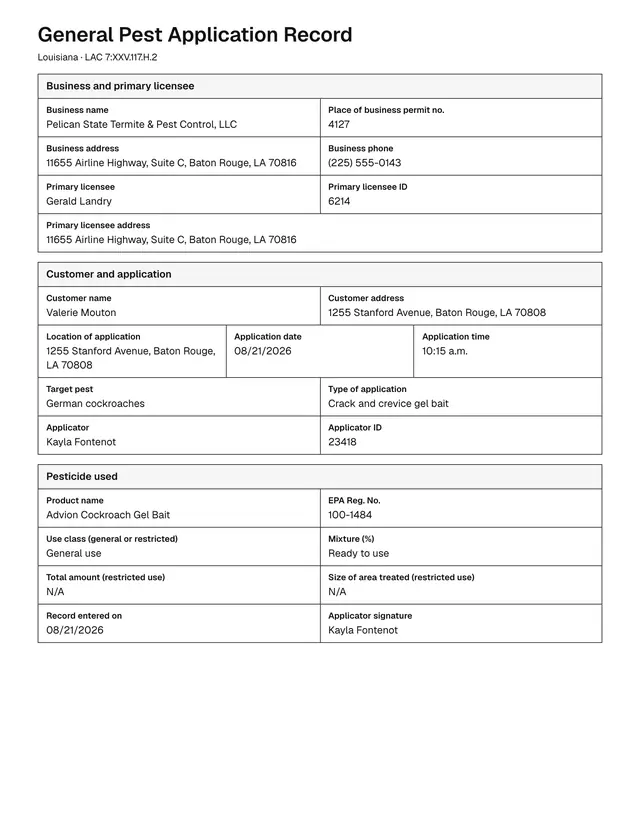
General Pest Application Record
Record each pesticide applied at a service visit. - Maryland
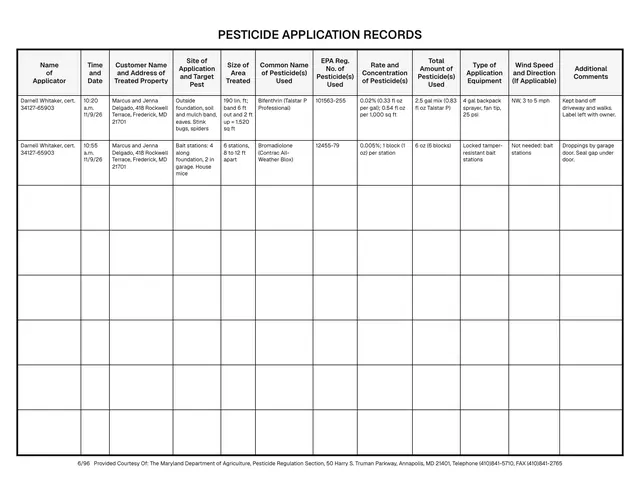
Pesticide Application Record and Customer Pesticide Information
Record each pesticide applied at a service visit. - Massachusetts
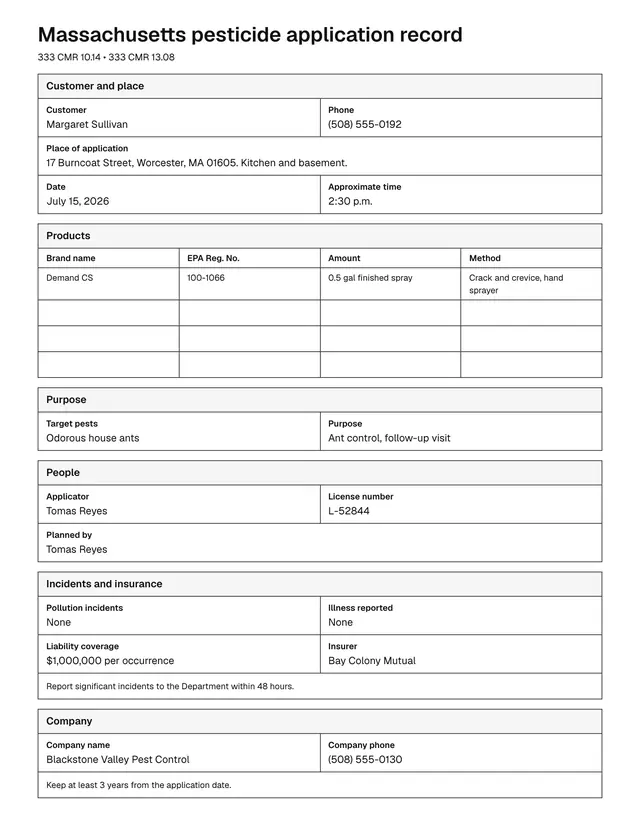
Massachusetts pesticide application record (333 CMR 10.14)
Record each pesticide applied at a service visit. - Michigan
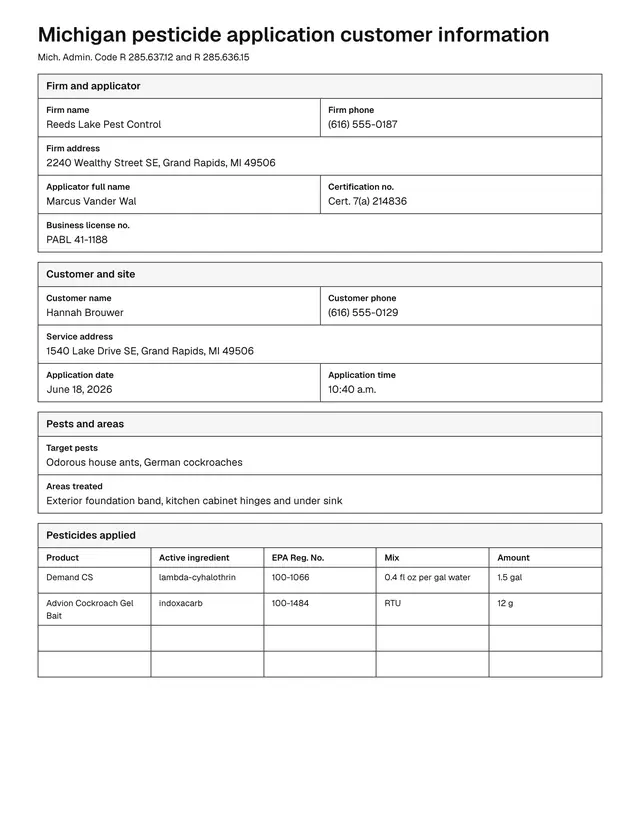
Michigan pesticide customer information receipt
Record each pesticide applied at a service visit. - Mississippi
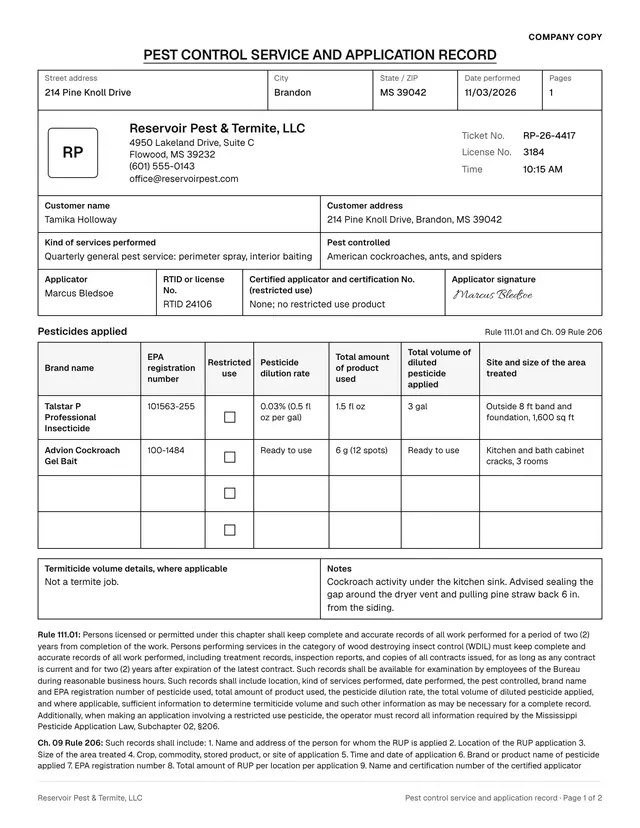
Pest Control Service and Application Record
Record each pesticide applied at a service visit. - Missouri
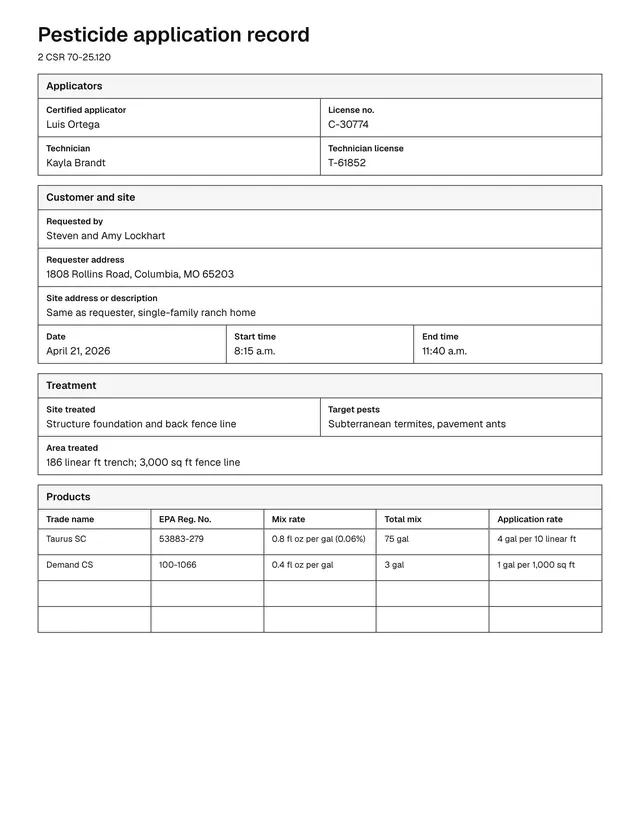
Missouri pesticide application record (2 CSR 70-25.120)
Record each pesticide applied at a service visit. - Nevada
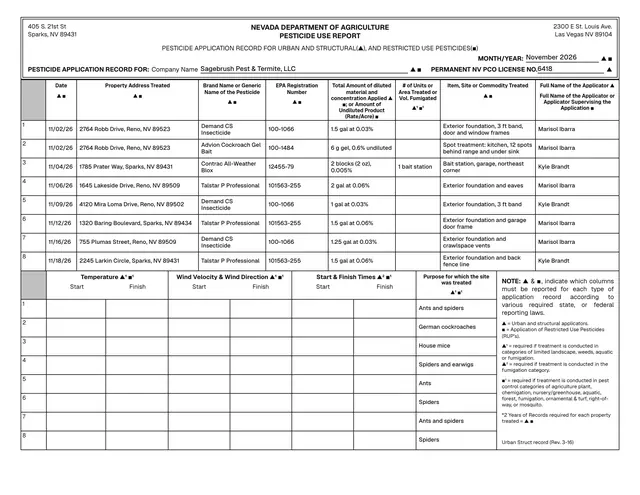
Pesticide Application Record for Urban and Structural and Restricted Use Pesticides
Record each pesticide applied at a service visit. - New Mexico
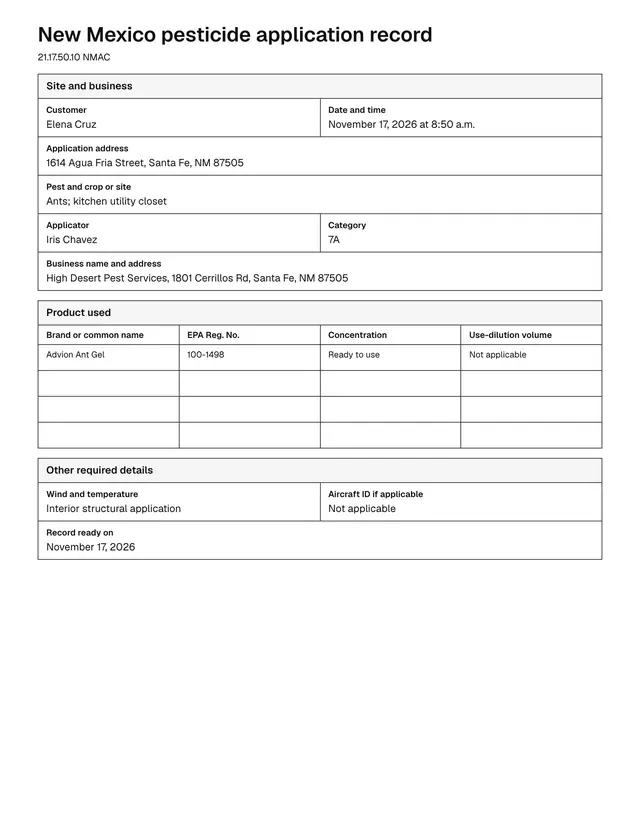
New Mexico pesticide application record
Record each pesticide applied at a service visit. - New York
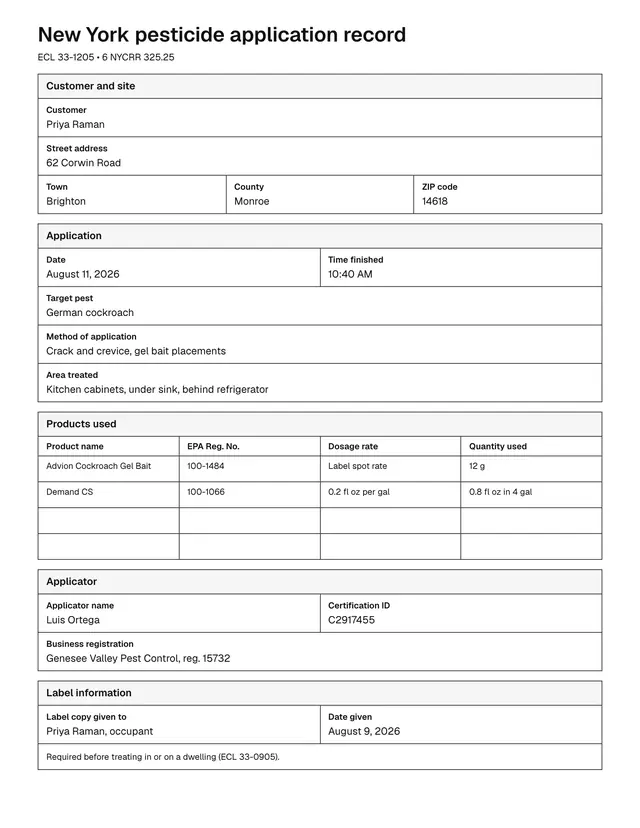
New York pesticide application record (6 NYCRR 325.25)
Record each pesticide applied at a service visit. - North Carolina
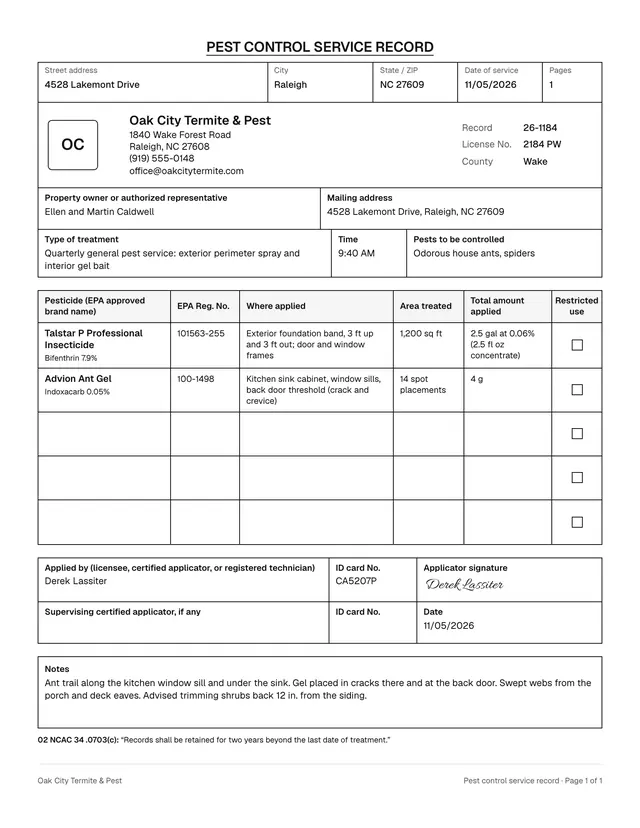
Pest Control Service Record
Record each pesticide applied at a service visit. - Ohio
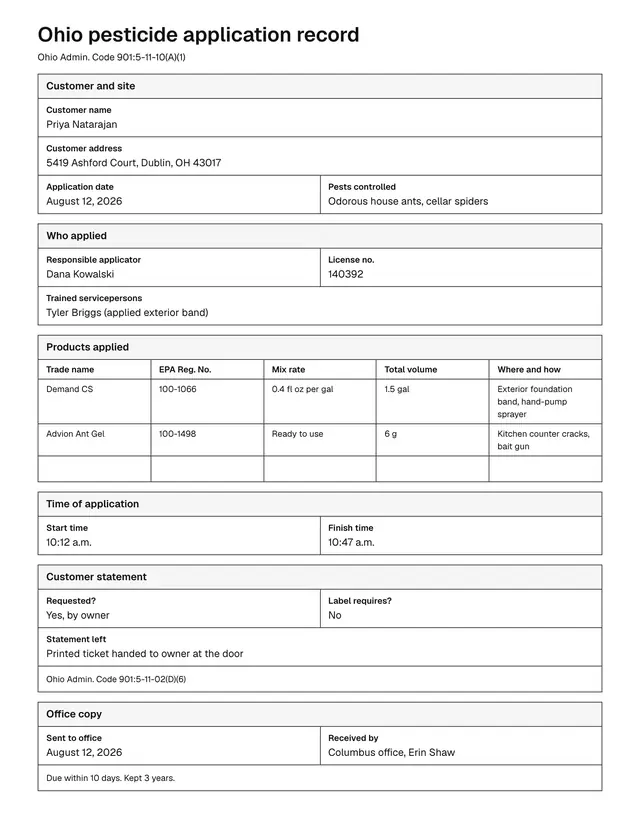
Ohio pesticide application record
Record each pesticide applied at a service visit. - Oklahoma
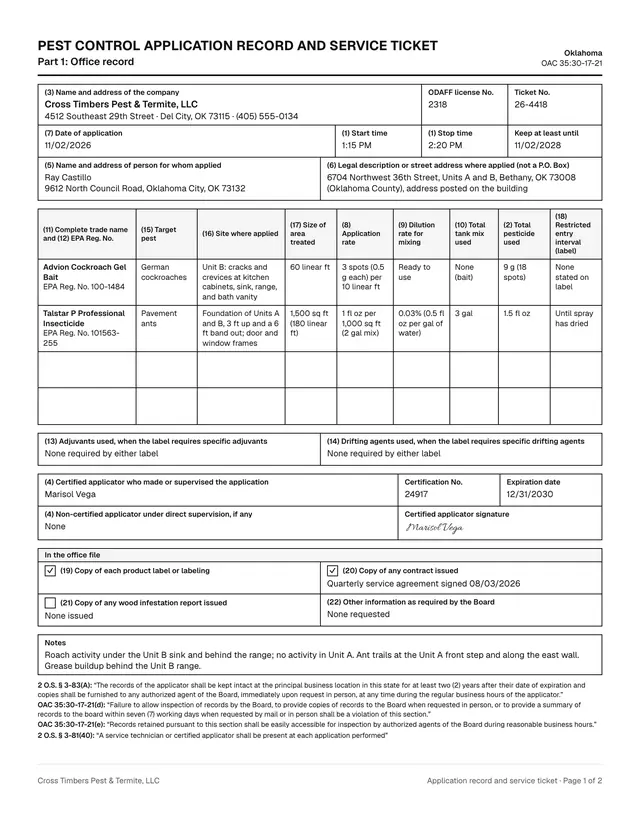
Pest Control Application Record and Service Ticket
Record each pesticide applied at a service visit. - Oregon
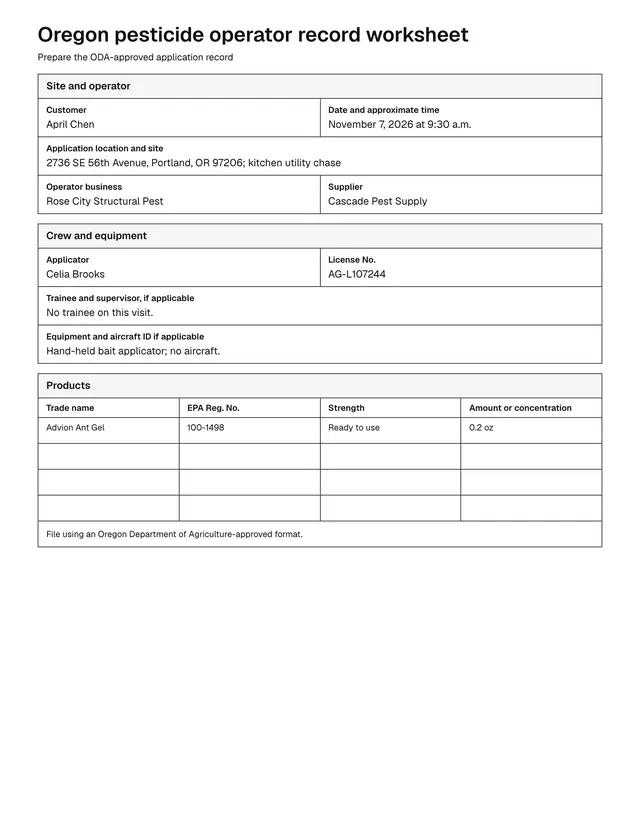
Oregon pesticide operator record worksheet
Record each pesticide applied at a service visit. - Pennsylvania
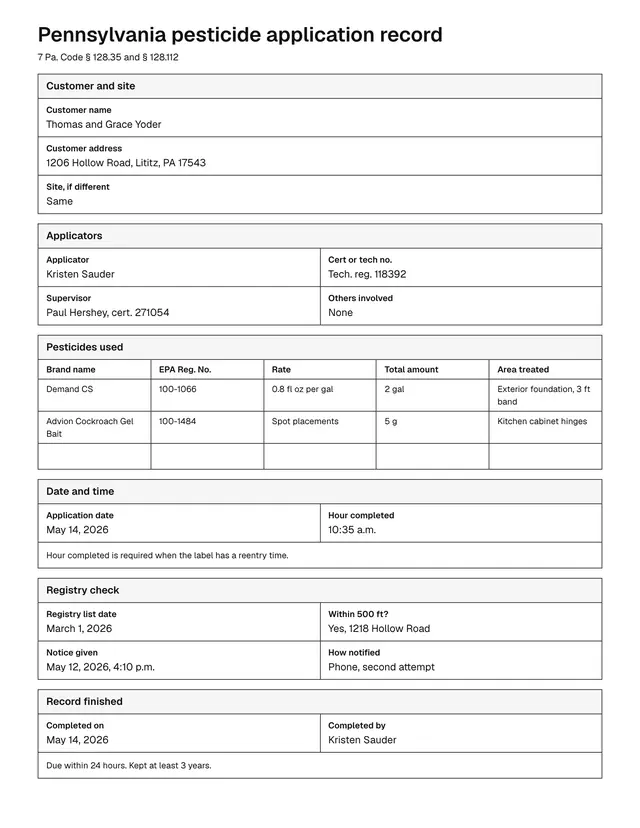
Pennsylvania pesticide application record
Record each pesticide applied at a service visit. - South Carolina
Pest Control Service Record
Record each pesticide applied at a service visit. - Tennessee
Tennessee pesticide application record
Record each pesticide applied at a service visit. - Texas
Pest Control Use Record
Record each pesticide applied at a service visit. - Utah
Utah commercial pesticide service worksheet
Record each pesticide applied at a service visit. - Virginia
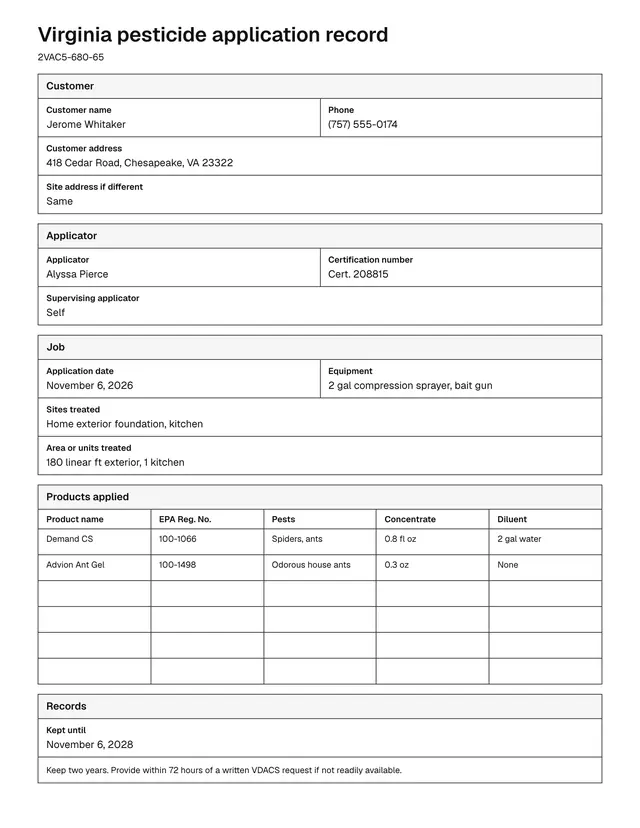
Virginia pesticide application record
Record each pesticide applied at a service visit. - Washington
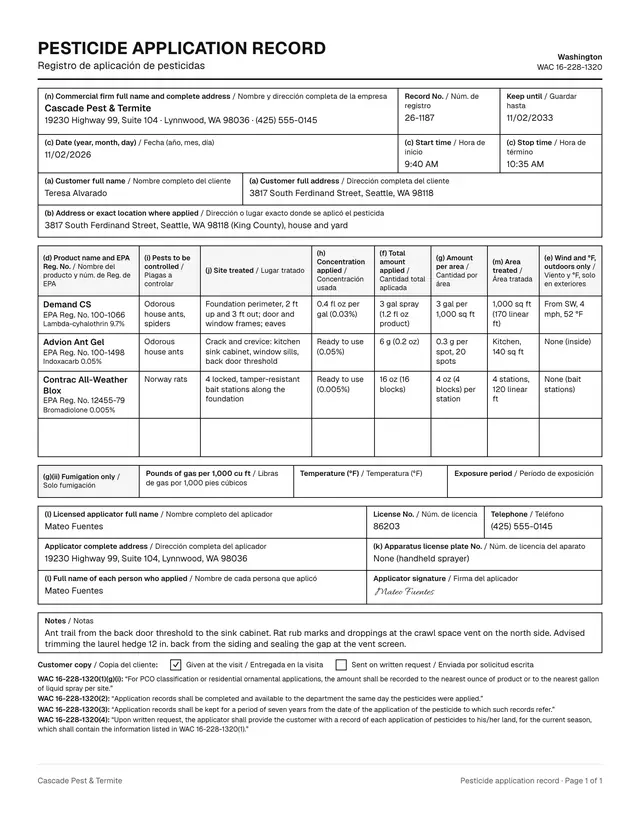
Pesticide Application Record
Record each pesticide applied at a service visit. - Wisconsin
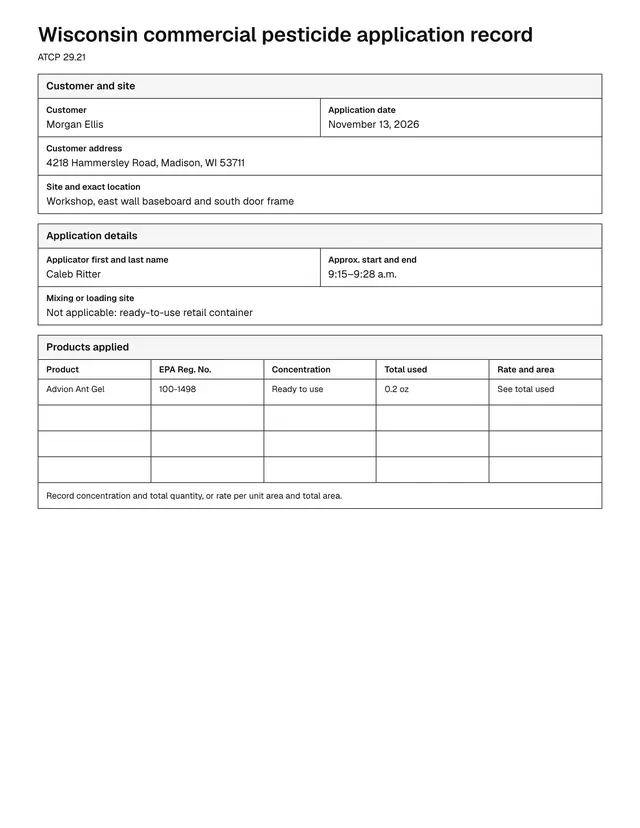
Wisconsin commercial pesticide application record
Record each pesticide applied at a service visit.