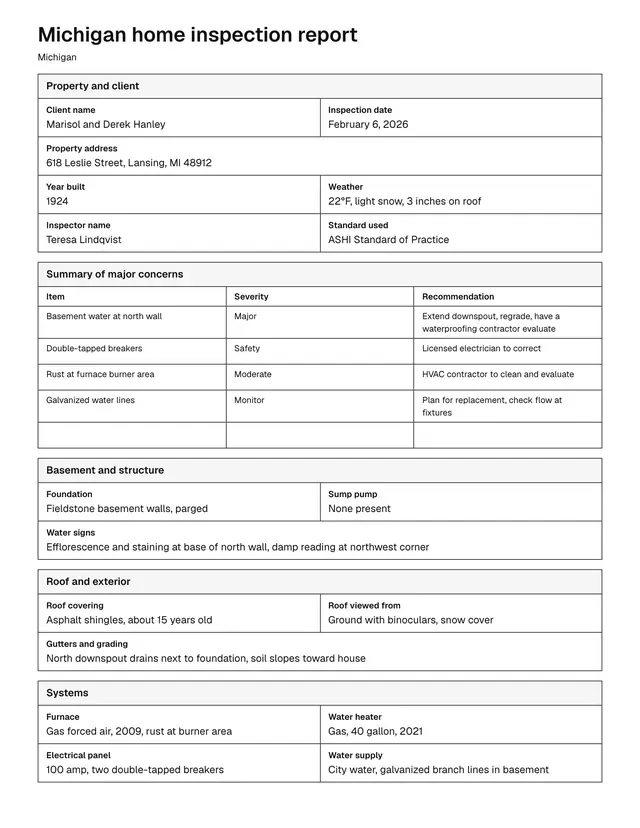
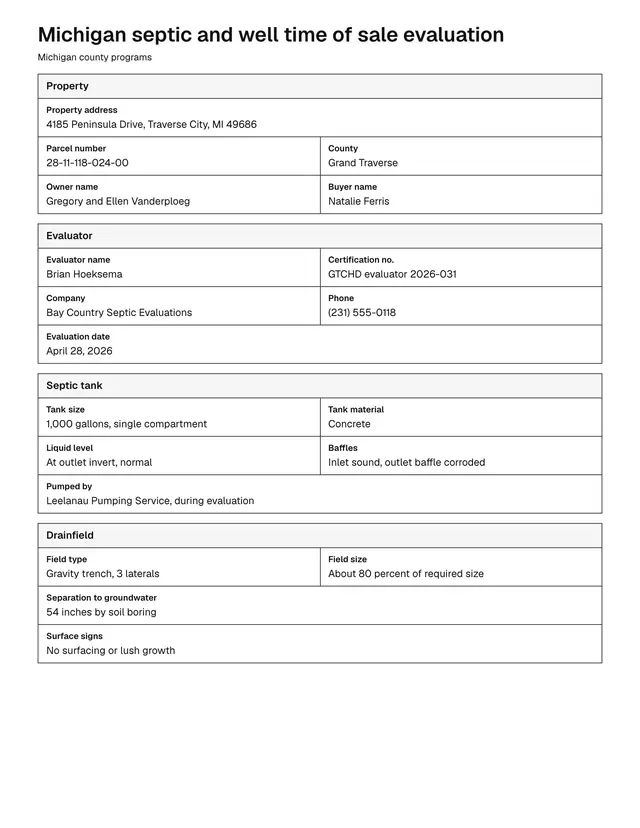
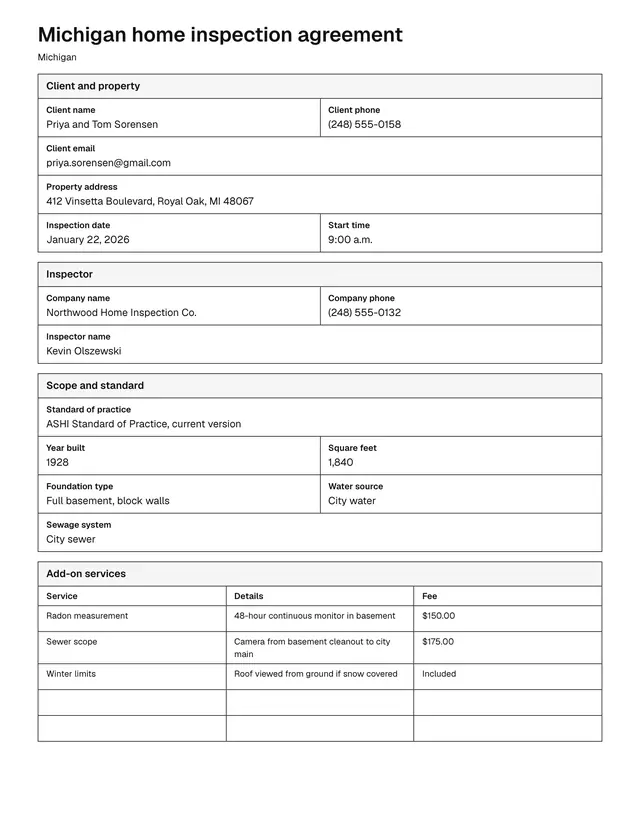
Michigan home inspection agreement
Michigan doesn’t license home inspectors, so no state rule says what your contract must cover. That makes the pre-inspection agreement the one document that sets your scope, your standard, and your limits.
At a glance
- State license
- None for home inspectors
- Common standards
- ASHI or InterNACHI
- Seller disclosure
- MCL 565.957
- Radon
- About 1 in 4 homes over the action level (EGLE)
Completed example
Download PDFNo state license means the contract carries the weight
Michigan is one of the states with no license for home inspectors. Bills to create one have come up in Lansing over the years, and none has passed. So there’s no state board, no required report format, and no state rule about what your agreement has to say.
That cuts both ways. You’re free to write the contract you want. But if a buyer is unhappy about a wet basement three months after closing, the agreement is the first thing anyone reads. It should say what you inspect, what you don’t, which standard you follow, what you charge, and what happens if there’s a dispute.
Name a standard. Most Michigan inspectors pick the ASHI Standard of Practice or the InterNACHI Standards of Practice. Both list the systems you look at and the things you don’t do, like moving furniture or entering a crawlspace too tight to work in. Naming one in the agreement brings that whole list in without retyping it.
Add-ons that belong in a Michigan agreement
A standard home inspection stops at the edges of the house. In Michigan, the questions buyers care about often sit just past those edges. Spell each extra service out with its own line and fee, or say plainly that you don’t offer it.
Radon. Michigan’s environment department, EGLE, says “one in every four Michigan homes is expected to have radon levels that exceed the recommended federal action level.” Put the test type, the number of days, and who keeps the house closed up in the add-on.
Well water. Many homes outside city water rely on a private well. A water sample for bacteria and nitrates is a separate service from looking at the pressure tank. Say which one you’re doing.
Septic. Several Michigan counties, like Washtenaw, Macomb, and Grand Traverse, run their own time of sale programs. If the county needs a registered evaluator, say whether that’s you. Our Michigan septic time of sale evaluation page covers those programs.
Termites and carpenter ants. If the lender needs an NPMA-33, that’s its own report. See the Michigan wood-destroying insect report page.
Winter limits. Snow on the roof, a frozen hose bib, or an AC that can’t be run in the cold. Add a line that says weather can keep parts of the house from being seen or tested, and that the report will name them.
Where the seller’s disclosure fits in
Michigan sellers fill out a disclosure statement under the Seller Disclosure Act. The form itself says it “is not a substitute for any inspections or warranties the buyer may wish to obtain.” Your agreement should say the same thing about your report from the other side: it’s a look at the house on one day, not a warranty.
Ask your client for a copy of the disclosure before the inspection. The very first question is “Basement/crawl space: Has there been evidence of water?” If the seller checked yes, you know where to spend extra time with the moisture meter.
Timing matters too. If the buyer gets the disclosure late, after signing a purchase agreement, they can back out within 72 hours of getting it in person or 120 hours by registered mail. The inspection window in a purchase agreement is usually short as well. A signed agreement on day one keeps your slot from being the thing that holds up the deal.
Can the buyer sign before you pull up?
Yes, and it’s better that way. A buyer who signs at the kitchen table after a two-hour walk-through can say they didn’t have time to read it. A buyer who signed the night before can’t. If two people are buying, get both names and both signatures.
Make the e-signed copy complete. It should carry the date and start time, the address, every add-on with its fee, the total, and when payment is due. If the agent books a radon test the day before, send a new version for signature instead of adding it by text. The agreement that’s signed should match the job you do, line for line, and the invoice should match both.
Noma specializes in the Michigan home inspection agreement (ASHI or InterNACHI standards, no state license). Upload your agreement once as a reusable document, and a booked job can send it for e-signature right away, so it’s signed before you leave for the house. See how Noma sends inspection agreements.
Frequentlyaskedquestions
Send this document in minutes, not an afternoon.
Other states
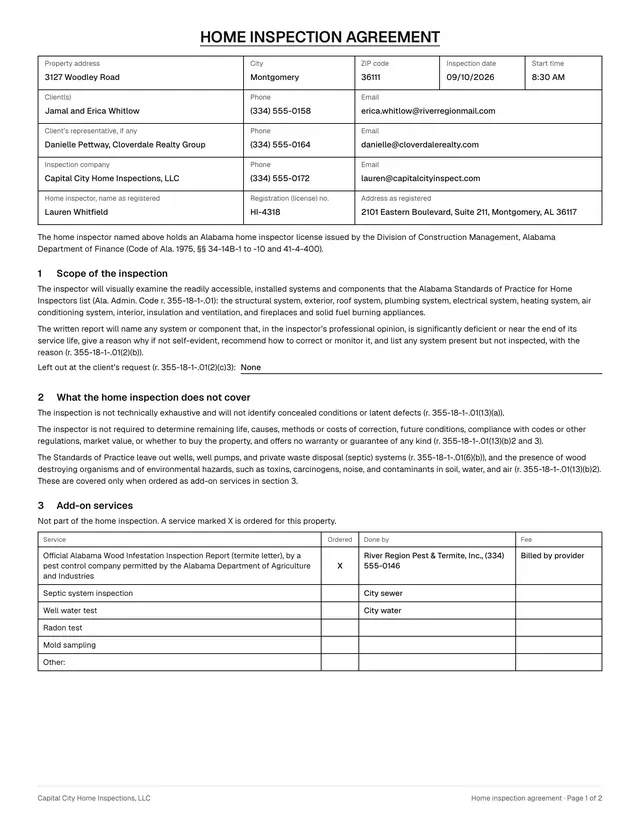
Home inspection agreement templates- Alabama
Home Inspection Agreement
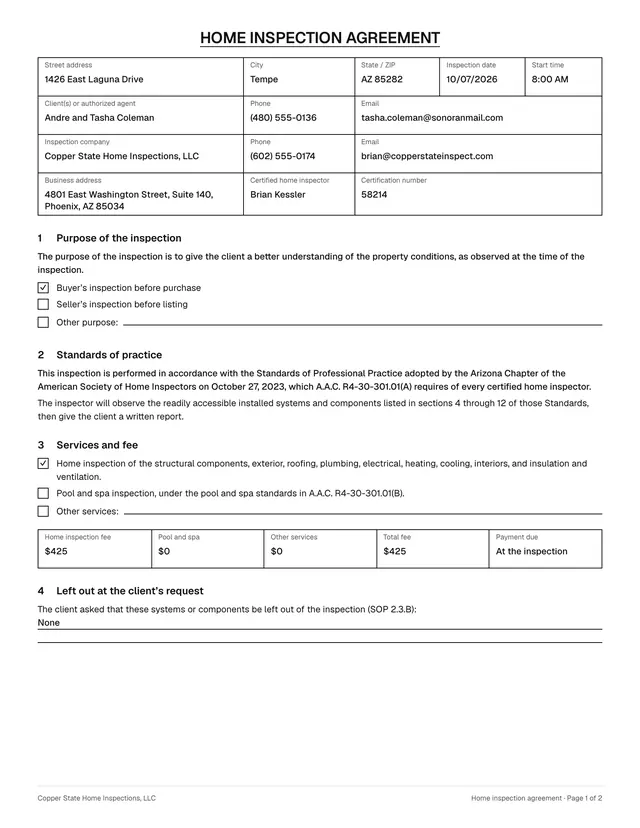
The contract a client signs for a home inspection. - Arizona
Home Inspection Agreement
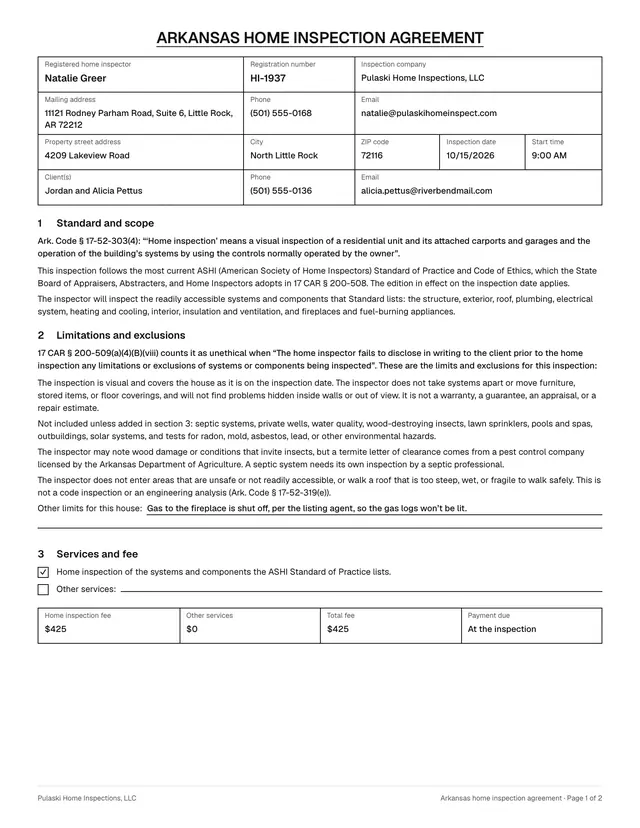
The contract a client signs for a home inspection. - Arkansas
Arkansas Home Inspection Agreement
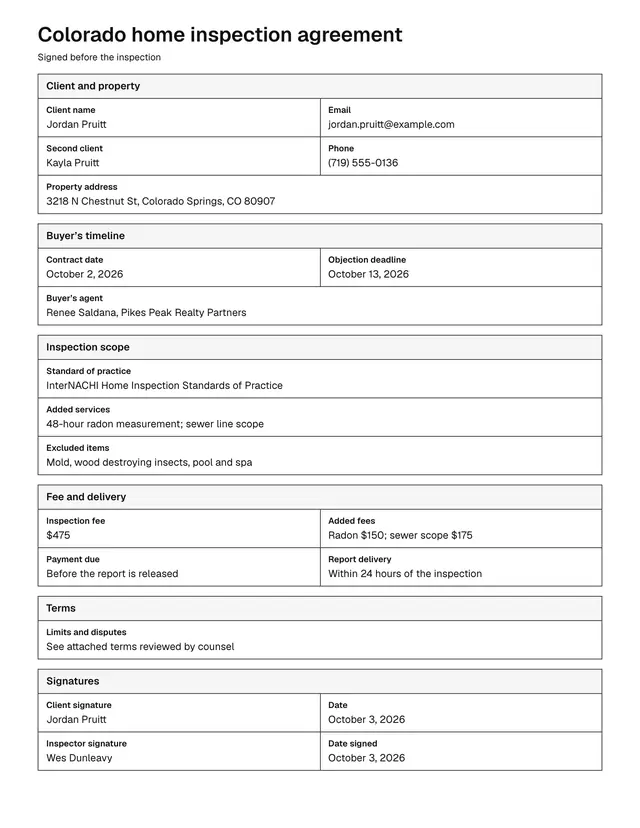
The contract a client signs for a home inspection. - Colorado
Colorado home inspection agreement
The contract a client signs for a home inspection. - Connecticut
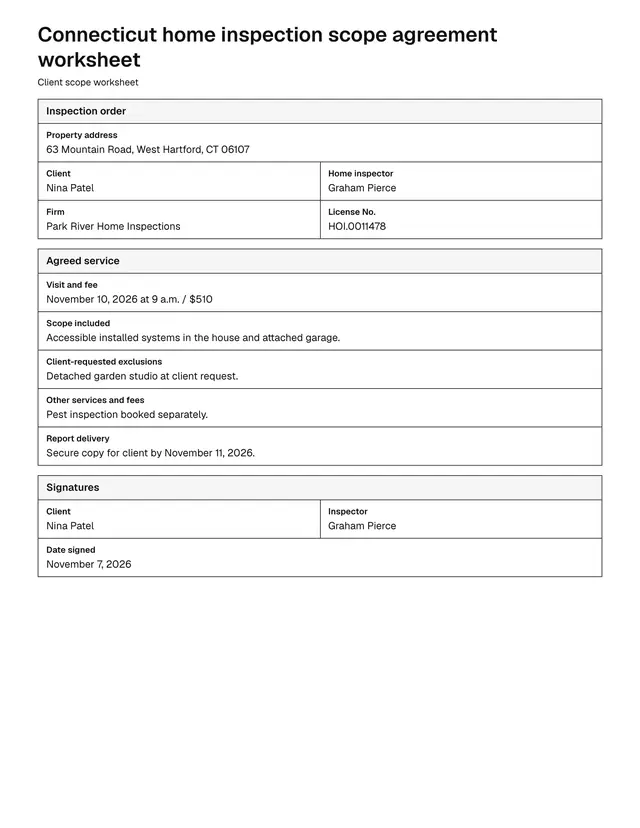
Connecticut home inspection scope agreement worksheet
The contract a client signs for a home inspection. - Delaware
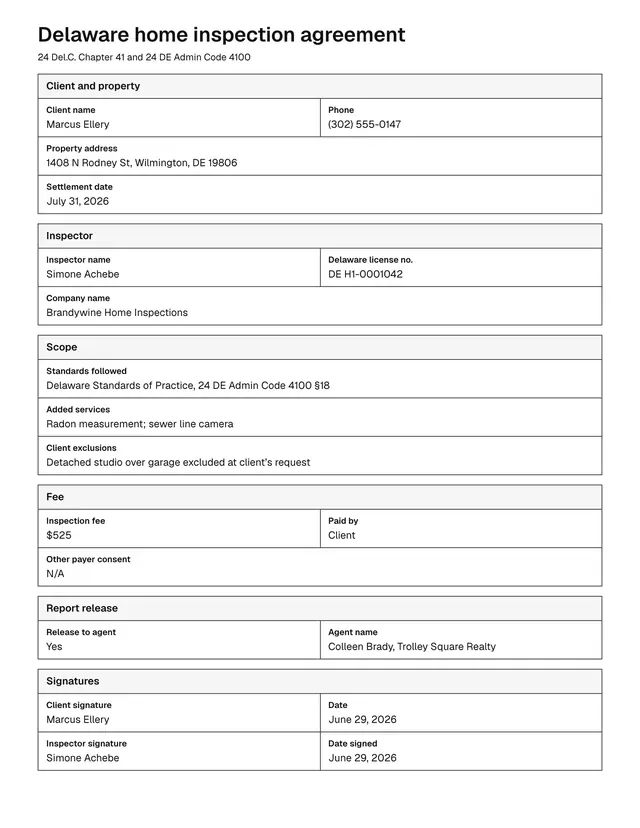
Delaware home inspection agreement
The contract a client signs for a home inspection. - Florida
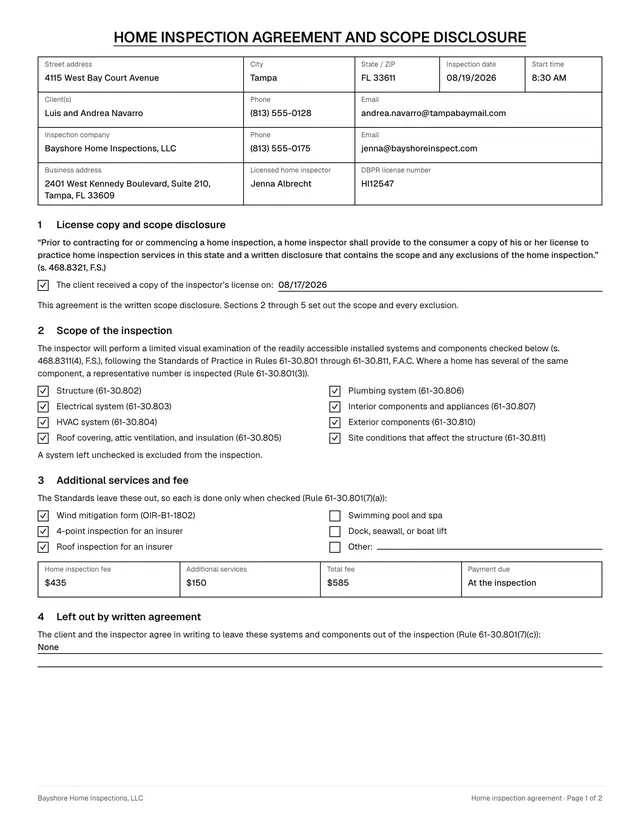
Home Inspection Agreement and Scope Disclosure
The contract a client signs for a home inspection. - Georgia
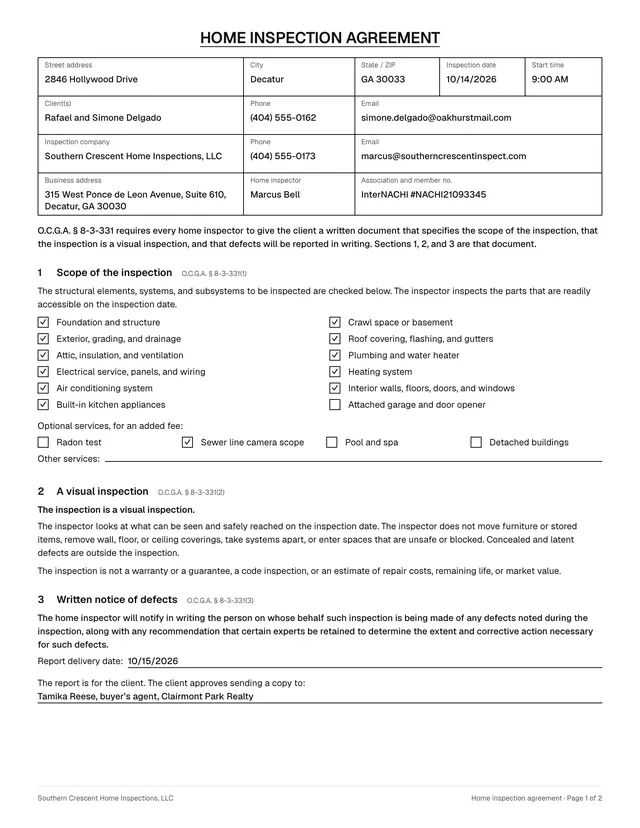
Home Inspection Agreement
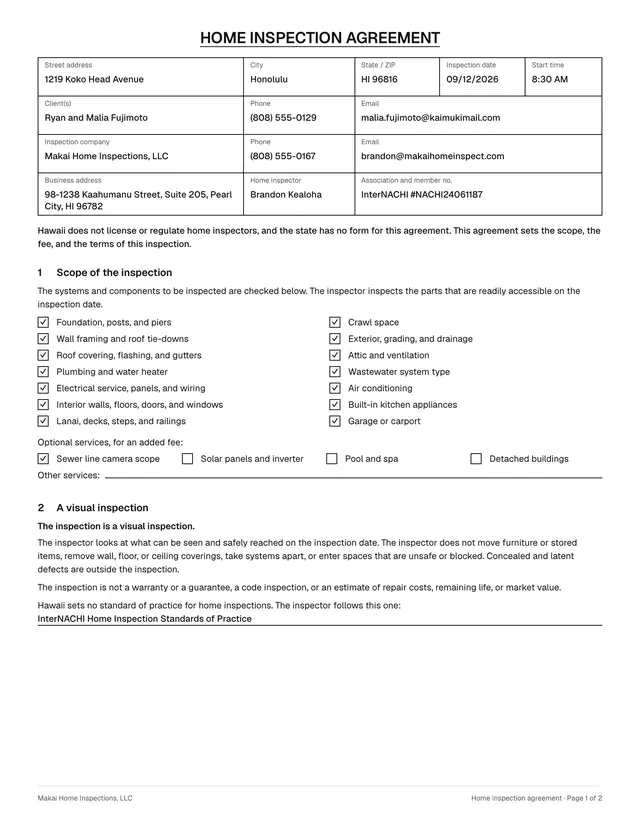
The contract a client signs for a home inspection. - Hawaii
Home Inspection Agreement
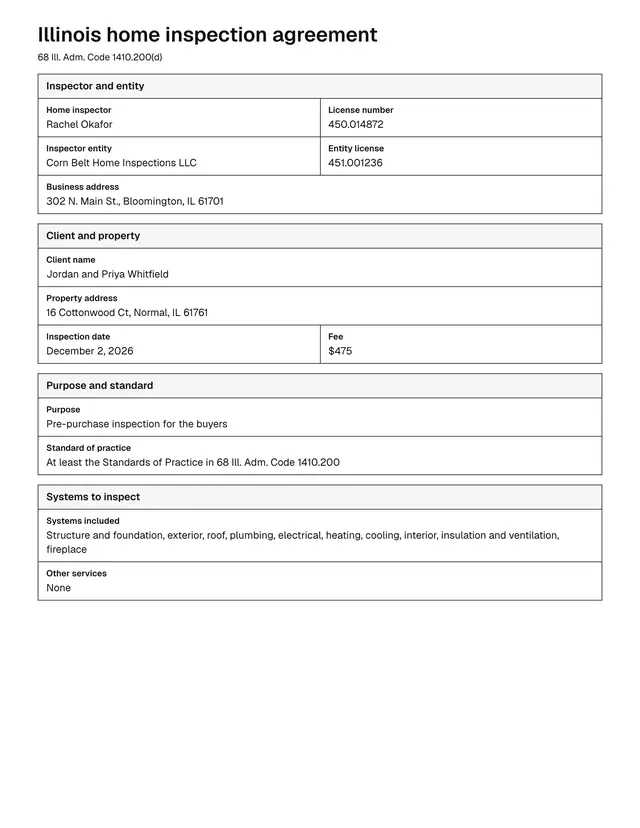
The contract a client signs for a home inspection. - Illinois
Illinois home inspection agreement
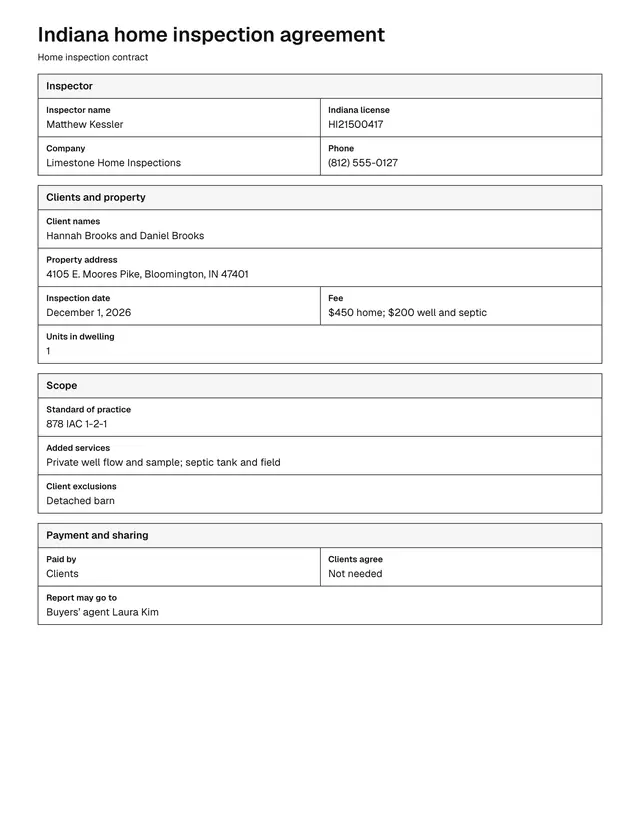
The contract a client signs for a home inspection. - Indiana
Indiana home inspection agreement
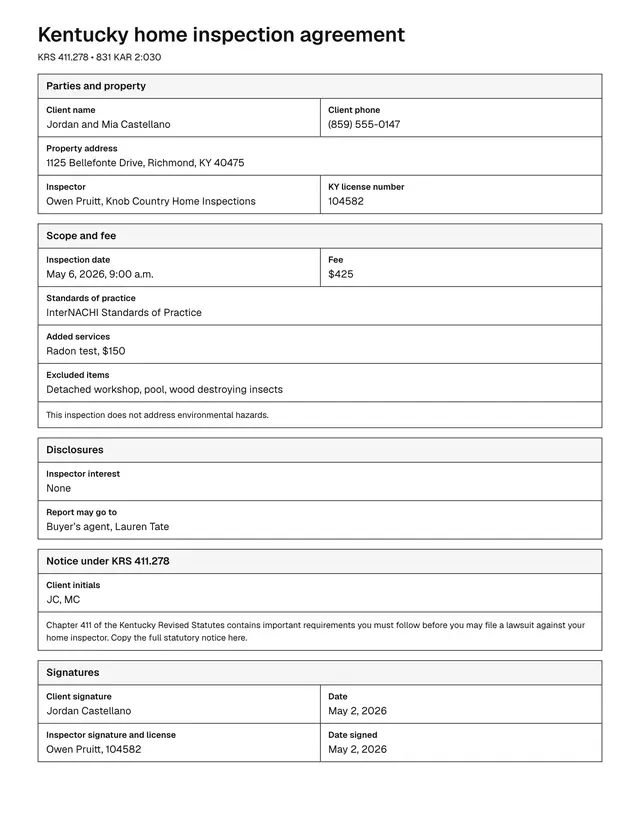
The contract a client signs for a home inspection. - Kentucky
Kentucky home inspection agreement
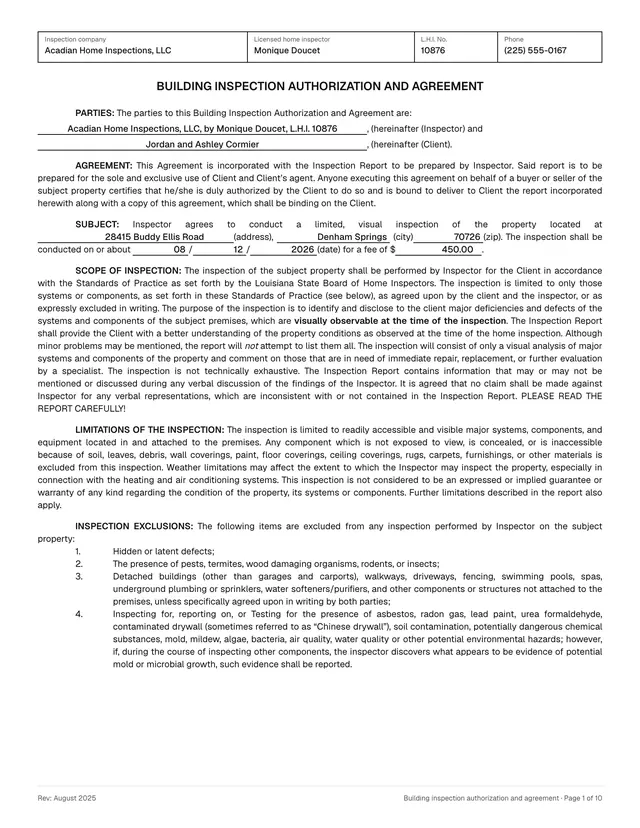
The contract a client signs for a home inspection. - Louisiana
Building Inspection Authorization and Agreement
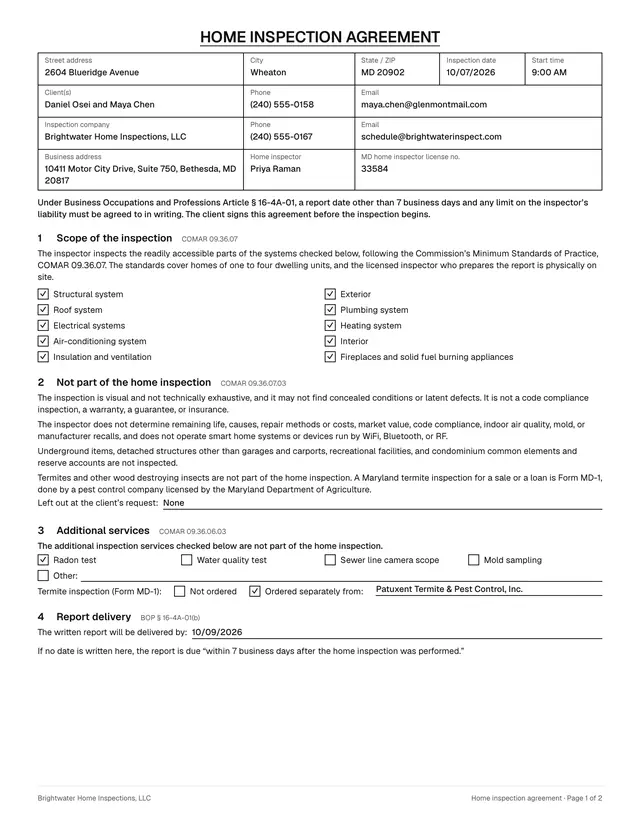
The contract a client signs for a home inspection. - Maryland
Home Inspection Agreement
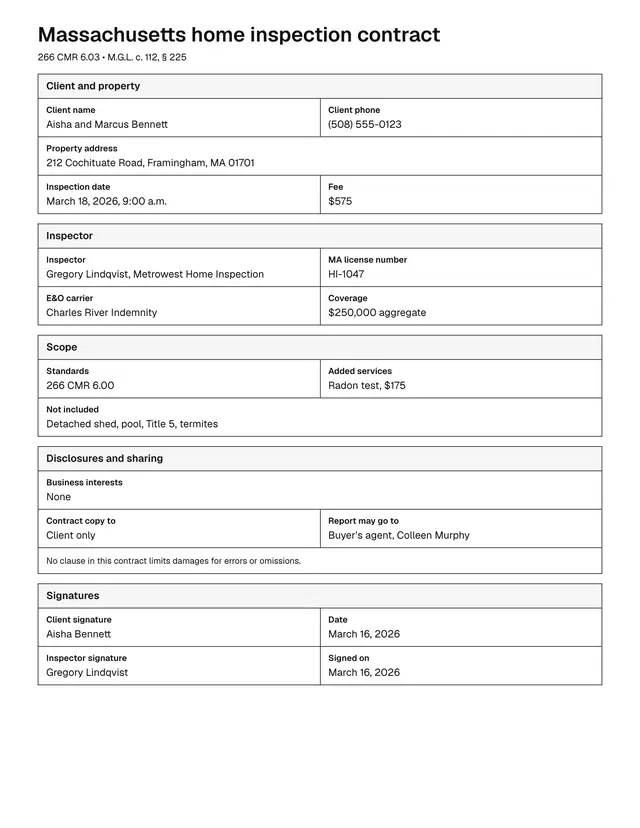
The contract a client signs for a home inspection. - Massachusetts
Massachusetts home inspection contract (266 CMR 6.03)
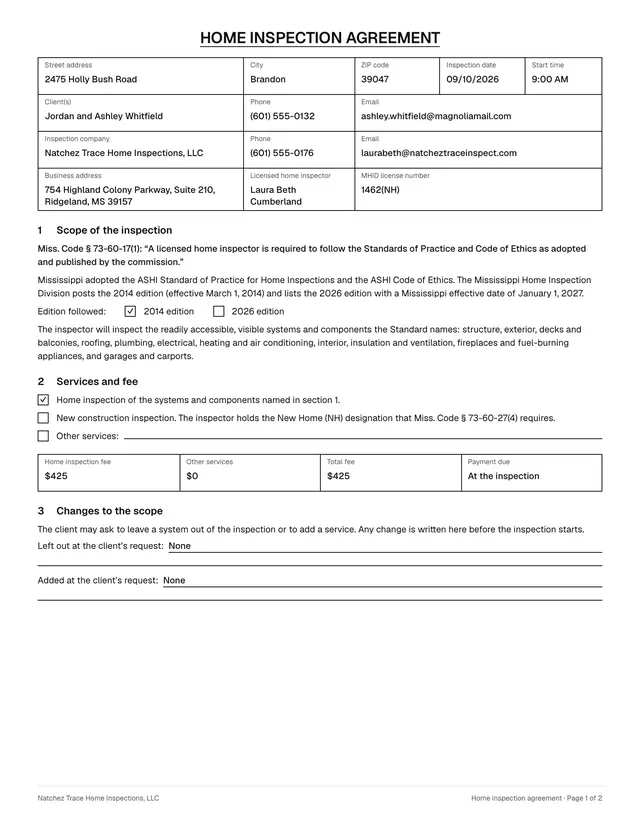
The contract a client signs for a home inspection. - Mississippi
Home Inspection Agreement
The contract a client signs for a home inspection. - Missouri
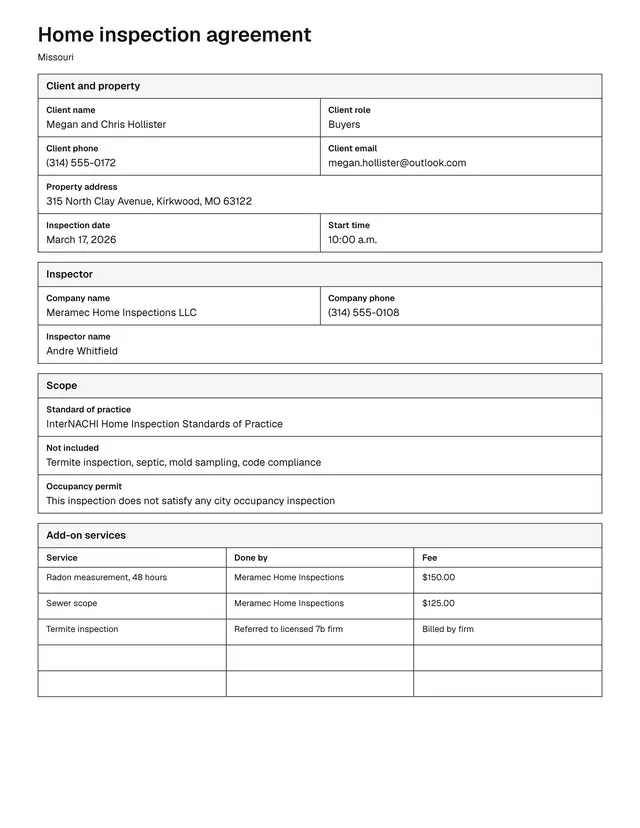
Missouri home inspection agreement
The contract a client signs for a home inspection. - Nevada
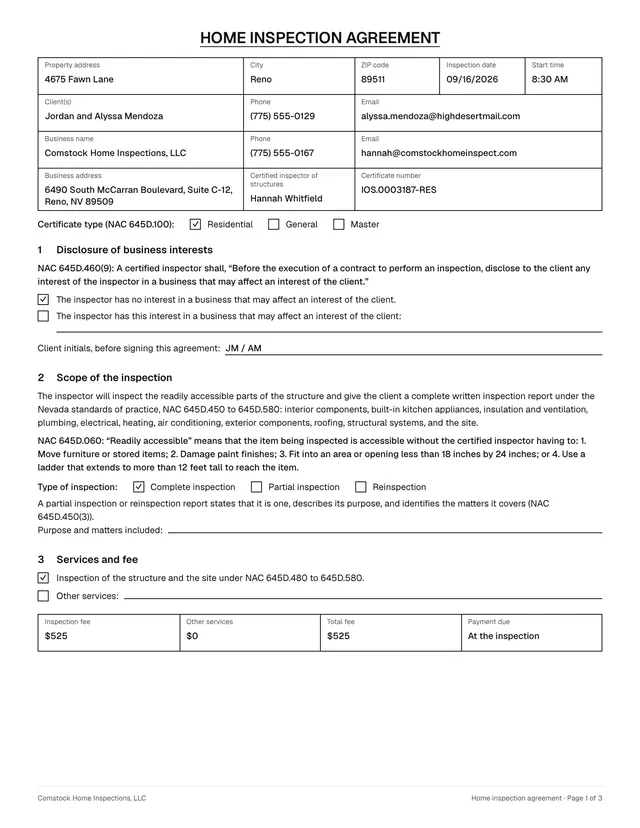
Home Inspection Agreement
The contract a client signs for a home inspection. - New Jersey
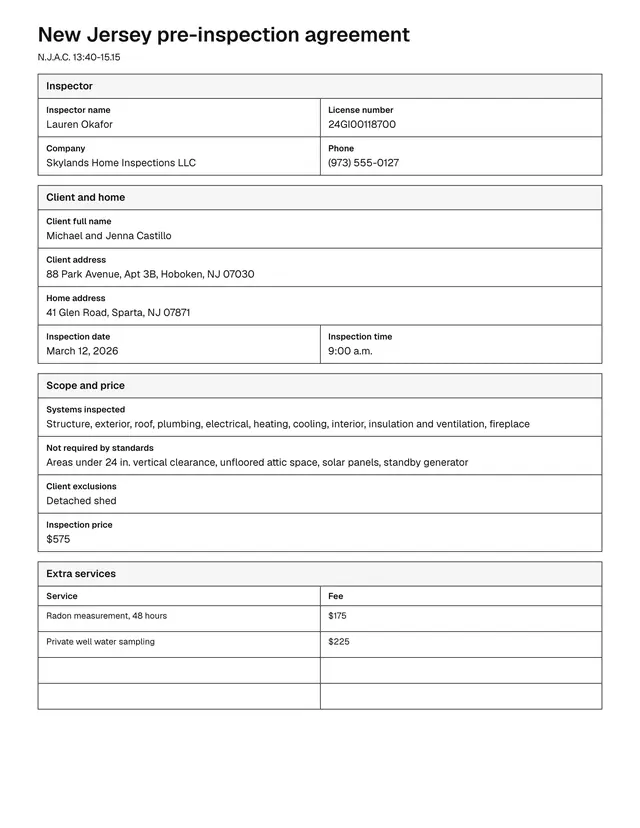
New Jersey pre-inspection agreement (N.J.A.C. 13:40-15.15)
The contract a client signs for a home inspection. - New Mexico
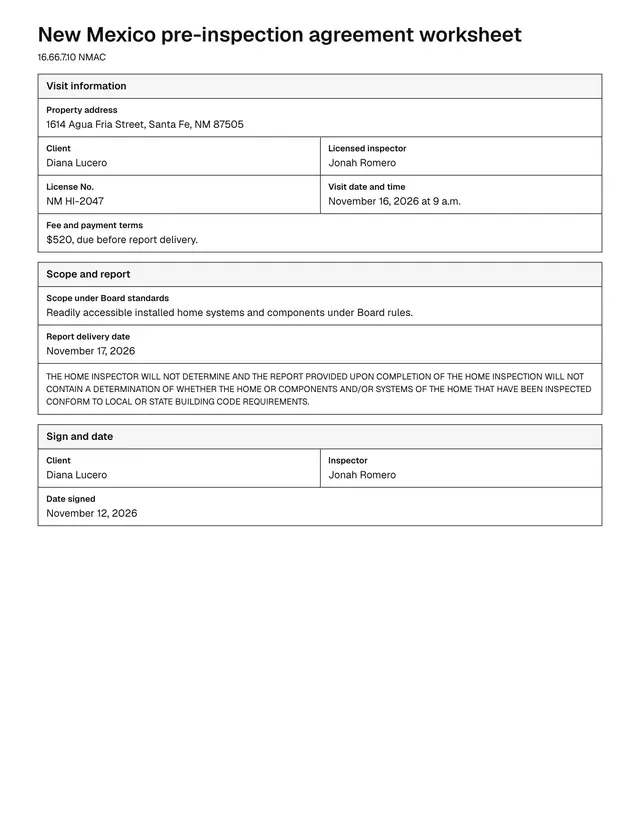
New Mexico pre-inspection agreement worksheet
The contract a client signs for a home inspection. - New York
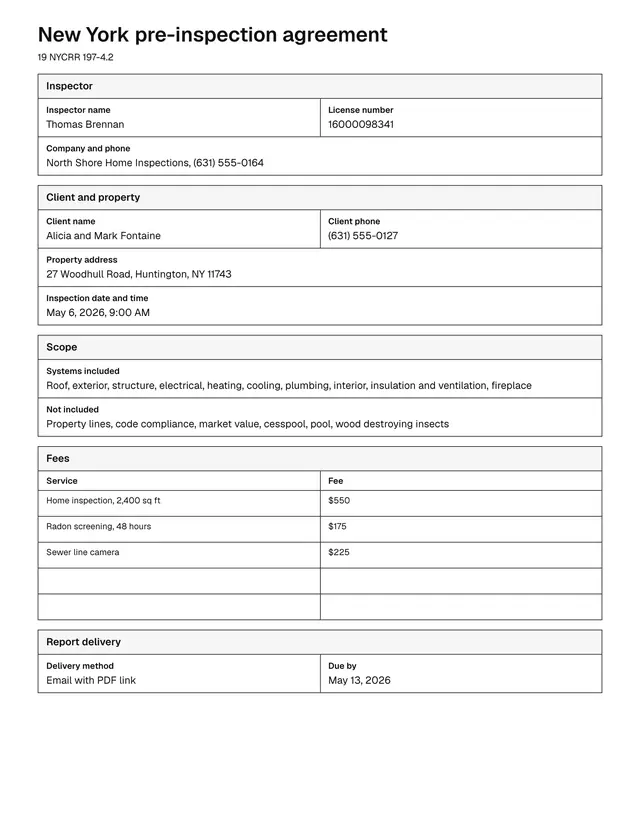
New York pre-inspection agreement (19 NYCRR 197-4.2)
The contract a client signs for a home inspection. - North Carolina
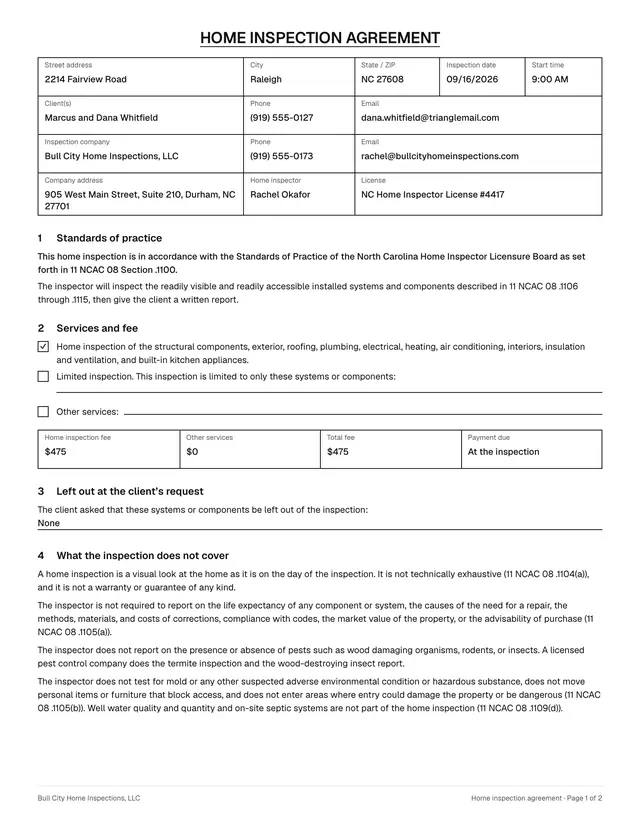
Home Inspection Agreement
The contract a client signs for a home inspection. - Ohio
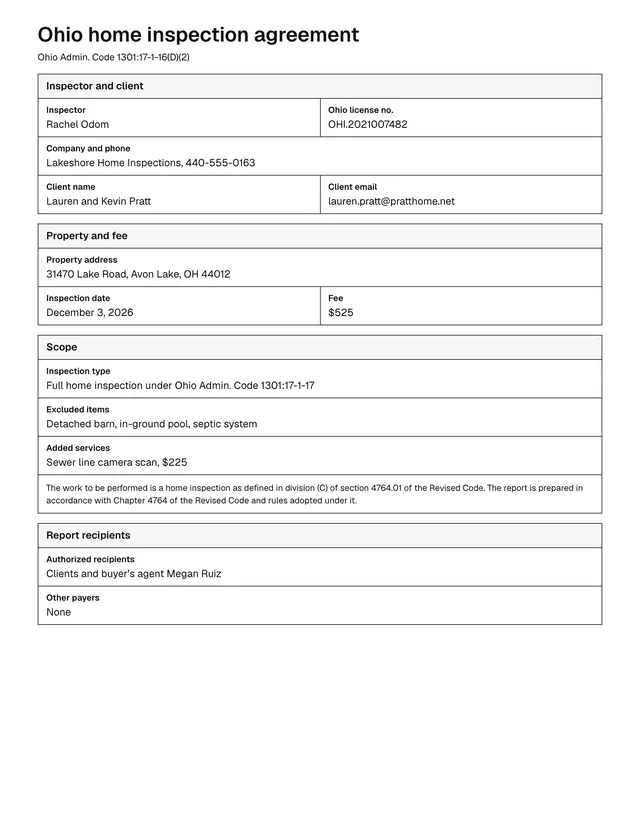
Ohio home inspection agreement
The contract a client signs for a home inspection. - Oklahoma
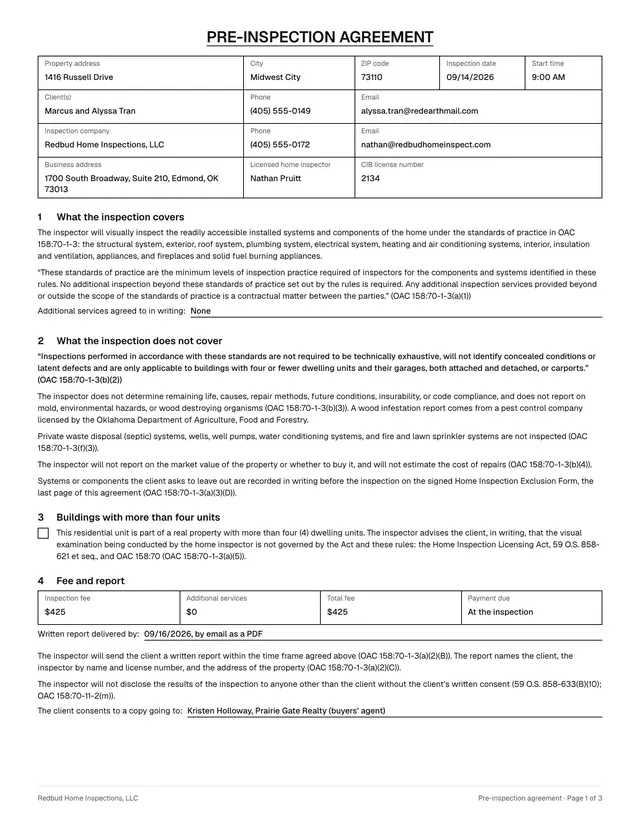
Pre-Inspection Agreement
The contract a client signs for a home inspection. - Oregon
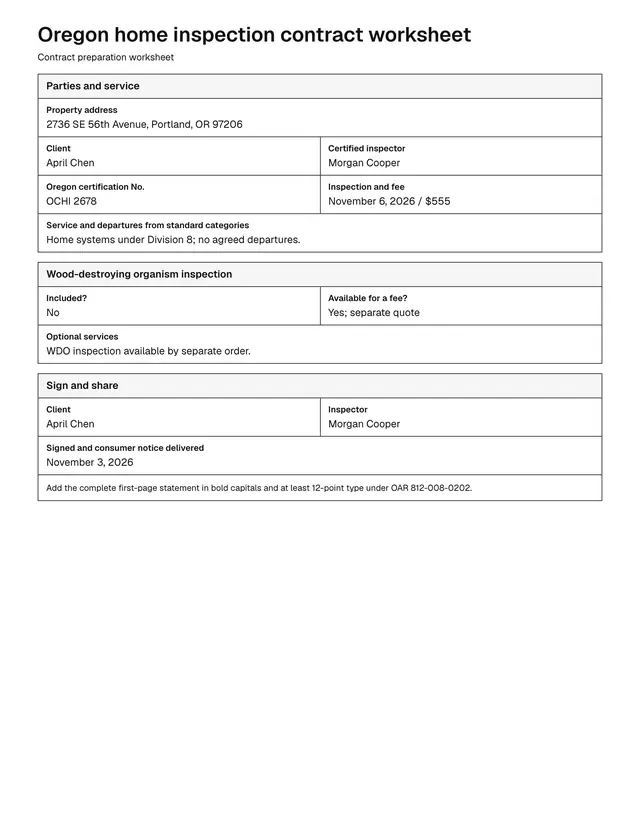
Oregon home inspection contract worksheet
The contract a client signs for a home inspection. - Pennsylvania
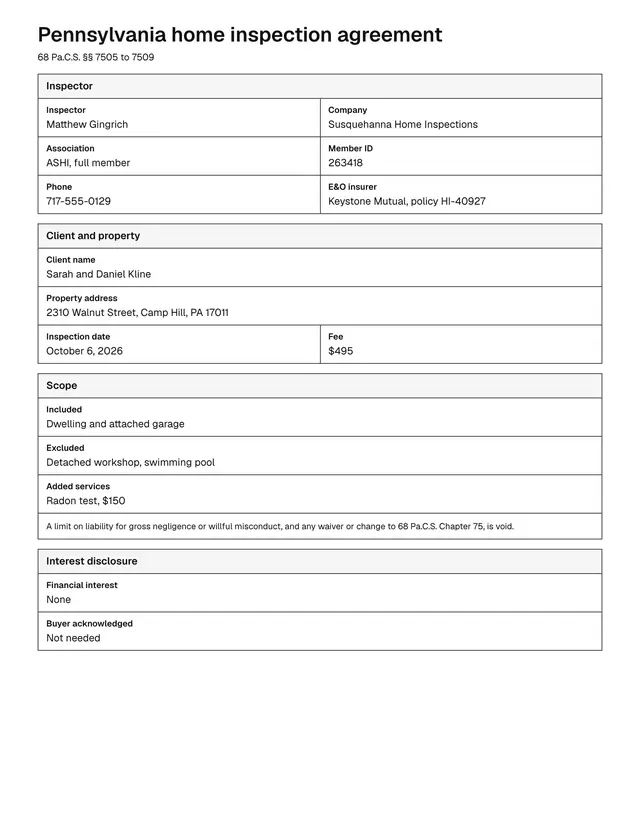
Pennsylvania home inspection agreement
The contract a client signs for a home inspection. - South Carolina
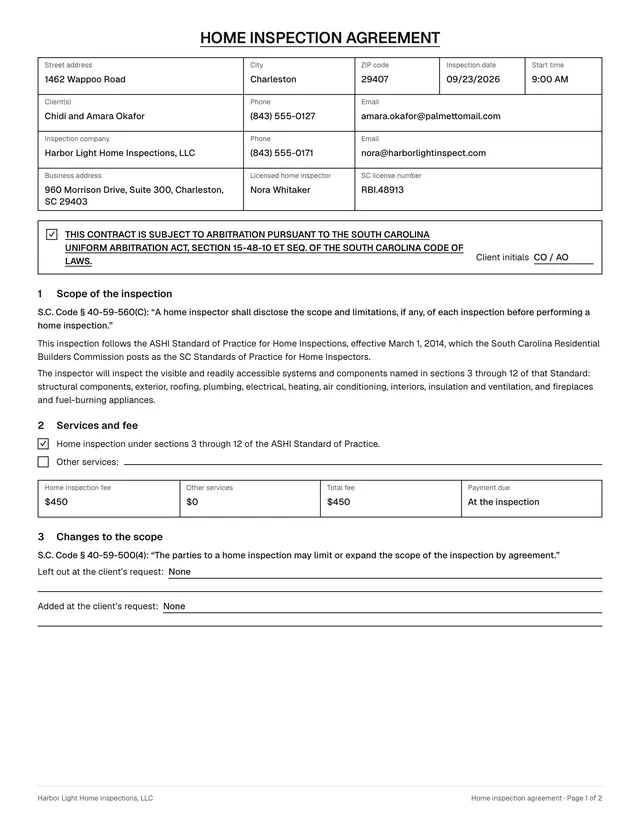
Home Inspection Agreement
The contract a client signs for a home inspection. - Tennessee
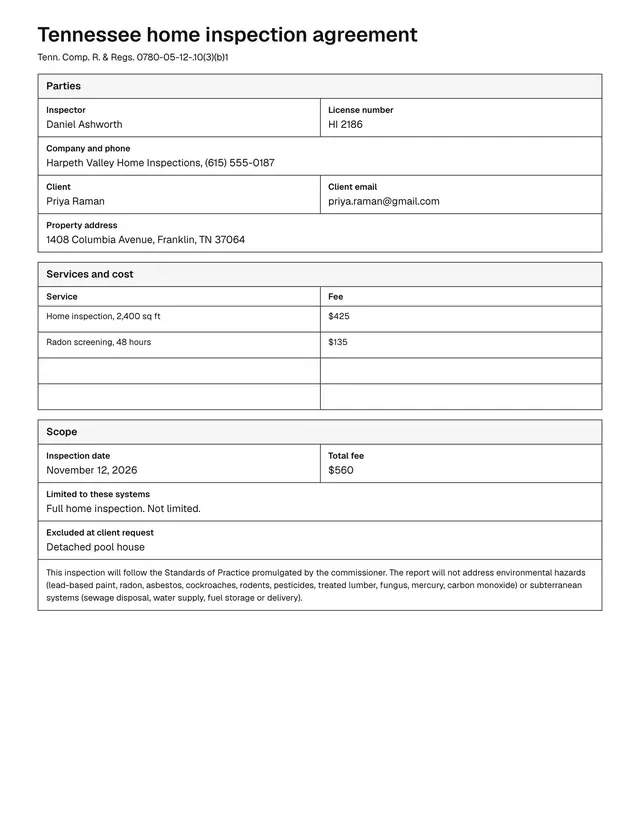
Tennessee home inspection agreement
The contract a client signs for a home inspection. - Texas
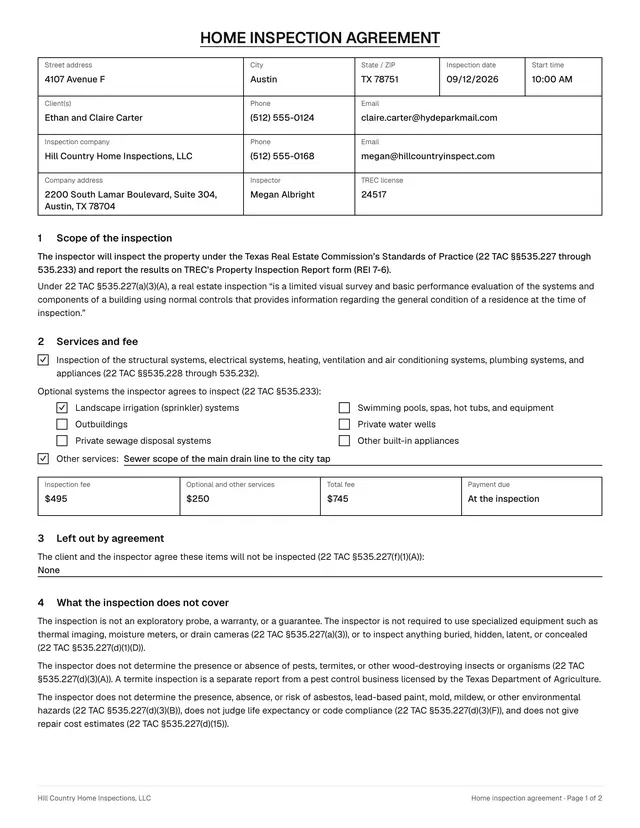
Home Inspection Agreement
The contract a client signs for a home inspection. - Virginia
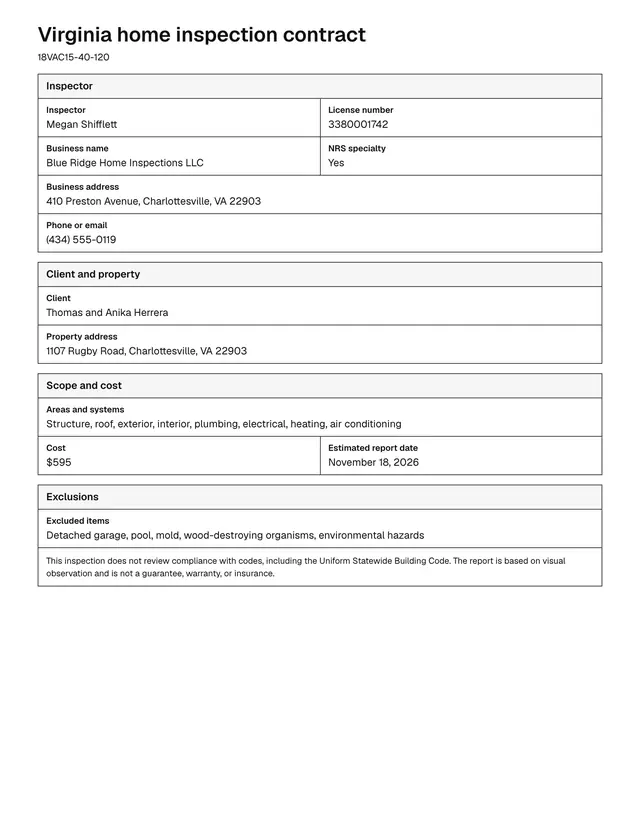
Virginia home inspection contract
The contract a client signs for a home inspection. - Washington
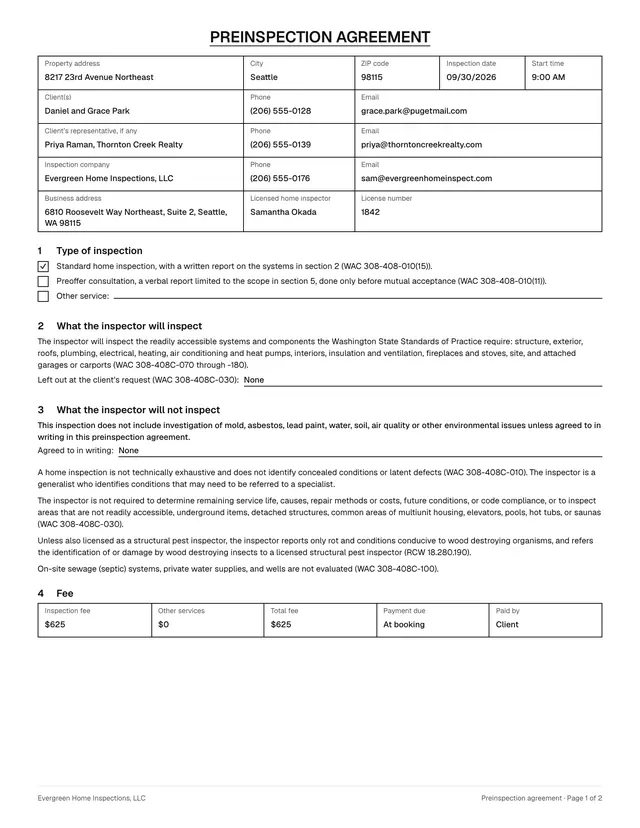
Preinspection Agreement
The contract a client signs for a home inspection. - Wisconsin
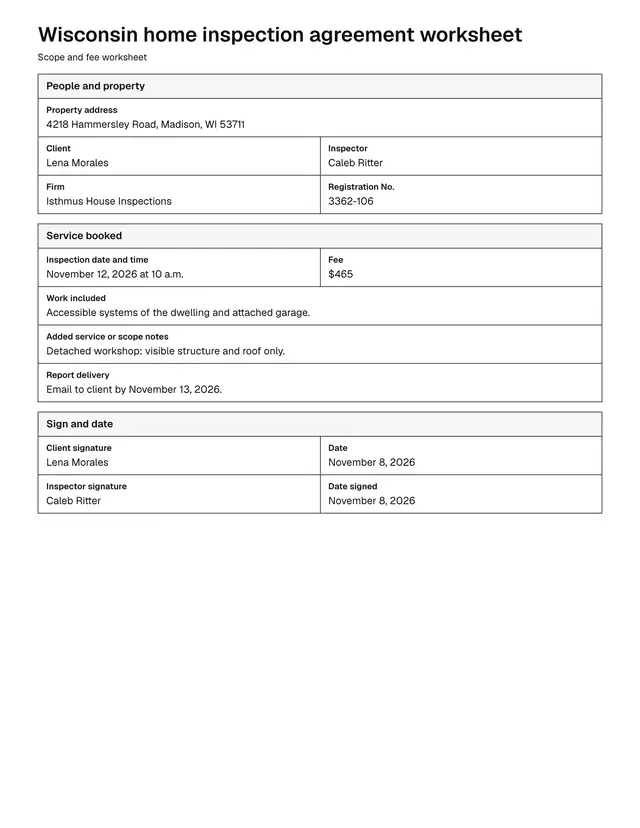
Wisconsin home inspection agreement worksheet
The contract a client signs for a home inspection.