Pre-Construction Soil Treatment Graph
In Georgia, the pre-construction soil treatment graph is the drawing a termite company makes for each application on a new home, with the footage and volumes Rule 620-6-.04(2)(a)4 requires.
At a glance
- Required by
- Rule 620-6-.04(2)(a)4
- Filled out by
- The applicator
- One per
- Soil application
- Final application
- Within 90 days
Completed example
Download PDFWhat is a pre-construction soil treatment graph?
It’s the drawing a termite company makes each time it treats the soil at a new home: the slab fill before the pour, the foundation, the outside after final grade. It shows where the termiticide went and how much, so the Department can check the job years later.
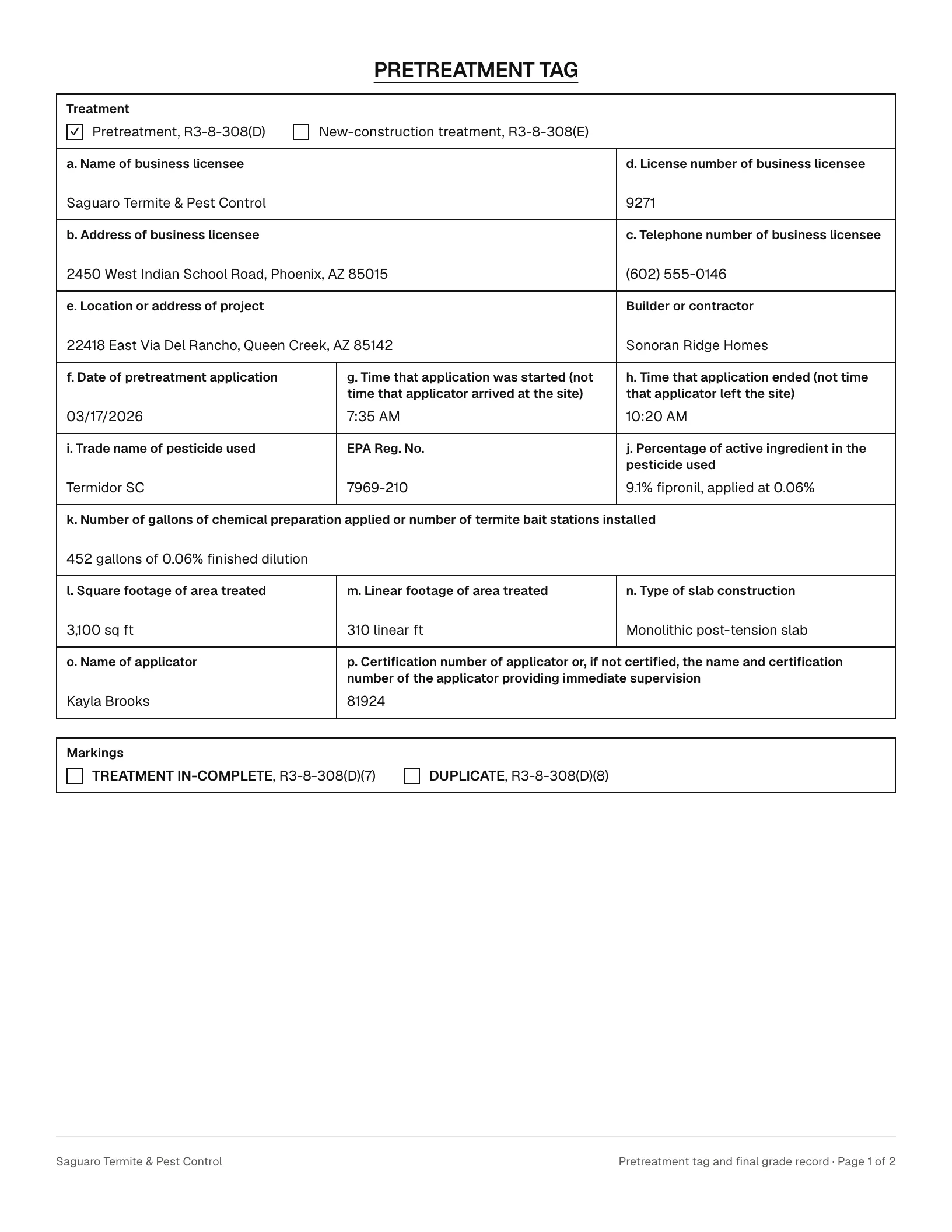
Georgia has no pretreatment tag or certificate. The paper trail is the termite contract, noted as pre-construction, a use record, and this graph. Rule 620-6-.04(2) says it must show the areas treated, including any utility areas, the structure’s linear footage, its total square footage, and the volume on each area.
When do you fill it out?
At every application. The rule says “For each application a separate graph,” so a house treated under the slab in July and around the outside in October gets two. Leave a pesticide use record each time too.
The last one within 90 days. The final application is due within 90 days after the earliest of the certificate of occupancy, someone moving in, the closing of a permanent loan, or the builder finishing the backfill. Check your label too. The Termidor SC label, for one, says to treat the outside of the foundation only after the final exterior grade.
How to fill it out
Measure the structure first. The structure’s linear footage and total square footage go on every graph, even when this round treats only part of the house. Count the garage and porch slabs, since they’re part of what you treat.
Letter each area. Mark the areas on the drawing with the volume table’s letters, a to f. The table prints the rule’s rates: 4 gallons per 10 linear feet per foot of depth for trenches, 2 per 10 for hollow walls, and at least 1 per 10 square feet under a slab.
Don’t skip the utility areas. The rule names them, and pipes are where termites get in. Mark each pipe and utility spot, such as the water line, the sewer cleanout, and the A/C pad, and give each its own volume.
Start the 90-day clock. Check the event that came first, write its date, and add 90 days. Note any earlier applications, then sign. If you use bait instead, GDA’s new construction policy counts it as a pretreatment when it goes in within the same 90 days.
How do you keep up with a builder’s schedule?
A busy builder can have a dozen lots at different stages. Each needs two or more visits, a graph and a use record for each one, and a final round inside 90 days. Miss the backfill date on one lot and the clock runs out quietly.
Noma specializes in the Pre-Construction Soil Treatment Graph (Rule 620-6-.04(2)(a)4). Schedule each application as a job, then invoice the builder and take payment online. See how Noma schedules and bills termite work.
Frequentlyaskedquestions
Send this document in minutes, not an afternoon.