Pretreatment Tag and Final Grade Record
In Arizona, the company that pretreats a new home for termites posts a tag at the site that day, then leaves a final grade record in the breaker box, as rule R3-8-308 requires.
At a glance
- Required by
- A.A.C. R3-8-308
- Filled out by
- The applicator
- Left at
- The site, then the breaker box
- Final grade due
- Within 18 months
Completed example
Download PDFWhat is this tag?
It’s the tag an applicator fixes to a new home’s site right after treating the soil for termites. It has to be easy to see and unlikely to get covered by concrete or dirt, so most go on the contractor’s permit board. Months later, after final grade, the same company leaves a second paper in the breaker box: the final grade treatment record.
Arizona spells both out item by item. Under A.A.C. R3-8-308, the tag holds 16 facts, from the spray times to the slab type, and the record repeats them minus square footage and slab type. The company’s warranty to the builder is a separate paper, the subterranean termite pretreatment warranty.
When do you fill them out?
The tag, right after the treatment. A.A.C. R3-8-308 says “immediately after completing a pretreatment,” and a new-construction treatment after the pour works the same way. If you have to leave early, you still post the tag for the work you finished, marked “TREATMENT IN-COMPLETE.” That’s how the rule spells it.
The record, once grading is done. The company that did the pretreatment owes the final grade treatment after all grading and soil work is finished, but within 18 months of the original treatment. Older handouts from the Pest Management Division (PMD) still say 12 months. The rule as changed by R26-10, 32 A.A.R. 443, in effect since April 6, 2026, says 18.
Each treatment also needs a termite action report form, the TARF, filed with the PMD within 30 calendar days under A.R.S. 3-3631. The tag doesn’t replace it.
How to fill it out
Check the kind of treatment. Pretreatment means before the slab is poured. New-construction treatment means after the pour but before the home is done. Then fill in items (a) to (e): the company’s name, address, phone, and license number, and where the project is. The builder’s name helps a duplicate land in the right file.
Write the spray times, not the drive times. Items (g) and (h) are when the application started and ended, not when you got to the site or left it. Then add the trade name, the EPA Reg. No. from the label, and the percent active ingredient.
Give the amounts and the slab. Item (k) is gallons of finished dilution or the number of bait stations. Then square footage, linear footage, and the slab type, such as monolithic or stem wall. An applicator who isn’t certified lists the certified applicator supervising them in item (p).
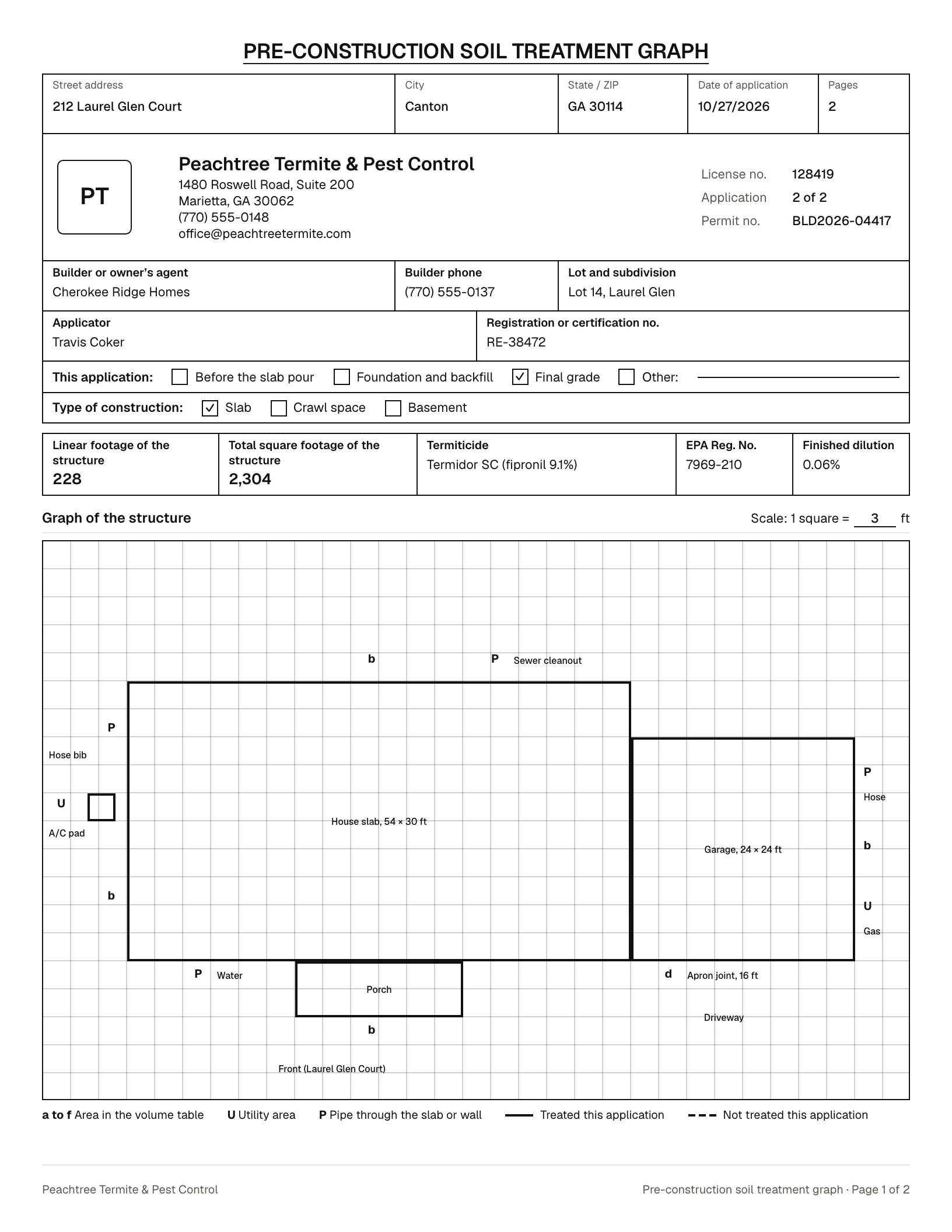
Fill out page 2 at final grade. Check termiticide or termite baiting system, add the date, and repeat the items except square footage and slab type. Item (f) keeps the rule’s words, so it holds the pretreatment date. Leave it in an unlocked electrical or circuit-breaker box, or post it or hand it to the property agent if there isn’t one.
How do you keep up with a builder’s schedule?
A tract builder can pour a dozen slabs a month, and each one starts an 18-month clock. Every house needs a tag, a final grade visit, a record in the breaker box, two TARFs, and often a warranty. Miss one final grade and you’re out of compliance on a house you treated last year.
Noma specializes in the Pretreatment Tag and Final Grade Record (A.A.C. R3-8-308). Schedule each pretreatment and final grade as a job, then invoice the builder and take payment online. See how Noma schedules and bills termite work.
Frequentlyaskedquestions
Send this document in minutes, not an afternoon.