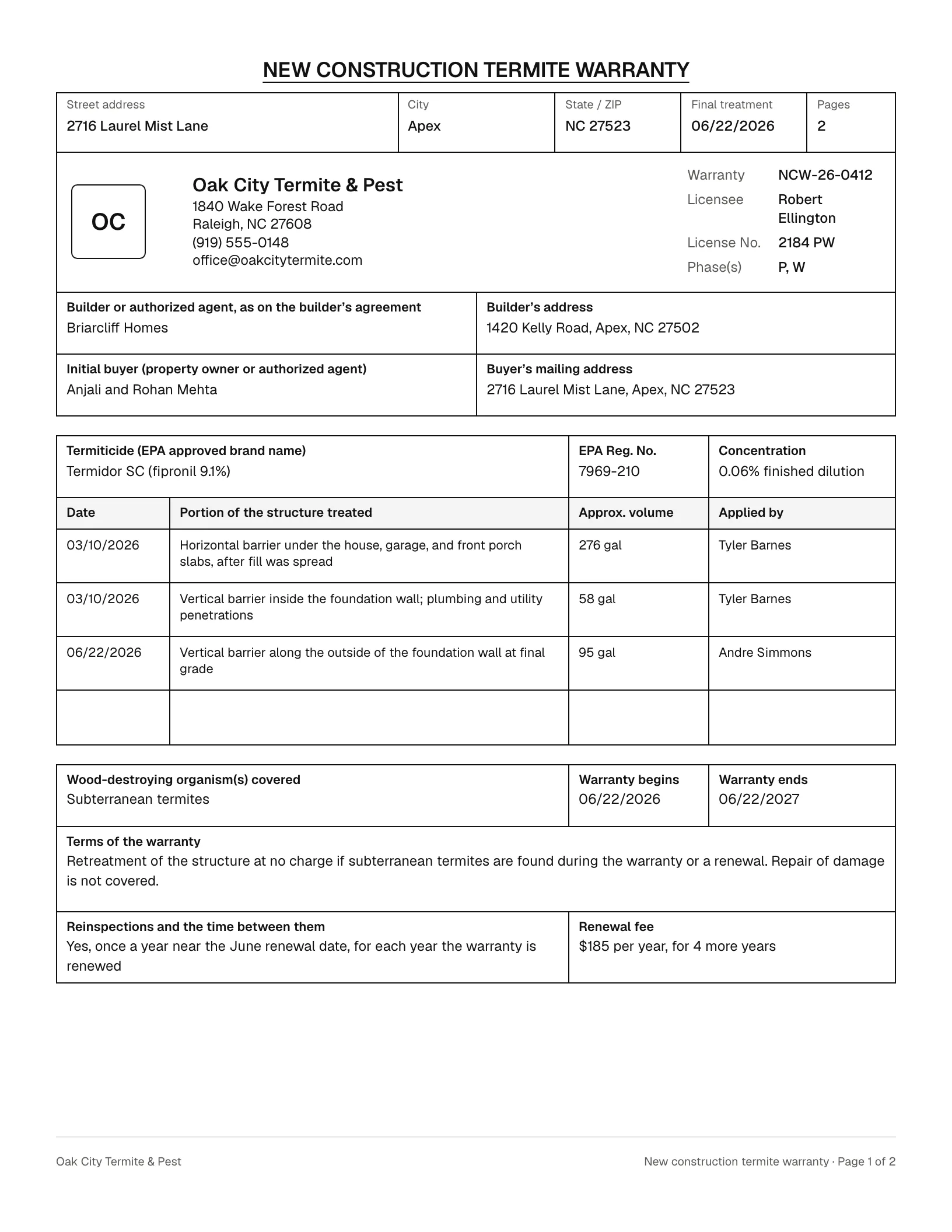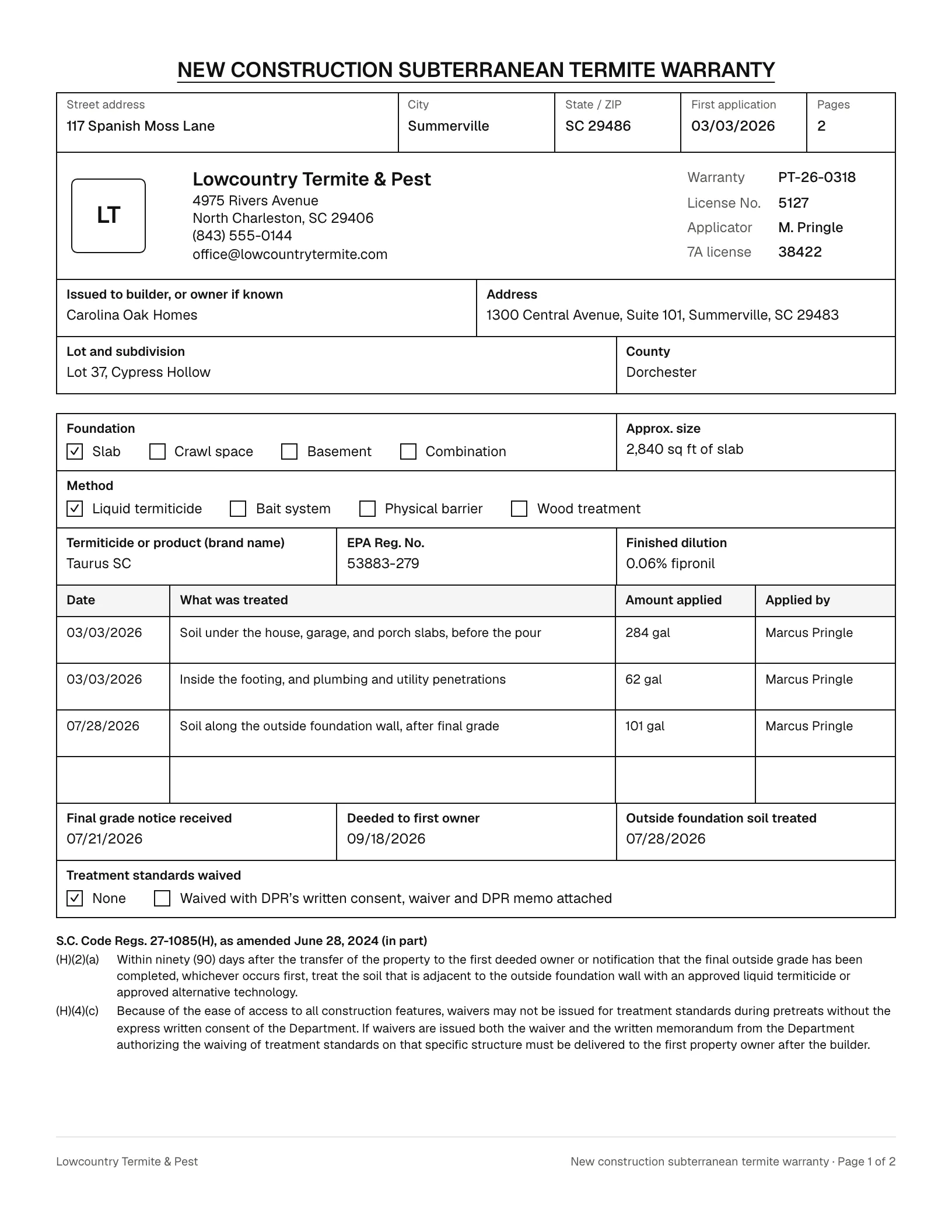
Subterranean Termite Pretreatment Warranty
In Arizona, the company that pretreats a new home can issue the builder a termite warranty, and it can’t promise less than the three years of free re-treatment that rule R3-8-309 requires.
At a glance
- Terms set by
- A.A.C. R3-8-309
- Issued by
- The business licensee
- Goes to
- The builder
- Free re-treatment
- 3 years from treatment
Completed example
Download PDFWhat is this warranty?
It’s the termite warranty a pest company gives a builder after treating a new home’s soil, either before the slab is poured or after. Under R3-8-308(H), a builder can get one only if the structure got one of those two treatments. On an FHA home, the builder also fills out the HUD-NPMA-99-A builder’s guarantee and you fill out the HUD-NPMA-99-B service record. This warranty doesn’t replace either one.
Arizona doesn’t print a form, but A.A.C. R3-8-309 sets terms no warranty can go under. You owe three years of free re-treatment from the first treatment, whether the warranty mentions it or not. The treatment itself is logged on the pretreatment tag and final grade record.
When does the warranty start?
On the day treatment begins. R3-8-309(B) sets that for every subterranean termite warranty. The three years of free re-treatment in R3-8-309(C) run from the first pretreatment or new-construction treatment too, not from the final grade or the closing.
Then the occurrence ladder. Each time termites show up, you re-treat the affected area free. On a one or two unit home, a third occurrence outside means re-treating the whole exterior perimeter, and a third one inside means a post-construction treatment of the whole house. A second or third occurrence counts only if it’s at least 25 feet from the earlier ones and 45 days after the last re-treatment.
Since R26-10, 32 A.A.R. 443 took effect on April 6, 2026, a final grade can be a termite baiting system. If it was, the full exterior re-treatment after a third occurrence has to use a liquid termiticide, unless the consumer turns that down in writing.
How to fill it out
Date it from the first day of treatment. Put that date in the effective date box, then add the home’s address, your license number, and the applicator and their certification number. Name the builder and its address the way its contract does.
Copy the treatment from the tag. The trade name, EPA Reg. No., percent active ingredient, gallons or bait stations, footage, and slab type should match the tag you posted at the site. Then check how final grade was treated and give its date, since a bait final grade changes the third-occurrence re-treatment.
Write terms that meet the rule. Free re-treatment runs at least three years from the effective date. Your warranty can last longer, transfer to later owners, or renew for a fee, but it can’t take away anything R3-8-309 gives. Page 2 prints the whole rule word for word, so the builder sees the floor.
Say plainly if you repair damage. R3-8-309 covers re-treatment, and the Pest Management Division’s termite recurrence guide tells owners to check their contract for damage. Write covered or not covered, and any dollar limit. Then sign it, and have someone sign for the builder when it arrives.
Can the builder sign for it without a trip to your office?
A tract builder can close forty homes a year, and each one gets its own warranty with its own three-year clock. When a house sells again, item 20 of the buyer’s termite inspection report has a line for the warranty’s expiration date, so the signed copy has to be easy to find.
Noma specializes in the Subterranean Termite Pretreatment Warranty (A.A.C. R3-8-309). Upload your warranty once as a reusable document, then send it to each builder for e-signature. See how Noma sends documents for signature.
Frequentlyaskedquestions
Send this document in minutes, not an afternoon.