New Construction Subterranean Termite Warranty
In South Carolina, a company that pretreats a new single-family home gives the builder a one-year transferable warranty for termite damage repair and retreatment, under S.C. Code Regs. 27-1085(H)(4).
At a glance
- Required by
- S.C. Code Regs. 27-1085(H)(4)
- Issued by
- The pest control company
- Goes to
- The builder, or the owner if known
- Lasts
- 1 year, renewals offered for 5
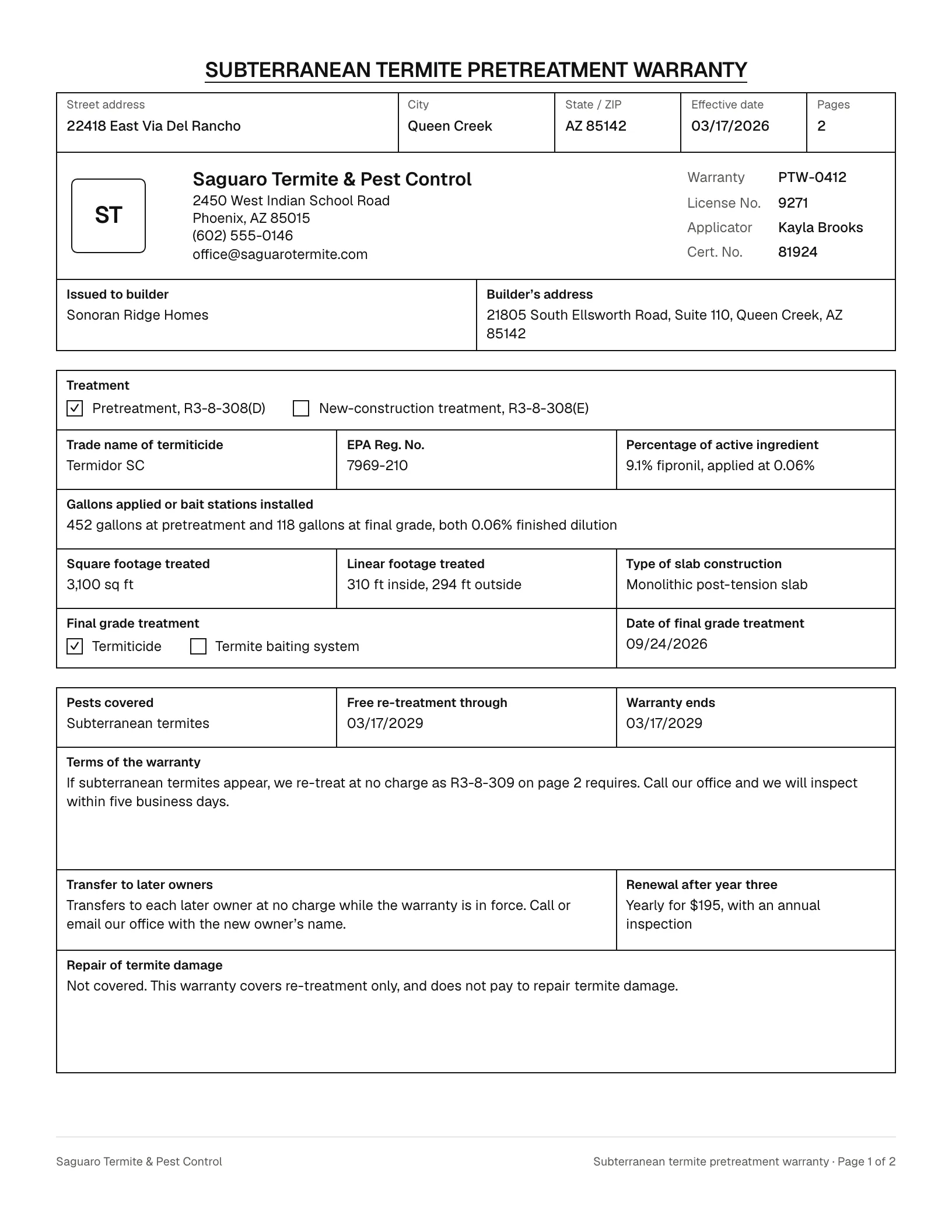
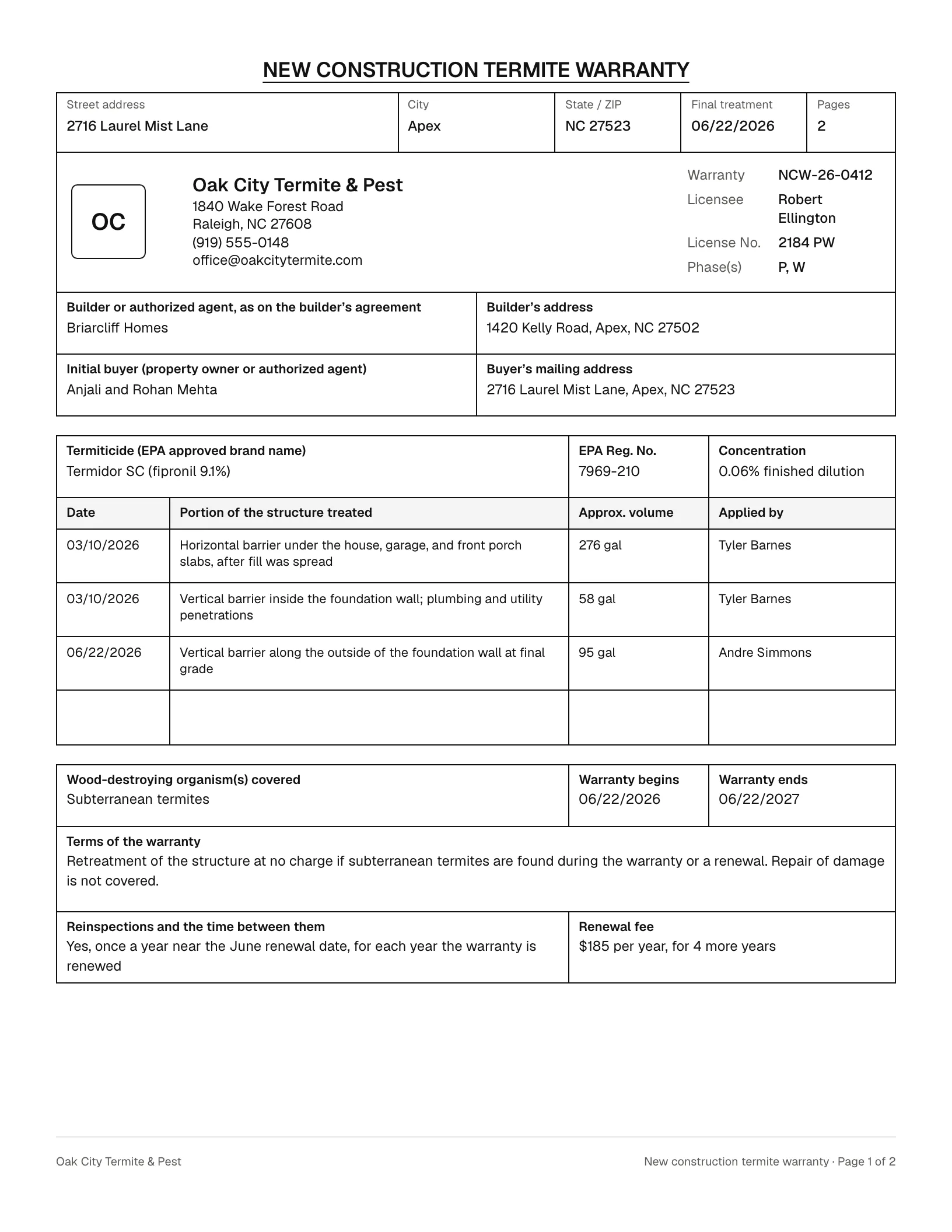
Completed example
Download PDFWhat is this warranty?
When you pretreat a new single-family home, S.C. Code Regs. 27-1085(H) says you give the builder, or the owner if you know them at the time, a one-year transferable warranty. It covers repair of subterranean termite damage and retreatment of the infested parts of the house.
Damage repair in year one isn’t optional here, and you owe five years of offered transfers and renewals after it. DPR doesn’t print a form, so the rule is the checklist. A house that’s already built gets the subterranean termite control contract instead.
When do you issue it?
The warranty starts with the first chemical application. That’s usually the soil under the slab, before the pour. The outside of the foundation comes later: (H)(2)(a) gives you 90 days from the first deed or the builder’s notice that final grade is done, whichever comes first.
Waivers are rare on a pretreat. Under (H)(4)(c), you can’t waive a standard without DPR’s written consent, and the waiver and DPR’s memo go to the first owner after the builder. On FHA and VA loans, the lender may also want HUD’s HUD-NPMA-99-A from the builder and HUD-NPMA-99-B from you. Use HUD’s own PDFs for those.
How to fill it out
Name the house and the builder. Give the address, plus the lot and subdivision, since a slab often gets treated before the house has mail. Write the builder, or the owner if known at treatment, and the date of the first application.
Log every application. Add the product, its EPA Reg. No., and the dilution, then one row per pass: date, what you treated, how much, and who applied it. The same facts go on DPR’s Record of Termiticide Use, which (D)(6) requires for every pretreat.
Set the renewal terms. Renewals follow your regular contract terms and must offer at least retreatment. Check retreatment only or retreatment and repair, then do the same for Formosans, since 27-1085(B)(4) makes every warranty say. Year one on this form covers Formosans like any other subterranean termite.
Sign it, then record the transfer. The licensee or an agent signs, and someone signs for the builder. Check any (H)(4)(b) exclusion that already applies, like a sealed crawl space with spray foam. When the house sells, write in the first deeded owner and the date.
What happens when the house sells?
A builder closing forty houses a year means forty warranties, each one transferable and renewable for five years. Unless someone asks, the paper sits in the builder’s closing file. Years later, the next buyer’s lender wants a CL-100 and asks whether a warranty transfers.
Noma specializes in the New Construction Subterranean Termite Warranty (S.C. Code Regs. 27-1085(H)(4)). Upload your warranty once as a reusable document, then send it to each builder or new owner for e-signature. See how Noma sends documents for signature.
Frequentlyaskedquestions
Send this document in minutes, not an afternoon.