New York commercial lawn application contract (6 NYCRR 325.40)
Before the first commercial lawn treatment in New York, the property owner signs a written contract with dates, total cost, and the label warnings in 12-point type. Here’s every required piece and the notice rules that come with it.
At a glance
- Rule
- 6 NYCRR 325.40 (ECL 33-1001)
- When
- Signed before the first lawn application
- Keep copies
- 3 years after the contract ends
- Markers
- Posted 24 hours after each application
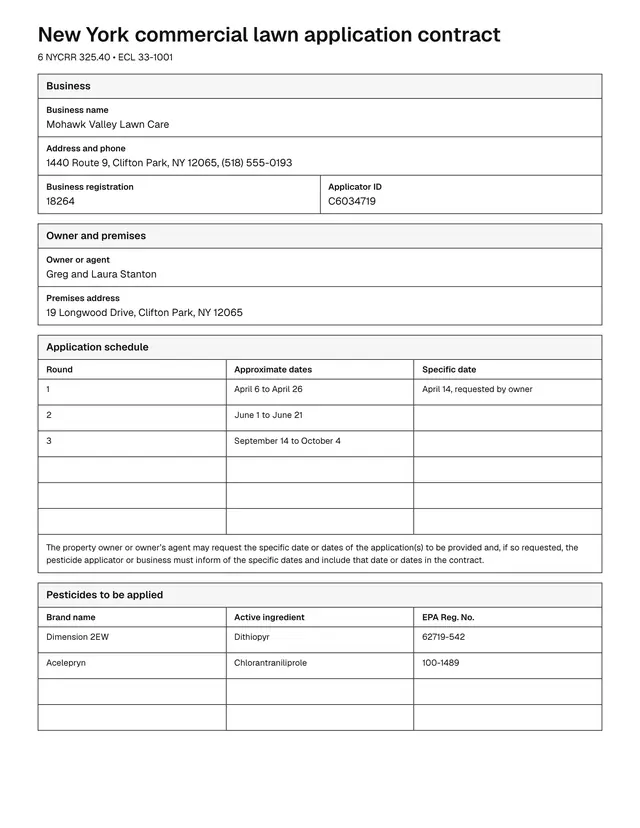
Completed example
Download PDFNo contract, no first application
New York makes lawn care companies put the deal in writing before they spray. 6 NYCRR 325.40 has been in force since January 1, 2004. Before a commercial lawn application, the applicator or business “must enter into a written contract” with the property owner or the owner’s agent.
The only property left out is land owned, leased, or rented by the applicator’s own employer. A golf course crew treating its own fairways doesn’t need a contract. A lawn company treating a house in Clifton Park does.
DEC’s guidance DSHM-PES-05-11 answers a question pest control companies ask a lot. A foundation treatment within 4 feet of the building, aimed at indoor pests, isn’t a lawn application. Your ant perimeter spray stays under the regular application record rules instead.
Seven pieces every contract needs
1. Dates. The approximate date or dates of each application. DEC’s guidance treats “approximate” as a window of 21 days or less. The contract must also prominently show this sentence: “The property owner or owner’s agent may request the specific date or dates of the application(s) to be provided and, if so requested, the pesticide applicator or business must inform of the specific dates and include that date or dates in the contract.”
2. Count. The total number of applications.
3. Cost. The total cost of the service.
4. A 12-point attachment. In at least 12-point type: the pesticides you’ll use with brand names and the generic names of the active ingredients, the label warnings about people, animals, and the environment, and your business name, address, phone, business registration number, and the certification ID card number of the person who will apply or supervise.
5. Who and where. The name of the owner or agent and the address being treated.
6. Signatures. Both sides sign. The owner’s signature can be replaced by a document that shows acceptance, like a copy of a prepayment check “in the exact amount specified in the written contract.”
7. Amendments. Any change, any renewal, and any multi-year deal needs an amendment, and you need written acceptance of it before you apply.
When plans change mid-season
Weather wrecks schedules. If the date in the contract won’t work, 325.40(c) says you give the owner oral or written notice of the new date and get their acceptance before you treat. Save that reply, even if it’s just a text that says “sounds good.”
If the contract lists a group of products without saying which one goes down on which visit, you give the owner a written notice naming the specific product before that application. And if you buy another company’s routes, the contracts can move with them, but only after you send each customer a written transfer notice with your own business details.
Signs on the lawn and notice next door
Every commercial lawn application gets visual markers. They’re at least 4 by 5 inches, rigid, yellow with black letters at least 3/8 inch tall. The front reads “PESTICIDE APPLICATION” (or “TREATMENT” or “APPLIED”), shows the date and time, says “DO NOT ENTER” and “DO NOT REMOVE SIGN FOR 24 HOURS,” and has a warning symbol at least 1.5 inches across. Post them before you start and leave them at least 24 hours.
Some counties go further. Where a county has adopted ECL 33-1004 as local law, 6 NYCRR 325.41 requires written notice at least 48 hours ahead to the homes on abutting property within 150 feet. It lists the address, your name, phone, and registration or ID number, the date plus two backup dates, and each product name with its EPA number. Granular products, spot treatments, and baits in tamper-resistant containers are among the exemptions.
How do you keep a season of contracts straight?
The rule says you keep a complete copy of each contract for at least three years after it expires and show it to DEC on request. With a few hundred lawns, the hard part is matching each customer to the right version, especially after a mid-season amendment. File the signed original, every amendment, and every date-change acceptance together under the customer’s name.
Noma specializes in the New York commercial lawn application contract (6 NYCRR 325.40). Upload your contract once as a reusable document, send it for e-signature from each booked job, then schedule every round of the season and take payment online. See how Noma handles lawn care contracts.
Frequentlyaskedquestions
Send this document in minutes, not an afternoon.
Other states
Service agreement templates- Arkansas
Pest Control Service Agreement
The recurring pest control contract an owner signs. - Georgia
Household Pest Control Service Agreement
The recurring pest control contract an owner signs. - Hawaii
Termite Control Service Agreement
The recurring pest control contract an owner signs. - Maryland
General Pest Control Service Agreement
The recurring pest control contract an owner signs. - Oklahoma
General Pest Control Service Agreement
The recurring pest control contract an owner signs.