New York Pesticide Reporting Law annual report (ECL 33-1205)
Every certified commercial applicator and technician in New York reports a full year of applications to DEC by February 1. It’s filed online, and the late notices go to the applicator, not the company.
At a glance
- Law
- ECL 33-1205
- Due
- February 1 for the prior calendar year
- How
- Electronic only, through nysprl.com
- Forms
- Form 26, plus Form 26A for combined reports
Completed example
Download PDFWho files, and by when
New York collects pesticide use from every commercial applicator under the Pesticide Reporting Law. It’s ECL 33-1205, and the filing goes to DEC “on or before February first” for the calendar year before. So applications made from January 1 to December 31, 2026 are due by February 1, 2027.
DEC’s 2022 guide for applicators lists who reports: certified commercial applicators (ID numbers that look like C plus seven digits), certified commercial technicians (T plus seven digits), and aquatic antifouling paint applicators. Private applicators on farms keep records but don’t file. Apprentices don’t file either, because their supervising applicator reports their work. The guide also says anyone certified at any point in the year reports, so a tech who got certified in August still files.
You’ll still see January 15 in the old regulation at 6 NYCRR 325.25(b). DEC’s OGC-3 policy settles it: the statute’s February 1 date governs.
What DEC wants for each application
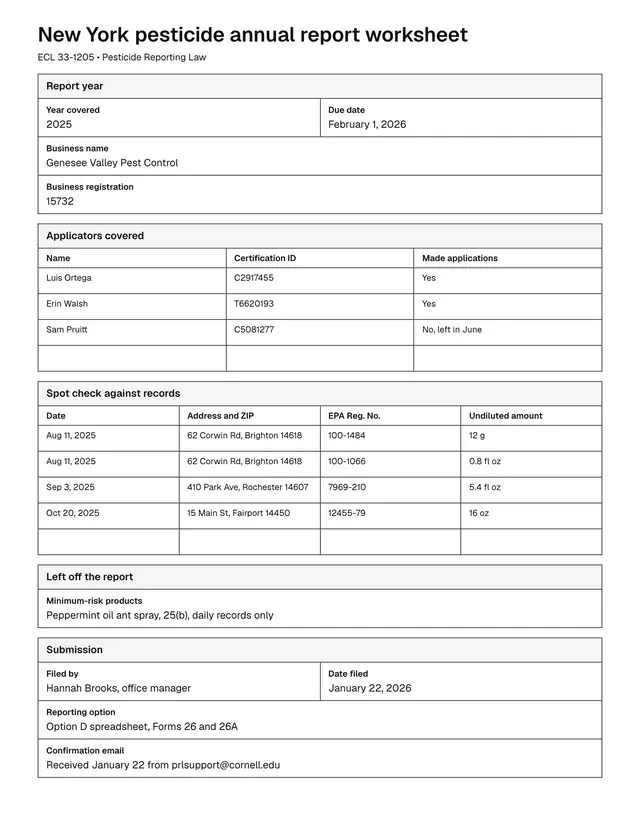
Each line on the report is one application, and it carries five things: the EPA registration number, the product name, the quantity used, the date, and the address including the five-digit ZIP code. DEC’s guide says the quantity is undiluted. So if a tech mixed 0.8 fl oz of Demand CS into four gallons, the report says 0.8 fl oz, not four gallons. Termite work follows the same rule. A pretreat with Termidor SC (EPA Reg. No. 7969-210) reports the ounces of concentrate, not the hundreds of gallons of mix in the trench.
Some products stay off. DEC’s guide says minimum-risk pesticides “must be recorded in daily use records” but “should not be included in annual reports.” Those are the federally exempt 25(b) products, like some peppermint oil sprays.
All of this comes straight from the daily application records your techs already keep. If those are clean, the annual report is mostly copying. If they’re missing ZIP codes or EPA numbers, January turns into detective work.
Filing for a whole crew
A business with several applicators has two choices. Each applicator can file their own Form 26 under their own ID. Or the business can put everyone’s applications on one Form 26 under one applicator’s ID and add a Form 26A that lists every certified applicator and technician it employed that year, even ones who made no applications.
Here’s the catch DEC spells out. “If reports are late or not accepted, the applicator will be issued a Notice of Violation, NOT the business.” If your office files for you, ask to see the confirmation. If someone left in June, they still belong on the 26A.
The forms come from DEC’s free reporting programs on the PRL service bureau site. DEC says not to change the form layout. You don’t have to wait for January, either. You can file as soon as you’ve made your last application for the year.
Before you upload, run a short check. Make sure every certified person on staff that year is on the 26A, including the one who quit. Look for records with no ZIP code or a five-digit number that isn’t a real ZIP. Make sure each quantity is the undiluted product, not the finished mix in the tank. Take out any 25(b) products. And spot check a few lines against the paper or app records, the way the worksheet below does.
What if you made no applications, or you’re late?
No-use years used to need a report too. DEC’s 2022 guide says anyone certified during the year must report “even if they did not make any pesticide applications.” The service bureau’s site now says that, after a recent policy change, you’re not required to file if you made no applications or sales. Check the site before you skip it, since it’s newer than the guide.
When you do file, watch for a confirmation email from prlsupport@cornell.edu, and check spam. The site also lets you check whether DEC has accepted your report. If you’re late, file anyway and call the bureau at 800-281-7538 or DEC’s PRL line at 518-402-8748.
Noma specializes in the New York Pesticide Reporting Law annual report (ECL 33-1205). Noma doesn’t file it, but when every job is booked, scheduled, and finished on the mobile app, you have a dated list of each visit and address to check against your Form 26 before February 1. See how Noma tracks every pest control job.
Frequentlyaskedquestions
Send this document in minutes, not an afternoon.